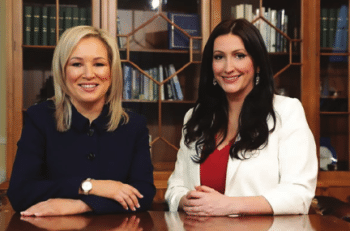
Unenthusiastic relief for both DUP and Sinn Féin at resurrection of Executive – and neither party can afford it to fail – but there are landmines for all especially strikes, austerity, Irish language, ideology and toxic DUP dissent
by Village
Unenthusiastic relief for both DUP and Sinn Féin at resurrection of Executive – and neither party can afford it to fail – but there are landmines for all especially strikes, austerity, Irish language, ideology and toxic DUP dissent
by admin
By David Burke. I was fortunate to have a book published recently. I won’t personally be much affected by who sells it it but it did spark me thinking about the beleaguered publishing industry in Ireland. It does sterling work promoting diverse, minority and high-quality works. Writing is an Irish speciality. Reflecting this, thankfully Ireland has more than its fair share of small publishing houses, a fact that reflects well on this country. Unfortunately, even in good times many of them just about managed to scrape by. Without them, the work of many Irish novelists, poets and historians would never see the light of day. Covid-19 now threatens to crush many of them. While heroic efforts have been made by some small bookshops to set up click and collect facilities and others are able to remain open because they sell other essential items, many have had to shut their doors. Tragically, Amazon is set to make a killing in their place. This is a shame because most independent Irish publishers have their own websites which do exactly what Amazon does with one big difference: Jeff Bezos – who doesn’t even know their books exist – grabs an enormous slice of the purchase price for doing very little. This is a shame because most independent Irish publishers have their own websites which do exactly what Amazon does with one big difference: Jeff Bezos – who doesn’t even know their books exist – grabs an enormous slice of the purchase price for doing very little. This article is a plea to go directly to the website of an Irish publisher or your local bookshop if open (and many bookshops have their own websites too) if you wish to purchase a homegrown – or any – book instead of visiting Amazon. There are quite a number of Irish books which were selling well before the latest lockdown. The bestselling example of this – literally – is ‘Champagne Football’ by Mark Tighe and Paul Rowan. In this instance the authors and their publishers have received a well deserved reward for their superb effort and hopefully will continue to do so. But what about the books which have just been launched or are about to come out over the next day or two? Frank Greaney’s ‘Crowded House, The Definitive Story behind the Gruesome Murder of Patricia O’Connor’ is a perfect example of this. Greaney attended the trial on a daily basis of those accused of both the murder itself and other offences in the aftermath thereof and, in the finest traditions of quality Irish journalism, has produced a riveting book length account of it. He gets to grips with the story behind the tragic death and dismemberment of Patricia O’Connor as well as the lengthy trial that followed the discovery of her remains scattered in the Dublin Mountains. In human terms this is an important book because it sets the record straight about the victim who had, in the course of the evidence which unfurled during a seven-week-long trial been portrayed as a monster. Greaney’s work tips the scales very much in favour of the deceased to build up a picture of what she was really like: a warm, caring, generous individual, a solid employee – she worked as a caterer in Beaumont Hospital – and decent colleague. Greaney weaves in the evidence given at trial (particularly that of the forensic anthropologist who dealt with examination of the bones of the dismembered parts, and the pathologist) into a chronological narrative to give the story the feel of a novel. Patricia O Connor had no voice but Frank Greaney has given her one. Anyone who followed this trial will also be able to read about many of the events and facts that had to be kept from the jury and therefore were not reported in the media but are now. The book also provides a fascinating insight into how a modern trial is run in our democracy. Does Jeff Bezos deserve to scoop up the lion’s share of the proceeds from this book and all the others which are about to be published? Greaney’s publishers are Gill. If you or anyone you know is interested in this or any other Irish publication, bypass Amazon and go to the website of the publisher.
Ireland’s largest party of the left may soon have us at last, whether we like them or not By Rory O’Sullivan Gerry Adams, the President of Sinn Féin from 1983 to 2018, published five Audacity of Hope-style books – part-autobiography, part-political manifesto – during the most intense phase of the peace process in Northern Ireland. The last one, which came out in 2003, was entitled Hope and History: Making Peace in Ireland. “Hope and history” is from those lines of Séamus Heaney’s The Cure at Troy which are quoted constantly: “Once in a lifetime/The longed-for tidal wave/Of justice can rise up,/And hope and history rhyme”. The Cure at Troy, first staged in 1990, is a version of the play Philoctetes by Sophocles, in which the Greek heroes Odysseus and Neoptolemus try to convince the wounded archer Philoctetes to return with them to Troy. A prophecy states that the Greeks will need Philoctetes’ bow of Heracles to help win the Trojan war, but at its beginning Odysseus had marooned Philoctetes on Lemnos; he had been bitten by a snake and his screams were distressing the crew. Heaney’s play is clearly about Northern Ireland, with the characters’ eventual conciliation a kind of symbol, and a roadmap. The Cure at Troy is really a play about getting over the wrong someone has done to you in order to share a future with them. But this is not quite what the Philoctetes is about, since in the end what Philoctetes agrees is to go back and fight a war which will end in destruction and massacre at Troy. During the sack of the city, all three men will commit sacrilegious acts, things which today we would call war crimes. They will in turn be punished by the Gods for them, and all of this is foreshadowed at the moment of conciliation with which the play ends. Philoctetes is not simply a guide to achieving peace or justice; it asks what justice can really mean in a world of endless conflict and guilt. And it is out of these two sides of the mouth that Gerry Adams speaks in the title of his book: “Hope and History”, the man who put down the armalite to fight with the ballot box instead; “Making Peace in Ireland,” the man who did it, not to reconcile with Unionists, but to defeat them. Even in 2003, it would never be ‘Northern Ireland’. Adams, now retired, has a blog called Léargas where he posts from time to time; he posted an entry last Friday, 24/1/20, entitled “Keep your eye on the prize”. He offers a Sinn Féin-centred view of the peace process, saying of the Good Friday Agreement that “we had in fact established an alternative – a peaceful way to win freedom for the first time in our history”. He closes by saying, “Unity is no longer an aspiration – it is achievable. It is a doable project. It is the prize. There for everyone on this island. All of this is part of the continuum of struggle”. Peace, or Irish unity: which is the prize? It depends who you ask; and if you ask Sinn Féin, it depends who’s asking. In the book, Hope and History, Gerry Adams describes the Sinn Féin tactic of “love-bombing”, which unnerved and bewildered Unionists during the peace process. When Adams and the UUP’s Ken Maginnis appeared together on America’s Larry King Show after the Ceasefire in 1994, Adams repeatedly tried to shake his counterpart’s hand and pat him on the shoulder. Maginnis stiffened up and didn’t know what to do. He looked out of date. The standard Unionist charge against Sinn Féin is that they committed to ‘Northern Ireland’ in the Good Friday Agreement only in order to destroy it, and have spent their time in Stormont using power-sharing against itself. Of course, this is a regressive point on Unionists’ part since it amounts to a demand that, as a precondition of peace and power-sharing, Republicans profess loyalty to the Union. But it is also true that Adams and McGuinness had long-believed that the Republican movement needed to be mainstream to win, and that this meant putting the political above the military as a matter of strategy. In his book, ‘Blanketmen’, the hunger-striker Richard O’Rawe claims that Adams ordered strikers to die so as to increase support for Sinn Féin and open the political theatre of the struggle. O’Rawe’s claim is disputed, but it is clear that by 1986 Sinn Féin’s leaders were carefully laying out the path that the Republican movement would follow through the 1990s and 2000s. In that year’s Ard-Fheis the party ended its policy of abstentionism in Leinster House. It was over precisely this question that Provisional Sinn Féin had split from the party in 1970; and the 1986 decision caused another split, with Ruairí Ó Brádaigh and the party’s Southern old guard breaking away and forming Republican Sinn Féin, whose military wing is the Continuity IRA. Ó Brádaigh gave a fiery speech at the 1986 Ard Fheis, excoriating Adams and McGuinness for betraying the core values of Republicanism. He said that ending abstentionism meant recognising the ‘Free-State’ as the government of Ireland, and therefore its army as the Irish army. In other words, and in contrast to Unionists like Maginnis, he argued that Sinn Féin were repudiating the principles behind the armed struggle. He ended the speech by saying: “In God’s name, don’t let it come about…that Haughey, Fitzgerald, Spring and those in London and Belfast who oppose us so much can come out and say “Ah, it took sixty-five years, but we have them at last”. Neither Ó Brádaigh nor the Unionists were wrong, exactly, in their criticisms of Adams and McGuinness, but neither had managed to see the pair from both sides. What drove Sinn Féin through the peace process and into Stormont was a pair of contradictory principles, each espoused in turn to different listeners. The only concession Sinn Féin made in principle
Posted in:
by admin
But it’s time to stop living for consumption by John Gibbons One of the innate limitations of living in any given era is the innate assumption that the way things are is how they have always been, and will continue, more or less, into the foreseeable future. In a time of rapid shift, such assumptions can be fatal. Over the last seven decades or so since 1950, the world has embarked on an era known as the Great Acceleration. In this era, the solution to every problem and the very goal of human endeavour all seemed to be the pursuit of growth and with it, ever-increasing standards of material comfort. At the dawn of this new age, in 1955, economist Victor Lebow wrote a stunningly prescient article for the US Journal of Retailing. His key insight was to realise that, for the first time in human history, industrial output exceeded public demand for products. “Our enormously productive economy demands that we make consumption our way of life, that we convert the buying and use of goods into rituals, that we seek our spiritual satisfactions, our ego satisfactions, in consumption”. He added: “we need things consumed, burned up, worn out, replaced and discarded at an ever increasing pace. We need to have people eat, drink, dress, ride, live, with ever more complicated and, therefore, constantly more expensive consumption”. While presented as though it were human nature itself, consumerism is simply a clever ruse dreamed up by marketing Mad Men charged with persuading the public to buy ever more stuff. Not in their wildest fantasies could Lebow and his colleagues have truly understood what forces they were unleashing on the world, and how, decades later, this spiralling global orgy of consumption would have trashed the planet to the point where it teeters on the brink of the ecological abyss. It was never just about consumption. To justify this spree, “we erected new politics, new ideologies and new institutions predicated on continuous growth”, according to author JR McNeill. Writing in 2000, he warned: “Should this age of exuberance end, or even taper off, we will face another set of wrenching adjustments”. Now, some twenty years later, instead of heeding the ever more insistent warnings from the scientific community that critical planetary thresholds were being breached, humanity has instead doubled down, further accelerating growth, consumption, resource depletion and pollution throughout our already stressed biosphere. The recent report from the UN’s Environment Programme (UNEP) on the parlous state of carbon emissions didn’t pull any punches. “The summary findings are bleak”, it noted. ‘Countries collectively failed to stop the growth in global greenhouse gas emissions, meaning that deeper and faster cuts are now required”. The report says that emissions have gone up by 1.5% every year for the last decade. In 2018, the total reached 55 thousand million tonnes of CO2 equivalent. The UNEP report noted that this rate of emissions will deliver a catastrophic rise in global average surface temperature of some 3.2ºC by the end of the century, if not sooner. The Intergovernmental Panel on Climate Change (IPCC) late last year set out in the starkest terms the dangers of allowing global temperatures to rise by more than 1.5ºC this century (they have already risen by just over 1ºC). To have any chance of meeting these targets, emissions need to be cut across every country, every economy and every sector by an average of 7.6% per annum, every year for at least the next decade. This would have to mean sharp declines in living standards across the entire developed world. Largely non-essential sectors, from aviation to tourism would need to dramatically contract over the next decade, as would the use of private cars and the consumption of all meats, including of virtually all red meat. The reality is of course that no government on Earth is planning anything of the kind, and even if some brave politician or party were to come forward with such an extreme austerity programme, they would face sure and certain obliteration at the ballot box. The science says that countries like Ireland need to drastically decarbonise every aspect of their economies, food systems and societies as a whole, or face ruin. Yet the response of our Taoiseach has been to talk up the merits of re-usable keep cups while half-heartedly rolling out a Climate Action Plan that was designed to fail. Meanwhile, Ireland’s Chief Scientific Advisor thinks some carbon-sucking technology is going to magically appear and somehow scale up to solve the greatest crisis in human history. Magical thinking used to be something we associated with hippies, dropouts and dreamers. Now, it’s what passes for policy among the ‘serious’ people like economists, politicians and senior public officials and advisors. We may not be lions, but we are assuredly led by donkeys. John Gibbons is an environmental writer and commentator @think_or_swim
by admin
By Mick Wallace OF COURSE I understood that the European Parliament represents a different way of working to that of the Dáil, but to say just how the European Parliament compares with what I had expected is difficult, mainly because I didn’t really know what to expect. I knew that it could be even more frustrating, if that’s possible, than the Dáil, that it was a structure which had neoliberalism built into its very essence, and that it was likely to present us with the political challenge of addressing the difficulty of making a real difference. Deciding to run for the European elections was not an easy decision. I’m still not certain that it was the right one; only time will tell. I’ve spent the best part of six weeks in Brussels and Strasbourg and the early experience has been head-melting. So far it’s been a mix of negative and positive. On the negative side the bureaucracy does my head in! Both Clare Daly and I got elected as Independents under the Independents 4 Change banner, with every intention of remaining Independent. One of our first challenges was to join a group of some sort: we soon discovered that there’s no perfect group, they all seem to be a bit of a mixed bag, and all challenging our natural allergy to political parties. We ended up with GUE/NGL (the Confederal Group of the European United Left/Nordic Green Left which brings together left-wing MEPs) – by no means perfect, but it was the grouping that allowed us the most freedom as Independents and they were the only grouping that didn’t apply a whip system – God knows, I was never very fond of being told what I should think. The battle for committees was next, and I eventually got what I wanted – Environment and Food Safety, which is a huge area, and is sure to be central to much of the parliamentary proceedings for the next five years. I also got Foreign Affairs, along with Security and Defence – the battle to prioritise peace over war, and to stop the ‘not so gradual’ militarisation of Europe has begun. A cursory glance suggests that I might regularly find myself in a minority – but nothing new there. The real work in the European Parliament takes place at committee level, and there are many strands to it. As an individual member of a committee you can look for a file on a particular issue, or for a directive, or for another piece of legislation that you are interested in. You can also look to be a co-ordinator where you would be the rep for your group on a particular file or piece of legislation, or you could look to be a rapporteur where you would be spokesperson for the file for all the co-ordinators of the different groups. There are also good opportunities to speak at committees. On the last pre-vacation sitting week, I managed to speak twice at the Environmental Committee. I spoke first on the Mercosur trade deal which I strongly believe should be opposed – it is bad for the environment, bad for food-safety standards and bad for the future of smaller family farms across Europe. I also spoke on the need to stop the use of glyphosate, better known in Ireland as ‘Roundup’. Its connection to any form of food production should not be tolerated. It is extremely bad for our health despite what the best science, that Monsanto’s money could buy, may have said. I also got to speak twice at the Foreign Affairs committee, and aside from having the opportunity to have my say, it was also good to be allowed to challenge two big hitters. I got to question the impressive Helga Schmid, Secretary General of the European Union’s diplomatic service, the EEAS, on Iran, and I also got to challenge the less impressive Gilles Bertrand, Head of the EU Delegation to Syria, about his outrageous support for regime-change in Syria. The previous week, I got to speak four times at the Parliament’s Plenary session in Strasbourg. I had fought like a bear for speaking time through the GUE/NGL group and failed, but by sitting through long debates from start to finish, managed to grind out speaking time on issues ranging from the Mercosur trade deal to challenging Federica Mogherini, EU Commission Head of Foreign Affairs, on how the EU is prepared to ignore International laws when it comes to Venezuela and Iran, conceding to the will of the US regime. It is early days yet but we do realise that we will have to work harder in Europe than at home, to make a difference, but that’s a challenge we relish. The numbers of MEPs are big out here but already we see a lot of people who we don’t believe will put the work in. We are also conscious of the fact that there’s a serious lack of democracy in how Europe works – but we didn’t stand for election to the European Parliament to just go with the flow. We believe in the European project but Europe must change, and we will do our damndest to change it. Right now it is undemocratic, it is wedded to neoliberalism, and if it continues to prioritise the interest of large corporations and big business over those of the people of Europe, the European project as we know it will perish. If it doesn’t change direction, the likely departure of the British could be the beginning of the end – but we didn’t come to Brussels to put an end to the European project, we’ve come to try to save it from itself.
by admin
FF will support FG-led minority government but a coalition must be led by Martin
Posted in:
by admin
An international campaigning alliance offers ideas for Ireland’s overburdened NGOs