
Culture

Random entry RSS

  • Posted in:

    The RHA and Sandra Hu:

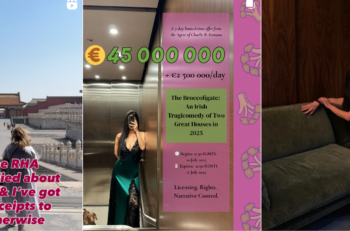
    Tradition betrayed by poor governance By Michael Smith Founded in 1823 in Dublin, the Royal Hibernian Academy of Arts (RHA) was born from the ambition of 30 Irish artists who petitioned the Crown for a charter of incorporation.  Early leaders were landscape painter William Ashford and architect Francis Johnston. By the end of the 19th century, the RHA stood as Ireland’s pre-eminent institution for promoting visual art.   Over time, the Academy gained a reputation for conservatism, particularly in the early Free State years when it embraced a nationalist realism. It was in reaction to this that the Irish Exhibition of Living Art emerged in 1943 to champion modernism. The RHA’s original premises on Abbey St burnt in 1916 and it demolished its splendid replacement headquarters on Ely Place in the 1960s.  A utilitarian new space was created there in the 1970s with financing from developer Matt Gallagher  and a final design by Arthur Gibney RHA, friend of Charlie Haughey. Finally, after years of debt stress,  in 2009 that space was upgraded to meet the RHA’s  royal aspirations,  and to include a well-regarded School.  It would be difficult to say it has made for an institution that is integral to the cultural life of Ireland.    The RHA is helmed for the moment by Abigail O’Brien, its first female President who was recognised with an honorary Doctorate of Fine Arts in 2019, and was the recipient of a “Woman of the Year” award in the Arts from Irish Tatler; and by Patrick T Murphy, who remembers breaking into the gallery in the early 1980s when the building was a concrete hulk “just to look at the spaces inside because they were so great”. who has served as Director for 28 years. Murphy spent the early part of his career lecturing in the National College of Art and Design, returning to Dublin in 1998 after a decade at the Institute of Contemporary Art in Philadelphia and has long been due to retire in the autumn. O’Brien, whose brother is one of Ireland’s richest men, Denis O’Brien, has announced she will go around the same time. This article explains how relationships between these senior officers and the RHA’s board have collapsed as the protagonists make for the departure lounge.      How it is supposed to work, and how it works in practice   The Academy is a charity that receives core Arts Council funding and operates under a spiffy Royal  Charter which was expensively rewritten a few years ago “for effect” but, according to insiders, without taking aim at deep structural problems.       Formally, the Assembly — comprising the membership — meets four times a year and retains ultimate authority. In practice, the Council, meeting monthly with roughly 8–10 members (several have resigned in recent weeks), functions as the board under company law. The President, Treasurer, Secretary and Keeper sit on Council ex officio, as its officers. They are Dr Abigail O’Brien PRHA, Andrew Folan RHA, Sinéad Ní Mhaonaigh RHA and Rachel Joynt RHA respectively.  Without RHA after your name you will not go far in this berobed world.      Several Council members and officers are now complaining that short tenures, blurred lines of accountability and a culture of informality have crystallised as dysfunction and stasis. Staff report no clear whistleblower route. Fundamental norms of good governance such as care with employment contracts, disciplinary processes and officers not employing staff, have not always been observed. The officers are not always responsive to their Council. There is inadequate guidance from the antique RHA’s bye-laws.      Concentrated power    The RHA now features  an unusually concentrated executive: Patrick Murphy is not only CEO/Director but also in effect Curator which gives him leverage over the RHA’s ever-aspiring artist membership. Admirers describe him as dynamic and artist-focused, with teaching experience and a reputation for ‘looking after’ the staff of roughly twelve. Critics characterise him as a poor manager with lax procurement and informal hiring (“jobs for friends”) practices, and a demonstrated partial aversion to paperwork — he has himself, it is said, no standard employment contract, though he will have inferred rights by law, and little systematic expense oversight. He draws a notable salary of around €120,000. He refused to inform one stakeholder of the salaries of the employees of the RHA as he said he was taking care of that himself. He has grown arrogant and territorial over the years. Artists and employees alike are reluctant to challenge such a powerful  CEO.   Murphy’s long-standing alliance with President O’Brien figures frequently in dispatches. Sources say O’Brien has taken a leading hand in discussions about Murphy’s retirement package and a mooted “RHA West” role in Ballina, proposals some Council members considered to make insufficient logistical sense.      Enter Sandra Hu   Into this culture stepped Sandra Hu, who “sashayed” into the organisation via training in Beijing, New York, Cheltenham Ladies’ College and Trinity College Dublin as ‘front-of-house’ without job advertisement or interview like many before her. Her title and responsibilities shifted — part-time at front-of-house, then — with the benefit of contracts — development co-ordinator, front of house manager and head of sales to front of house manager and head of commerce.  Through no fault of Hu’s, these roles sometimes overlapped with roles held by others, including the poor official Curator, whose job responsibility included sales. In a short period and without elementary process, Hu was catapulted from an entry level position to a prominent position with far-reaching responsibilities which, by all accounts, she discharged well.  She was charismatic, ebullient and gregarious and she generated a stir and perhaps some jealousy.    Colleagues describe her as efficient and hardworking, but increasingly critical of slippage in standards such as some RHA staff’s notoriously deficient starting hours. Hu felt she was not being rewarded for working overtime. She was pointedly excluded from several meetings and sidelined socially. There was an incident where Murphy publicly castigated Hu for bringing coffees to a Council  meeting centring on whether O’Brien had paid for them as President.  One  curator formerly

    Loading

    Read more

  • Posted in:

    Deserting as resistance: the Easter Rising’s impact on the Western Front

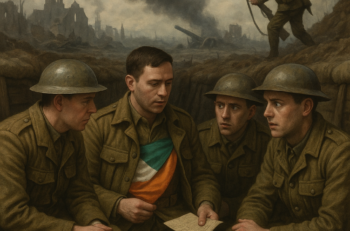
    British military justice backfired in the case of Irish ‘Tommies’ By Brian Flanagan School history teaches that World War I’s causes were complex: Nationalism, Militarism, Imperial ambition and decline. Sometimes the slogans were simpler: ‘the shot heard around the world’, ‘over by Christmas’, and ‘the war to end war’. New research into the Irish experience reveals just how precarious the whole edifice of war, including the State’s monopoly on violence, then was. Over 130,000 Irishmen, Catholic and Protestant alike, volunteered to fight for the then United Kingdom of Britain and Ireland. However, as the war dragged on, Britain’s heavy-handed suppression of the 1916 Easter Rising in Dublin — a rebellion timed to exploit Britain’s military commitments overseas — transformed Irish perceptions of British rule. New research reveals just how precarious the edifice of war, including the State’s monopoly on violence, was Disregarding warnings by Irish parliamentarians, the British authorities executed — by firing squad — the Rising’s leaders. These included the grievously injured James Connolly, himself a British army veteran, whom they tied to a chair. A backlash to these tactics ushered in the War of Independence, through which, by 1921, most of Ireland would exit British rule entirely. A study of the attitudes of Irish WWI volunteers, by Professor Daniel Chen  to be published in the Journal of Law, Economics and Organization, in July 2025, shows how decisively Britain’s actions eroded its standing as Ireland’s source of law and order. The British army lost over 700,000 men in Europe’s trench warfare. And there was no escape from the Western Front. Soldiers who fled the fighting were almost invariably caught within a fortnight, court-martialled, convicted and sentenced to death. A decision was then taken — on a seemingly random basis — on whether to implement or commute the soldier’s sentence. Through subjecting the convicts to this ‘pitiless lottery’, British commanders unwittingly created the conditions for a natural experiment by which the deterrent effect of capital punishment could be tested in roughly the same way medical trials test the prophylactic effect of a vaccine. Analysing the impact of executions and commutations on the army’s Irish contingent, Professor Daniel Chen of Harvard University made a remarkable discovery — one which runs counter to historical research that downplays the Rising’s effect on Irish morale. The harshness of British military justice seems to have had the desired effect of deterring indiscipline — in general. On the army’s Irish soldiers, in contrast, it had the opposite effect. Before the Easter Rising, about 17 percent of the unauthorised absences that followed the execution of an Irish soldier involved another Irishman — five points (12 percent) higher than when the soldier’s death sentence was commuted after the Rising, however, the share of absences that followed executions jumped to 23 percent, while that following commutations remained at 12 percent, widening the gap to over double. It appears irrational to be more open to committing a crime if you’ve seen someone else punished, let alone executed, for it. No government expects its people to react in this way. But this was precisely how Britain’s Irish soldiers increasingly came to view the offence of deserting their unit. Self-interest offers little explanation. In refusing to continue to fight for the Crown abroad, a judgement of its legitimacy at home was at work. Sometimes, an execution is just a killing — sometimes, a criminal punishment is just violence. In responding to the executions of their countrymen not with greater compliance but rather with risky defiance, Britain’s Irish volunteers demonstrated the difference—and how quickly one can seem to change into the other. Initially supportive of Britain’s war aims, the Irish poet Francis Ledwidge wrote, “I joined the British Army because she stood between Ireland and an enemy common to our civilisation”.  By the time of his death in the Battle of Passchendaele in July 1917, Ledwidge’s confidence had vanished: “If someone were to tell me now that the Germans were coming over our back wall, I wouldn’t lift a finger to stop them. They could come!”. This stark shift was mirrored widely: after the Rising, Irish military recruitment collapsed, and subsequent British attempts to impose conscription faltered. What Chen discovered is that, on the Western Front, Britain’s punishment of Irish revolutionaries at home had the effect of inverting the whole concept of British punishment as a deterrent. The experience of the Irish ‘Tommy’ remind us that the distinction between a legitimate government and a vigilante is always provisional We object to vigilante justice not because the punishment does not fit the crime but because of the punisher’s illegitimacy. We insist, instead, on the rule of law. The Irish volunteers’ reaction to the British punishment of militant republicans tells us that official justice is fragile. The tendency of even the severest punishment to positively encourage disobedience vividly illustrates how swiftly a State’s moral authority can unravel. With Britain’s seeming violation of the implicit trust that had sent Irishmen willingly into battle, desertion became as much an act of political resistance as a military crime. The experience of the Irish ‘Tommy’ reminds us that the distinction between a legitimate government and a vigilante is always provisional. Brian Flanagan is Associate Professor in the School of Law and Criminology at Maynooth University

    Read more