Election 2020

Random entry RSS

  • Posted in:

    Sinn Féin: not quite yet.

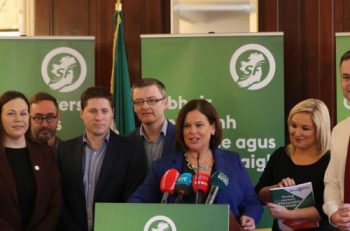
    Sinn Féin’s exciting economic and social agenda needs to be weighed against its ambivalence on violence, its cultism and its environmental weaknesses. By Michael Smith. Village believes equality of outcome, sustainability and accountability are the most important policies.  So how does, now rampant, Sinn Féin fare under these criteria? Of course Sinn Féin has been attacked for the alleged profligacy of its manifesto. For me its manifesto is an impressive piece of work and the high point of Sinn Féin’s offering. Nevertheless, economically, it uses smoke and mirrors and it is not clear by how much it would exceed the alleged fair-weather fiscal space of €11bn.   The Economy Sinn Féin plans to abolish the USC for incomes under €30,000 (costing €1.2bn)  and abolish the local property tax (costing €485m). It would increase stamp duty on commercial property and introduce a 15.75 tax rate on employers’ PRSi on salaries over €140,000. It would increase CAT from 33% to 36%.  It would impose  a 1% wealth tax (over €1m) and a 5% high-income levy.  Exciting and progressive stuff. It would spend an additional €6.5bn on house-building and €1.6bn on health over a five-year government, It would giveaway €2.4bn in tax reductions every year, and increase overall taxation by  €3.8bn annually It claims it will run a surplus every year, rising to €3.4bn by 2025, and misleadingly claims that the Department of Finance has somehow endorsed its package as a whole. This generation has been so profligate in terms of consumption and environmental degradation that it should be aiming to live more within its means and only to borrow for the benefit of the rising and future generations. To this end, Sinn Féin’s economic and social manifesto seems a proportionately radical approach. It is regrettable it is not proposing increases in capital gains tax, even on windfall land rezoning profits, and it is offensive that a republican party would not tax property, an atavistic regression to the Irish obsession with the land, ill-befitting a modern party with left aspirations.  Its proposals on REIT and IREF property vehicles are informed and appropriate.  It proposes increasing the Dividend Withholding Tax (DWT) for REITs and IREFs from 25% to 33%, applying a rate of 33% Capital Gains Tax on all property disposals by REITs and IREF and applying the full rate of commercial stamp duty on REITs and IREFs . This is targeted stuff: someone in Sinn Féin’s been talking to subversives in real estate. However, it again betrays a lack of seriousness for a socialistic party in eschewing increases on our 12.5% corporation taxes, or financial transaction taxes.   Of course the manifesto is not everything, particularly in circumstances where coalition is its only route to government.  Sinn Féin’s commitment to actually implementing a radical left agenda is unclear bearing in mind its defining preference for irredentist nationalism first over socialist ideology second, and its willingness to coalesce with Fianna Fáil or even Fine Gael.  Track Record Nor is its track record in power impressive.  Its performance at local-authority level is consistently banal.  In Northern Ireland, apparently unbeknown to Mary Lou McDonald, there seem to be more homeless per capita than in the Republic (a 2017 report from the Northern Ireland audit office, for example, said that “since 2005-06 around 20,000 households each year have presented as homeless with an average of 50% accepted as statutory homeless“; and its health service is by far the worst in the UK.  The governance Sinn Féin has provided North of the border is not distinctive or particularly leftist. Dysfunctionalities More generally Sinn Féin is cultist, over-disciplined and secretive, hitched to supportive plutocrats in the US,  and ambivalent about democracy and transparency.  Its internal elections never seem fully open.  It had a serious internal bullying problem. Its leaders lie casually about its, and the IRA’s, past.   It was certainly the case in the past that Sinn Féin leaders deferred to the IRA army council.  It is alleged, with some evidence – e.g. Máirtín O’Muilleoir’s consultations with veteran republicans as Stormont collapsed, and Mary Lou McDonald’s volte-face on a border poll – still to be the case. If it is no longer the case – and this is definitive – at the very least Sinn Féin should explain when and how the transition occurred. Many Sinn Féin leaders accept that overall the IRA campaign, which killed 1800 (out of 3500 killed in total during ‘the Troubles’ was a mistake, despite the systemic and evil provocations.  The single biggest move that might attract nay-sayers to Sinn Féin would be to apologise for its largely blind support for the inexplicably still-undisbanded IRA. As it is, it is vulnerable to the, sometimes disingenuously contrived, efforts of the media and other political parties, to highlight the litany of Sinn Féin ambivalence to IRA violence, such as the focus on its dubious role in imputing criminality to Paul Quinn who the IRA appear to have murdered, after the cease fire.   Nationalism, particularly irredentist nationalism, is a dead end and ultimately incompatible with equality which seeks to eliminate barriers, including borders, to treating people equally. In Sinn Féin’s case nationalism has taken the shape of support for violence.  It seems to me that violence, in the North, verged too often on the anti-egalitarian.  If you support shooting someone you are in effect saying not alone are they not equal, or somehow worth less, you are saying they are worth nothing.  That was a bad start for an egalitarian agenda. If not sectarian, Sinn Féin is at least tribal. It is systematically scathing of Unionism and it is anti-British.   Whatever about the vicious lies told casually about Paul Quinn, Mary Lou McDonald took the opportunity to march behind an “England get out of Ireland” banner at last year’s New York St Patrick’s day and stated that Slab Murphy, convicted on overwhelming charges of tax evasion, was “a good Republican”. Sinn Féin is still the party of anti-Black-and-Tan-bandwagonning and the late-night Tiocfaidh.   Its efforts to reach out to Unionists in the North rarely seem tailored to actually appeal to sceptical Protestants. Even in the South it is divisive. Sinn Féin’s campaign rhetoric has not

    Loading

    Read more

  • Posted in:

    The PBP/Solidarity explainer: from Campaigns to Revolution

    Ireland’s Trotskyist left and its structured campaigning, issue by issue, until the people overthrow capitalism. By Oisín Vince Coulter. On 10 March 2016, Richard Boyd Barrett was defeated by 111 votes to 9 in the election of the Taoiseach during the first sitting of the 32nd Dáil. Ruth Coppinger had nominated him with the Connolly quote: “The day has passed for patching up the capitalist system. It must go”.  In retrospect, almost four years later, that defeat may well have been the high water mark, both for Boyd Barrett personally and the Trotskyist left of which he is a part. The left was then riding high on the wave of the Right2Water campaign, the country’s largest mass movement in a generation. The 2016 general election returned 6 Trotskyist TDs, 3 from People Before Profit (PBP) and 3 from the Anti-Austerity Alliance (now Solidarity). With Labour and the Greens both sidelined after their respective disastrous coalitions, the Trotskyist left hoped to carve out a space for their particular brand of anti-capitalist politics.  They had little interest in working with Sinn Féin to do so, putting Boyd Barrett forward against Gerry Adams for Taoiseach despite some co-operation in the Right2Change electoral vehicle and during the Right2Water campaign. The potential for Trotskyism to burgeon into a permanent and dominant fixture of the Irish left seemed real. But current polling for this election does not look good for the Trotskyist left. Many of the social movements that they have poured their energy into over the last three years have failed to take off, from housing to healthcare, even though the issues are as relevant as ever. Their progress has stalled, and unless circumstances change they are facing into a decade of decline and growing political irrelevance.  The 2016 election result had come after a decade and a half of victories and defeats that saw them go from total marginality to having a widely acknowledged and outsized influence on national politics. After involvement in the anti-war movement and Shell to Sea, the Celtic Tiger years ended with the only Trotskyist national representative in the form of Joe Higgins losing his seat in the 2007 General Election. However, since then both what are now the Socialist Party/Solidarity and what are now the Socialist Workers Party/People Before Profit have grown to have a few hundred active members between them: councillors, TDs and MLAs in the north – not to mention significant roles in most of the major issue-based campaigns of the last decade. History and Background Some history is needed in order to get a grip on who PBP and Solidarity are. First, they have never been the same party. Trotskyism is rightfully infamous for unending fractious splits, but the two largest Irish Trotskyist parties descend from quite different intellectual traditions, namely two British Trotskyist parties: the International Socialists (IS) and the Militant Tendency (Militant). Both are ‘Trotskyist’ in the sense that they are communists in the tradition of Leon Trotsky, a key leader in Russia’s October revolution. Trotsky ended up the main rival of Joseph Stalin, and was eventually driven into exile by him and assassinated in Mexico on his orders.  The Socialist Workers Movement was launched in Ireland in 1971 by supporters of the British International Socialist  and was later renamed as the Socialist Workers Party (SWP) – the name of their British sister party, and one they are often still known as. They rebranded again recently as the Socialist Workers Network, and run in elections as People Before Profit (PBP).  The Militant Tendency in Ireland, like its British counterpart, existed within the Labour Party here until the late 1980s when numerous expulsions of their members drove them out. They were known as Militant Labour until 1996 when they adopted their current name of the Socialist Party. They used to run in elections as the Anti-Austerity Alliance, but recently rebranded to Solidarity.  There are a number of ideological differences between the SWP and Militant traditions in Ireland. Historically there were disagreements on the best way to organise politically, the nature of the Soviet Union, and various other theoretical questions. In terms of current political differences the biggest is the ‘national question’. The SWP has always been more sympathetic to republicanism and the belief that Northern Ireland is an ‘imperial holdover’. The Militant in Ireland and the UK, on the other hand, have always been hostile to what they regard as ‘crude nationalism’, generally trying to avoid engagement with the issue by focusing on their professed goal of uniting “all workers” regardless of culture and national identification in the pursuit of socialism. There are also differences on issues like sex work, with People Before Profit arguably taking a more ‘sex positive’ position. The relationship between the ‘Party’ and other political forces, among many continued theoretical and strategic differences that 99% of the population would find impenetrable, continues to divide them.  Both parties owe their success to a quirk of history as much as anything else. Ireland never had a mass communist party in the European tradition, like that of Spain or France. The closest thing to that and the most successful far-left party of the last fifty years was the Workers’ Party, which peaked in the 1980s and collapsed along with the Soviet Union in the early 1990s. However, in most of Europe, the dominant political force to the left of social democracy emerged from the remains of their traditional communist parties. When the Workers’ Party split, the resulting group – Democratic Left – ended up merging with the Labour party rather than becoming akin to Die Linke in Germany. This left a space open to Labour’s left in Ireland, and the two Trotskyist parties fought hard and with some success to fill it.  Strategy, Success and Failure To quote Trotsky, “The task of the Communist Party is to lead the proletarian revolution”. The Trotskyist left in Ireland consider themselves revolutionaries seeking to overthrow capitalism. If you know this, and have some knowledge of their strategy

    Loading

    Read more

  • Posted in:

    Socialism, not barbarism.

    Nuclear power, the future of our planet and how to handle differences on the left. By Éilis Ryan. Rather than a facade of unity pasted over our differences, what is required is a structure which enables differences to co-habit within an organised, disciplined and, yes, united Party. Somewhere on the road into Cork City, where I grew up, is a sign declaring you are entering ‘Cork City, a Nuclear-Free Zone’.  The sign went up in the early 1980s, a few years before I was born. As a child in a house full of left-wing politics, I associated the sign with a people’s victory – the little people winning against the might of brutal factory owners.  The people’s campaign behind that sign, of course, originated in the huge festivals of opposition to the establishment of a nuclear power plant at Carnsore Point in the late 1970s and early 1980s. In a country where victories for the left are hard to number, the victory for anti-nuclear campaigners at Carnsore Point, in the popular imagination, is precious.  Along with the bulk of the environmental movement since the 1970s in Ireland, there have always been members of the Workers’ Party opposed to nuclear power. And yet for many, inside and outside the Workers’ Party, it has become increasingly evident that that position, from an environmental perspective, was flawed, and must be amended.  Beyond the ‘tyranny of structurelessness’  The socialist left is often accused of dogmatism in sloganeering. It is an accusation which should be heard out – because politics based on slogans and tradition, rather than clear-headed analysis, would never allow us to admit we were wrong, or to change our views to reflect changing contexts. This ability to analyse changing contexts, all the time mindful of class structures, is the foundation of Marxism – not dogma. And is precisely what is needed for the left to embrace nuclear energy today.  The Workers’ Party operates on the principle of democratic centralism. Though often used as a slur to dismiss socialists as authoritarian, fundamentally democratic centralism simply means that the party has a clearly set out structure of elected bodies, from local branches up to the party’s leadership body, the Ard Comhairle, and clear rules as to how the leadership body is elected, and how any major policy or strategy changes.  It is highly organised, democratically accountable, and has a clear hierarchy. But it is this very clarity which, far from dampening down the views of ordinary members, allows for real democratic decision-making – and so allows views to change over time, as necessary. Far from being a mere rubber-stamping operation, this structure enables debate on issues where there are, quite regularly, real differences between party members.  Planet before pastoralism – the struggle to build an environmentalism of science, in Ireland  Nuclear power represents one such issue. Within the Party today, there is a variety of views, ranging from total opposition to nuclear energy to those who embrace it, with many in between who believe that, at a minimum, there is no credible evidence not to include it as one of the menu of energy options which we must examine carefully to save our planet from existence.  To mediate these differences, the Workers’ Party’s most recent Ard Fheis voted to hold a public consultation with members and branches on the issue of nuclear energy.  Ireland’s energy future is  important not only because of climate change. For those of us on the left, who wish to carve out a future distinct from the interests of (predominantly) American foreign policy and capital, it is crucial that we have sovereignty over our energy. Given the presence of uranium in Ireland, examining the possibilities of how it might contribute to our future energy needs is only sensible. And given Ireland’s very small energy requirements, it’s highly likely that uranium might become a lucrative export for a new state company, and sustain large number of jobs in prospecting, mining, processing and fuel fabrication. And it would save Ireland on the cost of importing, oil and free it from the vagaries of the international oil market.   With nuclear as a baseload power, and wind power to top it up, Ireland could be completely self sufficient and even be a consistent exporter of power abroad. Even more importantly, it could do so without releasing almost any CO2 in the process of power generation! In terms of safety, the reality is that studies consistently show nuclear to be the safest energy source after hydro-electric power. Although renewable sources such as wind and solar power do not have the sort of mega-disasters seen with oil or nuclear, they do require far more raw materials, and manpower for installation and maintenance; and cumulatively they result in far more deaths per unit of energy. And, as with all technology, with sufficient investment, it will be possible to reduce the disasters which have historically occurred even further. Meanwhile, the Simpsons-style image of nuclear waste as enormous barrels of green goo bears minimal relation to reality. The waste from a typical household’s lifetime energy consumption would be approximately 2kg – a tiny and, as a result, highly manageable, amount of material.  Regardless of our squeamishness about nuclear energy, the reality is that, in the here and now, as climate crisis engulfs us, no other technology exists which can more safely move us away from fossil fuels.   Indeed we have a concrete example of this fact. In Germany, a decision was taken to transition from both nuclear and coal to renewable energy, which resulted in the closure of the country’s nuclear plants and the investment, to date, of €200 billion in renewable energy. However there has been no reduction in the country’s carbon emissions (over their lifetime, both wind and solar produce significantly more CO2 than nuclear power) and, instead, a new coal-burning plant is on track to open in 2020 because of the enormous shortfall in energy usage. By contrast France, which generates 70% of its energy from nuclear, has

    Loading

    Read more

  • Posted in:

    What happened to the Social Democrats?

    The party was divided by Stephen Donnelly and remains divided by how much it should emphasise identity politics.  By Ronan Daly. In another world, pundits might be predicting a purple, rather than a green wave, on the 8th of February. We might today be talking about how Stephen Donnelly, Catherine Murphy and Róisín Shortall had turned their shared leadership from a weakness into a strength.  When the Social Democrats (SDs) were established in 2015, many believed that was exactly what would happen: that their brand of middle-class-friendly progressivism could make real electoral gains. Instead, they have become a rump of a party, less relevant to Irish politics than even Democratic Left once were. At the heart of their slide to irrelevance was a failure to realise that much of what made the party worth talking about in 2015 was highly transient. The party was anti-water charges, pro-Repeal and wanted root-and-branch reform to the parliamentary whip system. It promised increased social spending but emphasised fiscal responsibility. It is all hardly the sort of stuff that’s getting voters blood pumping right now, but remember that back in 2015 this was a relatively unusual combination. In the midst of Labour’s spectacular betrayal of their centre-left base, Joan Burton was refusing to identify Repeal as a red-line issue in potential coalition talks. So for Shortall, who had left Labour in 2013, an alliance with Murphy and Donnelly looked like an attractive prospect indeed, not least because of its potential to vindicate her resignation.  Donnelly left the world of consulting for politics in 2011; he ran in Wicklow and won, one of many independents who profited from the Fianna Fáil rout. Before the Social Democrats’ foundation, Murphy and Shortall were independents as well, with a decade separating their respective departures from the Labour party. Shortall and Murphy had both opposed the merger of  Democratic Left and the Labour Party, though from opposite sides of the divide.  Here were three politicians who represented wildly different traditions and approaches to any cogent interpretation of leftist politics in Ireland. If they could work together, and profit from their co-operation, it could have heralded the birth of a progressive party who voters could genuinely trust to govern.  Of course, in the end, the SD triumvirate failed to add to their party’s seat count in the 2016 election. Gary Gannon got within sniffing distance of a seat in Dublin Central but late-stage transfers saw Maureen O’Sullivan win instead. Still, returning all three of their leaders put the party ahead of Renua, which managed to lose both of the seats they’d held before the election.  It’s hard for a new party to expect much better in their first outing: the Social Democrats lacked funding, volunteers and really any of the kind of party machinery that matters in Irish elections. Next time though, party members said, the Social Democrats’ electoral success would catch up to the appeal of their message. But between then and next time was five years where a great deal could go wrong.  And a lot did go wrong, starting with Donnelly jumping ship to Fianna Fáil in 2016. Rather than strengthening the party, its three-way co-leadership proved impossible to sustain.  Donnelly’s much-lauded performance in the 2016 Leaders’ Debate ended up being a mixed blessing for his party. In a country which has always been more worried about the competence of its political newcomers than the corruption in its government, the SDs hoped to win over that segment of Irish society who want a fairer and more equal economic system, but need the comforting voice of a management consultant to convince them to actually vote for it. Donnelly provided that voice for the SDs, only for his brief popularity to backfire internally, with Murphy and Shortall resenting the disproportionate attention he received.  With his departure the SDs were dealt a triple blow: they lost their most popular figure and their veneer of competence, and voters started wondering whether there was any difference between the SDs and Fianna Fáil – a subversion of everything they stood for. For his part, Donnelly has been a much less electrifying presence without the SD platform. The eery reproduction of his “no-nonsense” approach in service of a party he once so vociferously attacked as part of the “stale cartel” of Civil War politics is Janus-faced, and reveals that in Donnelly’s instance, as is so often the case, pragmatic is a synonym for more power-hungry than you admit. With Donnelly gone, Murphy and Shortall found themselves with a budding party infrastructure that they didn’t quite know what to do with. Despite their distinct origins, they quickly found out that they disagreed with each other much less than did the new members of their party with them. Shortall is a far more capable media performer than Murphy, but little else separates them, after all they’ve been through.  They are both well established, female, centre-left politicians who bring out the worst in each other. Any time spent pondering why it is that Murphy and Shortall have their own party at all points towards the inescapable conclusion that it has a lot to do with tactics and little to do with ideology. Their close alignment on the issues and outsized stature in the party compared to most leaders has meant they have felt entitled to circumvent, out-manoeuvre and otherwise ignore the wishes of their party membership.  Consider the Ellie Kisyombe affair, which last year laid bare the cracks in the foundations of the young party. Kisyombe, an asylum seeker originally from Malawi and a direct provision campaigner, was standing for the SDs in the 2019 Dublin City Council elections when the Sunday Times reported that there were inconsistencies in her account of her time in Direct Provision.  After Murphy and Shortall wrote a letter which suggested that Kisyombe should be taken off the ticket, the reaction from SDs based in Dublin, of whom Gannon had the highest profile, was explosive. In their eyes, this interference was emblematic

    Loading

    Read more

  • Posted in:

    Micheál Martin, evasive and misleading, in 2020

    Answers, provided by a spokesperson for Fianna Fáil,  to the questions posed by Village to Micheál Martin, about his relationship with developers Owen O’Callaghan and John Fleming, are evasive and misleading. By Frank Connolly. The Fianna Fáil leader, Micheál Martin, sounds more like a man under pressure than one who looks most likely to be the next Taoiseach. During the seven-way TV leadership debates and in other interviews, Martin has been on the defensive across a range of policy issues and apparently obsessed with the political threat posed by Sinn Féin. He has desperately sought to distance himself from the “ghosts of Fianna Fáil” past and his decade-long participation in the Bertie Ahern-led governments that destroyed the economy and damaged the fundamentals of Irish society.   His utterances on health, housing, childcare and pensions, among other matters, sound hollow and unconvincing given that he was at the heart of the decision-making which contributed to the inequities which have beset these vital areas of public provision for so long. During RTÉ interviews with Sean O’Rourke on Wednesday (29th January) and Bryan Dobson on Friday (31st January), Micheál Martin stumbled into another potential minefield when he was asked about the close ties his party has enjoyed with builders and developers in the past and whether he could keep his distance in the future. In reality, the financial crash ensured that a lot of distance was put between his party and the builders when many of them went bust or into the bad bank of NAMA which was created by the last Fianna Fáil government in 2009. It was set up to bail out the distressed banks but despite all assurances to the contrary, the agency has also bailed out many of the developers that previously populated the party’s Galway tent in the ‘boomier’ times.  The legacy of that relationship continues to haunt the party and while Martin avoided much of the damage suffered by his former colleagues who came under deeper tribunal scrutiny his responses to difficult questions on the subject have not always been convincing.   The past relationship with property developers, speculators and landlords also touches on a core issue relating to Fianna Fáil’s ability or will to tackle the housing crisis. Martin has called for much-needed major investment by local authorities and the State in the construction of public and affordable housing to meet the current emergency. But it is Fianna Fáil-led governments since the 1980s that have divested local authorities of the resources and remit to build decent social and affordable homes and handed responsibility to the private developers and builders.  The gap in provision for those struggling with rents was filled by the obscene subsidies to private landlords facilitated under the Housing Assistance Programme. After the crisis Fine Gael-led governments transferred vast amounts of public assets and property to heavily-tax-incentivised global funds, including through the NAMA process.  In its election policy on housing, Fianna Fáil’s proposals to give one Euro for every three saved by first-time buyers would encourage builders to hike the house prices as happened with similar policies in the past. The party’s plan to reduce levies on developers would inevitably be pocketed rather than contribute to lower costs for home-buyers, if previous experience is anything to go by.   The corrupt relationship between Fianna Fáil and other politicians and the “builders” was ruthlessly exposed at the Planning and Payments Tribunal (also known as both the ‘Flood’ and the ‘Mahon’ tribunal) which was established in late 1997 following revelations concerning Ray Burke. It concluded with a deeply damning report in 2012, having exposed an extraordinary litany of illicit payments to politicians since the late 1980s. Micheál Martin was drawn into its remit when the tribunal examined payments made by Cork developer, Owen O’Callaghan, to various TDs, councillors and others from 1988 to the late 1990s.  O’Callaghan was accused by his former and reluctant business partner, Tom Gilmartin, of bribing a large number of national and local politicians, with the help of lobbyist Frank Dunlop, spending upwards of £1.8 million in the corruption process. The remit of the tribunal was restricted to Dublin and did not extend to those who were abusing the zoning and planning regulations across the rest of the country. Martin, who served as a councillor and then TD in Cork, was brought into the Flood tribunal because he received political donations from O’Callaghan. The first donation of £1000 was made to Martin around June 1989 during the general election after which he was elected a TD for Cork South-Central for the first time.  Scrutiny by the tribunal of the intent of all donations to Fianna Fáil during that election was intense. This was also the election campaign during which then justice minister, Ray Burke, received large payments from developers totalling some £80,000 which directly led to the establishment of the Flood tribunal eight years later. In June 1989, environment minister, Pádraig Flynn took a £50,000 donation to Fianna Fáil from Gilmartin and lodged it to his own bank account.    Martin told the tribunal that he cashed the £1000 cheque he received from O’Callaghan in 1989 and spent it on his election expenses. During the local election campaign in 1991, Martin received a further donation of £5000 from O’Callaghan through the developer’s company Riga Ltd. In his testimony to the tribunal, Martin said that the generous donation (equivalent to more than €10,000 today) was “not for me alone” but also “for the party’s expenditure in the ward”. He was unable to provide full receipts for the spending. At that time, politicians were not required to issue receipts for such contributions or to register political donations.  What was unusual in regard to the payment was that the cheque was lodged to his wife’s bank account in Dublin. In his written statement to the tribunal, Martin explained that: “With regards to the donation of £5000 made on or about June 1991, £3,500 was lodged to my wife, Mary’s AIB account, Baggot Street on 4th July, 1991…..the balance of £1,500 was cashed and applied for

    Loading

    Read more

  • Posted in:

    Labour: dynamic role for State, climate action and genuine equality

    Sinn Féin is the only party in Europe claiming left and Green credentials that opposes both a property tax and carbon tax. By Brendan Howlin. According to Irish Times’  focus-group research, undecided voters are overwhelmingly in favour of change, but they’re struggling to decide which party represents the change they want to see. However, according to the opinion polls, a possible outcome of this election is no change at all. With Fianna Fáil and Fine Gael refusing to coalesce with each other, and with both of them ruling out coalition with Sinn Féin, the polls throw up figures where it may be that neither party can form any sort of government except another arms-length, noses-pinched, ‘confidence and supply’ agreement. The breakup of old-style politics, based on divisions from the Civil War, means a gradual reorientation towards the politics of ideology. But the change isn’t smooth or straightforward. For all the traditional and personal animosity between Fianna Fáil and Fine Gael, even their supporters are finding it harder to tell them apart, as can be seen in recent vote-transfer patterns. In the longer term this is a good thing but, in the short term, their mutual antagonism is delaying the inevitable and is still presenting a bogus choice to the electorate – which threatens to paralyse future government formation. I don’t yet trust Sinn Féin as a progressive alternative. It is still a party of protest and opportunism, fomenting crises for its own advantage. It protests against Brexit now, but it did not campaign at all in Northern Ireland during the Brexit referendum. In reality, Sinn Féin could not bring itself to defend the European Union. It has campaigned for No in every single one of our EU referendums. It is as Euro-sceptic as the Tories – not a policy Ireland needs in government right now. Sinn Féin’s interest in Brexit is to ramp up concerns about the border and demand a poll on Irish unity. The party with a history of doing more than any other to sustain bitterness and division on our island now wants to pour more fuel on the fire. And Sinn Féin is in thrall to populism. Comically, it presents itself as both left-wing and eco-aware but it is the only party in Europe claiming left and Green credentials that opposes both a property tax and carbon tax. Labour is a European political party. We have a vision of how Ireland can become more like other European countries – countries that have built enough homes for their people and have provided good-quality, universal healthcare. Countries that have reliable public transport, excellent schools and strong rights for people at decent, well-paid work. The children of Reagan and Thatcher put their faith in the market. Whether it is Fine Gael’s conviction – in the teeth of all the evidence – that the market can resolve our housing crisis or Fianna Fáil’s recourse to the Treatment Purchase Fund to cut down hospital waiting lists, our two centre-right parties have conspired together to strip our State of its capacity to provide decent services for our citizens. And they have wasted the public’s money, hand over fist. This Government’s aversion to decent public services provided by a well-run public service means that we have an HSE recruitment embargo, with almost €1 million every day spent on agency staff instead. Fine Gael’s love affair with business means that it will give away ownership of our national broadband network and that we’ll end up with the most expensive hospital ever built in the world. Labour stands for a dynamic role for the State, working responsively and accountably. We believe that Ireland should aim to be in the top 10 countries for quality public services, climate action and genuine equality. There is a lot to be done. Nearly a quarter of workers are on low pay, and many jobs are insecure. Around 10,500 people are homeless, including nearly 4,000 children, and housing is too expensive for those on ordinary wages. People are not getting the medical care they need due to waiting lists and overcrowding. We produce too much pollution, waste and greenhouse gases. One in every 10 children is brought up in consistent poverty. Labour wants to build homes, fix health and provide better pay and job security. We’re committed to a fair start for every child, better work-life balance and socially just climate policies. Building an Equal Society, our manifesto, available on www.labour.ie sets out our vision – and our core redline commitments. But our ability to do this depends on our level of support in this election. That is why it is so important for you to vote Labour on Saturday. And, because it will fall to Labour and other progressive, constructive parties to work together towards a better future for our people, I’m also asking you to give your preferences to the other progressive parties and candidates in your area. Let’s end the waste of public money, build homes and fix health. Brendan Howlin, TD for Wexford, is leader of the Labour Party

    Loading

    Read more