

• Posted in:

    Humphreys honoured hoax-bombing, domestic-abuser garda with Scott medal

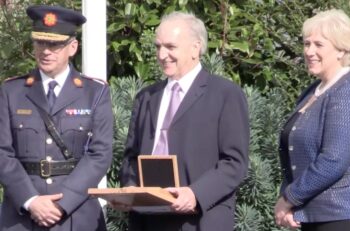
    By Michael Smith published in partnership with the Ditch A former garda who was accused by his wife of serious domestic abuse and of holding a gun to her head at their family home in Donegal was awarded a Scott Medal at a ceremony attended by then acting justice minister and presidential candidate, Heather Humphreys, in September 2021. Former Detective Garda Noel McMahon resigned from the Garda in 2004 after the Morris Tribunal found that he was involved in planting “hoax bombs” and ammunition across the North-West in the early 1990s He and a senior Garda colleague then claimed these as IRA explosives-finds to advance their careers. McMahon purchased illicit drugs which were then placed in the premises of publican Frank Shortt in Quigley’s Point, in County Donegal in October 1994 before a large force of gardaí raided the nightclub. Shortt was charged with allowing his premises to be used for the sale of illegal drugs and, in 1995, was wrongly imprisoned for three years. He later obtained a miscarriage-of-justice certificate and substantial damages from the State. Judge Freddie Morris found that Noel McMahon had lied during his evidence to the tribunal. McMahon faced dismissal from the Garda before he resigned in July, 2004. At the Morris Tribunal hearings, Sheenagh McMahon described how she was subjected to serious abuse by her garda husband who threatened her with his official firearm at their home in Buncrana in 1995. “He put a gun to my head and he told me he would blow my brains out,” she told the Morris tribunal in March 2003 as she recounted the years of abuse she suffered at the hands of her husband. She said that she was wrongfully arrested after Noel McMahon produced a false court Safety Order made against her in 1999 and that her children were placed in care as a result of his actions. She later regained custody of her children and obtained an apology and damages from the State in 2018 over her wrongful arrest. In the apology, lawyers for the State, the Garda, the Minister for Justice and Noel McMahon said in open court that: “The Defendants concede liability on the basis that they accept that the Plaintiff was wrongfully arrested and detained on 30th June, 1999 by reason of the arresting Garda executing a Safety Order produced by the Plaintiff’s husband which in fact had never been issued by the District Court”. Ms McMahon was awarded €20,000 in damages. She refused an offer of an additional €5000 if she would agree to the apology not being read out in court. In its final report, the Morris Tribunal stated that Noel McMahon had threatened a garda colleague with a loaded gun in Buncrana garda station in 1992 and that “nothing was ever done about this incident”. In September 2021, Heather Humphreys, acting Minister for Justice, attended the ceremony during which serving and retired members, including McMahon, were awarded the Scott Medal for bravery during the rescue of businessman, Don Tidey in 1983, after his kidnapping by members of the IRA. Ms Humphreys and Commissioner Drew Harris, with Noel McMahon standing between them, were photographed along with other recipients of the award. The former minister and Fine Gael presidential candidate told those present: “Your actions on that day were truly heroic. You performed your duty as garda members and for that we are thankful. You are honoured with this exceptional award”. 

    Loading

    Read more

  • Posted in:

    As predator George Gibney is extradited: what really happened

    Nailing the institutional culprits, ignored by Ireland’s deficient media By Irvin Muchnick In Ireland’s public square, I now ask yet again: “Why was Gibney living in Florida and who sponsored his Green Card?” The long-elusive goal of a second prosecution of at least some of George Gibney’s countless alleged sexual abuses of young swimmers now seems imminent.  The next stage is whether the media in Ireland deign to take the story deeper. Custom and practice suggest the prognosis is not promising. Mark Horgan’s podcast Where Is George Gibney? did succeed in notching Gibney. Unfortunately, a lot of important stuff has been either left on the cutting-room floor or ignored entirely. Taoiseach Micheál Martin’s remarks that it was this series that got this over the top spiked decades of advocacy by, among others, swimming star Gary O’Toole and journalists Johnny Watterson and Justine McCarthy. ‘Prime Time’ had questioned Gibney in a California car-park as long ago as 2006 As a result of Horgan’s 2020 series, which was broadcast by the BBC and Second Captains, fresh faces came forward to gardaí, grounding an indictment drawn up by the Director of Public Prosecutions for 78 counts of sexual assault and one of attempted rape. In October of last year the Irish embassy in Washington, D.C., submitted an extradition request. And on 1 July this year,  the one-time Olympic swimming coach was fitted for handcuffs and return, more than 30 years after his first prosecution got scuttled by now-discredited statute-of-limitations case-law. For the survivors of the newly alleged incidents, there is palpable relief. A trial will also be hygienic for the entire community of Gibney victims – some of them now dead, of whom at least one was by suicide. As the grimly cynical maxim goes, no well-connected predator meets his match without the emergence of “a live boy or a dead girl.” One live boy, Chalkie White, was a root whistleblower whose testimony now reaches back to events more than a half century ago. Almost incredibly, and in an illustration of the depraved reach of the republic of Gibneystan, another accuser of serial molestation was White’s sister Loraine Kennedy – alleging abuse when she was nine years old. I had the privilege of dining with that grand lady, in Dublin months before her 2019 death from cancer. Generally I prefer the term “predator” to “paedophile” which often gets appropriated by homophobes. But sometimes the shoe fits snugly. In my 2016-17 Freedom of Information Act case over whether Gibney’s privacy rights were outweighed by the public’s interest in cracking open his American immigration file, US federal judge Charles R Breyer delivered the defining analysis. “I have to assume”, Breyer said, “that if somebody has been charged with the types of offences that Mr Gibney has been charged with, the United States, absent other circumstances, would not grant a visa. We’re not a refuge for paedophiles”. Breyer’s utterance from the bench, in combination with the most basic artificial intelligence mashup via Google, will probably tell you more about where the Gibney narrative needs to turn in 2026 than the entirety of the mainstream Irish coverage of scandalously delayed — and so justice-denying — court proceedings. More than a decade ago, the headline over my first blog post on this sordid subject posed basic questions that remain not only unanswered but also unexplored, in both Ireland and the US. On the Irish side, this is sadly characteristic of the national style in the agonising space of historical abuse in high places. A victory lap by the Irish Times crowd always seems to replace the incommodious task of shining the klieg light of accountability on sports overseers, law enforcement and governments. In Ireland’s public square, I now ask yet again: “Why [Was] George Gibney – No. 1 At-Large Paedophile in Global Sports – Living in Florida? And Who Sponsored His Green Card?”. The BBC, Irish Times and RTÉ avoid contemplating the larger lessons and squash offshoot stories. They do not foster the investigative journalism that would generate challenging lessons In the generous interpretation, the podcast’s confinement by the parameters of its brand of storytelling precluded such a deep dive. In the less generous interpretation, the terms of engagement for underwriter BBC – like those of the Irish Times, RTÉ and many other institutions with the resources to do better – annul contemplation of  how hard cases make for larger lessons. They squash offshoot stories by atomising and sentimentalising core narratives. They do not foster the investigative journalism that could render our takeaways less domesticated, more explicit and more challenging. ***** To date, the defunct alternative site Broadsheet.ie (whose archives, happily, can still be accessed), starting in 2016, and Village, starting with my piece here in 2022, remain the only Irish outlets that have shared with news consumers certain relevant facts surrounding the determining official lapse in the Gibney saga. That would be the 1994 three-justice Supreme Court technical ruling which effectively scuttled Gibney’s 27-count indictment. One of the judges was Susan Denham, later, of course, the Chief Justice. She is the sister of Patrick Gageby, who was Gibney’s barrister. Not until 2019 were Ireland’s judicial ethics guidelines reformed to say that judges should not consider cases involving close relatives. To a foreign journalist, the principle is intuitive with a capital I. It is a gloss on a Latin formulation: nemo judex in causa sua, or “no one shall be a judge in their own cause”. Yet a number of my Irish friends demur. They have tried to impress upon me that, in a country of only 5 million, where many members of the elite legal stratum inevitably know each other and some are even related, it is not so nefarious that this rule of thumb is, or until recently was, fungible. On that point, you can colour me sceptical. They further point to the protocol that barristers cannot  choose the clients on whose behalf they act, if the work is within their area of expertise. In

    Loading

    Read more