


Politics

Random entry RSS

  • Posted in:

    Deserting as resistance: the Easter Rising’s impact on the Western Front

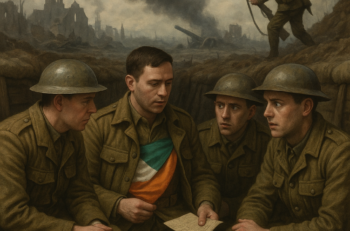
    British military justice backfired in the case of Irish ‘Tommies’ By Brian Flanagan School history teaches that World War I’s causes were complex: Nationalism, Militarism, Imperial ambition and decline. Sometimes the slogans were simpler: ‘the shot heard around the world’, ‘over by Christmas’, and ‘the war to end war’. New research into the Irish experience reveals just how precarious the whole edifice of war, including the State’s monopoly on violence, then was. Over 130,000 Irishmen, Catholic and Protestant alike, volunteered to fight for the then United Kingdom of Britain and Ireland. However, as the war dragged on, Britain’s heavy-handed suppression of the 1916 Easter Rising in Dublin — a rebellion timed to exploit Britain’s military commitments overseas — transformed Irish perceptions of British rule. New research reveals just how precarious the edifice of war, including the State’s monopoly on violence, was Disregarding warnings by Irish parliamentarians, the British authorities executed — by firing squad — the Rising’s leaders. These included the grievously injured James Connolly, himself a British army veteran, whom they tied to a chair. A backlash to these tactics ushered in the War of Independence, through which, by 1921, most of Ireland would exit British rule entirely. A study of the attitudes of Irish WWI volunteers, by Professor Daniel Chen  to be published in the Journal of Law, Economics and Organization, in July 2025, shows how decisively Britain’s actions eroded its standing as Ireland’s source of law and order. The British army lost over 700,000 men in Europe’s trench warfare. And there was no escape from the Western Front. Soldiers who fled the fighting were almost invariably caught within a fortnight, court-martialled, convicted and sentenced to death. A decision was then taken — on a seemingly random basis — on whether to implement or commute the soldier’s sentence. Through subjecting the convicts to this ‘pitiless lottery’, British commanders unwittingly created the conditions for a natural experiment by which the deterrent effect of capital punishment could be tested in roughly the same way medical trials test the prophylactic effect of a vaccine. Analysing the impact of executions and commutations on the army’s Irish contingent, Professor Daniel Chen of Harvard University made a remarkable discovery — one which runs counter to historical research that downplays the Rising’s effect on Irish morale. The harshness of British military justice seems to have had the desired effect of deterring indiscipline — in general. On the army’s Irish soldiers, in contrast, it had the opposite effect. Before the Easter Rising, about 17 percent of the unauthorised absences that followed the execution of an Irish soldier involved another Irishman — five points (12 percent) higher than when the soldier’s death sentence was commuted after the Rising, however, the share of absences that followed executions jumped to 23 percent, while that following commutations remained at 12 percent, widening the gap to over double. It appears irrational to be more open to committing a crime if you’ve seen someone else punished, let alone executed, for it. No government expects its people to react in this way. But this was precisely how Britain’s Irish soldiers increasingly came to view the offence of deserting their unit. Self-interest offers little explanation. In refusing to continue to fight for the Crown abroad, a judgement of its legitimacy at home was at work. Sometimes, an execution is just a killing — sometimes, a criminal punishment is just violence. In responding to the executions of their countrymen not with greater compliance but rather with risky defiance, Britain’s Irish volunteers demonstrated the difference—and how quickly one can seem to change into the other. Initially supportive of Britain’s war aims, the Irish poet Francis Ledwidge wrote, “I joined the British Army because she stood between Ireland and an enemy common to our civilisation”.  By the time of his death in the Battle of Passchendaele in July 1917, Ledwidge’s confidence had vanished: “If someone were to tell me now that the Germans were coming over our back wall, I wouldn’t lift a finger to stop them. They could come!”. This stark shift was mirrored widely: after the Rising, Irish military recruitment collapsed, and subsequent British attempts to impose conscription faltered. What Chen discovered is that, on the Western Front, Britain’s punishment of Irish revolutionaries at home had the effect of inverting the whole concept of British punishment as a deterrent. The experience of the Irish ‘Tommy’ remind us that the distinction between a legitimate government and a vigilante is always provisional We object to vigilante justice not because the punishment does not fit the crime but because of the punisher’s illegitimacy. We insist, instead, on the rule of law. The Irish volunteers’ reaction to the British punishment of militant republicans tells us that official justice is fragile. The tendency of even the severest punishment to positively encourage disobedience vividly illustrates how swiftly a State’s moral authority can unravel. With Britain’s seeming violation of the implicit trust that had sent Irishmen willingly into battle, desertion became as much an act of political resistance as a military crime. The experience of the Irish ‘Tommy’ reminds us that the distinction between a legitimate government and a vigilante is always provisional. Brian Flanagan is Associate Professor in the School of Law and Criminology at Maynooth University

    Read more

  • Posted in:

    Jes Paluchowska interviewed the on-message candidates for President of Trinity College Dublin’s Student Union. Voting closes on 27 February at 4pm

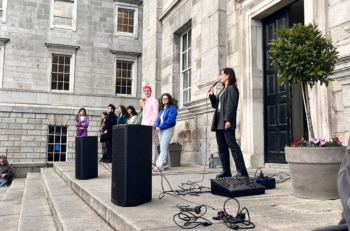
    . The Student Union in Ireland’s top-ranking university, Trinity College, is currently in the process of electing new sabbatical officers. The first hustings was on 18 February.  Last year, the Students Union (SU) President, Laszlo Mornafi, made headlines when it promoted an encampment that blocked access to the Book of Kells as an act of protest against the war in Gaza. Recognising the importance of Trinity’s student body, Village asked the SU’s presidential candidates to give a brief account of how, if in office, they plan to address the values of sustainability, diversity and equality. Here are their responses. Patrick Keegan “Trinity has many shortcomings, and it’s up to us to take action to hold the college to account. Students have the power to enact change, and we must engage in direct action and lobbying at every step to ensure that Trinity properly represents us all. Trinity often focuses on optics rather than real sustainability, and has partnerships with companies like Coca Cola and Ryanair, promoting greenwashing while they continue their harmful practices.  On diversity and equality, we must push Trinity to do better. Student consultations are crucial to identify areas for improvement. We must ensure that all students from all backgrounds feel welcomed at Trinity, and it’s through consultations that we can best identify and address all issues, no matter how big or small. Trinity must also confront its ties to oppressive regimes, such as apartheid Israel, and address shortcomings in trans healthcare and racism. Trinity must do more to support Irish-language speakers, such as by offering modules through the medium of Irish. As President, I will work for all students, demanding the college prioritises students. Trinity also has much to do to ensure equal access to education, as many lectures are not recorded, and many students don’t have their LENS reports properly met. We will address these issues through lobbying, information campaigns, and direct action. Additionally, our campaign weeks provide a perfect opportunity to address specific issues. We are the largest stakeholders, and we must hold Trinity accountable, acting radically to ensure Trinity represents us all”. Giovanni Li  “Sustainability, diversity and equality are three of the most recent popular buzz-words within this decade, advocating for the rights as well as the well-being of the average person and not just those who are privileged. No matter the race of the individual, background, status or any other external factor. If I were to be elected it would be of utmost importance to me that these core values are held to the highest standard possible, no student will be left behind, no tables unturned in fighting for what we now know as student rights, no blind-eye will be turned to any individual who poses a threat to the well-being of students. But most importantly, I will ensure that ignorance will be the last thing that shows up on the Union’s doorstep. To advocate and allow visibility for the needs of the students such as rent pressure alleviation, campus quality, poorly run examinations, lack of recourses, lack of accessibility, lack of inclusivity… the list goes on and I will not stand down or be silent in these tumultuous times. I will turn what we now know as a Trinity into a haven for students, a place where they feel safe, heard and educated without barriers. We must break free of these barriers that have been placed upon us by our oppressors. #VoteLiBreakFree”. Seán Thim O’Leary “I view all three values as deeply intertwined. Sustainability is the ability to operate and live up to one’s values in the long term. Diversity should lead one to proactively take steps to bring about fair access for those from marginalised backgrounds. Equality then is self-evidently linked in, involving proactive and codified efforts to engage and improve experiences of those from marginalised and disadvantaged backgrounds. If elected  President, I would like to draw particular attention to the systemic barriers within and outside college, which impact thousands of Students within Trinity. I would like the Union to take a proactive welfare- and service-based approach to meet student needs on campus, while employing grassroots organising, to aggregate the voices of students of all backgrounds, and use that as a platform to fight the government and college administration for justice on students’ behalf. The government disregards the student perspective, and disregards some students far more than others; the fight for justice here is a fight for all students. Specifically within Trinity, I want to take the opportunity to highlight chronic underfunding of the student counselling service, college health, and necessary course equipment (impacting students from STEM to Creative Arts). Here we have a lack of focus from college administration, and chronic neglect from the government; tackling this requires targeted political action, and on campus organising over a sustained period. The Union needs to properly engage and mobilise student action on this front, and not just through token surveys”. Jes Paluchowska is studying English and Philosophy in Trinity Photos: Trinity News

    Loading

    Read more