I reject your apology. I cannot forgive you
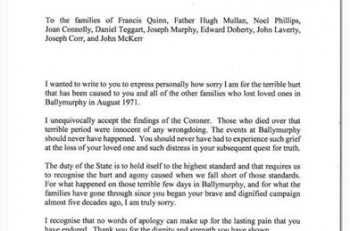
By Christopher Stanley, Litigation Consultant, KRW LAW LLP, Belfast* [i] In the last six months victims of violent abuse in Ireland have been ‘granted’ apologies. First, the Irish Taoiseach apologized to the victims and survivors of the Mother and Baby Homes. Writing in The Independent on 14 January 2021 Emer O’Toole noted: “On Wednesday, the Irish Taoiseach issued an apology to survivors, saying, rightfully, that “the shame was not theirs; it was ours”. While this state apology is important, the Taoiseach’s speech historicises the lack of respect for the dignity and rights of survivors. This trend continues across Irish political discourse, where emphasis is on closing a dark chapter in Ireland’s history. But survivors of Mother and Baby Homes and Irish adopted people are still not being listened to. They are still being denied their rights.” Second, the British Prime Minister apologized to the relatives of the victims of the Ballymurphy Massacre 1971 in which British troops shot and killed 11 civilians. Writing in The Irish Times on 25 May 2021 Sarah Burns reported that the families of the victims described the apology as “feeble and insincere”. It is widely believed, at least by the media and victims, survivors and relatives, that these apologies were hollow, weasel words, granted too late, absent of understanding, integrity or meaning. Words mouthed by politicians to an empty audience, as a gesture of apparent humility, amounting to nothing save for a ritual of vacant contrition. In terms of the violent legacy of systemic institutional abuse in Ireland (South and North) and the violent legacy of the Conflict (North and South) the apology for historic actions and inactions, acts and omissions, collusion and complicity and impunity by the State, is part of the State-sponsored system/process of Truth and Reconciliation. A societal Truth and Reconciliation process is an aspect of ‘moving on’ from the scene of violent incursion and of suturing a social wound so that such violations and breaches (of the social contract, of human rights) cannot be repeated. We Promise. Trust Us – we apologized to you. Truth and Reconciliation: Soft (Transitional) Justice. If there is a right to truth it must be a right to know why. Why was my body broken? Why was my baby forcibly removed? Why was my mammy shot by a British soldier? Why was my husband executed by the British state? This is not a Soft Right but rather it is a Hard Truth for those responsible, for those being held. “But it did not happen on my watch” says the Politician, the Civil Servant, the Bishop, the General. Therefore, the words of apology fall upon deaf ears. I reject your apology. I cannot forgive you. Is this wrong? Does it make the victim lesser than the abuser? [ii] The Oxford Reference website entry for the word ressentiment is as follows: “A vengeful, petty-minded state of being that does not so much want what others have (although that is partly it) as want others to not have what they have. The term, which might be translated as ‘resentment’, though in most places it is generally left in the original French, is usually associated with German philosopher Friedrich Nietzsche, who defined it as a slave morality. Nietzsche sees ressentiment as the core of Christian and Judaic thought and, consequently, the central facet of western thought more generally. In this context, ressentiment is more fully defined as the desire to live a pious existence and thereby position oneself to judge others, apportion blame, and determine responsibility.” (Ressentiment – Oxford Reference last accessed 11 June 2021) In psychological terms ressentiment is a profound sense of resentment, frustration, and hostility directed at that which one identifies as the cause of one’s frustration, generated by a sense of weakness/inferiority and feelings of jealousy/envy in the face of the ’cause’, that ultimately generates a rejecting/justifying ‘value system’ or morality that exists as a means of attacking or denying the perceived source of one’s own sense of inferiority. (Ressentiment last accessed 14 June 2021) Ressentiment is not resentment but rather a philosophical, ideological and psychological condition. It is the suffering of not understanding, the suffering of being located within a victim-hierarchy, and the suffering of not being able to forgive because of perceived self-weakness because I suffered. [iii] In the jurisprudence on the definition of torture (upon which there is an absolute prohibition) there is an important distinction between torture and inhuman and degrading treatment because of the stigma attached to torture. The victim of torture becomes stigmatized or scapegoated because they are the victim of torture. The victim of torture cannot escape the scar imposed upon them and the violence inscribed upon their flesh. [iv] Kafka describes the infliction of punishment as the crime is inscribed upon the flesh of the body of the condemned in his short story In The Penal Colony: “Yes, the Harrow,” said the Officer. “The name fits. The needles are arranged as in a harrow, and the whole thing is driven like a harrow, although it stays in one place and is, in principle, much more artistic. You will understand in a moment. The condemned is laid out here on the Bed. First, I will describe the apparatus and only then let the procedure go to work. That way you will be able to follow it better. Also, a sprocket in the Inscriber is excessively worn. It really squeaks. When it is in motion one can hardly make oneself understood. Unfortunately, replacement parts are difficult to come by in this place. So, here is the Bed, as I said. The whole thing is completely covered with a layer of cotton wool, the purpose of which you will find out in a moment. The condemned man is laid out on his stomach on the cotton wool—naked, of course. There are straps for the hands here, for the feet here, and for the throat here, to tie him in securely. At the head of the Bed here, where the man, as I have mentioned, first lies face down, is this small protruding lump of felt, which can … Continue reading I reject your apology. I cannot forgive you
Copy and paste this URL into your WordPress site to embed
Copy and paste this code into your site to embed