• Posted in:

    Shame us, Séamus (or at least say something genuine)

    When I was a young man, I managed various used and rare book stores for a company based in Washington DC. As part of this book ‘empire’, we leased a large warehouse across the Potomac River in Arlington, VA. It comprised several cavernous rooms. In one of these rooms stood a veritable Everest of books. Further, the entire heap comprised a single title – undustjacketed, misbound and/or damaged US editions of Seamus Heaney’s Poems 1965-1975. Ironically, close by squatted a larger mound of equally misshapen copies of a later printing of the Complete Poems of Robert Frost. To recoup some of his loss, an unscrupulous binder, rather than honouring his contract and pulping the volumes, had sold them to us for a price that would importune a covert cash payment. Kevin Kiely’s bluntly titled, Seamus Heaney and the Great Poetry Hoax, (Areopagitica Publishing, 2018), opens with a comparative appraisal of these two milk bucket obsessed northern agrarians, Frost and Heaney. Kiely focuses on Heaney but neither poet is to his taste. He finds Heaney’s incessant reliance on rural themes disingenuous and out of touch. Certainly, Kiely has a point. What else but nostalgia and bathos could steer anointment and garlanding of the award-winning poet by ensconced academics, wealthy potentates and entertainers who writes lyrics which extol the virtues of peat and cow shit? As Kiely so admirably and doggedly points out, as a consequence, there is nothing honest in Heaney’s work. I think we can agree that Ezra Pound, though for the most part a fine judge of poetry, was a spotty judge of character. Though he called his birthplace of Hailey, Idaho, half savage Pound initially misconstrued Robert Frost’s New England Yankee ‘plain speak’, an intrinsic characteristic of Frost’s work, as providing some sort of spare, down-on-the-farm expression of the American ethos when in reality it was just a faux homespun ‘higher hokum’. Yet I and, in his lukewarm assessment of Frost, Kiely would agree that the folksy American’s snake oil and illusory tales are more genuine than Heaney’s. This even though Frost was little more than a gentleman farmer and Heaney was, at least at one time, a genuine farm boy. If, as Kiely states, and I concur, Frost’s fancies ring truer than Heaney’s what does that say about Heaney’s oeuvre generally? In Heaney’s infinitely tired reprises of farm life – the damp, the smells, the stoic heroism, the sentimentality – one hears faintly the same sort of bombast one gets from America’s ‘Good Gray Poet’, Walt Whitman, who most certainly lived in a country that never existed and never will. If it’s not naïvete, both Whitman’s and Heaney’s approaches manifest sheer cunning. Kiely is correct and, given Heaney’s stature, courageous to tilt at Heaney’s legacy. Whitman was constrained sexually by the very culture he bloviated about. Thus his product was a cry for acceptance which he somehow thought he could gain by pandering to the existing order. And to a frightening degree, it worked – for all the wrong, nationalistic, jingoistic reasons. As Kiely does, let’s assess one of Heaney’s most famous lines from one of his most read and ‘beloved’ poems, Digging. Heaney writes: “Between my finger and my thumb The squat pen rests. I’ll dig with it”. The poem has about it a lassitude as though Heaney himself had grown tired of his subject matter. He opens with a wholly inept and personally disingenuous image which compares two wholly different utile appendages, a pen and a spade — reworking Bulwer-Lytton’s famous quote of pens/swords. Then, after a 22-line instructional on how to use a spade, he resorts to the murky bathos of comparing his pen to that shovel. Kiely, by now frustrated with Heaney’s metaphorical fuzziness, queries “how much earth can you dig with a pen”? But it’s worse. At first, though still painfully sentimental, the shovel-incised blocks of bog, of dead (yet organic) matter, serve the living by providing heat and fertiliser. But what is the bog? History? Tradition? Heaney’s mind may have done some digging. But his pen can only record the process. Within reason and art, the pen does not do the digging. And Heaney is no André Breton, no surrealist, as Kiely points out, so the mental image flounders and flops. Kiely trounces Heaney’s stances on Irish history, international politics, Nobel, institutional pandering and how these factors influenced his poetry. Kiely demonstrates that to avoid the convulsions Ireland faced, especially from 1968 to 1988, Heaney, more often than was tolerable, wrote nostalgia about farm life or buried his poems’ relevance in a miasma of prehistory. Heaney’s stance reminds one of Yeats’ position on Northern Ireland before the Easter Rising. Though Yeats continued to generally support non-violent solutions, he was shattered by the brutal treatment at the hands of the British inflicted on the Irish nationalists as evidenced in his superb poem Easter, 1916. However, Yeats solution of a non-violent literary rebellion with nostalgic Celtic roots reminiscent of Heaney’s bathos, smacks of wishful thinking. As is well known, the far more pragmatic James Joyce would dub Yeats’ and Lady Gregory’s Celtic Twilight the ‘Cultic Twallette’ in his masterpiece, Finnegans Wake. Further, as an individual living the bloody hypocrisy of American foreign policy, I’m certain that palling around with a war criminal like Bill Clinton, as Heaney did, does not speak well of one’s character. And, Seamus, the same went for the Nobel, which the poet Ed Dorn referred to as the Dynamite Prize. The Nobel was in recent years given to yet another American mass murderer and apologist for the very Wall Street that bankrupted Ireland, Barack Obama. And there is some foul whiff that our current golden-domed Baboon-in-Chief should be foisted with Stockholm’s much tarnished award. Kiely also points up another insidious influence on Healey’s ascendance from ‘the Land of the Fee and the Home of the Knave’ — literary critics Harold Bloom and Helen Vendler. It’s bad enough that across the pond, these two old literary fossils have erred so much toward the ‘I’ centered, solipsistic lyric that our current poetic product has all the

    Loading

    Read more

  • Posted in:

    Ireland, Italy and the Disclosures Tribunal

    Leonardo Sciascia was an Italian political journalist, an elected radical member of parliament and the most prominent anti-mafia critic. All of this features in his famous detective novels which are in fact anti-detective novels or works of political observation. Coupled with his masterly analysis of the assassination by the Red Brigade of the Christian Democrat conciliator and former Prime Minister Aldo Moro they amount to a sustained critique of Italian and Sicilian political and cultural life. They reflect the complex interstices of corruption and collusion between extreme-right-wing Catholicism, organised crime and the shadowy self-protection syndicates of big business, politics, a malevolent state bureaucracy and crime. His books show the lethal effects of innuendo, smoke, mirrors and sighs, the nefarious rumour mill, shadows. Sciascia was a specialist in the mafia and he demonstrated how they kill and destroy. First they isolate, disempower and then denigrate. They in effect demonise their prey. And those who seek to investigate them, such as Judge Giovanni Falcone, who act on principle are destroyed in the process. This is exquisitely detailed in ‘Equal Danger’, his best book. In Sciascia’s fiction, it is the detective, not the murderer, who is isolated and suspected. Ironically in the end Sciascia attacked the crusading judges as putting civil rights at stake in an article, when he was dying, that irredeemably punctured his reputation, by attacking Falcone as a celebrity judge. This is deeply relevant to Ireland. Our mafia are our corrupt politicians, bankers and lawyers and the toxic relationship of our shadow state of governance between the police and the justice department. Those who challenge corruption or blow the whistle are reputationally destroyed, personally attacked, framed, driven to self-destruction or simply disposed of. Ireland is Italy and “equal danger” a cautionary text. The smearing of the state knows no boundaries and frequent collusion with Tulsa a criminal conspiracy maintained by many lawyers who should be disbarred. Another Sciascia theme, particularly evident in his most famous text, ‘The day of the Owl’ is the Sicilian trait of anomie or indifference. A shrug of the shoulders. It is what it is. Life moves on. Principle, justice and the truth are a waste of time. In controlled societies such as Ireland and Italy Sciascia’s books show the lethal effects of innuendo, smoke, mirrors and sighs, the nefarious rumour mill, shadows, in Italy trivialisation amounts to a resigned admission that the victims of crime had it coming to them in some obscure way. It betrays a desire for yourself not to go the same way. Being principled in an unprincipled society is very difficult. We know more than 10 black sacks of shredding left the office of the Commissioner under the supervision of a superintendent who has given evidence twice already to the Tribunal. The phone of the two past heads of national intelligence, Callinan and Ms. O’Sullivan are gone…vanished, destroyed. Yet no issue of the destruction of crucial evidence seems to be of concern to the Tribunal. It was the husband of the former Commissioner O’Sullivan who was appointed to take charge of the investigation into Superintendent Taylor. The phone of the Superintendent was taken but that crucial evidence too is lost. It seems to be simply a matter of no consequence. A judge whose orientation in private practice was prosecutorial and who, on the bench, has been somewhat indulgent of changes to evidential exclusionary rules to the advantage of fact-gathering gardaí, risks steering a Tribunal away from the glaringly obvious criminality of the highest level of the Department of Justice and the police. Moreover Maurice McCabe is represented at the Tribunal by former Minister for Justice Michael McDowell SC, a long-time and visceral political defender of the police and law and order. If I were McCabe I would contemplate refreshing my legal representation and wonder how the now ascendant narrative is that a cock-up rather than obvious state criminality smeared him. He should dwell on whether it was in fact appropriate for him to concede that the evidence established that the inclusion of the false allegation against him of rape in the 2013 Tusla report “was some form of cut and paste error”, and that the error was not the result of any deliberate action or ill will. And he should consider how the damning evidence of the press secretary Dave Taylor was not addressed first, as the Tribunal’s first module, as dictated by the terms of reference; and how the sequence of modules was altered so the less clearcut Tusla model was heard first. Instead the Tribunal opened with an arbitrarily selected series of smokescreen narratives implying a cock-up by Tulsa, and culpability for outlying zealot Callinan perhaps. Noel Waters, former Secretary General of the Department of Justice, has suffered from amnesia. In his evidence to the Tribunal he declared he could not remember, on nearly 50 occasions. Most damningly, he spoke to Nóirín O’Sullivan at a crucial moment during the O’Higgins Commission which in 2015 was looking at allegations of poor policing in Cavan/ Monaghan made by Sergeant McCabe, phone records indicate. However, neither Waters nor O’Sullivan can remember the 14-minute call on May 15, 2015. The crucial moment was when O’Sullivan’s lawyers were asked by the commission to confirm that they had been instructed to attack Sergeant McCabe’s motivation, and the commission adjourned briefly so that she could be contacted. The Tribunal had previously heard that O’Sullivan “sought time to speak to the Department of Justice” before confirming her original instructions. The Department has maintained neither it nor then Minister for Justice Frances Fitzgerald had prior knowledge of, or input into, the legal strategy. Waters said he could not remember the call, and insisted the Department had played no role in the strategy. When it was put to him by Tribunal counsel, Diarmaid McGuinness SC, that it was reasonable to assume he and O’Sullivan discussed what was occurring at O’Higgins that day, Waters replied: “I have to say in response that I have no recollection of that at all”.

    Loading

    Read more

  • Posted in:

    Punker

    “Things can only get better”, went the lyrics to the hit by D:Ream which became the anthem of the incoming New Labour government in 1997, fronted by the relentlessly upbeat Tony Blair. Six years later, Blair joined the US in its illegal invasion of Iraq, a move that plunged the entire Middle East into a new era of violent instability and a refugee crisis that today, some 15 years later, shows little signs of abating. Things, it turns out, can also get worse. Statistics can, however, be schooled into presenting a beguilingly different picture of the true state of the world, and the darling of global optimism, psychologist and author Steven Pinker is a skilful inquisitor of data. His scholarship seems to have caught the zeitgeist of the latest wave of techno-optimism, and his data-fuelled Panglossian creed is being enthusiastically embraced by global influencers like billionaire Bill Gates. So excited were the editors of Time magazine that in January, for the first time in its more than 90-year history, it invited Gates to be guest editor of an edition, titled ‘The Optimists’. His editorial was essentially a re-heat of Pinker’s tome, ‘Enlightenment Now’, which, Gates gushed, was his “new favorite book of all time” and “the most inspiring book I’ve ever read”. High praise indeed. Gates’ benediction no doubt helped Pinker’s tome to become a runaway bestseller. What got the Microsoft über-nerd so excited is that: “this is not some naively optimistic view; it’s backed by data”. And Pinker cites data by the chartload, much of it undoubtedly painting an accurate picture of one species doing remarkably well. Life expectancy is a case in point. In just the last 28 years, the number of children dying before their fifth birthday has halved. Women’s and LGBT rights have made remarkable, if uneven, advances in recent decades. Fewer people are living in absolute poverty. Child labour, slavery and sexual abuse have not been eradicated globally but all indicators point towards major progress for millions of people. Catastrophic famines are rarer now; more people now live in democracies (Trump’s populism notwithstanding) than in all of human history and, while there are hundreds of deadly local and regional conflicts around the world, there are, mercifully, no full-scale wars between countries. Were an 18th or 19th century European to survey the region today, they would be astonished to find that the perpetually warring great powers – France, Italy, Spain, Germany, the Netherlands and Britain – have enjoyed more than 75 years of peace, co-operation and prosperity, with just occasional insults now being hurled at one another, where until quite recently, disputes were routinely settled with bloodbaths and pogroms. So, all’s well with the world, it seems. Another contributor to the Time special edition was the estimable investor and billionaire Warren Buffett. He waxed about the astonishing economic progress that swept across the US in the 20th century. No argument there. “The game of economic miracles is in its early innings. Americans will benefit from far more and better ‘stuff’ in the future”, he opined. At this point, it’s time to take a deep breath and a sharp step backwards. How can such heavy-hitters as Pinker, Gates and Buffett have possibly discounted or ignored the ecological train-wreck hurtling ever closer towards humanity? Pinker’s book does indeed grapple – after a fashion – with environmental limits, but it’s hardly encouraging that someone who prides himself on offering numeracy as the cure for biases then launches – unprovoked – into a biased jeremiad against the “quasi-religious ideology” that is what he disparagingly terms “greenism”. For someone regarded as among the world’s great thinkers, this is dull fare indeed. Undeterred, Pinker lashes out at this “apocalyptic creed” which he finds to be “laced with misanthropy”. Quite why it was necessary for Pinker to denigrate environmentalism becomes clear as the narrative unfolds. The vehemence of his anti-environmental rhetoric is in inverse ratio to his ability to address the profound critiques of his beloved ‘progress’ posed by the findings of climate and environmental sciences. He points out – correctly – that as countries get richer, they usually clean up their own rivers and ease local pollution. The fact that rich countries simply outsource much of their dirty heavy industries and ship their wastes to the ‘developing’ world is glossed over. Climate change of course does not respect national borders; faced with the quite over-whelming evidence from the physical sciences (and he frequently claims to be an advocate for science), Pinker baulks at what he dismissively calls the “tragic” view that humanity may well destroy both industrial civilisation and itself in the process. Pinker concedes: “humanity has never faced a problem” like climate change. Rather than ponder this existential threat, he instead brandishes the magic wand of eco-modernism and waves away the gloomy ‘eco- pessimism’ he and his billionaire fan club find so objectionable. He points out that global carbon intensity has been static or declining slightly in recent years. The atmosphere is, however, indifferent to such subtle points. All that matters are the gross numbers, and these continue to climb inexorably. Science tells us we have a finite and rapidly reducing global ‘carbon budget’. The only way of avoiding irreversibly smashing through this budget in the next 10-20 years is drastic, compulsory, permanent and deeply unpleasant cuts in carbon, starting yesterday. Per capita, the greatest carbon polluters on the planet are the global elite, billionaires like Gates and fellow Microsoft founder, Paul Allen. The latter maintains three very large ocean-going yachts at all times, so that one is always fully staffed and equipped close to wherever in the world he might happen to jet. That’s an awful lot of carbon to have to forego. The eight richest billionaires control as much wealth as the world’s poorest 3.7 billion people. Imagine then how pleased Gates will have been to read Pinker’s pronouncement that staggering and increasing wealth inequality is really not that big a deal. In common with Trump, Pinker also tries to blame the media for stoking “irrational pessimism” about the state of the world. I have long argued the opposite:

    Loading

    Read more

  • Posted in:

    ‘Reclaiming the State – a Progressive Vision of Sovereignty for a Post-Neoliberal World’

    ‘Reclaiming the State – a Progressive Vision of Sovereignty for a Post-Neoliberal World’ is the title of what will surely come to be seen as one of the more important social science works of our time (Pluto Press, 2017, €23). In it Australian economics professor William Mitchell and Italian political theorist Thomas Fazi reconceptualise the Nation State as a vehicle for progressive change. They issue a highly topical challenge to progressives, leftwingers and genuine liberals to come to the defence of national sovereignty and not cede that issue to the populist right. For the thirty years from the end of World War 2 to the 1970s a left-oriented Keynesian consensus held sway in the developed world. Then, for reasons this book describes, the mainstream Left as represented by the mass Labour and Social Democrat parties in Britain, France, Germany and elsewhere, and by the Democrats in the USA, ideologically disarmed themselves before rampant neoliberalism. Key neoliberal propositions were that national sovereignty had become irrelevant in today’s increasingly complex and interdependent international economy. Globalisation had made individual States increasingly powerless in face of market forces. The growth of multinational companies and the internationalisation of finance had eroded the ability of national States to pursue progressive social and economic policies and deliver prosperity for their peoples. Consequently the only hope of meaningful change was to “pool” State sovereignty and transfer it to supranational institutions such as the European Union, thereby regaining at supranational level the sovereignty that has been lost at the national level. Many who regarded themselves as progressive and on the Left came to share these views, stressing how neoliberalism has involved a retreat or a hollowing-out of the State, which found itself increasingly powerless in face of market forces. To cover their abandonment of criticism of capitalism as a social system, progressives and Left parties generally focused instead on issues such as racism, gender, homophobia, multiculturalism and environmentalism – social marginality being no longer described and opposed in terms of class but rather in terms of identity. This book analyses the political timidity, ideological opportunism and intellectual fallacies involved in this surrender. For example the decades of neoliberalism have seen little or no decline in State spending as a percentage of GDP – a key measure of the strength of the State in society. Even supposedly neoliberal governments such as Reagan’s or Thatcher’s did not reduce overall public spending, although they altered its composition, for example spending more on weaponry and less on welfare. As the authors point out, “even though neoliberalism as an ideology springs from a desire to curtail the State’s role, neoliberalism as political-economic practice has produced increasingly powerful interventionist regimes.” Neoliberalism has entailed extensive and permanent intervention by States and their Governments: for example the liberalization of goods and capital markets, the privatization of resources and public services, deregulation of finance, the reduction of workers’ rights in collective bargaining, cuts to social programmes and the lowering of taxes on wealth and capital at the expense of the middle and working classes. The authors show how neoliberal ideology, in its official anti-State guise, has been little more than a convenient alibi for what has been an essentially political and State-driven project aimed at placing the commanding heights of economic policy in the hands of capital and especially Finance Capital. Far from neoliberal globalisation making the Nation State out of date, all its key elements were the result of choices deliberately and consciously made by national governments as their ruling elites set out to limit State sovereign rights. The authors call this a process of “depoliticisation” of policy. Its principal elements were: the reduction of the power of parliaments via-a-vis the executive; making central banks formally independent of government; adopting constitutional limits on debt-to-GDP ratios and public spending, as with the 2012 Stability treaty, thereby limiting what politicians can do at the behest of their voters; enforcing free movement of goods and capital, and, above, all shifting government powers from the national level to the supranational. Why did national politicians choose to ‘tie their hands’ in this way ? As the EU case epitomises, the creation of these self-imposed ‘external constraints’ allowed national politicians to reduce the political costs to themselves of neoliberal policies that were generally unpopular. It enabled them to ‘scapegoat’ these externally imposed rules and supranational and ‘independent’ institutions. These could be publicly presented as an inevitable outcome of the new harsh realities of globalisation, about which supposedly little or nothing could be done at national level. In this way national government choices and State macroeconomic policies were insulated from popular criticism and protest. Mitchell and Fazi contend that the war on sovereignty has been in essence a war on democracy. This process was brought to its most extreme in Europe where the 1992 Maastricht Treaty that created the euro-currency embedded neoliberalism into the EU’s very fabric, effectively outlawing in supranational EU law the Keynesian policies that had been commonplace in the previous decades. Given neoliberalism’s war against State sovereignty it is only natural that the revolt against neoliberalism should first and foremost take the form of demands for a ‘repoliticisation’ of national decision-making processes – that is, for more democratic control over politics and particularly over the destructive effects of the free movement of capital, goods and labour unleashed by neoliberalism. This necessarily can only be done at the national level by means of the national State in the absence of effective supranational mechanisms of representation. The latter are impossible to bring into being as long as people’s primary political identification is with their own nationality and State. Supranational structures will always lack democratic legitimacy because people do not identify with them as their own. The case of Iceland shows what even a tiny country can do when it used its State sovereignty, an independent currency, capital controls and sequestration of its banks to overcome an extreme economic crisis. The authors argue that progressives and the political Left should not regard Brexit –

    Loading

    Read more

  • Posted in:

    Cometh the hour

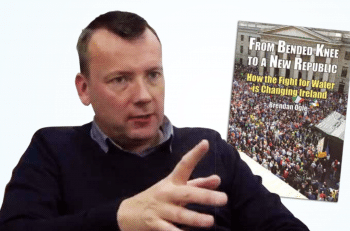
    ‘From Bended knee to a New Republic: How the fight for water is changing Ireland’ by Brendan Ogle, promises in its opening pages to take us on a journey “through the travails of a nation broken, sold and left in penury”. Ogle, unlike the many politicians and political parties he describes, fulfils this promise. The book brings you on a fascinating, inspiring, informative, and thoughtful journey through inequality in Ireland and “a nation’s fightback against it”. It should be clear from this that the book, just like the protest movement itself, is about much more than water. It comprehensively answers the question that many have asked: why was water the “issue that Irish people would take their first and biggest real stand against austerity?”. Ogle is the Education, Politics and Development organiser for the Unite trade union in Ireland and one of the founders of the Right2Water and Right2Change campaigns. The first quarter of the book provides detailed analysis of the political, economic, and social circumstances that gave rise to the Irish water protests which are “the biggest (per capita) and most peaceful protest movement for social change anywhere in the world”. These include the global water privatisation agenda, austerity, poverty and the health and housing crises. Neoliberalism is explored before an analysis of the self-evisceration of social democracy through Tony Blair’s ‘third way’ acceptance and implementation of neoliberalism, and its adoption by the Irish Labour Party. He suggests the Labour Party has become an “obstacle to progress toward a more equal Ireland, and is in fact an enabler of neoliberal inequality”. Ogle spends the rest of the book describing how the Right2Water campaign was organised and the challenges it faced in becoming a mass movement. He recounts how he and Dave Gibney, the other main organiser in Right2Water, withstood difficult negotiations with local communities who had been let down by trade unions in the past but had started this new movement in order to build trust and a strong working partnership with them. He writes about how ‘civil society’ organisations failed to offer much support to the movement. He describes the constant work required to build unity amongst the fractious left-wing parties that make up the ‘political pillar’ of the movement. We can read how he and others in the water movement which “could so easily have been just another failed campaign in a failed Republic”, actually developed the most successful mass-protest movement in modern Irish history. It is, therefore, an essential read for those looking to understand not just how and why the water movement developed in Ireland but for those seeking lessons of how to build successful social movements. A central purpose of the book is to set out the origins and purpose of the water movement, and to tell the story of the water activists, which, as Ogle rightly says, you won’t read about in the media or many other places. The book provides an important contribution to documenting Ireland’s recent socio-political history and geography, particularly the excluded voices and views in society which are too often ignored. The book documents how the movement was built from the grassroots up in working class communities like Edenmore in Coolock in Dublin and by “wonderful people” from all over Ireland “who were determined to make a difference”. It tells the inspiring story of water activists such as Karen Doyle, a “housewife and mother who also works part-time outside the home” from ‘Cobh says No’. She got involved in the water charges movement and formed one of the hundreds of ‘meter watch’ groups, which were the heart of the movement across the country, to obstruct water meters being installed. It is from such actions that a broader social movement was born. Ogle writes: “every week-day morning someone would rise about 4.00 to 5.00 am and find where the meter contractor vans were heading. Text alerts were sent so that by the time the vans arrived people like Karen were at estate entrances to protest. A caravan and trailer were procured and soup, tea and coffee produced every day for sustenance. Margaret Thatcher would have hated it. Society! People came from their homes, their individual isolated bolt holes, to start sharing stories about where it had all gone wrong, how their lives had been impacted by the breaking of a nation, which gave them the strength, the determination, to do something about it”. These groups, according to Ogle, faced problems from “some on the ultra-left” who saw the local groups “as a vehicle for advancing their own agenda, viewing people like Karen as potential recruits”. He describes how “people who got involved in a campaign out of genuine concern for their community and their country”, were hurt as they found themselves “the focal of bitter and personalised attacks”. He notes that in the past “many have walked away from the campaigns, surrendering them to the dogmatic ultra-left and the inevitable failure to deliver on their promise”. But not this time. Karen and many other community activists like her continued on and developed their own spaces and confidence to keep building a broad and inclusive movement. important in this was the support given by the Right2Water trade unions, and Unite in particular through its political economy education. It ran nine free ‘political economy’ courses for 150 ‘non-aligned’ community activists “with the objective of giving activists who were central to the growing water movement access to the type of information that would enable them to understand the political economic agenda behind water privatisation”. This was a very innovative approach which provided an important longer term empowering aspect to the movement. Ogle writes how “through the training we not only helped them connect with each other on a national level but showed how the tax and privatisation agenda are global issues…giving renewed energy as to how to challenge the neoliberal consensus”. Ogle persuasively tackles the critiques of the water movement in relation to water conservation. He highlights how people in the UK, which has

    Loading

    Read more

  • Posted in:

    Haughey cleaned up his own mess

    The author is a senior lecturer in the department of Modern History at Liverpool’s hope University. He has carefully mined the available documentary sources to produce a book that covers Haughey’s, much disputed disposition and policy instincts on Northern Ireland. Given the longevity and impact of Haughey’s career this, by definition, involves a painstaking trawl through a variety of sources. His cautious conclusion is that “Northern Ireland, it seems, was only one of a handful of issues to which Haughey left a positive legacy”. However, even this tentative conclusion is set against the view of the haughey critics who saw his actions as opportunistic and maladroit. The Arms Trial is of course the defining event in Haughey’s career. Stephen Kelly goes a great distance to establish that Haughey was, however unwittingly, the person who most facilitated the emergence of the Provisional IRA as a terrorist organisation in the years that followed from the upsurge of violence in Northern Ireland following the events of 1969. He states that Haughey’s “subversive involvement in the distribution of monies, guns and ammunitions” indirectly facilitated the yet to fully emerge Provisional IRA. The only issue I can see with this line of argument is that it suggests that Haughey was in fact subversive when in fact most of the testimony, research and evidence suggests that the arms importation was part of a fully authorised, albeit covert, operation of state. There is little or no doubt, at this remove of time, that Haughey was part of a plot to import arms for nationalists in Northern Ireland and that this operation was initiated at the highest levels of government and was supervised, quite deliberately, by army intelligence as opposed to that other security arm of the state the Special Branch. The lack of co-ordination between the two agencies meant the importation was badly managed. Kelly appears to give credence to the line, pursued by the Jack Lynch faction, in the wake of the Arms Trial, that Blaney and Haughey were in effect usurping their mandate from government and foisting their own policy on Northern Ireland. The problem in sustaining this argument is firstly the actual jury verdict in the trial which concluded that the accused persons did have a government mandate for their action. The second difficult issue is the copious evidence from military intelligence officers that the operation was run with the active involvement of a variety of ministers including the Minister for Defence. Stephen Kelly does well when covering Haughey’s subsequent efforts, when in power as Taoiseach, to develop policy on Northern Ireland and the famous early summit with Mrs Thatcher. His mishandling of Mrs Thatcher over the Falklands war and its consequences for Anglo-Irish relations is well covered. This book also gives a valuable insight into Haughey’s early approval of contact between Fianna Fáil and Sinn Fáin as well as the careful cultivation of Fr Alex Reid, the Redemptorist priest, who became a crucial interlocutor in what has become known as the peace process and the ending, by way of formal ceasefire, of the IRA’s campaign of violence. In may 1987 Haughey, who had become Taoiseach, was presented with a 15-page letter from Fr Reid. The contents of the letter were groundbreaking. Contained within were the terms of a proposed IRA ceasefire, seven years before the end of hostilities in August 1994. Apart from his secret dealings with republicans, it was also Haughey who first won concessions from John Major, Margaret Thatcher’s successor as prime minister, on Northern Ireland. In December 1991, following three years of discussions between Adams and Hume, Haughey presented Major with a draft of a model joint British-Irish government declaration, known as ‘Draft 2’ which would later become the ‘Downing street Declaration’. Stephen Kelly has set himself a hard task. John Bowman produced his definitive De Valera and the Ulster Question, 1917-1973 with the benefit of a PhD thesis and a lifetime of topical interviews with some of the key people through his work as a broadcaster before he produced his book. Kelly has produced something that will be of great value to others who may wish to write full biographies of haughey in the future. A book yet to come from Vincent Browne is much anticipated. My only other quibble with stephen Kelly is his claim in a footnote that my biography ‘Haughey – Prince of Power’ is a hagiographical work. I might humbly suggest he re-read the book. Perhaps the best part of this book is its description of the build up to and the contents of Haughey’s ground breaking summit with Mrs Thatcher in December 1980. Stephen Kelly rightly gives the credit on the British side to two senior Whitehall mandarins namely Sir Robert Armstrong and Sir Kenneth Stowe. Persuaded by Haughey’s persistence in demanding that there be an Irish or Dublin role in relation to the North, and a personal belief on Armstrong’s part that a united Ireland was inevitable, the two civil servants shifted Thatcher on this issue. This is rightly attributed to be the beginning of a series of agreements that brought both Dublin and London closer together. My father was hugely energised by the Dublin Castle meeting and told me afterwards, on the basis of conversations with Armstrong, that the British had given up the ghost on staying on in Ireland. The process begun at Dublin Castle was a move towards a joint British-Irish stewardship of the Northern Ireland issue. ‘A Failed Political entity – Charles Haughey and the Northern Ireland Question 1945-1992’ by Stephen Kelly is available from Merrion Press. Conor Lenihan

    Loading

    Read more

  • Posted in:

    Paean to culturally rich, politically limited patriots

    The paperback version of ‘Handbook of the Irish Revival’ was recently launched at Notre Dame’s O’Connell House, to coincide with their St Patrick’s day festivities and, of course, the commemoration of the 1916 Rising. The volume, an anthology of Irish Cultural and Political Writings 1891-1922, is beautifully produced by Abbey Theatre Press with the look and feel of a hardback though it is very reasonably priced at just €15. As the Abbey director-turned publisher, Fiach Mac Conghail, reveals in his introduction, the book arose from the ‘Theatre of Memory’ Symposium in 2014. During the concluding session Declan Kiberd lamented the fact that so few of the original writings of the Irish Revival were readily accessible. It’s to Mac Conghail’s enduring credit that he rose to the challenge by facilitating Kiberd and his co-editor PJ Mathews. Kiberd, though not a professional historian, has emerged as one of the most authoritative voices on the 1916 Rising, providing us with the clearest insights into the complex and sometimes confused intellectual world of the revolutionaries. He has always contended that for Romantics like Pearse and MacDonagh, both keenly interested in English literature, the Rising was a piece of theatre that could only end in their own deaths. Pearse who was described by one of his admirers as a “bit of a pose” may have been comfortable with the bizarre pageantry of the GPO, but he lacked the skills of a military commander. A prolific writer in both English and Irish, he features regularly in the anthology. It’s a digest of essays and articles, pamphlets, songs and poetry – most of them no more than two pages long – from the great names such as Yeats, Synge, Joyce and some of the lesser known but also influential. Each of the chapters is accompanied by an introduction in much larger font. Indeed, the overall design of the book makes it very appealing. No sooner have you read one chapter than you immediately want more. It’s a book for the serious academic or the ordinary punter who wishes to dip into writings of the period to get a avour of the zeitgeist. As you read it you get the sense, as the introduction states, that these were men and women who “lived intensely in the present moment; took ideas more seriously than their own careers; and contributed brilliantly to debate”. That selflessness, brilliance and intensity is perhaps best reflected in the writings of Connolly, whose prose can hardly contain his obvious passion. Take for an example this sentence from his 1897 essay ‘Erin’s Hope’: “Recognise the right of all to an equal opportunity to develop to their fullest capacity all the powers and capabilities inherent in them by guaranteeing to all our countrymen and women, the weak as well as the strong, the simple as well as the cunning, the honest equally with the unscrupulous, the fullest, and most abundant human life intelligently-organised society can confer upon any of its members”. What it lacks in Orwellian precision it makes up for it in its obvious fervour. This passage is taken from the chapter entitled ‘Militarism and Modernism’ whose introduction identifies the reason for the cultural and political malaise that would soon envelop the new state. “Militarism began to trump modernism”, the authors observe- the men of the the Rising, war of independence and the civil war were better suited to military affairs then forging a modern democratic state: “Mass suffrage came to many areas but soon declined into mere electoralism, as political leaders whose consciousness had been formed more through soldiering than through cultural action, offered ever more dogmatic, ever less thoughtful analyses”. It is easy to ‘idealise the idealists’ at this remove, but it would be foolish to forget that our new State was governed for its first fifty years by the men – the women were written out – of 1916. Socially and economically our new state was illiberal and stagnant, a failed state dominated by the Catholic church. So while this book shows that those who inspired the Rising may have been enlightened, it could also be argued that they were in many ways obstructions to progress. The new State was patriarchal, consigning women to the home and discriminating against them in the workplace. It must have been a disappointment to the women who had campaigned for universal suffrage such as Eva Gore Booth. In her poem ‘Women’s Rights’ from 1906 she portrays male dominance as contravening the natural order: Men have got their towers and walls, We have cliffs and waterfalls. Oh, whatever men may do, Ours is the gold air and the blue. Men have got their pomp and pride – All the green world is on our side’. The new State’s attitude to the Rising has been at times ambivalent. We have moved swiftly from commemoration to revisionism back to celebration. We have also moved from isolated nationalism to become the most globalised country in the world, without pausing for breath or even adequate reflection. The transformation has been staggering. Ireland, the country that its citizens wanted to leave, and whose citizens emigrated in droves, is now a favoured destination for migrants. From the end of the Second World War up the start of the 1960s we were the only state in Europe that experienced population decline. Now one in eight people is a non-national in a population that has grown steadily. This new Ireland is closer to Boston than Berlin and has, as perhaps might be expected, even turned its back on some British virtues. The British tried with some success to introduce a system of planning for urban and rural areas. One only has to contrast the British countryside with its beautifully planned towns and villages with the free-for-all in Ireland, to know that independence embraces the freedom to make a mess of things. And though there are many who wouldn’t change a thing, this strain of individualism is unhealthy in a State that is not just unplanned but saw t to

    Loading

    Read more

  • Posted in:

    Review: Faith in Politics by John Bruton

    John Bruton (Taoiseach 1994-7, Minister for Finance 1981-2, 1986-7) has a book out. His publisher, Currach Press, suggested journalists might like to interview the lively former Taoiseach. I signed up and an appointment was arranged. The morning of our interview the man from Currach texted to say Bruton was concerned it should be primarily about the book and then half an hour later to say there was bad news, Bruton would not do it and he would not say why. I said I’d do it by email and was mostly interested in the book. Currach said they would get back to him. But I heard no more. Rude. Maybe he was worried I’d ask him about Cherrywood. In 2006 Bruton told the Mahon (Planning) Tribunal that a donation of £2,500 to him as party leader was received from Monarch Properties in November 1992, during the general election campaign. At that time I was campaigning against a make-or-break rezoning scheme being pursued by Monarch for 234 acres in Cherrywood, Co Dublin. Most Fine Gael County Councillors had not supported the rezoning in 1992 but they would vote for it in 1993: in addition to Bruton, nine out of the 12 FG Councillors who would talk to their party’s internal Inquiry in 2000 admitted receiving money from Monarch or Frank Dunlop (or both) in the 1991-1993 period when I was concerned with the Cherrywood vote. Monarch’s boss, Phil Monahan, had told me he was paying Councillors for rezonings and that many of the Fine Gaelers would vote against it in 1992 but in favour (when it really counted) in 1993. Monarch was duly found by the tribunal to have obtained the rezoning corruptly. During the 1997 general election campaign, the party received a further cheque for £3,800 from Monarch Properties. Later Bruton said he had not tried to “whip” Fine Gael Councillors on 78-member Dublin County Council though he had pressured his 19 party councillors to act coherently when he met them in September 1993: Councillor Mary Muldoon told him that acting coherently would require the minority of non-rezoners moving to back the majority of rezoners. The Council rezoned the Monarch lands shortly afterwards, in November 1993. According to leaflets we produced at the time FG voted 7:7 on the up-zoning in 1992. By 1993 their vote was 12:5 in favour. Why did so many change their minds? The torpid tribunal never asked. Frank Dunlop informed the planning tribunal that he had told Bruton about demands for a £250,000 bribe made to him by a Fine Gael councillor, Tom Hand, to rezone the Quarryvale development. Dunlop testified that Bruton replied, “There are no angels in the world or in Fine Gael”. Bruton vehemently denied this but, following further inculpatory evidence at the Tribunal, returned and conceded that “it gradually came back to me”, that Dunlop, “did say to me something about a councillor looking for money”. He acknowledged that he did not investigate the matter because he had found the story told to him by Dunlop “exceptionally hard to believe”. Anyway the book: Faith and Politics: I couldn’t really see the connection. Bruton is is an intellectual by Irish political standards but he’s wrong to endorse GK Chesterton’s illogical comment that “When a man stops believing in God he doesn’t believe in nothing, he believes in anything”. It is good to see an assiduous Christian Democrat recognise that freedom is no alternative to ethics, as it says nothing about how we should treat one another. He’s right the Rising probably held back a 32-County consensual Republic, and that support for “our gallant [Axis] Allies in Europe” weakened our case for independence, at the 1919 Paris Peace Conference. He’s right that the obligation on Northern MLAs to declare themselves Nationalist or Unionist is now holding back a new politics that transcends history. He’s wrong to even contemplate that we can burn all the fossil fuels left in the world. I hadn’t realised how consistently the EU had emphasised the need for economic and monetary union and (as far back as the 1971 Werner report) that it would involve EU involvement in domestic economic policy. It’s interesting that a man of Bruton’s experience considers a third party in coalition can mitigate tensions. Sometimes he is demonstrably illogical as where he claims that 30 minutes daily spent on religion in schools has not reduced Irish educational attainment because we have been doing it for generations and the reductions are only recent; but then claims that teaching Irish, which we have also been doing for generations, has reduced educational attainment. Some of his articles seem hastily put together, like the ill-thought- through views on ‘waste’ and the half-baked views on Ireland’s “strengths and weaknesses”. And more generally it’s unwise for an ex-Taoiseach to preach the need for Irish people to do more with less when he has a public-sector pension of €141,849 and, perhaps because he’s getting a six-figure salary as president of the IFSC, to obtusely advocate reining in regulation of the banks. Michael Smith

    Loading

    Read more