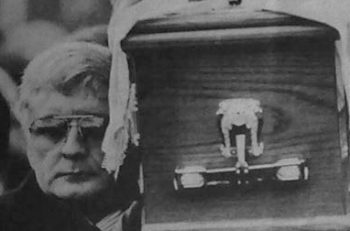
Dick Walsh

Random entry RSS

  • Posted in:

    When the Official IRA and the UDA became Partners in Crime and Murder…and nearly killed me.

    By Ed Moloney. The document reproduced above is the opening five-paragraph extract of a four-page, forty-paragraph Ulster Defence Association (UDA) intelligence report, or ‘memo’ as it is titled, describing the genesis of the corrupt relationship that developed in the late 1970s between the Official IRA and some leading members of the UDA. Since both groups dealt in death as well as thievery and racketeering, some people lost their lives as a result, others came uncomfortably close to that fate. I was one those who had a lucky escape. Targeted by the Official IRA for my journalism in The Irish Times, my name was put on a hit list by OIRA and the UDA was given a false story that I was an intelligence officer for the INLA, using my work as a cover. But for the fact that the UDA leaders knew me well enough to smell a rat, I almost certainly would have been killed and my name besmirched in death. On the day I got the phone call from Gawn Street, asking to see me, I assumed a routine encounter would follow. The UDA leaders enjoyed the company of journalists and sometimes what might follow would be a story worth the trip. There were three senior figures waiting to see me. Since two are now long dead – John McMichael and Davy Payne – no harm can be done by naming them. The third is still living so he will remain nameless. The trio told me that I had been named as an undercover INLA activist but they had investigated and found the charge to be baseless. I subsequently learned that a senior figure in the Official IRA called Harry McKeown, was the source of the accusation. But he was only the errand boy in this case. The deal began with a self-serving pact between the UDA and the Official IRA but it eventually emerged that the UDA leadership had sanctioned deals with all the republican paramilitary groups, including the Provisional IRA and the INLA – although not everyone in the UDA power structure was aware of the arrangements. The corrupt relationship between the UDA and OIRA centered on self-enriching rackets – involving the extortion of building sites and/or tax exemption frauds in the construction industry – but in the case of the Provisional IRA it revolved around a so-called ‘top man’s agreement’, in which the Provos and the UDA agreed that their respective leaders would not be targeted for assassination. Needless to say this arrangement was a tightly guarded secret in both organisations and was known about only at the highest echelons of both groups and even then known selectively. In practice ‘the top man’s’ deal was honoured as much in the breach. It broke down on both sides several times. On two occasions the UDA tried to kill Gerry Adams, while the IRA succeeded in assassinating the UDA’s military leader, John McMichael. This was almost certainly due to the fact that not all those in the UDA’s top tier knew about the deals with the OIRA and PIRA. The fact that McMichael was investigating Jim Craig’s role in the corruption when he met his death may be more than a coincidence, and suggestions persist to this day that Craig set up McMichael for IRA assassination. Another attempt on Adams’ life was sabotaged by the British Army with the aid of the UDA British Army spy, Brian Nelson. But when Adams was badly wounded in a March 1984 UDA ambush in Belfast city centre, an indignant Joe Haughey phoned the UDA HQ in Gawn Street in East Belfast on behalf of the Provos to complain about this breach of the ‘top man’s agreement’. Craig was eventually shot dead by his own side, mostly on the initiative of the late Tommy Lyttle who led a putsch which also saw UDA Supreme Commander Andy Tyrie ousted. On the weekend that Craig was gunned down, in an East Belfast bar, Lyttle took a trip to Scotland, giving himself the perfect alibi. All these convulsions can credibly be traced back to the corrupt deal cut between the Official IRA and the UDA. Much more successful and enduring was the racketeering deal between the Official IRA and the UDA, an arrangement that was sanctioned by at least some of the UDA’s Gawn Street leadership and which enriched both organisations and individuals in leadership positions. The rackets centred on the construction industry and took two forms. First was the straightforward extortion of building sites using threats of violence. But much more lucrative, albeit more complex and difficult to arrange, were tax exemption frauds. These swindles worked in various ways; the most popular was to deduct income tax from bricklayers, roofers, plumbers etc employed on a job but fail to send the money on to the inland revenue. When the time came to pay up, the tax man would discover the business had folded. In practice, of course, the UDA, the Official IRA and their respective leaders arranged the bankruptcy of their businesses and then pocketed the government’s share of tax owed., The key figure in the scam, someone who made all this corruption possible, was Harry McKeown, an Official IRA member and one-time construction company owner who knew the corrupt side of the business better than most involved in the building trade. Without his accumulated knowledge the scam would never have got off the ground. McKeown had been a member of the IRA before the 1970 split and then went with the Officials at the parting of the ways. He was arrested in the August 1971 internment swoop but released the following year. In April 1972 he gave this interview to the New York Times, in which he indignantly complained that internment had cost him a thriving construction business. Former Observer and Irish Times journalist, Kevin Myers knew Harry McKeown well, better than I who had met him during my brief sojourn with the Republican Clubs in 1972. He wrote this tribute to him, in the Irish Independent, after his

    Loading

    Read more

  • Posted in:

    Vandalising history. How the truth about Ireland’s Arms Crisis was corrupted by a gang of NI paedophiles, a dissembling Taoiseach, Private Eye magazine in London, some British Intelligence black propagandists as well as an Irish Times reporter who was an ally of the Official IRA.

      By David Burke. Introduction. The story of the Arms Crisis is a perfectly simple one. It only becomes complicated when the lies, fantasies and myths that engulfed it are entertained as if serious. Only two participants in the débacle told the full, accurate and unvarnished truth: Captain James Kelly and Colonel Michael Hefferon, both dutiful officers of Irish Military Intelligence, G2. It is my intention to publish a book next September which will reveal the deepest secret of the affair, aiming to make it even easier to comprehend. For the most part, I have ignored the parallel  story of how the truth was washed away by a flood of hogwash because it does little more than confuse the narrative. However, I will take this opportunity to present some of the more dramatically erroneous materials that made it into print. In other words, this is the story of what did not happen during the Arms Crisis and its aftermath. When the vines of deceit which wrapped themselves around the story are stripped away, what really happened in 1969/1970 becomes clear: James Gibbons, the Minister for Defence, 1969-70, oversaw an operation to import arms which were to be stored in the Republic under Irish Army lock and key. Charles Haughey and Neil Blaney were deeply involved too. Blaney was probably the main protagonist in the affair. Jack Lynch knew about it too. The paedophile, the propagandist and the political correspondent: William McGrath, Hugh Mooney and Dick Walsh. The weapons – which never reached Ireland – were intended to be distributed to certain vulnerable Catholic communities in Northern Ireland but only in the extremely unlikely event of a ‘doomsday’ situation such as a pogrom. Since no ‘doomsday’ scenario in fact occurred, the weapons would have done little more than gather dust and might have become no more than a minor footnote in recent history. All that changed when news of the importation attempt leaked out and all political hell broke loose. History was corrupted by a motley crew comprising a group of paranoid and malicious paedophiles who surrounded Ian Paisley, a cabal of deceitful British Intelligence propaganda experts, a Taoiseach who dissembled under great pressure – as did his minister for defence, a collection of delusional Official Sinn Féin activists, a legion of profoundly ignorant British journalists, and finally Dick Walsh, a secret ally of the Official OIRA in the Irish Times. This ramshackle crew concocted a variety of gobbledygook conspiracy theories. Broadly speaking, they can all be boiled down to a simple and core allegation, namely that the arms were destined for the IRA as part of some sort of dastardly plot involving Charles Haughey. Lying on an industrial scale: Jack Lynch and Jim Gibbons. One of the reasons the Arms Crisis became so confused was because of the hogwash they spouted about it. 1969: INTRODUCING THE EXTREMIST LOYALIST CHILD-RAPIST, ORANGEMAN, BIGOT, THIEF, BOMBER AND TERRORIST WHO INSTIGATED THE FIANNA FÁIL-IRA SMEAR All the trace elements of the Arms Crisis myth can be found in a devious story published in the pro-Paisley newspaper, The Protestant Telegraph, in 1969. A group of extreme Loyalists zealots including ‘Dr’ Ian Paisley, his associate William McGrath, and Paisley’s one-time bodyguard, John McKeague, and one of McKeague’s friends, Alan Campbell, ratcheted up sectarian hatred in the 1960s in tandem with other like-minded bigots. McGrath was a vile creature: a notorious paedophile who would be convicted for child rape in December 1981. The RUC referred to him as ‘The Beast’. McKeague was worse; not only was he a child rapist but his depravity extended further – he became a UVF/Red Hand Commando serial killer and torturer. He would be murdered in February 1982 after he threatened to reveal what he knew about the Kincora Boys Home scandal when it looked like the RUC CID was on the verge of arresting him for rape. Alan Campbell was one of the three men who led the notorious Shankill Defence Association alongside McKeague. Campbell was also the RUC’s chief suspect in the abduction and murder of a ten-year-old boy in 1973 in Belfast. McGrath, McKeague and Paisley Back in April of 1969, McGrath, McKeague, Paisley and other hate-fuelled fanatics mounted a ‘false flag’ bomb campaign in the North, i.e. one they perpetrated but blamed on the IRA and Jack Lynch’s government. The most notorious bomb of the campaign was the one which exploded in the Silent Valley and cut off the water supply to parts of Belfast. At the time the IRA hardly existed and  certainly had no intention of launching any sort of military campaign against the NI State. The allegation that the April 1969 bombs were part of an IRA campaign was circulated in the pro-Paisley newspaper, The Protestant Telegraph. It declared deceitfully that a source “close to [Stormont] Government circles” had informed the paper that a purported “secret dossier” on the Castlereagh electricity sub-station explosion contained: “startling documentation and facts. Original reports suggested that the IRA could have been responsible, but in Parliament no such definite statement would be made…We are told that the Ministry of Home Affairs is examining reports which implicate the Eire Government in the £2 million act of sabotage — By actively precipitating a crisis in Ulster, the Eire Government can make capital, win or lose. The facts, we hope, will be made public, thereby exposing the chicanery of the Dublin regime”. The Irish government ignited the Troubles – if you believe McGrath – by bombing the water supply to Belfast. This picture shows some of the débris left after the Silvent Valley bomb explosion actually perpetrated by supporters of Ian Paisley. William McGrath blamed Fianna Fáil for it. These lies would be laughable but for the vitriol they helped whip up in extreme Loyalist circles. McGrath was the main promoter of the lie. He used the then deputy editor of the Protestant Telegraph, David Browne, as his conduit to plant the story in the paper. Browne had been present at a meeting in

    Loading

    Read more

  • Posted in:

    The Official IRA planned the murders of journalists Ed Moloney and Vincent Browne.

    An Irish Times insider passed a spiked Ed Moloney article about the Official IRA to its commanders, who spread a rumour he was a terrorist, expecting the UDA would murder him. The material was later published by Vincent Browne inspiring plans by the Official IRA to murder him. By David Burke. Ed Moloney A MEETING WITH THE HARD EDGE OF THE UDA’s INNER COUNCIL Shortly after the February 1982 general election, Ed Moloney of the Irish Times found himself standing in a room “in the office of Andy Tyrie at the UDA’s HQ in Gawn Street on the Newtownards Road” with three senior UDA leaders. The trio included John McMichael, a member of the UDA’s Inner Council and Commander of the Ulster Freedom Fighters (UFF), the name the UDA used when it perpetrated assassination, torture and other acts of violence. The name was used so that the UDA itself would not be proscribed. No-one was fooled, least of all the British government and its security services. The second individual was “a very senior member of the Inner Council who is still alive”. Ed Moloney does not want to name him. The third man was Davy Payne, one of the UDA’s most feared killers and torturers. Like the other two, he was a member of its ‘elite’ Inner Council. John McMichael Moloney still recalls how “Payne was to my left. The other two were to my right. Their presence lent considerable authority to what Payne told me, since these three were the UDA’s main military men on the Inner Council”. Ed Moloney survived his encounter with these men. He continued to work as the Northern Editor of the Irish Times and went on to be voted Irish journalist of the year in 1999. Before the encounter with the UDA, he had worked for  Hibernia and Magill. After his time at the Irish Times, he went to work at the Sunday Tribune. He now lives in New York and publishes a blog, ‘The Broken Elbow’. He has contributed to Village. He is also the author of a string of acclaimed books about the Troubles. A CRITIC OF THE WORKERS PARTY During the course of Moloney’s work he had gathered ample evidence that the Official IRA (OIRA) was still in existence despite claims by its political wing, Sinn Féin the Workers Party (SFWP), to the contrary; and, moreover, that it was engaged in a wide range of criminality including bank robberies and extortion. After SFWP won three seats in the February 1982 general election, the party found itself holding the balance of power. The new SFWP TDs voted for Charles Haughey as Taoiseach in a stark choice between him and Garret FitzGerald of Fine Gael. Dick Walsh of the Irish Times, who was an ally of Cathal Goulding, chief of staff of the Official IRA, was appalled by his party’s support for Haughey. He described the development as a “Hitler-Stalin pact of sorts” in the Irish Times. The pact was never destined to last and Haughey’s government would collapse eight months later when the SFWP deputies withdrew their support. After the February 1982 election, Moloney wrote two pieces for the Northern Notebook of  the Irish Times. He has explained to Village  that one part of the series “dealt with the political journey SFWP had taken to power in the South. That part duly appeared on the Saturday as all Northern Notebooks did”. He submitted a second piece which was not published. It  “dealt with the continued existence of the SFWP’s military wing and the various criminal activities it was involved in, including racketeering and paramilitary activity”. This part “never appeared and I was never officially informed nor given any explanation by the Irish Times.  I cannot even say whether my copy was even shown above the level of sub-editor”. Moloney believes that “the real SFWP/OIRA influence was wielded at sub-editor level where stories could be changed and challenged without senior figures even knowing”. Shockingly, someone in the Irish Times – position unknown – passed the article to the Officials behind Moloney’s back. Moloney subsequently handed the research over to Magill, then edited by Vincent Browne, who published a two-part series on SFWP in March and April 1982. The magazine flew off the shelves and sold out completely. This was egregiously embarrassing for SFWP. It later changed its name to the Workers Party (WP) in an effort to distance itself from the whiff of sulphur that clung to the Sinn Féin part of its old name. Vincent Browne (left); Cathal Goulding on the cover of one of the two 1982 Magill articles which incensed the Official IRA; Ed Moloney (right) As Moloney has confirmed to Village, “I certainly gave Vincent the material I had gathered over the years, including material the IT had refused to publish”. THE MACHIAVELLIAN OFFICIAL IRA PLOT TO MURDER ED MOLONEY That the OIRA tried to set Moloney up for murder is not in doubt. The only issue is whether they did so after the publication of the Magill articles, or before. If it was before, it means that the murder attempt was designed to prevent the information he had gathered from reaching the public. If after, it was an act of revenge and a possible attempt to prevent further revelations. The plot was deeply Machiavellian: two Sinn Féin the Workers Party members told the UDA that Moloney was in the INLA. “Since people like Andy Tyrie and John McMichael knew me and doubted the claim, the UDA stayed its hand. The allegation against me was apparently made to the UDA by two members of Sinn Féin the Workers Party” Moloney has told Village that: “I learned about the threat to my life from the late UDA North Belfast Commander Davy Payne who informed me one day that the UDA had been told that I was a member of the INLA but, since people like Andy Tyrie and John McMichael knew me and doubted the claim, the UDA stayed its hand.

    Loading

    Read more

  • Posted in:

    Dick Walsh’s covert committee monitored OIRA media enemies. Future Irish Times Assistant editor put colleagues on lists.

    By David Burke. Part 1 of this series can be found at https://villagemagazine.ie/dw/ THE OFFICIAL IRA AND OFFICIAL SINN FÉIN The IRA fractured in December 1969 into what became known as the Provisional IRA and the Official IRA. Sinn Féin split along the same lines the following month. Before the division, the IRA had been led by IRA veterans such as Cathal Goulding, who was its chief of staff, Seán Garland, Seamus Costello, Tomás MacGiolla, Ruairí Ó Brádaigh and Seán Mac Stíofáin. On the political front, they controlled Sinn Féin. Together the IRA and Sinn Féin were known as the Republican Movement. Goulding, Garland, Costello and MacGiolla sided with the Officials after the split and reproduced the military and political formula for their new organisation. Ruairí Ó Brádaigh and Seán Mac Stíofáin set up the Provisionals. Goulding’s faction managed to retain control of the United Irishman, the movement’s monthly newspaper. Collectively they also became known as the ‘Stickies’. Cathal Goulding avoids the media The United Irishman had been edited by Tony Meade, Denis Foley, Séamas Ó Tuathail (who brought sales to a height of 100,000 in 1969) and then Eoin Ó Murchú. In late 1972 Ó Murchú left and Dick Walsh of the Irish Times, later to become its political editor (from 1985) and indeed its assistant editor (from 1999), was asked to take care of the paper while a new editor was found. The full-time replacement turned out to be Jackie Ward, who had been in charge of the The Starry Plough which had appeared in Derry. In 1973 the Officials launched another publication, The Irish People, a weekly paper. Pádraig Yeates, who edited it between 1977 and 1982, joined the Irish Times in 1983. The Officials also produced numerous pamphlets, most but not all of which were produced openly as Official Sinn Féin publications. The Official IRA (OIRA) issued statements which were reported in the press. After they called a ceasefire in 1972, they continued to exist for purported ‘defensive’ purposes and continued to issue statements. The Irish Times continued reporting them until the mid-1970s. Bizarrely, when the paper interviewed Goulding wearing his political cap in 1983, it reported that the OIRA had ceased to exists in 1972, as if all the statements it had carried for the three to four years after the 1972 ceasefire had never appeared on its pages. It was the least of the dysfunctionalities in that paper’s nexus with the OIRA. WALSH’S SECRET COMMITTEE Behind the scenes Goulding and his GHQ staff decided to draw up a list of their friends and enemies in the media. Goulding, now chief of staff of the OIRA, appointed Dick Walsh as the kingpin of this clandestine effort. He was assigned to lead a committee which drew up lists of journalists and to characterise the attitude of each towards the Officials. The OIRA also spied on their political opponents throughout the 1970s and into the 1980s and probably well beyond. Their penetration of the Revenue Commissioners caused so much internal rancour that some civil servants tried to set up their own union. They felt the Officials had taken over the existing set up. The Officials’ spies in the Revenue Commissioners paid particular attention to the tax affairs of politicians such as Charles Haughey and well-known big -businessmen. Ultimately no use was made of the information they accrued because they did not want to draw attention to their assets in the department. The OIRA also spied on groups who were opposed to the Soviet Union such as the Irish Council for European Freedom and the Irish Czech Society. Their reports were presumably furnished to the Soviets. Amnesty International was another target. One of those monitored was Louise O’Brien. THE GOOD, THE BAD AND THE UGLY Dick Walsh broke the media into five groups. Category ‘A’ consisted of those deemed friendly towards the Official Sinn Féin and the OIRA. This group consisted of between ten and twenty reporters who were prominent in the early 1970s. Walsh included himself in it, along with members of the OIRA who were working in the media and those who, while never in any wing of the IRA, were sympathetic to the left-wing direction in which Goulding was taking the Officials. The political wing of the Party became known as Sinn Féin the Workers Party (SFWP) and later again simply the Workers Party (WP). Walsh and his committee presumably updated the list from time to time. One possible motive for the exercise was to help create a network of supporters in the media. On the other side of the coin had the revolution, that Goulding, Garland, MacGiolla and their comrades were fomenting, actually succeeded, the information would have been a useful resource to identify likely counter-revolutionaries. A number of ‘A’-listed OIRA figures were, or became, employees at the Irish Times. The purpose of this article is not to suggest that the Officials succeeded in taking control of the paper because they did not. The plot to murder a journalist at the Irish Times – which will be described in the next article in this series – demonstrates this definitively. Overall the paper was a broad church, especially under the editorship of Douglas Gageby. However, the ‘Stickies’ did have a number of notable successes in promoting their essential views, including their grossly distorted account of the Arms Crisis. THE IRA VOLUNTEERS AT THE IRISH TIMES As readers may recall from Part 1 of this series, James Downey, a former deputy editor of the Irish Times, stated that Dick Walsh was not only “an intimate of Cathal Goulding and the other leaders of what would shortly become the ‘Official’ Sinn Fein and IRA” but also that there were “two or three who were actual members of the IRA, on the paper”. (Downey p. 102.) Sean Cronin, former Chief of Staff of the IRA and Irish Times Washington correspondent during the Troubles Downey was disturbed by the OIRA presence and opined that “…the position of Dick

    Loading

    Read more

  • Posted in:

    How the Irish Times got its biggest story of the last 50 years wrong.

    The Assistant Editor of the Irish Times distorted the truth about the Arms Crisis. He was a friend of both the chief of staff of the Official IRA and the Taoiseach, ‘Honest’ Jack Lynch. The Official IRA had a vested interest in manipulating the story. Over time, the journalist portrayed Lynch as the hapless victim of the Arms Crisis. This article will look at his relationship with the Marxist wing of the IRA, the Officials.   By David Burke   Part 1: Dick Walsh and the Official IRA. CATHAL GOULDING AND THE ALDERSHOT MASSACRE Cathal Goulding In February 1972 the Army Council of the Marxist wing of the IRA, the Officials, directed an attack on the HQ of the British Army’s 16th Parachute Regiment Brigade at Aldershot in Hampshire. At the time, the Army Council consisted of Cathal Goulding, Sean Garland, Tomás Mac Giolla and others. On 22 February a time bomb was conveyed to the Aldershot complex in a Ford Cortina vehicle. It weighed 280 pounds (130 kg). The driver alighted and fled the scene with the bomb detonating seconds later. The Officials who had scouted the complex cannot have missed the fact there were many civilians in the vicinity. A few seconds later five kitchen staff were slaughtered: Jill Mansfield (34); a mother of an eight-year-old boy. Her body was identified by a tattoo on her arm; Thelma Bossley (44); Margaret Grant (32); Cherie Munton (20); Joan Lunn (39), a mother of three. So too was a gardener, John Haslar (58) who died from a fractured skull. Finally, a Catholic priest, Gerry Weston (38) perished. 19 others were wounded by the explosion. Not a single soldier died. CROCODILE TEARS AND LIES Goulding and his cronies declared that “initial reports confirmed that several high-ranking officers had been killed [at Aldershot]. British propaganda units then moved into action, and miraculously the dead officers disappeared”. The statement added that the Official IRA’s intelligence department, had ascertained that 12 officers of the Parachute Regiment had been killed in the attack. These claims were entirely dishonest. On 23 February, the Officials explained that the attack had been perpetrated in revenge for Bloody Sunday: “Any civilian casualties would be very much regretted as our target was the officers responsible for the Derry outrages [i.e. Bloody Sunday]”. Stripped of the crocodile tears, Goulding was saying that it was acceptable to kill a handful of kitchen staff, a gardener and a priest in a botched atrocity because his motive had been pure – the murder of soldiers. Stripped of the crocodile tears, Goulding was saying that it was acceptable to kill a handful of kitchen staff, a gardener and a priest in a botched atrocity because his motive had been pure – the murder of soldiers. The Officials also said that the bombing would be the first of many such attacks on buildings occupied by British Army regiments which were serving in the North. In November 1972 Noel Jenkinson from Meath was convicted for his part in the Aldershot atrocity. He died from a heart attack in October 1976. Cathal Goulding The Army Council of the Official IRA remained tight-lipped about the other members of the Aldershot unit and they all escaped justice. I spoke to Sean Garland – briefly – about the Aldershot atrocity many decades later. He acknowledged that the attack was “indefensible”. In fairness to him, he did seem genuinely remorseful. A FUNERAL ORATION FOR A FALLEN OFFICIAL IRA VOLUNTEER Dick Walsh was the political editor of the Irish Times. He died in 2003 at the age of 65. After his death, his former colleagues at the paper described him as someone who was “believed to have used his influence in the left-wing circles in which he then moved to urge the Official republican movement to abandon violent means to settle the Northern Ireland problem”. If he did, he certainly took his time about it. Joe McCann of the Official IRA. The violence continued. Walsh did not shun the Official IRA after Aldershot, nor does he appear to have advocated an abandonment of “violent means to settle the Northern Ireland problem” in the immediate aftermath of the attack. Why can this be said? Because Walsh helped write the funeral oration for an Official IRA volunteer called Joe McCann which was delivered by Goulding. McCann was killed on the streets of Belfast on 15 April 1972 while being chased by soldiers of the Parachute Regiment. He was unarmed. Details of his death can be found at https://en.wikipedia.org/wiki/Joe_McCann. McCann is the silhouetted figure in the main photograph of this article, the man crouching with a gun in his right hand.) There was little sign of a foreswearing of ‘violent means’ in the oration. Goulding said that “those who are responsible for the terrorism that is Britain’s age-old reaction to Irish demands will be the victims of that terrorism, paying richly in their own red blood for their crimes and the crimes of their Imperial masters”. Perhaps blood was still high after the Bloody Sunday atrocity and the murder of the unarmed McCann by soldiers of the Parachute Regiment and Walsh only came around to lobbying for non violence tactics later. Perhaps Goulding added the blood-curdling rhetoric himself. Walsh was presumably strongly in favour of the ceasefire the Officials purported to call on 30 May 1972. I say “purported” because Goulding, Garland and Mac Giolla et al reserved the right to engage in “defensive actions”. Hence, the Official IRA did not go away; far from it in fact. They retained their arms and engaged in murderous feuds with the Provisionals, the INLA and others. The Officials killed 25 people between the calling of the ceasefire and 1983. While the feuding might conceivably be shoehorned into the category of “defensive actions”, the bank robberies and building-site extortion rackets the Officials carried out, could not. Interested readers should purchase a copy of ‘The Lost Revolution’ by Hanley and Millar for further details about the feuding – and much

    Loading

    Read more