Dublin

Random entry RSS

  • Posted in:

    A physical quandary beats a digital swipe: James Merrigan reviews Tanad Aaron’s ‘We’ll See You Now’ at Pallas Projects Dublin

    In the 1990s, artists working in diverse mediums, from painting to installation, redescribed the world in the image of the “non-place”. Coined by French anthropologist Marc Augé, non-places are transitional spaces (motorways, airports, hotel rooms) found between places that are more culturally established and static. In such non-places the socially constructed identity of the individual is less certain, groups cannot form, and loneliness permeates. As Gertrude Stein said, “there is no there in a non-place”. Art, in one sense, is the display of the parts of the world we don’t notice or value, but discover anew in the work of art For the contemporary artist, these non-places are a perfect metaphor for a distracted body politic, whose members go about their workaday lives without paying attention to the liminal nooks and crannies of society. In a sense, the transitional non-place is a marvellous foil and opportunity for the artist to exhibit what is in plain sight, something both familiar but ignored by society at large. Art, in one sense, is the display of the parts of the world we don’t notice or value, but discover anew in the work of art.  The most common non-places redescribed by the contemporary artist have an uncanny quality that evince a Freudian influence. Installation artists such as Mike Nelson, Mark Manders, Miroslaw Balka, Gregor Schneider, and photographers Thomas Demand and Jeff Wall, construct strange yet familiar spaces dotted with objects and props, that unsettle their architecture’s normalcy with the theatre of the absurd and the psychology of fear.  In the same uncanny vein, the conceptual and minimalist artists of the 1970s presented the viewer with almost empty gallery spaces, such as Michael Asher’s removal of a gallery partition to reveal the machinations of the gallery administration and nothing more; or the masturbatory mechanics of desire performed in Vito Acconci’s Seedbed, where the artist jerked off under a solitary timber ramp in an otherwise empty gallery. Closer to the mainstream, Lars von Trier’s Dogville (2003) starring Nicole Kidman, is a good example of how stripping back a film stage to chalk-outlines can haunt the viewer with their own imagination and desires, like the inkblot Rorschach dramatised in the psychological TV drama.  Why the long preface to a review (my first review for Village Magazine) of the solo exhibition We’ll See You Now by Tanad Aaron at Pallas-Projects Dublin? Well, I want to begin this critical venture by making explicit the importance of context and setting in the appreciation — what Christoph Menke calls more appropriately “apprehension” — of contemporary art. If we are dealing with subjectivities and ideologies over truths and facts in the apprehension of art, it helps if you are armed with a little context. The context (or ghost) that haunts Tanad Aaron’s work at Pallas Projects Dublin is collaboration. For close to a decade the artist has been instrumental in building timber displays and gallery furniture for exhibitions in the Irish art scene. Curators, art institutions and artists have commissioned Aaron’s artisan sensibility to consistent effect. In the early days, Aaron was known as part of a trio of artists (with Andreas von Knobloch and Tom Watt), who made exhibitions on their own terms, not under the aegis of curators and art institutions, who wanted yet another piece of shelving or table to decorate their administrative settings. In these curated contexts Aaron, von Knobloch and Watt became artist-technicians, commissioned for their carpentry skills to fabricate settings for exhibitions, which was at first novel, but then became convention. Going it alone at Pallas Projects is both an intriguing and challenging prospect for Aaron. Pallas Projects is a small gallery space, divided by a hinged partition that facilitates one large gallery space or two smaller ones. Aaron has gone for the latter configuration, using the larger entrance room to display some wall- and floor-bound objects, including tentative oil paintings that redescribe the shape of the curved ramp that arcs into the smaller room of the gallery.  The gallery is dark, with the alien vibration of blue and green light emanating from argon tube lights that form illegible doodles in plain sight, or in-hiding under the platform. The lighting, which some might refer to as obsolescent neon without referring to the list of artworks, sets the mood, the feeling, that this is a space that tries to evade easy description. Empty speech bubbles, in their glass and refracted-light manifestations, testify wordlessly throughout the gallery. For those who aren’t equipped with context, whether historical or local, I can only imagine that Aaron’s exhibition presents a conceptual stumbling block, even though the timber platform is accessible via a smoothly crafted ramp. Craft is a big thing in Aaron’s toolbox. Even in his use of cheap plywood, MDF and paper bags, every corner and edge is finely bevelled and pleated in a dutiful alchemy. So much so that my attention is repeatedly drawn to the corners and edges of his timber fabrications, at the expense of digging deeper into the elusive content.  You might say that this is to Aaron’s credit, that he is not interested in presenting the theories or issues of the day, rather they exist here as sublimation, not a headline. In the user-friendly press release the artist casually signposts to “waiting rooms” and sites of permanence and impermanence. And yet without other signposts, whether philosophical, journalistic, or literary, the installation slip-slides away, always going with the grain, without any breaks in the uniformly tanned language of MDF. If you refer to the gallery map, as I did, it does help to divide and conquer the wholeness of this exhibition into bit-parts, named and orphaned from their maternal MDF embrace.  Socially primed for pronoun usage, the use of the pronoun we, as in the exhibition title We’ll See You Now, does (or doesn’t) do one of two things: it points to the obvious fascination the art world (and every other institutional bubble) has these days with the we of inclusion and community; or two,

    Read more

  • Posted in:

    From the Temple of Bars to Listowel Writers Week

    Dermot McLaughlin mismanaged Temple Bar and, facilitated by the uncontrolled Arts Council which never took responsibility for failures in Temple Bar, is now arrogantly calling out mismanagement in Listowel. By Michael Smith Temple Bar Properties converted Temple Bar into a high-rent drink-driven cultural centre in the 1990s. Its focus then moved from physical regeneration to consolidating the cultural offering it was housing and, in 2006, it became Temple Bar Cultural Trust (TBCT), with a new board appointed by Dublin City Council. It was a private and limited not-for-profit company engaged in cultural development in Temple Bar, organising Temple Bar Food Market, concerts, circus, street, Culture Night and Handel’s Day. In 2005 it had an income of €2m, with €1.6m of this coming from its 50-strong property portfolio estimated to be worth at least €100m. Its CEO was Dermot McLaughlin, a 17-year Arts Council employee who had risen to become its assistant director. He was also a talented fiddler. Governance of TBCT was dysfunctional and in 2011 a review by Latitude, a consultancy, recommended it be wound up and subsumed into the Council. Independent City Councillor Mannix Flynn, a board member of TBCT, tabled a successful motion to that effect. The then city manager John Tierney agreed to commission a review of the organisation focusing on corporate governance standards, board representation and whether the trust was fulfilling its brief as a cultural promoter and enabler. However, a Council audit report published in March 2013 levelled charges of a different level of seriousness against TBCT, including failures of corporate governance and “control weaknesses and/or regulatory violations [that] represent unacceptable exposure and risk” for the company. McLaughlin remains a continuing consulting favourite for funding by the Arts Council of which he was once a senior employee The report found that the trust’s board minutes and papers were “not available” in relation to certain financial transactions, noting that TBCT’s business plan for 2010 and 2011 had not been approved by its board. There were found to be no appropriate financial procedures and the fact the same external auditors had been acting for over 10 years was deemed “in contravention of good corporate governance”. The party at most risk from these failures was the publicly-funded Arts Council which funds most of the cultural activity in Temple Bar, not exactly an oasis of private culture, to the tune of €9m in 2022. The Arts Council notably failed to investigate whether certain sums paid by it to institutions in Temple Bar were forwarded as intended to TBCT. A TBCT-commissioned review of the audit by former IBEC chief Turlough O’Sullivan found that the McLaughlin-fed board had “failed in its duty of oversight and governance by not enquiring into and satisfying itself that proper procedures were in place around financial transactions”. O’Sullivan was no subversive so it was telling that even he found this level of delinquency. McLaughlin resigned, agreeing not to pursue actions for defamation, and obtaining a substantial severance package after a disciplinary hearing into his role in offering generous redundancy packages to four senior staff members was cancelled. So what’s happened to the man who presided over the mess? Funny thing is McLaughlin doesn’t now mention his period in the van in Dublin’s Cultural Quarter. He remains a continuing consulting favourite for funding by his former employer, in the absence of a clear Arts Council policy on how it procures its consultants. According to now free agent Dermot McLaughlin he’s “been involved in voluntary work with organisations and on boards for many years. I enjoy being involved, I’m always interested in finding ways to help, and I love learning new things. So for me, voluntary work in enriching and valuable”. His voluntary work which came largely to an end after 2008 included spells as: Chairman (2011-2018) of Irish Traditional Music Archive; Chairman (current) of TG4 Gradam Ceoil selection panel (annual national traditional music awards); Chairman (2007-2011) of Dublin Dance Festival; Chairman (2007) of Údarás na Gaeltachta and Arts Council National Monitoring Committee on Gaeltacht arts; Board Member (2006-2008): Irish Architecture Foundation. Beyond this strings to McLaughlin’s bow include that he was: Board Member (2003-2005): Rough Magic Theatre Company; Founder and Board Member (1994 to date): Scoil Cheoil Frankie Kennedy; Founder and Committee Member (1982 to date): Cairdeas na bhFidléirí. In 2014 he set up his own independent consultancy practice, Creative Strategic Solutions. After that he was involved in the Arts Council of Northern Ireland’s Audit of Traditional Music in Northern Ireland (2014-15); the Arts Council’s review of contemporary music policy initiative (2015) Ealaín na Gaeltachta’s Competitive assessment of funding proposals (2015); and An Cosán Glas’s Business planning, negotiation strategy (2015). It’s amazing how far an unassailable relationship with the Arts Council can take a man. He also claims (admits?) he was involved in the “Meeting House Square €2.2m capital redevelopment, business planning and marketing project (2010)”. Sounds good, so let’s have a look at what the project architect says about this. Seán Harrington architects’ website is as sanguine as McLaughlin is about the situation. “There is a saying in Ireland that you can have four seasons in one day. Warm spring sunshine can lead to intense summer light. Lively autumn gales can turn to a sudden wintry shower because Irish skies are constantly changing. Seán Harrington architects was commissioned to find a solution. The innovative solution provides a convertible umbrella covering over a popular public square in Dublin Temple Bar area. The landmark umbrella projects bespoke design comprises of four 21-m high steel structural masts”. This is shameless and shocking when you realise the, admittedly attractive, umbrellas don’t work, never really did. In the last few weeks one of the brolly arms buckled and repair costs are so prohibitive as to make its reinstatement unlikely. The audit commissioned by Dublin City Council was particularly scathing about Temple Bar Square: “Board minutes were altered, deleting concerns raised by some Councillors, and provided to Ulster Bank to support a loan; Reams of financial data relating to the project were

    Loading

    Read more

  • Posted in:

    Embargo

    The lacklustre prose might have tipped you off that all of the above items are from press releases, and so lack the sharpness good newspaper prose should have after subediting. But it’s not just PR-speak that distinguishes these news items. Each one was subject to a news embargo. News embargoes are not unknown in Ireland, and are usually honoured. Sometimes, they are even lifesaving. A few years ago, to pick one example, the Garda press office issued an alert to journalists about an “incident” where a man had barricaded himself inside a house. The brief notice asked journalists to respect a blackout in reporting the incident until it was resolved. Sometimes, based on their assessment of a crisis situation, Garda authorities will ask journalists to cover an event as much as possible, for example as a way of communicating directly with someone who may be listening to a radio. And sometimes, they ask for silence, to avoid inflaming a situation. The barricading incident was resolved without tragedy, and the stand-off was then reported by the press. There’s no way to tell if the embargo helped or not, but it was observed by every journalist who learned about the case. There’s no legal basis for a press-embargo system. It’s just something that evolved over the years. One of the compromises entailed is implied by press releases labelled “check against delivery”. The text of a speech, usually from a Minister or party leader, is leaked in advance to journalists to help them over the pressure of impending deadlines, but on the understanding that the journalist will listen to the speech in case the minister changes what he says at the last minute. Often of course, what the minister says in an off-the-cuff or unrehearsed remark departing from the script is the most newsworthy event of the night. Such a system made sense when print was the dominant news medium, and it took up to eight hours to get a news report from one end of the country to another. When a government or news website can upload the same speech in seconds, and then promote it through social media directly to citizens, the embargo makes less sense. On the (to be honest, not that frequent) occasions when the script contains urgent and newsworthy information, there is no reason why the planned script a Minister is going to deliver should not be reported. And if the actual delivery changes, then that too is news to report. A press embargo should be rare, and only invoked in the public interest. The barricading incident described earlier is an illustration. But instead, it is abused more often than respected. Some embargoed stories, such as an increase or reduction in homeless numbers, are of immediate interest. Many, quite frankly, are not. In addition to numerous speeches by ministers and TDs, among the recent embargo requests I’ve received were the launch of a new website and app by a government agency, tractor testing regulations, the opening of a courthouse, and a speech about the cost of Garda overtime. All worthy and worth reporting in the public interest, but few of immediate interest to the public, and certainly not meriting the spurious importance attached by the word “embargo”. Most of the embargoes in my inbox expire either at midnight, or at 4.30PM. In other words, they are blatant attempts to influence news coverage, hoping to feature prominently on morning newspaper front pages, Morning Ireland, or evening drivetime news broadcasts. What should be a rare occurrence, urging media restraint in the public interest, has instead become a way for press officers to manipulate news cycles. It is time for journalists to ignore embargoes. Gerard Cunningham

    Loading

    Read more

  • Posted in:

    Illiberal liberalism

    College campuses around the world are renowned as centres of free thinking, individuality, and acceptance of those from all walks of life. And they are; as long as you think the right way that is. In recent years, it has become more and more normalised for people to be silenced because their opinions are seen as unpopular. In the lead-up to the abortion referendum debates raged across the nation, with students being particularly vocal, perhaps because they had little internal opposition. Although most, if not all, universities have pro-life societies, their Student Unions hold a pro-choice stance. In my experience many students feel demonised by the authoritarian view of the majority and are unable to express their opinions freely for fear of vituperation from other students. The impeachment of Katie Ascough, the former UCD Student Union president in late October 2017 is a notable example of the backlash some pro-life students face. Ascough made the decision to remove information concerning access to abortion from the SU’s magazine ‘winging it’, claiming she was acting on legal advice due to the strict laws surrounding the publication of such material and information. The decision led to the reprinting of the student magazine at an estimated cost of 8,000, a figure which her antagonists claimed was far higher than any potential fine that would have been incurred from the printing of the original material. Ascough was further criticised for making a decision that was not in line with her Student Union’s pro-choice mandate, which had been formally voted in by the student body the previous November. The grounds on which Ascough were impeached were somewhat questionable, however. She did, after all, act in accordance with the law, and technically did not actively withhold the information as it was readily available from other sources. What she did do was express a hugely unpopular opinion which was met with immediate ridicule and condemnation from fellow members of the Student Union and the student body. Posters and pamphlets were spread around campus with pictures of the original copy of ‘winging it’ containing the pricing information of obtaining an abortion and information on where to obtain abortion pills online, accompanied by pictures of President Katie Ascough’s campaign manifesto. Would the reaction have been the same if she had come out with a pro-choice guide? Perhaps not. My own experience as a student in DCU has had similar if less extreme overtones. It is almost automatically assumed that you are pro-choice; it is what is expected of you from other students. Certainly, the Student Union encouraged students via social media, not only to vote Yes in the referendum but to take part in pro-choice events which were happening throughout the year and particularly coming up to the referendum itself. DCU’s Student Union is not an outlier here, as almost every student union in the country supported the pro-choice movement. I was not the only student who saw a problem with this lack of representation for pro-life students. An organisation called Students for Fair Representation, led by a small band of DCU students, petitioned for the DCU Student Union to take a neutral stance on the abortion debate, stating in a Facebook post: “College is a time when we make up our minds on important social and political issues – like the abortion issue. But why does our Students’ Union – our voice – only pick one side of such a controversial issue to represent us and invest our welfare money in?”. From my experience, the conversations being had on campus were dominated by pro-choice opinions and this was easy to see from social media. I can’t even begin to count how many of my friends on Facebook put the Yes filter on their profile pictures. It is perfectly natural for members of the Student Union to support a movement they feel strongly about, after all, they are only human. But I feel it is also important to feel supported by the Union which claims to represent the interests of all students. It is imperative, if you have been elected, to represent those who have elected you rather than your own politics. Membership of a student union is not optional. They should be slow to take stances that even political parties, membership of which is very clearly optional, see as issues of conscience. Liberalism has several guises but the one that is subversive of those who are perceived as less liberal is unattractive, especially where the zeal of the Liberals seems to be in inverse relation to the complexity of the issue. The tainted legacy of the long-intolerant Catholic Church may be that it has left us a society of intolerant liberals, most dramatically our young people. Dearbhla Gormley

    Loading

    Read more

  • Posted in:

    Dublin’s North Inner City

    Dublin’s North City fell out of fashion after the flight of the future Duke of Leinster to Kildare St and the Act of Union. That’s more than two centuries ago and the journey back has been slow. It suffered shocking poverty over succeeding generations, the collapse of world-class mansions into tenements, dereliction, the flight of nearly all private residents and a drugs and crime epidemic. In the last twenty-five years it has been subjected to an inundation of third-rate private-sector apartments, the re- division of many old houses including the removal of period features and a pogrom of gang killings. It has also witnessed wholesale immigration and a degree of cultural diversity. It has a dramatic need for new apartments but the focus for new development in 2018 appears to be hotels and (high-quality if expensive) student housing, not – perhaps because standards are in flux – apartments. It seems likely a naïve Minister for Housing and Planning will indulge a reduction in building-height standards that may compromise perhaps the area’s principal attraction, its historic human scale. CONSERVATION The focus of this piece is on one small new pattern of development: some exciting conservation projects. ORMOND QUAY The construction of Ormond Quay Upper and Lower – named after James Butler, 1st Duke of Ormonde – began during the 1670s with the development of the former lands of St. Mary’s Abbey by Sir Humphrey Jervis, and with the setting out of a formal quay-line and carriageway as part of the Corporation’s grant of substantial lands to Jonathan Amory in 1675. These developments were facilitated by the construction of two bridges under the auspices of Jervis linking the walled medieval city with the new north-side suburbs: Essex Bridge (now Grattan Bridge), erected in the late 1670s, and Ormond Bridge (now O’Donovan Rossa Bridge), completed by 1684. The speculative development of the quay front soon followed, with the lands of Ormond Quay Upper developed as a fashionable residential parade with associated commercial uses under the freehold of Lord Santry, Henry Barry.   1-1A ORMOND QUAY LOWER The house on the corner of Capel Street and Lower Ormond Quay is most famous from its appearance on a late-18th-century Malton print (the ones you find on greasy place mats and on bathroom walls in Dublin 6) with a view across the river to the then Custom House where the Clarence Hotel now stands. It’s been derelict for twenty years since it served as offices for a solicitors firm fronted by Liam Cosgrave Junior who was disgraced after unedifying information about planning corruption emerged in the planning tribunal. It comprises an existing four-storey over basement protected structure with four bays and two shopfronts facing Ormond Quay and two bays with one shopfront facing Capel Street. The shopfronts are shuttered and now messy. There was previously a fast food restaurant at street level. The façade of the building is rendered and in a poor state of repair; however, there are interesting features including arched windows at first-floor level and corner quoins. Permission has been granted for development comprising conservation and a change of use at first, second and third floor levels from commercial occupancy to use as short-term-lease guest suites and change of use of the ground floor and basement to restaurant/cafe use, supervised by James Kelly of Kelly and Cogan Architects. Indeed it might be argued that in view of the strategic significance of the site, facing the overblown Temple Bar, in effect an ambassador for the North Side, public uses – pub or restaurant – might have been suitable for the entire building. The site of No 1 Capel Street was originally occupied by a larger house, which also occupied part of neighbouring plots. The exact age of the building is unclear but it is shown on a map dating from 1784, and also on a 1795 image by James Malton. The building was used as the state lottery office before 1800 and was then in a variety of uses including draper, feather merchant, stationer, bookseller and bookbinder in addition to briefly accommodating solicitors’ offices. By the mid-19th-century the building had been stucco-finished, with quoin detailing and decorative moulding added. The facade to the quays was partly blank but included an arched window at street level. During the Civil War in 1922 the façade and shopfront of the building were damaged. A new shopfront was then provided on the façade to Ormond Quay, which was divided into two parts and included a new entrance lobby onto the quays, though access to the building was, and remains, tricky with narrow pavement on two sides and a torrent of parking-free traffic down the quays. By the late 20th century the retail/commercial unit at ground floor level had been subdivided. It is stated that the building has been largely unaltered since the late eighteenth century, with the exception of the alterations to the shopfront and the plastering over the original brick façade. Original fabric, including the gothic rounded headed windows to Capel Street and the quays, survives, as do internal joinery works including architraves, staircase and doors. The building retains its commercial character, while the original plan form is substantially intact. 18 UPPER ORMOND QUAY On Upper Ormond Quay, to the South of the area, the Dublin Civic Trust is leading a project to restore an interconnected pair of riverfront merchant buildings. – the quayside house dates to 1842-43 and the rear building to the 1760s. The four-storey over basement house includes a rare arcaded Georgian shopfront composed from cut granite of, depending on who you listen to, a date of 1789 or around 1810. This is the most challenging and transformative building project the under-celebrated Trust has embarked on since its foundation in 1992 and is one of the most significant initiatives of its kind in Ireland. Both buildings require extensive structural stabilisation and careful conservation of fabric. The project will restore residential use to the upper floors and traditional shop use below. Number 18 started life as a river-fronting

    Loading

    Read more

  • Posted in:

    Mary, Mary, quite contrary

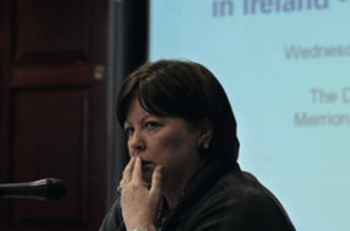
    By Frank Connolly. Former Minister for Health, Mary Harney, met one of the US firms at the centre of the cervical smear-testing scandal on three occasions in 2008 and 2009. Harney was Minister when US firm, Quest Diagnostics, secured the tender for smear testing in 2008 against the advice of leading Irish cytologists who questioned the reliability of the US laboratories. According to documents obtained by Village from the Department of Health, Harney met representatives of Quest in October 2008, June 2009 and October 2009 although details of the discussions were not revealed. The first encounter took place soon after Quest was awarded the multi-million-euro contract to provide laboratory-testing services to the HSE. It had been checking slides from Irish hospitals for breast and other cancers for some years but with the introduction of national-screening programmes and a significant backlog in Irish laboratories, it was decided to outsource the service to Quest and, two years later, to other US laboratories. Objections raised by Irish pathologists, including by Dr David Gibbons of St Luke’s Hospital, about the poor quality of US tests compared to Irish results were dismissed by the HSE and by Tony O’Brien who was then in charge of the National Cancer Screening Service (NCSS). Dr Gibbons has said that he resigned from the oversight board which supervised the NCSS after his warnings were ignored. O’Brien stood down from his post as Director General of the HSE last month in the wake of the cervical-smear scandal. In 2008, the NCSS awarded the contract to analyse 300,000 Irish smear tests to Quest Diagnostics. Two years later Clinical Pathology Laboratories (CPL), based in Austin, Texas, was awarded a tender to provide laboratory services for CervicalCheck, the programme run by the NCSS. Both firms continue to provide laboratory testing services to the Irish health service. Two months ago, Vicky Phelan (43) from Limerick settled her action in the High Court action against CPL for €2.5m. A smear test by the US firm in 2011 was misdiagnosed and failed to detect her cancer which was not found until three years later. She was not informed until September last that an audit in 2014 had discovered the 2011 misdiagnosis. Emma Mhic Mhathúna was diagnosed with cervical cancer in 2016 after being told that a test of her slides had been wrongly diagnosed by Quest in 2013 and possibly as far back as 2010 when another slide was apparently misread by the New-Jersey-based company. The 37-year-old mother of five children is dying of cancer. In late May, further distress was caused to her when the High Court was informed that Quest was seeking to have her children interviewed by a psychologist to assess the impact her death would have on them. There was significant controversy when Quest was awarded the major testing contract in 2008 – with cytologists and medical laboratory scientists warning that there was already evidence that the US system produced results that were less accurate than the work done in Irish hospitals, including at St Luke’s Hospital and the Royal College of Surgeons in Dublin and Cork University Hospital (CUH). Village has recently learned that an inquiry by HIQA into the incorrect diagnosis of tests of cancer sufferer Rebecca O’Malley was informed by a medical scientist in CUH in 2007, a year before the main contract was awarded to Quest, that there was an unacceptably high failure rate in its test results. The debate over the decision to award the contract to Quest was revived in February 2009 when it emerged that Harney had spent almost a week in the US, including on visits to Texas, Arizona and Washington DC a year earlier, in February 2008 – just months before the contract to Quest was awarded. Most of the media attention focused on her attendance, with her husband Brian Geoghegan, at the Super Bowl football game in Arizona during her trip. She visited several US health facilities including the Mayo Clinic and a cancer-treatment centre in Houston, Texas. The itinerary provided by the Department of Health to Village in recent days does not include any mention of meetings or visits to Quest or any other laboratory testing firms. Details released under Freedom of Information at the time disclosed that the trip cost some €190,000 involving 23 hours of flying time on the government jet at a cost of €163,000, €11,000 on hotel bills, €3,380 on food and drink and more than €11,000 on hiring mini-buses to ferry the seven-member delegation to various venues. Asked about the content and outcome of her meetings with Quest in 2008 and 2009, the Department did not address the question directly but said: “A dedicated team is in place in the Department to oversee and progress the CervicalCheck records trawl. Work is ongoing and the trawl is being informed by the broad terms of reference of the Inquiry being undertaken by Dr (Gabriel) Scally. At this point, however, the Department can advise that following a check of the Minister’s diary database there are three entries relating to meetings between the then Minister and Quest Diagnostics: 9/10/2008; 17/6/2009; 13/10/2009”. Harney, who was the leader of the Progres- sive Democrats during her time as Minister in the Fianna Fáil led government, is expected to appear before the Scally inquiry to explain the contents of her discussions with Quest. She will also be asked to explain her role in the decision to outsource to the US laboratories the testing of slides of Irish women seeking to avoid life-threatening cancer conditions. The decision to outsource the service to US companies was hugely influenced by the estimate by the HSE and the Department of Health that the programme would be significantly more cost-effective than the Irish system at the time. Irish laboratories complained at the time that the tender criteria, whereby applicants must be capable of carrying out large volumes of tests, rendered them unable to compete given the shortage of laboratory scientists although there were training programmes underway. Most of the

    Loading

    Read more

  • Posted in:

    Villager June 2018

    Harris asleep Young Simon Harris seems to think the women of Ireland will stay loyal to him if he just puckers up and adopts the mantra that it was all an honour and done for Mná na hÉireann. The night before the referendum he tweeted in what is being seen as a ‘Song of the Camino’ moment: “will sleep tonight in the hope of waking up to a country that is more compassionate, more caring and more respectful. It has been an honour to be on this journey with you and to work #togetherforyes. See you all tomorrow!”. Unfortunately no-one cares how well the Minister for Health sleeps, they care how well the mistreated patients under his aegis sleep. And Villager has been struggling to get the image of the eager nightcap-topped and pyjama-ed Simon out of his fevered head. Sinna Gáel Sinn Féin’s new leader Mary Lou McDonald has said it wants to form a coalition government after the next election with either Fine Gael or Fianna Fáil. “I want to lead the party into government. I want to do that from the strongest possible position. I want us to discuss, debate, agree with others a programme for government”, Ms McDonald told The Irish Times in an interview. All those years, all that effort, pretending Sinn Féin wasn’t just Fianna Gael for slow learners. The view from Dalkey David McWilliams, a metaphorical bow-tie wearer, sometimes gets a hard times in these columns but his Irish Times Saturday feature packs an economic punch and is always accessible and often entertaining and there’s no worthy ideology he won’t eventually come around to or at least promote. But he’s what Villager’s primary teachers used to call a notice box and he’s often wrong. Recently he said Dublin needs to be like Belfast in its policy on high buildings in its historic centre, to avoid a housing crisis. No expert says height is a solution to the housing crisis. The real problem is one of density in Dublin’s suburbs not height in its uniquely-human-scale city centre. Indeed fiddling around with heights sows confusion and is partly responsible for inertia in the city centre as developers wait for ever greater flexibility in standards and correlative extra profitability for their hoarded sites. McWilliams also said people are emigrating because of housing. But Ireland has net immigration. Armchair planning. The view from Dublin’s South Inner City The ascendant Press Up group has outbid several property developers to buy the Celtic Revival style headquarters of New Ireland Assurance on Dublin’s fast-rebeautifying Dawson Street, a more elegant counterfoil to the jaded global offering of next-door Grafton St. The group led by Paddy McKillen Junior and Matt Ryan is paying €38 million for the two interlinking five and six-storey office blocks. Despite helpful suggestions from the Irish Times’ veteran property correspondent, Jack Fagan, Press Up won’t demolish the buildings, but instead will convert the ground floor into restaurant and other retail uses and to add the usual greedy extra office floor to bring the overall office content to 70,000sq feet. In his day Paddy McKillen liked nothing better than a bit of façade-retention but Junior is cornering the market in historic refurbishments with Roberta’s and Dollard in the former Temple Bar printers that Senior (and Bono and Edge) wanted to demolish a decade ago, and the exquisite Art Deco Stella Cinema in Rathmines for which demolition permission had been granted. A bit of authentic taste will get you quite far in sophisticated Dublin now. And if it’s not real, Pressup can elegantly fake it – as with the (actually newish) Vintage Cocktail Club on Crown Alley, and the ye olde Peruke and Periwig pub on Dawson St and Lucky Duck on Aungier St. No pub paraphernalia for these whizzes, as they reportedly prepare for a stock-market otation, but not, Villager is certain, for a downturn. Weird Norman defines normal Norman Tebbit, the former Chairman of the Conservative Party, has announced that he will be boycotting religious services at Bury St Edmunds, Suffolk, whenever the Reverend Canon Joe Hawes officiates, because the Rev is gay. Lord Tebbit has described him as a “sodomite”, an offensive term. Tebbit, who has been worshipping at the cathedral for nine years, has explained that he finds “it difficult to accept a sodomite as a member of the clergy who will, for example, be called upon to conduct marriage services. I will struggle to attend if he is officiating”. Lord Tebbit discovered that Hawes, aged 52, is in a civil partnership with another cleric, the Reverend Chris Eyden, from a newsletter last March and that he was destined to become the cathedral’s most senior official. “The cathedral has taken this decision and I disapprove of it but I do not wish to damage the cathedral in any way. I will maintain my financial support for it every year because it will be there long after the dean and I are gone”. Tebbit is part of a dwindling generation that deems loving relationships between adults of the same sex to be offensive. What is really sickening is Tebbit’s toleration of an actual sinner, Sir Peter Morrison MP, who served as his Deputy Chairman back in the 1980s. Morrison was a violent child rapist. We need look no further than official British archive records for proof of Morrison’s proclivities. The archives show that on 4 November, 1986, Sir Antony Duff, Director-General of MI5, wrote to Sir Robert Armstrong, Margaret Thatcher’s Cabinet Secretary, after allegations of child abuse had been made by separate sources against Morrison. Morrison had been accused (entirely accurately as it transpired) of child abuse. Duff opined that Morrison was only a minor “security danger”. After the Morrison memo came to light in July of 2015, Armstrong (famed for his use of the phrase “being economical with the truth”), defended his inaction thus: “Clearly I was aware of it…but I was not concerned with the personal aspect of it, whether he should or should not be

    Loading

    Read more

  • Posted in:

    Right to buy means right for landlord to buy you out

    The myth that Irish people have a historically-rooted preference for home ownership is a long-standing cornerstone of Irish housing policy. The story goes that Irish people will always have an innate preference to own their homes, regardless of how attractive, secure and affordable renting is made. In the middle of the country’s worst housing crisis, this myth has, extraordinarily, justified yet another round of Council-housing sell-offs, with the 2016 Tenant Incremental Purchase Scheme. Tenants are given a discount of up to 60% in the market value of their home, if they choose to buy it from the Council. It then disappears from Council stock and, a generation later, is sold onto the private market. If there is limited evidence to support the myth that the Irish have an in-built preference for home ownership, what is clear is that government policy in the last half century has done everything in its power to grant preferential treatment to the purchase of homes. What is touted as an ‘innate preference’ for home ownership has in fact been carefully incentivised and manufactured through decades of developer-driven housing policy. Margaret Thatcher, Ireland and the ‘right to buy’ In 1980, British Prime Minister Margaret Thatcher passed legislation granting a legal right to all Council tenants in the UK to buy their homes. It was the culmination of her philosophy that the freedom to accumulate profit was the foundation of all human freedom. Speaking about the scheme in 1984, she said that “Spreading the ownership of property more widely is central to this Government’s philosophy, because where property is widely owned, freedom flourishes”. Any freedom gained by those who managed to buy their Council home was temporary at best. As with all public goods that are privatised, Council-built homes were transformed into commodities to be bought and sold for profit. Now, it’s estimated that 40% of ex-Council homes are owned and let by private landlords. The Tory Minister behind the scheme, Michael Heseltine, once said that the major victory of the “Right to Buy” scheme was “the transfer of so much capital wealth from the state to the people”. If by “the people” he meant “wealthy landlords” – then yes, he was probably right. Otherwise the darling of one-nation Toryism needs a rethink about his party’s victories. Astonishingly, successive Irish governments’ commitment to selling off social-housing stock pre-dated, and has arguably always been stronger than even, Maggie Thatcher’s. Provisions had been in place since the 1930s to enable tenants to buy their Council house in rural areas, and from 1966, with the introduction through the Housing Act of a nationwide ‘right to buy’, there was a surge in the numbers of publicly-built homes which were sold off. As in the UK, the temporary benefits of home ownership have not provided security for further generations. Over time our housing stock, particularly in sought-after areas closest to the city, has been commodified just like the in UK. House built by the Council in places like Marino and Cabra regularly sell for €400,000-€500,000. Working-class estates are under threat of becoming gentrified enclaves. Home ownership has never been affordable – so the State had to introduce schemes to make it so A critical point justifying subsidies to home ownership is that they are designed to somehow rectify temporary problems in the housing market. Lack of affordability is blamed on a temporary market malfunction (for example, lack of adequate supply), and temporary extraordinary measures are deened necessary to enable access to that market. In reality, however, these measures will be required forever – not just to rectify one-off market malfunctions. Michelle Norris has outlined how, in the 1960s, it was possible for a buyer to recoup up to a third of the purchase price of a house through various government subsidies. In the 1970s and 1980s, a hundred thousand Council-built houses were sold to tenants at knockdown rates, ostensibly as a way to make home ownership affordable. And as recently as 2004, the National Economic and Social Council was highlighting that:“The high entry costs of home ownership have conferred advantages on those whose families have housing equity and disadvantages on those who do not have access to ‘parental gifts”. In fact there has been no time when home ownership was ‘affordable’ in the sense of a majority of the country’s population being able to afford to purchase a home on the open market, unassisted by the government. Any ‘affordable housing’ initiatives delivered by this or future governments, will simply be the latest in a long cycle of state subsidies to the private market. Is it a good use of money for the State to subsidise home ownership? Fundamentally, what the debate about ‘right to buy’ and ‘affordable housing’ comes down to is whether it is a good use of public money to subsidise ‘home ownership’. As debates and inaction over the housing crisis rage on, a demand for public housing is being gradually subsumed into a broad and amorphous call for “social and affordable housing”. The notion is that some people will always want to buy their own home, and that they have a right to State support equal to that of those who rent from the State in secure, affordable publicly-owned housing. But what is being lost in this conflation of public housing and affordable housing, is that, unlike investment in public housing for rent, when the government subsidises ‘affordable home ownership’, the investment serves only one generation. The home can then be sold on to the chaotic, unjust and uncontrollable private housing market. “Affordable home ownership” – whether through land, or through ‘right to buy’ schemes selling off Council houses – keeps the property market bubbling. It suits the developers, solicitors and estate agents who benefit from increasing house prices that the state funnels money into pushing more and more workers into that market. But it does absolutely nothing to tackle the housing crisis. The real solution When considering how we invest public money to tackle the housing crisis, we need to look

    Loading

    Read more

  • Posted in:

    Stalin’s Englishman On Trial in Ireland

    The paperback edition of Andrew Lownie’s highly regarded Stalin’s Englishman is now on sale with updates which did not appear in the hardback version. It is a riveting biography of the notorious Eton- and Cambridge-educated British spy and traitor Guy Burgess, bristling with new information based on first-hand sources including hitherto unpublished letters and files. Significantly, a careful reading, between the lines, reveals a lot for the discerning Irish reader about a hidden and deeply murky aspect of the Troubles here. RECUPERATING IN IRELAND, BURGESS-STYLE Burgess was a frequent visitor to these shores. One of his trips landed him in the dock of the District Court. Lownie describes how Burgess had tumbled down two flights of stone steps after a drunken midnight wrestle with a friend called Fred Warner, as the pair was leaving the Romilly Night Club in London in early 1949. Burgess smashed his elbow, slightly cracked his skull and dislocated three ribs. Warner pushed him into a taxi, bleeding profusely, and took him back to his rooms from where he telephoned without avail, every doctor whom he knew by name or repute. He received no reply and he remained there all night, with Burgess groaning on the bed. In the early dawn, he found a doctor who took Burgess off to the Middlesex Hospital. Some rest and recuperation were advised and, after ten days in hospital in London, Burgess went with his mother, with whom he often holidayed, first to Wicklow and then for a few days at the Shelbourne hotel in Dublin. In Dublin Burgess met the writer Terence de Vere White. Lownie’s recalls how de Vere wrote how Burgess was “travelling with his mother, a quiet lady. He took the centre of the stage. He was dark and bright-eyed and was either an old-looking young man or a young-looking middle-aged man, I was not quite certain which . . . He was in the Foreign Office and was taking a rest in Ireland on account of an accident in the Reform Club [sic], where he had fallen and bashed his head on the stairs. As a result of this, he was under doctor’s orders to keep off alcohol and if he disobeyed the rule, the result was a complete blackout, lasting for more than a day. I noticed that he drank tomato juice, which seemed out of character”. ON TRIAL AT THE DISTRICT COURT IN DUBLIN True to his reputation, Burgess was actually drinking incessantly. He and de Vere White parted ways after an hour as Burgess was off to enjoy a play at the Abbey Theatre. Shortly afterwards, on 4 March, de Vere White was contacted by phone and asked if he would give evidence for Burgess in the Dublin District Court. Burgess, he learnt, had been charged with “driving a car while drunk, driving without reasonable consideration, and dangerous driving” two days before, on Grafton Street. “Confronted with the most positive medical evidence of a shaky walk and alcoholic breath, Burgess was invited by the Justice . . . to explain how he reconciled this with his story of complete teetotalism”. He responded “with a most affable air” suggesting his tomato juice might have been doctored and pointed at de Vere White who was forced to give an account of the evening. Burgess’s old friend from Eton, Dermot McGillycuddy, now a lawyer with an office on Kildare Street beside the Oireachtas, was brought in as his defence solicitor and managed to make a silk purse out of a sow’s ear. The case was dismissed, with the judge describing Burgess as “a man of brilliance who appeared overwrought and nervous…a man of cultivated tastes” – he had been returning from seeing a play at the Abbey Theatre when the accident took place. According to the doctor, a friend of McGillycuddy, who examined Burgess at the police station, “There was no smell of drink which witnesses could detect from his breath. He was smoking continuously, his speech was confused and when witnesses asked him to walk in a line, he was definitely unsteady and limp”. DRUGS FIT FOR A HORSE Burgess continued his excessive proto-rock star lifestyle while in Dublin. The tumble in London had left him with bad headaches and insomnia which he treated with Nembutal to put him to sleep and Benzedrine to wake him up. He managed to secure his supplies from a vet. The dosage was fit for a horse. A friend quoted by Lownie wrote later that, “Drugs, combined with alcohol made him more or less insensible for considerable periods in which, when he was not silent and morose, his speech was rambling and incoherent” to the extent he “seemed, hardly capable of taking in whatever it was one was saying to him”. A LOT TO LEARN ABOUT THE HIDDEN HISTORY OF THE TROUBLES Reading between the lines of Lownie’s book, there is a lot to be gleaned about the dangerous and seedy side of the Troubles. Burgess, of course, was an MI5 and MI6 officer who worked secretly for the Soviet Union as part of the infamous Cambridge Circle of traitors which included Sir Anthony Blunt, Kim Philby, Donald Maclean and John Cairncross. Village has described aspects of the Anglo-Irish paedophile network of which Blunt and Burgess were members on a number of occasions over the last two years. Burgess knew some of the more senior members of the Anglo-Irish Vice Ring. The ring had probably existed in one form or another for generations but was reorganised on a systematic basis after WWII with access to orphanages and care homes in NI for paedophiles. It survived until at least the mid-Troubles, if not long afterwards. The British Establishment is still engaged in an ongoing cover-up of its activities. Survivors are hopeful that at least some of its Irish branches will be put under the microscope by the London-based Inquiry into Child Sexual Abuse (IICSA). The wider ring included friends of Burgess such as his fellow traitor Sir Anthony Blunt; the poet Brian

    Loading

    Read more