gerry adams

Random entry RSS

  • Posted in:

    Sinn Féin and the politics of the struggle

    Ireland’s largest party of the left may soon have us at last, whether we like them or not By Rory O’Sullivan Gerry Adams, the President of Sinn Féin from 1983 to 2018, published five Audacity of Hope-style books – part-autobiography, part-political manifesto – during the most intense phase of the peace process in Northern Ireland. The last one, which came out in 2003, was entitled Hope and History: Making Peace in Ireland. “Hope and history” is from those lines of Séamus Heaney’s The Cure at Troy which are quoted constantly: “Once in a lifetime/The longed-for tidal wave/Of justice can rise up,/And hope and history rhyme”. The Cure at Troy, first staged in 1990, is a version of the play Philoctetes by Sophocles, in which the Greek heroes Odysseus and Neoptolemus try to convince the wounded archer Philoctetes to return with them to Troy. A prophecy states that the Greeks will need Philoctetes’ bow of Heracles to help win the Trojan war, but at its beginning Odysseus had marooned Philoctetes on Lemnos; he had been bitten by a snake and his screams were distressing the crew. Heaney’s play is clearly about Northern Ireland, with the characters’ eventual conciliation a kind of symbol, and a roadmap. The Cure at Troy is really a play about getting over the wrong someone has done to you in order to share a future with them. But this is not quite what the Philoctetes is about, since in the end what Philoctetes agrees is to go back and fight a war which will end in destruction and massacre at Troy. During the sack of the city, all three men will commit sacrilegious acts, things which today we would call war crimes. They will in turn be punished by the Gods for them, and all of this is foreshadowed at the moment of conciliation with which the play ends. Philoctetes is not simply a guide to achieving peace or justice; it asks what justice can really mean in a world of endless conflict and guilt.  And it is out of these two sides of the mouth that Gerry Adams speaks in the title of his book: “Hope and History”, the man who put down the armalite to fight with the ballot box instead; “Making Peace in Ireland,” the man who did it, not to reconcile with Unionists, but to defeat them. Even in 2003, it would never be ‘Northern Ireland’.  Adams, now retired, has a blog called Léargas where he posts from time to time; he posted an entry last Friday, 24/1/20, entitled “Keep your eye on the prize”. He offers a Sinn Féin-centred view of the peace process, saying of the Good Friday Agreement that “we had in fact established an alternative – a peaceful way to win freedom for the first time in our history”. He closes by saying, “Unity is no longer an aspiration – it is achievable. It is a doable project. It is the prize. There for everyone on this island. All of this is part of the continuum of struggle”. Peace, or Irish unity: which is the prize? It depends who you ask; and if you ask Sinn Féin, it depends who’s asking. In the book, Hope and History, Gerry Adams describes the Sinn Féin tactic of “love-bombing”, which unnerved and bewildered Unionists during the peace process. When Adams and the UUP’s Ken Maginnis appeared together on America’s Larry King Show after the Ceasefire in 1994, Adams repeatedly tried to shake his counterpart’s hand and pat him on the shoulder. Maginnis stiffened up and didn’t know what to do. He looked out of date.  The standard Unionist charge against Sinn Féin is that they committed to ‘Northern Ireland’ in the Good Friday Agreement only in order to destroy it, and have spent their time in Stormont using power-sharing against itself. Of course, this is a regressive point on Unionists’ part since it amounts to a demand that, as a precondition of peace and power-sharing, Republicans profess loyalty to the Union. But it is also true that Adams and McGuinness had long-believed that the Republican movement needed to be mainstream to win, and that this meant putting the political above the military as a matter of strategy.  In his book, ‘Blanketmen’, the hunger-striker Richard O’Rawe claims that Adams ordered strikers to die so as to increase support for Sinn Féin and open the political theatre of the struggle. O’Rawe’s claim is disputed, but it is clear that by 1986 Sinn Féin’s leaders were carefully laying out the path that the Republican movement would follow through the 1990s and 2000s. In that year’s Ard-Fheis the party ended its policy of abstentionism in Leinster House. It was over precisely this question that Provisional Sinn Féin had split from the party in 1970; and the 1986 decision caused another split, with Ruairí Ó Brádaigh and the party’s Southern old guard breaking away and forming Republican Sinn Féin, whose military wing is the Continuity IRA.  Ó Brádaigh gave a fiery speech at the 1986 Ard Fheis, excoriating Adams and McGuinness for betraying the core values of Republicanism. He said that ending abstentionism meant recognising the ‘Free-State’ as the government of Ireland, and therefore its army as the Irish army. In other words, and in contrast to Unionists like Maginnis, he argued that Sinn Féin were repudiating the principles behind the armed struggle. He ended the speech by saying: “In God’s name, don’t let it come about…that Haughey, Fitzgerald, Spring and those in London and Belfast who oppose us so much can come out and say “Ah, it took sixty-five years, but we have them at last”.  Neither Ó Brádaigh nor the Unionists were wrong, exactly, in their criticisms of Adams and McGuinness, but neither had managed to see the pair from both sides. What drove Sinn Féin through the peace process and into Stormont was a pair of contradictory principles, each espoused in turn to different listeners. The only concession Sinn Féin made in principle

    Loading

    Read more

  • Posted in:

    Adamned if he does, adamned if he doesn’t

    The news that serial non-litigator Gerry Adams is to sue over allegations he sanctioned the murder of IRA informer Denis Donaldson, cannot surprise. Contrary to what has become the received wisdom, the former security force agent in the IRA did not tell BBC Northern Ireland’s ‘Spotlight’ programme on September 20th that Gerry Adams sanctioned the killing of Denis Donaldson in 2006. His allegation was much more tentative. Despite this, media outlets have run with the allegation that the decision to carry out the killing was agreed by Adams, and that the IRA carried it out. An example is the Irish Independent headline: ‘Gerry Adams sanctioned the killing of British spy, claims former IRA man’. This is based on a section of the programme, where reporter Jennifer O’Leary is interviewing ‘Martin’, a former IRA man and police agent. A transcript reads: Jennifer O’Leary: “Martin also said he told his Special Branch handlers what he had learned about the murder”. Martin: “Not too long after Denis was murdered I was told by a member of the IRA, an active member of the IRA, that the IRA had killed Denis, and not anybody else. I gave that information to the Special Branch.”. Jennifer O’Leary: “What was your handlers’ reaction to that information?”. Martin: “They were just totally mute. There wasn’t any acknowledgement of what I’d said. The subject was changed to something else”. Jennifer O’Leary: “Are you surprised?”. Martin: “No. I think they knew themselves. You see I just think you know they and the whole status quo had seen Denis’ death as internal housekeeping and they were happy enough to put up with it. I believe they acted on some information and didn’t act on other information because it was too politically sensitive to do so”. Jennifer O’Leary: “Martin believes that the shooting of Denis Donaldson was sanctioned by the man at the top of the Republican movement, Gerry Adams. Spotlight understands that by 2006 Gerry Adams had stepped aside from the IRA Army Council but Martin claims that Adams was consulted on all matters”. Martin: “I know from my experience in the IRA that murders have to be approved by the leadership and they have to be given approval by the leadership of the IRA, the political leadership of the IRA and the military leadership of the IRA”. Jennifer O’Leary: “Who are you specifically referring to?”. Martin: “Gerry Adams. He gives the final say”. Note: there is nothing indicating this IRA man had first-hand knowledge of Adams’ approving the killing. Note also: the final line is “He gives the final say”. Not “He gave the final say”. What we may call the alleged allegation runs contrary to the Real IRA’s claim of responsibility for the murder in 2009. After the programme, a former Real IRA army council member spoke to journalist Suzanne Breen of the Belfast Telegraph, and reiterated the claim. Breen is a trenchant critic of Adams and the mainstream IRA, so the claim must be taken seriously. Unfortunately, Donaldson was cavalier about his own safety. Some time after he was unmasked in 2005, he went to a cottage in Donegal that had been a safe house for the INLA and IRA for years. It was secluded, so killers could stake it out if necessary. It was near a main road, in an area with a lot of holiday homes, so escape was easy and strangers didn’t stand out. Donaldson had been an informer since at least the mid-1980s. Two groups had particular grudges: families and friends of those killed as alleged informers, people not as well-connected as Donaldson; and families and friends of those IRA members killed or imprisoned because he may have betrayed them. Crucially, the IRA did not need to kill him. He no longer had their protection, and there were plenty of others willing to do it. The killing was similar to that of Dungannon taxi driver Barney McDonald in 2002. In both cases a shotgun was used, making forensics difficult. The current story took off because there is a media obsession with Adams, who is a safety-valve for Sinn Féin’s opponents in politics and the media. It must be said that he has left himself open by seeming ridiculous with his denials of IRA membership. Martin McGuinness receives nothing like the same treatment, despite his admitting having held high rank in the IRA. As Deputy First Minister, McGuinness is central to the political process in the North. The DUP perceive him as a ‘moderniser’ in Sinn Féin. So a media campaign against him might damage the political process. The episode of ‘Spotlight’ is available on the BBC I-player until October 19th. The relevant section can be watched beginning at 51 minutes. Anton McCabe

    Loading

    Read more

  • Posted in:

    SF won’t prop up FF, FG or Labour

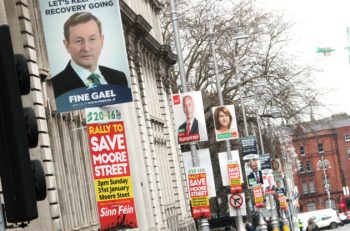
    The recent General Election was a very good one for Sinn Féin. We increased our number of TDs from 14 to 23. That’s a 65% increase – a success by any standards. Importantly, Sinn Féin also further increased the geographical spread of the party. There are now very few regions in the State in which there isn’t Sinn Féin Dáil representation. There is also in place, another whole raft of Sinn Féin representatives who, although not returned at this election are very likely to be elected next time around if they continue with the valuable work they are doing. So, Sinn Féin returns to the Dáil, not just with a significantly larger team but also with a team of very high-calibre TDs, including more women and more younger representatives. Sinn Féin had two clear objectives going into the election. The first was to get rid of a Fine Gael/Labour government that has brought chaos to housing and health, imposed unfair taxes and promoted mass emigration. We succeeded in that. In the early days of the election campaign we holed the coalition’s strategy below the waterline by proving that their figures were wrong and that they presented €2 billion which they did not have. I think we were also successful in demonstrating that you cannot have US-style taxes and at the same time invest in decent public services.Our other objective was to prove to people that there is a realistic, credible political alternative of which we are a significant part. That is very much a work in progress. We may not have succeeded, at this point, in getting enough seats to form a progressive Government but that will improve as we go on. But the realignment of politics in this State took an important step forward in this election and the next election will see that trend intensify. The political domination of Fine Gael and Fianna Fáil is finished. What we now need to do is increase the cohesion among those who advocate an alternative view of how the economy and society should be organised. Over the past five years, Sinn Féin has been the genuine voice of opposition in Leinster House, offering an alternative to the dreadful austerity policies of Fine Gael, Labour and Fianna Fáil. All of Sinn Féin’s pre-Budget submissions demonstrated a way of ensuring economic growth while also being socially equitable and protecting the vulnerable. We repeatedly warned the Government of the escalating homelessness crisis. The Government refused to listen and it became an emergency. We also consistently raised the issue of all-Ireland integration and the political, economic and social case for a united Ireland. Sinn Féin has now received an enhanced mandate to continue with that work. The post-election sham fight between Fine Gael and Fianna Fáil is nothing to do with the real issues affecting citizens. The people who were homeless last Friday will remain homeless under Fine Gael and Fianna Fáil. Patients will still languish on trolleys in our hospitals under Fine Gael and Fianna Fáil because those parties are not serious about resolving these issues. Going into this election Fianna Fáil picked up on a sense that voters were moving to the left, so they began to steal the phrases Sinn Féin was using about fairness and a recovery for all. That strategy resulted in a partial recovery of the Fianna Fáil vote itself but still left it far, far short, in his-torical terms, of where it once stood. Throughout the election campaign, Sinn Féin made it clear that we would not prop up those parties that created and sustained the economic and social crisis facing our people. That is the mandate we received and we will not break our commitments. Sinn Féin will continue to consult with others, including those aligned to the Right2Change platform, on the way forward. If not in the immediate period ahead, the objective of a genuinely progressive alternative Government in which Sinn Féin plays a lead role is a live possibility. Over 400,000 people voted for candidates aligned to the Right2Change platform to end water charges. The Fine Gael/Labour Government has been defeated and water charges should leave the stage with them. What is now clear from the election is that people voted for real change and a more equal society. Sinn Féin is committed to achieving that and to pursuing and preparing for the peaceful reunification of Ireland and the reconciliation of all our people. Whether in Government or in opposition, Sinn Féin will stick by the mandate we have been given. Gerry Adams Gerry Adams TD is President of Sinn Féin

    Loading

    Read more