independance

Random entry RSS

  • Posted in:

    Panoramaphosa

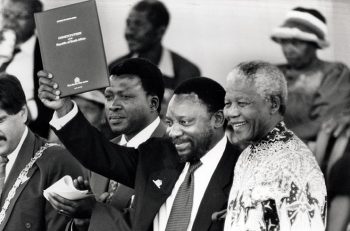
    On a recent drive to Cape Town International airport the ‘Rainbow Nation’ was nowhere to be seen. Instead it was like old times when I was the Irish Times Correspondent there in the 1990s. The scene carried a strong message of the work that faces the country’s new President Cyril Ramaphosa. Along the motorway known as ‘Settlers Way’ there was a clear run out of town to deposit the hired car and catch the early-morning flight to Lanseria north of Johannesburg. The other carriageway, the one carrying traffic into the city centre, told an entirely different story. On that side the traffic was chock-a-block and consisted almost in its entirety of white minibuses carrying black workers from the vast townships of Gugulethu, Langa and elsewhere. They were travelling in their thousands to service the needs of the white population of the city and its wealthy suburbs. Earlier that week in Franschhoek, a tourist and wine-producing town , it was also like old times. The restaurants were full of white folk of retirement age being served by waiters from the Black and Cape Coloured Communities. In Johannesburg restaurants things were different but only slightly. There were tables occupied by white clients and tables occupied by black clients but no tables at which blacks and whites dined together. These casual and anecdotal observations don’t tell the full story but they are an indication of how deeply-ingrained apartheid and its legacy have been in South African society. It will take a very long time and a great deal of patience to make significant changes but there is no doubt that the country’s new President, Cyril Ramaphosa, is a patient man. -Nelson Mandela indicated that Ramaphosa was his preferred successor but the African National Congress (ANC) was, and still is, a very complicated organisation and as in most African countries ethnic loyalties played their part in the succession stakes. Ramaphosa is a member of the small Venda nation. His opponent for the vice- presidency and eventual presidency, Thabo Mbeki, was a Xhosa, a group that produced Mandela himself, his political partners Oliver Tambo and Walter Sisulu as well as the influential churchman Archbishop Desmond Tutu. Nelson Mandela merely indicated a preference for Ramaphosa but his estranged wife Winnie mobilised the ANC Youth League behind Mbeki’s candidacy. Ramaphosa’s time for campaigning had been limited due to his involvement in negotiations on a new Constitution. All these factors: tribes, internal ANC politics and time constraints played their part in his defeat by Mbeki. Ramaphosa had to wait until December of 2017 before he could make his move. Mbeki, a small bookish man with a penchant for the poetry of W B Yeats, fell under the spell of American pseudo-scientists who peddled the theory that HIV did not cause AIDS. The result for South Africa was disastrous but the ANC’s response was predictable. As a former liberation movement, loyalty had been vital to the organisation’s very existence during the struggle against the apartheid regime but it became a hindrance to progress after the party came to power. ANC loyalty kept Mbeki in power amid a catastrophic AIDS epidemic, just as it kept Jacob Zuma in a presidency that smacked of intense corruption and maladministration. After Mbeki had won the nomination to become Mandela’s vice-president, Ramaphosa made a rare rash decision. He refused to attend Nelson Mandela’s presidential inauguration in Pretoria in 1994. From then on, however, he matured and played a political waiting game, concentrating on business opportunities that made him one of South Africa’s wealthiest men with a personal fortune of more than $550 million. During that time Zuma, a member of the Zulu nation, the country’s largest ethnicity, became entangled in a web of deals with the Guptas, a wealthy Indian business family. Corruption allegations abounded and a new glossary of political terms was spawned, the most prominent of which was ‘State Capture’ suggesting much more than personal corruption. The phrase indicates the belief that the entire State and its institutions had been ‘captured’ by the Guptas and their allies in the ANC. And Zuma was not the only ‘captured’ ANC member. In Parliament, as the popular newspaper City Press recently put it, six ministers sat in what it has been tempted to call the “Gupta Corner” of the Government front bench. Ramaphosa has recaptured the cabinet in a quick reshuffle in order to get moving but by doing so has increased tensions and enmity within his own party. The ANC’s traditional loyalty to its leader in this instance could provide a positive counteraction to its negative effects in the past. He has got off to an energetic start, setting out on early-morning exercises in his Ronald McDonald socks in various parts of the country, ranging from the promenade at the prosperous Cape Town suburb of Sea Point, to the beach at East London; and on a long walk at 5.30 am in the Cape from the black Township of Gugulethu to the ‘coloured’ community of Athlone. In each case these were exercises in building up his profile in local communities as a man of the people instead of his image as a wealthy man who loves fast cars and good wine. In parliament his State of the Nation address was delivered without interruption, a very rare happening in a place where raucous heckling is frequent. In that address he touched on the country’s problems which he has vowed to solve. The education system is in a parlous state. Poverty abounds mainly in non-white areas but also amongst Afrikaans-speaking people who have always had a “poor white” section of their community. Health services need reform. Public transport is almost non-existent with Uber taking over its role especially in white areas. There have been a number of murders of white farmers, and Ramaphosa caused raised eyebrows among them by stating in his address that he would pursue the expropriation, without compensation, of land that had been confiscated from blacks. Right-wing commentators saw their chance and

    Loading

    Read more