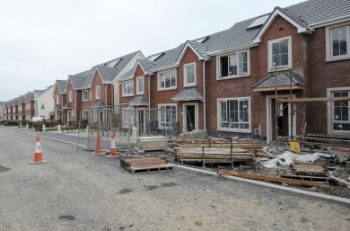
public housing

Random entry RSS

  • Posted in:

    State land could provide 114,000 dwellings

    Both NAMA (The National Asset Management Agency) and Local Authorities have been criticised for ‘land-hoarding’, ‘sitting’ on sites particularly in Dublin and the Greater Dublin Area (GDA) and not developing land that could be used to address the current housing crisis. Despite the amount of land under their control, Minister Eoghan Murphy has recently asked the Attorney General if powers to effect Compulsory Purchase Orders (CPOs) could be upgraded to encourage those with vacant homes and land to sell quickly. The enhanced powers are part of a new strategy on vacant homes and land due to be announced by Government in June (1). The Minister’s strategy is puzzling given that the State itself has been using less than one percent of its current zoned development land-banks for housing every year. Public land potential: Local Authorities, NAMA and Government A year ago the Department of Housing pub- lished ‘the Rebuilding Ireland Land Availability Survey’ which included details of State-owned land. This report confirmed that Local Authorities own zoned residential land with capacity for 37,950 dwellings (on 1,211 hectares) and that this represented just a portion of State-owned land (2). However, based on individual returns from seven Local Authorities, the figures are much higher. Local Authorities own zoned land with capacity for 48,724 dwellings nationwide (1,317 hectares). Dublin City Council owns zoned residential land with capacity for more than 18,000 dwellings and in County Dublin there is the potential to build 29,278 dwellings. When it comes to the NAMA, the picture is similar. It currently controls the loans on enough development land to build 65,399 dwellings (1,691 hectares); in County Dublin NAMA controls land with the potential for 43,075 dwellings. (3) Nationwide the State controls development land with the capacity for 114,123 dwellings (3,008 hectares) – more than 17% of all zoned residential land by area and more than one quarter of the potential housing capacity in the country. In addition, according to the Irish Times, at least 334 sites or buildings controlled by the Government are lying idle across the State, some of them for more than 30 years. The worst offender is the Health Service Executive with 137 unused buildings or sites. The other 197 sites are shared between nine Government departments, and include Garda stations, courthouses, military barracks and customs posts. Almost half of all County Dublin residential development land is State-controlled and between NAMA and Local Authorities there is the capacity for 71,425 dwellings (1,212 hectares). These figures exclude holdings owned by the Housing Agency and other State and Semi-state bodies. In Dublin City three out of every four vacant residential zoned sites are either owned by Dublin City Council or NAMA debtors. REFERENCES  1. “Government ponders increasing compulsory purchase powers” Irish Times, 14 May 2018; https://www.irishtimes.com/news/ireland/irish-news/government-ponders-increasing-compulsory-purchase-powers-1.3185489 2.“Almost 40,000 social homes could be built by local authorities” Irish Times Nov 2017; https://www.irishtimes.com/news/social-affairs/ almost-40-000-social-homes-could-be-built-by-local-authorities-1.3301442 3. NAMA Residential Delivery Updates (December 2017): https://www.nama.ie/development-funding/nama-residential-delivery-updates/. There is a reduction of 238 hectares from end-2017. There are number of factors for the reduction, including: the land has been built on, The land has been sold, the land has been re-zoned, the debtor has repaid or refinanced their debts and their loans are no longer in NAMA. In 2017, 2,503 were completed by debtors/ receivers funded by NAMA. 7,200 since counting began in 2014. Public Housing: Demand and Supply In the four years since 2014, 7,200 new dwellings have been completed by NAMA debtors and Local Authorities built 818 social homes. In the past twelve months 17,914 new households experienced rental distress and signed-on for Housing Assistance Payment (HAP). Official figures report that Local Authorities built 780 social homes (4) and a further part-State funded 1,078 were built by not-for-profit Approved Housing Bodies (5). However, when ‘turnkey’ units purchased from the private sector from developers are removed, Local Authorities built just 394 homes last year. 11 Local Authorities including South Dublin County Council built no (zero) homes. Approved Housing Bodies (AHBs) built only 270. In contrast in 2017 10.5% of all new homes sold were purchased by AHBs or Local Authorities nationwide as social housing. One year’s supply of purpose-built social housing is meeting less than two weeks of subsidised housing demand. Last year eleven Local Authorities built no social housing, including South Dublin County Council, which has more than 7,500 on housing waiting lists. Dublin County Council built just 232 homes and have more than 40,200 on housing waiting lists. Official targets for 2018 social-housing builds and acquisitions have been increased by just 11% on last year’s levels(6) (expect less than 450 Local Authority builds this year nationwide. By the end of 2018 one in three tenancies will be in receipt of some form of State rent assistance, making up almost 1950m. At current rates of increase by 2019 this annual spend on rent assistance will increase to over 11.1bn per year. In addition to zoned residential development land, the State owns massive landbanks, significant parts of which may be suitable to be re-zoned to residential use in the longer term. Even if a large percentage of the land controlled and owned by the State is not suitable for development, there is still more than enough to build 10,000 social homes per year, a recommendation of the All Party Oireachtas Committee on Housing and Homelessness in 2016 (7). The price of local authority housing (in Dublin City) should be 1175,000 for one-bed units, 1183,000 for two-bed units and 1200,000 for three-bed units. According to Simon Coveney: “The St Michael’s estate regeneration team proposal, ‘Our Community a better way: campaign for fair rental homes’, [launched on 26 April in Buswell’s Hotel] comprised 300 homes, of which 150 of which were social and 150 were cost-rental. The State would fund the capital cost of all units at a cost of 156 million. There would be a mix of one, two and three-bedroom apartments costing on average 1175,000, 1183,000 and 1200,00, respectively. Average monthly rent on a cost-rental basis would be 1900”. REFERENCES 4. Overall social housing provision | Department of

    Loading

    Read more

  • Posted in:

    Wicklow Council reacts to housing crisis

    A fiercely fought decision by Wicklow County Council officials to buy and demolish an Edwardian house in central Bray for 45 car spaces raises questions about the power of local authorities. The house, inhabited until now, was torn down on 12-13 April. Residents suspect that spending at least€1.3m to buy and replace it constitutes an indirect public subsidy to Paddy McKillen’s Oakmount/Navybrook. Oakmount is erecting the Florentine retail centre nearby, for which Wicklow council reduced the number of car spaces required compared to previous plans. Officials snubbed a last-minute appeal by local TD and Minister for Health Simon Harris who supported the residents’ call for independent legal advice before proceeding with, as Harris put it, “the irreversible action of demolishing this heritage house”. Minister Simon Harris TD and Sinn Féin’s John Brady TD, as well as the Green Party, An Taisce, Bray Cualann Historical Society and many local residents (including this writer) have objected to demolition. But a coalition of Fianna Fáil and Fine Gael councillors held firm and rejected calls by fourteen councillors for an independent legal opinion on the process followed. And the Office of the Information Commissioner has now informed residents that it has identified more than thirty records relating to St Paul’s Lodge that the council did not previously disclose to it on foot of a continuing Freedom of Information appeal by residents. Wrecking St Paul’s Lodge during a housing shortage is the latest in a series of controversies involving Wick- low County Council. Last year it was strongly criticised by a High Court judge. The Council was originally poised also to buy and demolish for more spaces at the same location a second house, occupied by Wicklow’s former county manager. Although the Council assured An Bord Pleanála that the planned Florentine centre included enough car spaces, it now claims that new spaces are needed elsewhere “urgently” and at public expense. Critics point out that at least double the number of spaces planned to replace St Paul’s Lodge are empty daily in the car park under the Council’s own civic offices on Bray’s Main Street, and objectors have also identified other alternatives. For some time critics have called on the minister for the environment to initiate an enquiry into how Wicklow Council does business. The management of Bray’s fire services and of related matters following the death of two firemen there, the presence of an illegal dump in West Wicklow that may cost the state tens of millions to clean up, the status of land near Greystones, and the sale of public properties on Bray seafront and elsewhere have given rise to concerns. It is remarkable (and not widely appreciated) that, when endorsed by a majority of councillors, plans to demolish or build on council-owned properties cannot be appealed even to An Bord Pleanála. The absence of any right to appeal may be unconstitutional. John Ryan, the Fine Gael councillor most prominently supporting demolition, recently filed a form declaring his interest in a contract to provide services to Wicklow County Council staff. But he did not inform or withdraw from meetings about St Paul’s at which councillors had to adjudicate between council staff and objectors. Nor did Fianna Fáil’s Pat Vance, who owns commercial properties facing the Florentine site. Eight of 32 Wicklow councillors represent Bray, with just one each from Fianna Fáil and Fine Gael (elected last and second-last respectively). Fianna Fáil’s Bray councillor is Pat Vance, currently deputy chair of Wicklow council. Fine Gael’s is John Ryan. Most independent councillors in Wicklow, especially retired garda Brendan Thornhill, along with Green Party and Sinn Féin councillors have strongly resisted the demolition of St Paul’s Lodge. Protesting councillors convened a special meeting of Wicklow County Council in March to question the way in which the decision to demolish St Paul’s Lodge has been taken. That meeting lasted over two hours but the large Fianna Fáil-Fine Gael bloc largely remained silent before voting against a proposal to take independent legal advice. It was backed by Bray District Chairman, Councillor Christopher Fox. Councillors from these two parties in Wicklow generally support one another, with implications for resources. Three trips abroad during the St Paul’s controversy cost the Council over €6,500 and saw Council chairman Edward Timmins in New York with the county CEO, while deputy chair Pat Vance and a Council official went to Dublin, California (twinned with Bray). With residents against the demolition of St Paul’s refused permission to address the full Council, and their requests to meet officials rebuffed since last June, such trips exacerbate a sense of exclusion. The Council told residents last June that it was examining all options for parking. In fact, as its appeal to the Office of the Information Commissioner has already revealed, the Council had earlier decided to try and purchase both St Paul’s Lodge and an adjacent house. No record has been discovered that reflects any consideration of options beyond Herbert Road. Nor have records been uncovered that record any authorising decision early last year to buy two houses, or that might reveal who inside or outside the Council first suggested this, or what budget was allocated for the transaction. The Council eventually spent well above its initial valuer’s estimate of €765,000 buying St Paul’s Lodge, and even covered the cost of the vendor’s auctioneer, solicitor and furniture removal to Spain. Residents would have campaigned earlier to stop demolition had they been frankly informed when they first enquired. They object especially to the fact that council officials closed the purchase of St Paul’s unconditionally before the necessary statutory ‘Part 8’ consultation was even commenced, and question the point of that consultation, in which 150 parties including An Taisce made submissions. The Council admits that it did not ask its own heritage officer for her opinion. Submissions opposing demolition were also not circulated to councillors but were instead dismissed in a report presented by the Council official who had directed the purchase of St Paul’s Lodge. Most of the undisclosed records now

    Loading

    Read more

  • Posted in:

    50 years since 1968

    Not a week has gone by in 2018 Ireland without several street demonstrations, especially about abortion and the housing crisis. In France, protesting is part of the vernacular. Riots are common: just look at 1789 and 1968. Ireland and France share a reputation for feistiness. A comparison between Irish and French demonstrations could be instructive. “What do we want? Public housing! When do we want it? Now!”. More than 10,000 people are currently home- less in Ireland. The demonstration I attended, organised by the National Homeless and Housing Coalition, on 7 April was good-natured: festive and serene. People played and sang music as they marched. The Garda seemed engaged and smiled while overseeing the demonstration: a safe protest. It appeared the crowd was representative of the general population, as perhaps you might want. It started at the Garden of Remembrance and ended in front of the Custom House in Dublin in light rain, as cheerful as the weather allowed. Its effectiveness was its mainstream attendance; there was no danger here. It would, I reflected, be different: more fractious, less representative, angrier – in France. Ireland fights for Human Rights At the moment Ireland is in arms over: abortion, education, sex education, health, animal welfare, drugs. But I have the sense that some of these campaigns are not mainstream, even as protests. Certainly the Water Protests were successful, albeit the underlying political message (no new taxes?) and symbolic value were not too clear. Abortion is a long-standing divisive issue in Ireland, symbolising the hegemony and, later, decline of the Catholic Church. Protests date back to 1983 when an unwise blanket prohibition was approved in a referendum. In May there will be a rerun. There are many events, debates and demonstrations on both sides, with pro-choice as fashionable politically as pro-life must have been a generation ago. The demonstration I attended in April was ‘pro-choice’- for ‘Equality, Freedom and Choice’, organised by Rosa. The rally was jubilant and confident, almost over-confident. The Daddy of all modern Irish marches is the PAYE protests from 1979-1980. Around 700,000 Dubliners marched against the stifling ‘Pay As You Earn’ tax. The BBC called it “the largest peaceful protest in post-war Europe”. But I sense things have changed since then. There is no longer an Ireland the sense that the regime is fundamentally at odds with its electorate. Perhaps it’s because the country now mostly complies with international norms or is fast moving in that direction; perhaps it’s because the country is simply much wealthier and has never been so confident. In 2003, Irish anti-war protesters organised a demonstration for peace in Iraq. The British and Americans had invaded Iraq. 100,000 walked on the streets of Dublin. It was a thoroughly internationalist protest. In 2006, a violent demonstration took place in Dublin’s O’Connell Street. For some reason Northern Unionists wanted to organise a ‘Love Ulster’ Parade to honour the victims of the IRA. A counter demonstration materialised and a riot started. Several Molotov cocktails were thrown and cars were burnt. A total amount of 14 persons were wounded and 41 arrested by Garda. Locals put the intense violence down to the alien influence of recalcitrant Northerners: it didn’t symptomise a new riot mentality. These kinds of demonstrations are pretty rare in Ireland compared to in France, where there are wide-ranging politically-driven strikes and demonstrations every year. Governments can fall as a result of demonstration culture in France. If France had had an international bailout that was forcibly inflicted on the population; if France had had the iniquities of Nama bailing out the richest failed developers there would have been strikes and riots. A country’s protest mentality varies from generation to generation. We’ll put down the Irish monster meetings and boycotts of the nineteenth century as the fruits of a different era. Where a country is colonised and not run for the benefit of the majority – or a significant minority – wideranging subversion is to be expected. In Ireland it culminated in the Easter Rising in 1916 and the War of Independence 1919-21. In the North of course discrimination against Catholics fuelled a later whirlwind. In the Bogside riots of 1969, eight people were killed, a majority Catholic, and over 150 homes destroyed; and the IRA campaign resulted in 1696 deaths. But, though important, this all speaks little to the modern-day Republic of Ireland.   France, protest pioneer French demonstrations have been well-known and lethal since at least the 18th century with a sustained and celebrated (though not of course by Edmund Burke) historic riot: the French Revolution, facilitating a declaration of the rights of man and changing forever the notion of the political establishment. In the twenty-first century, protests are still an important political phenomenon. France has been a global leader in dissent. The rockstar of street opposition was May 1968 when strikes and demonstrations led by students and workers and the occupation of universities and factories across France brought the entire economy of France to its knees and political leaders feared civil war or revolution. The moribund government itself ceased to function for a while after President Charles de Gaulle secretly fled France for a few hours in Germany. ‘68 changed France’s democracy: the super-annuated President De Gaulle resigned, the Assemblée Nationale was dissolved, and government committees were formed to restructure secondary schooling, universities, the film industry, the theatre and the news media. The Grenelle Accord gave better conditions for the unemployed, a 35% increase in the minimum wage and a fourth week of paid leave for those in employment. Mentalities started to change too with a sexual revolution from the young. Mixed schools became more common. 1968 sundered a post-War France of austerity, conservatism and asceticism. Nevertheless the movement succeeded “as a social revolution, not as a political one”. President of the Republic (2007-12) Nicolas Sarkozy famously denounced May 1968 as the source of contemporary France’s problems. The student revolts against bourgeois society introduced a “relativism”, he argued, that undermined national identity, the spirit of

    Loading

    Read more

  • Posted in:

    Get moving on that social housing

    Homelessness was always a winter story and affected individuals only. Now it’s an all-year narrative and the homeless are no longer just isolated individuals -although they are still there – but families, in all their forms and colour. Our recent research for the Housing Agency report, ‘Family experiences of path- ways into homelessness – the families’perspective’, sheds some light on the causes,consequences and features of these unwelcome developments. The research was basedon interviews with a sample of 30 families,including a mixture of family types (couples and one-parent households with children of differing ages, as well as families from minority – Traveller and migrant – backgrounds). The human story was com- pelling. Both of us, ‘seasoned’ researchers long involved in the homeless field, were shocked by the conditions and circumstances in which the families found themselves. Some were homeless for months, but for others it was years. We met families living for months in one room of a hotel. Others lived in damp basements and rooms, with heat turned on for only a few hours a day. Most of the families we met no longer had possessions, apart from those they could put in a suitcase. They were broke, having used up whatever savings they had. Parents were distressed, despairing, humiliated – often eg under curfew – but absolutely determined to ensure their children survived the experience. At a policy level there were clear findings. Almost all the families had lived in private rented accommodation: none were dispossessed mortgage-holders. Many had been in private rented accommodation that they liked, some in the same home, for long periods, whilst others moved around frequently.The problem was that this time, when they left or were evicted (the euphemistic term is ‘issued with a Notice of Termination’), they could not find an affordable alternative. They could not get back in. They typically called prospective landlords, or called door-to-door, 50, 60 times only to find the accommodation already gone, or, more likely, to be assailed with “no rent allowance here”. For some, leaving or being evicted was a sudden and brutal process: eg a violent ex-partner turning up and causing trouble, a ratinvasion or the roof falling in. For the majority, though their departure was the landlord deciding to get more rent from tenants. For tenants told to leave, the one thing theyneeded more than anything else was a reference for the next landlord, so they did not argue. Campaigns for tenants to be ‘better informed’ of their ‘rights’, when they have almost none, overlook the inequality of power. With little new housing built in recent years and a dearth of social housing, which can be traced to 1987, a previous austerity period and its cuts in spending on local authority housing, our rising population has put more pressure on accommodation. The bottom of the private rental market gets ‘squeezed’, and those on low incomes are squeezed out. As demand rises, landlords know that they can charge more. Rents move higher and higher above the rent supplement levels that the Department of Social Protection pays, putting them out of reach of those on low incomes. The introduction of the Homeless Housing Assistance Payment (HAP) which permits a 20% increase in rent supplement marks a welcome recognition that rent supplement levels are no longer adequate. The homeless families to whom we spoke had many ideas on how to solve the homelessness crisis, including the opening up of boarded-up local authority homes. For them(and we should listen), local authority accommodation was the ultimate solution, offering security, acceptable standards and affordable rent. The Social Housing Strategy 2020 – a six-year plan to address social-housing needs – commits to the provision of 35,000 new social-housing units, over half (18,000 units) of which are due to come on stream by the end of 2017, with the remainder (17,000 units) scheduled for completion by the end of 2020 at a cost of €3.8bn.While the requirement is clearly immediate, a useful additional measure has been the introduction of a Ministerial direction which requires named local authorities to allocate up to half of available social housing units to homeless (and other special needs) households for the first six months of 2015. Notably, no-one we spoke to expected to get back to private rented accommodation, ever. Kathy Walsh and Brian Harvey Kathy Walsh is Director of KW Research and Associates Ltd, and an experienced social researcher and strategic thinker with expertise in equality and integration.

    Loading

    Read more