• Posted in:

    Questions remain over Kathryn Thomas’ car brand connections despite Rose success

    By Conor O’Carroll At the midway point of the Rose of Tralee competition, the decision to break tradition and appoint Kathryn Thomas as co-host alongside Dáithí Ó Sé looks to be a success. Taking turns interviewing each Rose, Thomas and Ó Sé eased through the first night without any gaffs or wayward comments and facilitated open discussions of autism and the additional challenges the competition brings for those with ADHD. Thomas’ calm performance has prompted some to suggest her name for the now-vacant RTÉ Radio One show previously occupied by Ryan Tubridy. Much like Tubridy, however, Thomas has a close relationship with many car brands, leaving the door open to suggestions of editorial influence over the prominent radio show. There was some surprise when Thomas, also a Noel Kelly Management client, was announced as co-host of this year’s Rose of Tralee following her poorly timed announcement of her latest brand deal with Peugeot. In her Instagram post, released on the same day as RTÉ revealed Ryan Tubridy’s top-up payments, Thomas is pictured standing next to a new Peugeot 408, valued at between €40,000 to €53,000. This also wasn’t the first time the presenter of RTÉ’s ‘Operation Transformation’, formerly of ‘Rapid’ and ‘No Frontiers’ has received cars from manufacturers, having previously held lucrative brand ambassadorships with Audi and Land Rover Jaguar. Her relationship with Audi dates back to at least 2012 when she promoted the brand across social media and attended its sponsored events and showroom openings. In return for this, she received a convertible Audi A5, a car she described as her favourite accessory and praised for its Alcantara seats. After her stint with Audi, Thomas moved up to a more luxurious brand, partnering with Land Rover. As part of this partnership, Thomas received a Range Rover Evoque Plug-in Hybrid and later took part in a controversial greenwashing campaign that was criticised by the Advertising Standards Authority for Ireland (ASAI). In a now-deleted sponsored advertorial published by the Irish Times in 2021, Thomas promoted the SUV for its sustainability and zero emissions when driving in electric mode. The advertisement was part of a series of articles that drew criticism from the ASAI for not producing evidence that driving a Land Rover SUV would lead to a more sustainable lifestyle. RTÉ did not respond to questions asking whether Thomas had received permission from RTÉ management to enter into these brand partnerships. However, they did state that “RTÉ is expediting the establishment of its Register of Interests for staff and contractors, in consultation with the TUG [Trade Union Group]. The terms of reference for the register are being developed. In addition, Acting Deputy DG Adrian Lynch has written to all relevant line managers in RTÉ seeking clarification on any potential breaches of RTÉ’s journalism and content guidelines and meetings are underway”. Noel Kelly Management did not respond to a request for comment on Thomas’ behalf. The Rose of Tralee itself is intertwined with car brand sponsorship, with the website prominently featuring a competition to win a 232 Kia Ceed GT Line. Perhaps then it’s little wonder that Kathryn Thomas is very comfortable presenting it.

    Loading

    Read more

  • Posted in:

    RTÉ and Ryan Tubridy are financially rich but morally poor

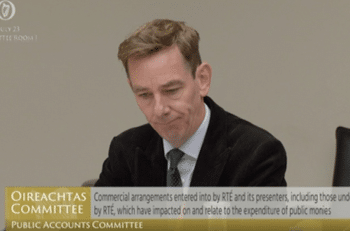
    Ryan Tubridy’s evidence to the Oireachtas Committees displays his personal values that have also characterised his broadcasting career – sadly they, and RTÉ’s, are shallow and materialistic. By J Vivian Cooke Ryan Tubridy volunteered to give an exhausting full day of evidence to two Oireachtas committees – (Public Accounts and the Tourism, Culture, Arts, Sports and Media committees) – in order to rescue both his career and his reputation. He can be satisfied that his performance last week left him in a better position than he was in at the start of the day and that he has improved his prospects of returning to the airwaves. Tubridy’s contributions were clear and polished but also focused and consistent in its messaging; for all his polite and respectful congeniality there was plenty of steely resolution on display. There was also an obduracy in how he continued to characterise the payments at the heart of the controversy. Ryan Tubridy’s income paid by RTÉ was not reduced. Although he is correct in saying that the money that RTÉ paid him directly for his broadcasting work was reduced. But this pay cut was made up by a separate contract between Renault and Tubridy for €75,000 per annum for personal appearances. Tubridy’s position is that the calculation of his salary from RTÉ should not include the €75k p/a payments as they were not for his broadcasting work. He maintains this position even after the revelation that the amount Renault paid to him was offset by a reduction of the same amount in how much RTÉ charged Renault for advertising. Moreover, Tubridy’s contract stipulated that RTÉ indemnify him for any failure by Renault to make the contracted payments. When Renault withdrew from this direct contract with Tubridy, this guarantee was called on and RTÉ ended up paying Tubridy €150,000 (2 payments of €75,000) directly – not mediated through the series of transfers of earlier payments. As it transpired, RTÉ funded Tubridy’s payments either indirectly through their credits to Renault or directly once the guarantee was invoked. The fact that Tubridy, or Kelly for that matter, was not aware of how these payments were structured does not validate their factually incorrect assertions. Yet they refuse to correct their position in the face of the established facts. Still, the evidence in the public domain clears Tubridy of any culpability in and any knowledge of dodgy accounting practices. While Tubridy has acknowledged that he has made some mistakes over the years in not questioning or challenging erroneous RTÉ statements, he feels, with good reason, that RTÉ used his celebrity as a diversion from its own delinquencies. In response, Tubridy and his agent attempt to apportion all of the blame for the scandal at RTÉ’s doorstep. However much this is true for the presenter, many committee members repeatedly quizzed Kelly about his participation in the deceptions and questioned the credibility of his evidence. Kelly is Tubridy’s agent in both the show-business sense and in the sense that he is authorised by Tubridy to represent him and to act on his behalf. As such, Kelly’s actions reflect on Tubridy’s character – particularly given Tubridy’s repeated declarations of faith and trust in his agent even in light of the revelations put to him. Both Kelly and Tubridy displayed complete indifference to ensuring the facts of the payments were accurately stated. Kelly provided the invoices that facilitated RTÉ’s accounting deceptions when requested. Their stated objections to the recording of his end-of-contract payment that he forewent were faint and not pursued. The fact that Tubridy, or Kelly for that matter, were not aware of how these payments were structured does not validate their factually incorrect assertions. Yet they refuse to correct their position in the face of the established facts. Like the presenter’s own shows, and, sadly, too much of RTÉ’s output, their behaviour at the time was complacent when confronted with commercial impropriety; was to avoid forcefully challenging or questioning those in power; and above all, not to be disruptive nor create problems. Kelly’s actions reflect an ethos that he shares with Tubridy – a corporate sensibility that is concerned with financial profit while being spiritually bankrupt. While Tubridy has not disputed that, in his own words, his salary was “eye-watering” he makes no apologies for seeking to extract the maximum remuneration from RTÉ or other companies. Tubridy repeatedly stated that he employs Kelly to maximise his income without any consideration of the appropriateness of the quantum of those payments in the context of the company or society that ultimately pays his fees. Tubridy’s commercial personal ethics translates to promoting crass consumerism that sacrifices environmental survival or social equity for the sake of material acquisition. It is a value system that is selfish and narcissistic in its utter unconcern for anyone or anything else. The problem with Tubridy in this instance and throughout his career is not what he has done but what he fails to do.

    Loading

    Read more

  • Posted in:

    PAC fails to prick Tubridy’s story.

    Having promised to provide box office viewing, today’s Public Accounts Committee failed to deliver meaningful answers to important questions. By Conor O’Carroll After three hours of questioning by the Public Accounts Committee, Ryan Tubridy and his agent, Noel Kelly, emerged largely unscathed following a failure by the committee to ask direct, pointed questions that reached the heart of the ongoing scandal. Despite a long opening statement from Tubridy, it quickly became apparent that Kelly’s presence at the committee was to serve as a shield for his star talent. His insistence during his opening statement that “this is not the Ryan Tubridy scandal. This is the RTÉ scandal” is proof of that strategy. At one stage, while a question was being posed to Tubridy, Kelly even interjected, requesting permission to answer on behalf of his client. However, his eagerness to defend Tubridy was premature, as Tubridy himself turned to him and said, “we don’t even know the question yet”. Kelly later said that he “sees people as brands”, a stomach-turning equivalence that goes some way to explaining why he leapt to Tubridy’s defence at every opportunity. He was merely protecting brand Tubridy, hopeful no doubt that his star man will return to the airwaves in due course. During the following quizzing from members of the committee, a common theme emerged where Tubridy attempted to absolve himself of all ethical and moral responsibility, pointing the finger at his agent, who then in turn pointed the finger at RTÉ. While Kelly’s repeated answers of ‘we were just following RTÉ’s instructions’ bordered on unbelievable at times, the committee failed to bombard either witness with pointed follow-up questions. The closest we came to a bruising came from Alan Dillon TD, who focused on one of the most pertinent outstanding questions: was Noel Kelly, and by extension Ryan Tubridy, complicit in the potential fraud raised by RTÉ former Chief Financial Officer in a Public Accounts Committee hearing two weeks ago. However, Kelly resorted to the now tried and tested rebuttal, stating that “we were just following process…the lack of credibility is on RTÉ’s side”. Further questioning on the issue failed to move beyond this answer. Questions regarding why the invoices were met by two different companies (both owned by Noel Kelly), and later why the tripartite deal was not signed by Noel Kelly Management until April this year, were left similarly unresolved. The blame was laid squarely at the feet of RTÉ, with the insinuation being that Tubridy and Kelly were just pawns in the game of chess played by the executive board. Kelly’s insistence that the tripartite agreement was “brokered by RTÉ” further attempts to disassociate both himself and Tubridy from the mess created as a result of this scandal. Having been hyped up on social media as essential viewing since it was announced, today’s Public Accounts Committee failed to bring about answers to the remaining questions in this saga. Little was actually learnt about the details of the arrangement, and Kelly was largely permitted to reiterate the same response every time: It’s not us, it’s RTÉ. Disappointingly, perhaps the most memorable exchange came right at the end when Chair of the committee Brian Stanley TD asked what Noel Kelly sold for Cadbury’s. The laughter in the room and subsequent response on Twitter says it all about today’s hearing.

    Loading

    Read more

  • Posted in:

    Tubridy’s environmental heedlessness is on show with his motors.

    RTE’s lead talent has rarely covered environmental topics and the range of gas-guzzling cars he drives goes some way to explain why. By Conor O’Carroll. Amid the ongoing controversy over payments made to Ryan Tubridy through a barter account by RTÉ as part of a sponsorship arrangement with Renault, his relationship with cars ought to be examined. Particularly against the background of the dramatic lack of environmental coverage showcased on his TV and radio shows down the years. Last week, People Before Profit TD, Paul Murphy, told the Dáil that The Late Late Show had covered climate change just twice in its history, questioning whether sponsors were exerting editorial influence over the show’s production. Renault has been the show’s main sponsor for eight years – the longest in its history – and details of the agreement between Renault, RTÉ and Tubridy are now the focus of intense public scrutiny. And it is difficult to forget Tubridy’s controversial comments on RTÉ Radio 1 back in 2019, where he criticised climate campaigner Greta Thunberg’s impassioned speech to a United Nations summit. He claimed that watching her, he wasn’t thinking about the climate. Instead, he appeared to focus on her appearance, describing “her face contorted in pain, in agony and in anxiety”, adding that he felt her campaign to save the planet was “not good for her mental health and wellbeing”. Tubridy continued his dismissal of Thunberg by suggesting she “return to the simple things”, such as being brought home to watch a movie or go for a walk, as if to say ‘leave this stuff to the adults’, whilst ignoring the fact that ‘the adults’ are part of the reason we’re on the verge of an environmental catastrophe. He later apologised for his comments. The reticence over environmental causes begins to make sense when examining Tubridy’s relationship with cars. It appears he favours a gas-guzzler. And of course, there’s the nostrum that you cannot convince people of the truth of something if their pay packet depends on not recognising the truth. The issue of RTÉ ‘talent’ receiving sponsorship deals to drive cars is far from a new phenomenon. Tubridy himself had a brand relationship with Lexus, signing a two-year contract with the manufacturer in June 2003 “to drive an IS200 and to participate in a number of Lexus customer events and promotions”. In an interview with the Irish Independent in 2004, Tubridy remarked how much he enjoyed the heated seats on his luxury car. Nice and cushy. However, those heated seats fell short, because after Lexus rejected Tubridy’s request for a larger, more expensive model, their partnership ended and Tubridy returned to driving a BMW, as he had before the arrangement with Lexus. Unluckily for Tubridy, it was around this time that the German manufacturer announced its decision to end its ‘brand ambassadorship’ programme, requiring several RTÉ ‘stars’ to return their sponsorship cars to the company. I drive an old car, it’s an ’07, but it’s a beautiful looking car Tubridy was not a part of this programme, though BMW did confirm he had approached the company about upgrading his current car to a newer, flashier model. Several years on from this, it was reported that Tubridy had elevated his choices, swapping his BMW for a swanky Jaguar XJ. It’s a brand he appears happy to promote, having been pictured alongside former Ireland and Leinster scrumhalf Eoin Reddan in front of a brand-new Jaguar F-TYPE in 2014 as part of the inaugural Jaguar Golf Classic for the Irish Youth Foundation. Jaguar Ireland insists that Tubridy has never been part of their ambassadorial scheme, stating that “while he may personally own and drive a Jaguar, that is not, in any way, directly linked with Jaguar”, and that “any attendance at events was also on a personal level and no way part of any partnership with the brand”. From here on, the make and model of Tubridy’s car of choice is difficult to pinpoint, though he is always quick to remind us of how old his car is. A 2021 interview with The Times makes pointed reference to the fact that the car parked in his drive is 14-years-old, and during a discussion of electric cars on his radio show in 2022, he repeatedly reiterates that “I drive an old car, it’s an ’07, but it’s a beautiful looking car”. Let’s face it: it’s not truthful to describe an old Jaguar as an old car: the connotation is misleading. These reminders attempt to convey a sense that Tubridy is ‘just like everyone else’, a narrative that has been truly shattered following the revelations over the past few weeks. It also doesn’t help that in 2020, before this grandstanding about how old his car is, he can be pictured leaning out of what appears to be a modern Volvo. It’s impossible to say whether this is the car Tubridy refers to, but the car certainly doesn’t appear to be 14-years-old. With such a list of petrol-burning automobiles, it’s little wonder that Tubridy’s environmentalism is elusive. Having suggested that Thunberg went for a walk, perhaps a humbler Tubridy may accept that he needs to get out of those cars to retain the public confidence on which his career depends.

    Loading

    Read more

  • Posted in:

    BAIance under threat

    The well-worn phrase “it’s all over bar the shouting” couldn’t be more apt with regard to the Referendum which repealed the eighth amendment to the constitution (article 40.3.3). The referendum is all over, the shouting has begun and it is going to continue for some time. So far the shouting has been confined to a small number of very conservative Catholics on the one hand and people whose fury at the Catholic Church knows no bounds on the other. These relatively small numbers will grow. When clinics to provide abortion eventually open they will be picketed by conservatives and the pickets in turn will probably be picketed by left-wing groups. This has been the experience in the United States but at least in Ireland we can be reasonably confident that neither side will be armed. It is important that Ireland studies the American experience not only in order to learn from it but also because there is little doubt that US activists were involved in the referendum, largely on the NO side, but possibly in smaller numbers in supporting the winners. That the US is ultra-sensitive to foreigners intervening in its own electoral events added a touch of irony and paradox to the procedure. The decisions by Facebook to ban advertising from outside Ireland and by Google to ban all advertising highlighted the total absence of regulation not only of social media in general but also of the online activities of mainline broadcast media. Here’s an example of what is possible in a referendum or general election. The Broadcasting Authority of Ireland lays down the guidelines for election and referendum coverage and these include a moratorium on broadcasts from 2.00pm onwards on the day before the vote. So let’s take the case of a fictitious broadcaster called Radio Populism or RP for short. Its talk show is drawing a large listenership as 2.00pm approaches. One of the speakers says he is about to reveal some devastating information concerning corruption and bribery by his opponents. Just as he starts to make his statement the clock strikes 2.00pm. If the broadcast continues then RP will be in breach of the guidelines and get itself into trouble with the BAI. The presenter, however, makes an announcement saying that the discussion will be brought to an end on air but will continue as a podcast on the station’s website. RP, therefore, will move from the highly-regulated sphere of traditional broadcasting to the unregulated territory of the internet. Once that switch from one medium to another has been made the moratorium will not be broken because the BAI has no authority over internet podcasts and the only things that can deflect the speaker from accusing his opponents of bribery and corruption are the Courts of Justice and the law of the land in the form of the Defamation Act of 2009. The year 2009 was a busy one for legislation for it also saw the arrival of the Broadcasting Act under which the BAI was set up and the regulation of broadcasting in Ireland was brought up to date. Since then there has been an exponential growth in internet media, social and otherwise. What was up-to-date in 2009 is now outdated to almost prehistoric levels in 2018. One thing that has happened according to successive surveys is that a large majority o the younger cohort of the population listens to radio and watches TV over the internet rather than by traditional broadcast means. In our hypothetical case above while older listeners might have made a dash from radio to laptop to stay with the programme their younger fellow citizens would probably have used the unregulated internet to access the broadcast from the start. In years to come, therefore, the BAI could find itself with nothing to regulate. There are a number of options. The Act could be allowed to stagnate and we could be off on a Limbaugh-dance to US style Shock-Jock podcast radio where the concept of balance and impartiality of any sort would simply not apply. There are plenty of people with right-wing views who would welcome such a situation and who have enough money to exploit its political and social advantages. On the other hand a new Broadcasting Act could be introduced in an attempt to bring broadcasting regulation particularly in the area of coverage of the democratic process into line with today’s reality. The first necessity in any new legislation should be a re-organisation of the BAI itself. It is staffed by a highly professional group of public servants whose expertise made an extremely positive impression on me during my membership of the Authority’s board. Apart from the most publicised activity of dealing with complaints against broadcasters the BAI gives financial assistance to broadcasters under its Sound and Vision scheme and this has led to the production of very-high-standard programming especially from smaller independent companies with limited funds of their own. But the set-up imposed on the BAI by the 2009 Act has led to a highly-complicated situation which has been described, with reasonable accuracy, from within as a “three-headed monster”. The three heads are as follows: 1) The Authority which is essentially the board of directors of the BAI and set the strategic direction of the organisation. 2) The Contract Awards Statutory Committee that does exactly what it says on the tin. It awards licence contracts to broadcasters. 3) The Compliance Committee is another statutory body and it monitors broadcasters for compliance with broadcasting regulations such as impartiality. It also investigates complaints against broadcasters and publishes its decisions. But it’s even more complicated than that. As might be expected in any public or private company, decisions of the Contract Awards Committee are put to the board of the Authority for ratification. The Authority is, after all, the board of directors. The Compliance Committee’s decisions, on the other hand, are not ratified by the board. In effect therefore the Compliance Committee is an independent body with some membership links to the Authority itself (it includes two Authority members and two members of the

    Loading

    Read more

  • Posted in:

    Capitalisteracy

    Ireland has a dreadful, inequitable, dangerously failing healthcare system. The State’s answer is the likes of healthy Ireland, which runs a public campaign that, in essence, throws the responsibility for health on to individuals – who seemingly just need help from an initiative to ‘empower and motivate them’. February saw the launching conference – hosted by the Broadcasting Authority of Ireland (BAI) at Facebook Ireland HQ – of a new network, Media Literacy Ireland (disclosure: I’m in it). From the conference stage there was lots of talk about empowerment and not much talk exploring from whom it might be necessary to take power away. There was even a speaker from healthy Ireland, lest the analogy be missed. Don’t be surprised, then, to encounter an Irish campaign in the next year or two imploring you to the media equivalent of ‘eat your vegetables, get some exercise, don’t smoke cigarettes’. Something along the lines of ‘read the Irish Times, trust in Miriam, don’t tweet fake news’. Or maybe not. Media Literacy Ireland potentially has some of the hallmarks of industry-friendly campaigns like Drink Aware and Gamble Aware, plus the involvement of a regulator, the BAI, which might like a campaign that implicitly justifies light-touch regulation abetted by ‘greater public awareness’. On the other hand – and credit to its organisers for this – Media Literacy Ireland has come into being as a genuine network of interested researchers, activists, community-media practitioners and others. And most of us in it are not disposed to frame the problem with Irish media as one of public credulousness, to be addressed by offering tips for spotting ‘extremism’ online. Regular readers will know my view: that media (like healthcare) have a capitalism problem, and that everything from fake news to clickbait to inadequate investigative resources to Denis O’Brien ows from that basic source. But you don’t have to agree with me and name the underlying problem as capitalism to understand that there are structural causes for crises such as the one that erupted recently over Government ‘advertorial’. “I believe the Government is attempting to exploit the difficulties many local and regional titles are facing to promote their party interests”, said no less a media critic than Fianna Fáil’s Timmy Dooley, the party’s spokesman on communications. (How sweetly old-fashioned that word ‘communications’ can sound as it grapples with the changing world.) Media literacy, if it is to be of any use, has to do more than implore us to look for the little ‘special feature’ tag on the top of a piece of paid corporate or government puffery, then to regard the ‘journalism’ below with due scepticism. It must mean understanding ‘the difficulties’ for all journalism that operates in the current market, especially one in which technological change has accelerated existing trends toward blurred lines, and in which advertisers have alternatives to local and regional newspapers when it comes to reaching eyeballs. If the most poignant aspect of that brief, quickly snowed-under ‘Ireland 2040’ crisis was the image of the Taoiseach issuing guidelines for labelling advertorial content – guidelines of which the most callow intern in a local newsroom should surely already be aware – we shouldn’t lose sight of the fact that media have been operating at the edges of such guidelines for decades, for the benefit of advertisers looking to buy a little ersatz editorial credibility. How can this fail to be a lesson about how fragile, at best, any such credibility has become ? As the media may or may not have told you, global research shows trust in media is in tatters – media are less trusted than governments, NGOs, businesses – and Irish people are at the mistrustful end of the distribution. In this context, media literacy can hardly consist of legacy media saying ‘trust us, not them’. What can be done ? (Yes, short of getting rid of capitalism.) Anyone who has worked in a newsroom knows what a frightening prospect it would be to try to earn the public’s trust with transparency and accountability about our editorial practices. On a daily basis, contingent and incomplete information is transformed into definitive statements of ringing certitude. That’s one sausage factory we don’t want you to see inside, especially since the work often consists of sticking our label on someone else’s meat. The irony is that the technology often over-simplistically blamed for creating the journalism crisis has long offered tools for remarkable transparency, tools that most journalists have chosen to use only in limited ways. What if hyperlinks in journalists’ stories led not to dull pages of cross-references or to Wikipedia, but rather to images of documents and notebook pages, audio of interviews, pictures of the journalist in the field ? It can be done and has been done, but the experiments in transparency of the early web – notably the extraordinary 1996 investigative series by the aptly named Gary Webb in the San Jose Mercury news, about the CIA’s involvement in the cocaine trade – have rarely been repeated, let alone built upon. Such transparency would foster media literacy without the onus being placed on the audience. Whether it would foster trust is, of course, a matter of what audiences thought of the practices revealed by transparency. Interactivity and social media mean we have some tools whereby that reaction could be tested and gauged. Dublin Institute of Technology, thankfully, is prepared to put its money where my media-literacy mouth is: it’s funding a project that will will use the Liberty, a student- produced ‘hyperlocal’ newspaper and website for Dublin’s Liberties area, to innovate in the area of journalistic transparency. We’ll employ social media as a forum for sharing ‘the story behind the story’, with tweets, Facebook updates, Youtube videos and Instagram posts that unveil aspects of the production of journalism, from notebook pages to editing history, from who-was-interviewed to who-refused. A doctoral-level researcher will be responsible for implementation, monitoring, community engagement and evaluation of this project, which should help readers to understand better the process of news construction, and help journalists-in-training become accustomed to

    Loading

    Read more

  • Posted in:

    Classholes

    Last month the early departure of another Garda Commissioner drew much media attention – probably more than it deserved, given that the wheels keep turning, the Gardaí still show up for work, and the ship of state creaks on. The change, if any, will be largely cosmetic. But the week before the Commissioner “retired”, a man was shot by a garda in Dublin city. The garda was off-duty. The man was unarmed. This came in the wake of revelations that have seriously damaged the credibility of An Garda Síochána, from the conspiracy to smear whistleblower Maurice McCabe, to the penalty-points fiasco, to doctored drink-driving stats. But there were no signs of concern in our media about the shooting of an unarmed man. Our journalists, instead of querying the chain of events that led to an unarmed man being shot by an off- duty garda, swallowed and regurgitated the Garda line without question. The victim of this shooting was smeared as “known to gardaí” before any inquiry, let alone court case. Due process, but not for the working-classes m’lud. The Sun asserted the victim was a “close associate of well known gangster”. Of course no source was cited for this information. Crime reporting still operates to a standard of citation that would not be acceptable in an undergraduate essay. One can only assume this information came from the Garda, but are they to be trusted? Forgetting the recent scandals that led to the “resignation” of the previous Commissioner, and calls for the current Commissioner to step down also, there are other serious questions about credibility. The Judge in the Jobstown trial, for instance, had to instruct the jury to disregard all Garda evidence . This is all well-known and on the public record, and should counsel caution when it comes to trusting versions of events put forward by our police force. In the case of a shooting, it is folly to accept without question an account that comes solely from the person doing the shooting. This is elementary, self-evident. There is far too much motivation to paint a picture that exonerates them. And unsurprisingly that is the picture that has been painted. Worse, this is the second time in just over a year this has happened. Last summer an unarmed man was shot in the face. This was similarly reported as an “accident”, before any inquiry, and without the remotest semblance of investigative reporting, or even critical thinking on behalf of our journalists. That very day, RTÉ News reported the victim of that shooting was a suspect in a spate of burglaries. This is not some tabloid, this is the national broadcaster. Similar stories were published in a other media. How did they know this to be true? Why do they feel justified in applying uniquely low probative standards? They didn’t say but one can assume they heard it from the Garda, the same organisation whose member carried out the shooting. So, before any inquiry the shooter was exonerated (it was “accidental”) and before any court case the victim was implicated (“known to gardaí”). Despite the fact An Garda Síochána are supposedly being subjected to an ever increasing level of scrutiny by politicians and media both, precisely the same events had played out again. The message this sends is that gardaí can shoot young men without any criticism from our press. Our media remain beholden to the Garda in a sort of dysfunctional symbiotic relationship. Gardaí continue to give them stories at individual discretion, which risks leaving journalists in thrall to a police force that has, we know, been compromised by scandal after scandal, many relating to honesty and veracity. The feudal bestowing of stories on favoured journalists makes a mockery of the concept of independent journalism. It is disgraceful that this situation persists given the ongoing revelations about An Garda Síochaná. No better is the near-silence of the liberal commentariat on this issue. Those who paid easy and empty lip service to the ‘Black Lives Matter’ movement couldn’t seem to care less when the poor people getting shot are from closer to home. Class remains one of the biggest predictors of life outcomes in this country. More people die of economic inferiority in this country every year than died in 30 years of the Troubles. Even when our police force are shooting unarmed men, Irish liberals side with the establishment, in untypical silence. This “must have deserved it” mentality is a mirror image of the prejudice which allows innocent black men to be killed in their droves in America. In Ireland, those who shout loudest for equality for races, genders and sexualities are hypocritically squeamish about…class. Frankie Gaffney

    Loading

    Read more