Social

Random entry RSS

  • Posted in:

    BAIance under threat

    The well-worn phrase “it’s all over bar the shouting” couldn’t be more apt with regard to the Referendum which repealed the eighth amendment to the constitution (article 40.3.3). The referendum is all over, the shouting has begun and it is going to continue for some time. So far the shouting has been confined to a small number of very conservative Catholics on the one hand and people whose fury at the Catholic Church knows no bounds on the other. These relatively small numbers will grow. When clinics to provide abortion eventually open they will be picketed by conservatives and the pickets in turn will probably be picketed by left-wing groups. This has been the experience in the United States but at least in Ireland we can be reasonably confident that neither side will be armed. It is important that Ireland studies the American experience not only in order to learn from it but also because there is little doubt that US activists were involved in the referendum, largely on the NO side, but possibly in smaller numbers in supporting the winners. That the US is ultra-sensitive to foreigners intervening in its own electoral events added a touch of irony and paradox to the procedure. The decisions by Facebook to ban advertising from outside Ireland and by Google to ban all advertising highlighted the total absence of regulation not only of social media in general but also of the online activities of mainline broadcast media. Here’s an example of what is possible in a referendum or general election. The Broadcasting Authority of Ireland lays down the guidelines for election and referendum coverage and these include a moratorium on broadcasts from 2.00pm onwards on the day before the vote. So let’s take the case of a fictitious broadcaster called Radio Populism or RP for short. Its talk show is drawing a large listenership as 2.00pm approaches. One of the speakers says he is about to reveal some devastating information concerning corruption and bribery by his opponents. Just as he starts to make his statement the clock strikes 2.00pm. If the broadcast continues then RP will be in breach of the guidelines and get itself into trouble with the BAI. The presenter, however, makes an announcement saying that the discussion will be brought to an end on air but will continue as a podcast on the station’s website. RP, therefore, will move from the highly-regulated sphere of traditional broadcasting to the unregulated territory of the internet. Once that switch from one medium to another has been made the moratorium will not be broken because the BAI has no authority over internet podcasts and the only things that can deflect the speaker from accusing his opponents of bribery and corruption are the Courts of Justice and the law of the land in the form of the Defamation Act of 2009. The year 2009 was a busy one for legislation for it also saw the arrival of the Broadcasting Act under which the BAI was set up and the regulation of broadcasting in Ireland was brought up to date. Since then there has been an exponential growth in internet media, social and otherwise. What was up-to-date in 2009 is now outdated to almost prehistoric levels in 2018. One thing that has happened according to successive surveys is that a large majority o the younger cohort of the population listens to radio and watches TV over the internet rather than by traditional broadcast means. In our hypothetical case above while older listeners might have made a dash from radio to laptop to stay with the programme their younger fellow citizens would probably have used the unregulated internet to access the broadcast from the start. In years to come, therefore, the BAI could find itself with nothing to regulate. There are a number of options. The Act could be allowed to stagnate and we could be off on a Limbaugh-dance to US style Shock-Jock podcast radio where the concept of balance and impartiality of any sort would simply not apply. There are plenty of people with right-wing views who would welcome such a situation and who have enough money to exploit its political and social advantages. On the other hand a new Broadcasting Act could be introduced in an attempt to bring broadcasting regulation particularly in the area of coverage of the democratic process into line with today’s reality. The first necessity in any new legislation should be a re-organisation of the BAI itself. It is staffed by a highly professional group of public servants whose expertise made an extremely positive impression on me during my membership of the Authority’s board. Apart from the most publicised activity of dealing with complaints against broadcasters the BAI gives financial assistance to broadcasters under its Sound and Vision scheme and this has led to the production of very-high-standard programming especially from smaller independent companies with limited funds of their own. But the set-up imposed on the BAI by the 2009 Act has led to a highly-complicated situation which has been described, with reasonable accuracy, from within as a “three-headed monster”. The three heads are as follows: 1) The Authority which is essentially the board of directors of the BAI and set the strategic direction of the organisation. 2) The Contract Awards Statutory Committee that does exactly what it says on the tin. It awards licence contracts to broadcasters. 3) The Compliance Committee is another statutory body and it monitors broadcasters for compliance with broadcasting regulations such as impartiality. It also investigates complaints against broadcasters and publishes its decisions. But it’s even more complicated than that. As might be expected in any public or private company, decisions of the Contract Awards Committee are put to the board of the Authority for ratification. The Authority is, after all, the board of directors. The Compliance Committee’s decisions, on the other hand, are not ratified by the board. In effect therefore the Compliance Committee is an independent body with some membership links to the Authority itself (it includes two Authority members and two members of the

    Loading

    Read more

  • Posted in:

    Equality over freedom

    Politics is a continuum from equality to freedom. If freedom is the vertical axis of a graph and equality the horizontal axis, every society – and every citizen – decides where the balance should be. A libertarian society tending towards survival of the fittest will not foster equality; an egalitarian society may need to be enforced by a strong state to the detriment of individual licence, and so on. Philosophers from Tocqueville to Hayek to mainstream liberals accept there is a trade-off. Village tends to the egalitarian end of the scale: truly free equality, after education and reflection – precise processes for which have been touted by many modern philosophers – is a mature and more stable goal than equal freedom. Workaday politics can be charted and defined on the graph. However, the same political action can be justified by different points on the graph. Issues like divorce, gay marriage, and abortion can be deemed imperatives of either freedom or equality. In this respect the language used is not a definitive indicator of the politics. A campaign can claim to be about equality but in fact on analysis be defined by positions only of freedom. Any campaign fronted by Simon Harris or Leo Varadkar – agents above all of the propertied, of the status quo for the wealthy – is unlikely to be rooted in any real substantive equality. It is perfectly legitimate to campaign for gay marriage or abortion because you want yourself or others to exercise rights to freedom to get married or have an abortion. Telltale signs if you do so you may include that you are less likely to make common cause with campaigns for others suffering discrimination of all sorts. You may ignore issues like racial equality, Travellers rights; you may express no concern about economic, social and educational inequalities. It is legitimate but it is not Village’s political motivation of preference. For Village recent referendums reached the right solutions but were disappointingly rooted in the politics of freedom rather than that of equality. The egregious wrongs in Irish society are best resolved by solutions driven by equality. This society above all facilitates those who are economically adroit. It provides opportunity for people who are strong; worse still it provides opportunity for them to make mistakes (trashing the environment is the one posterity will most register). It provides very little vision as to how they should exercise their freedoms. – this is in part the problem of 100 channels but nothing on the television. But on a societal scale. It is now time to move on to new agendas that are really radical. These include: agendas of radical redistribution of wealth in society, of radical changes to the opportunities available to those who have suffered traditional discrimination, including (still) to women and to those of minority sexual orientations, to racial minorities including Travellers; of educational opportunities facilitated by positive discrimination so even (or especially) the poorest in society can be whoever they want to be; of redistribution of power so it is exercised at the lowest, most local, most democratic levels; of attenuation of property rights so they are exercised in the common good. The goods in society should be distributed by that society so those least well off are most compensated. Everyone in society is morally equal, they should be treated by society in a way so they can participate in the fruits of the earth equally. It is a myth that the fruits of the earth are distributed in accordance with merit – they have been accumulated largely by force and luck. The idea that in 2018 a child’s future is determined by the time it reaches two years old is an abomination. Ireland is growing up politically. Ireland has waved good-bye to the invidious influence of an unrealistic Church and voted the right way on divorce, gay rights and abortion. However, these are really liberal causes focused on issues of identity. It is time we addressed the issues of endemic inequality enshrined down the generations. As regards the Constitution we do need to abolish Article 41 which recognises the woman’s life within the home, so devaluing women who choose not to work within the home; and to eliminate the part of the preamble which invokes the Constitution “in the name of the Holy Spirit”. Indeed the Constitution’s premises relate to another era and the whole document should be reconceived. More generally, materialism, capitalism and competition have had their day, it is time to welcome in a new agenda – of equality of outcome/condition: equality of wealth and power, of quality of life, of environment, of education, of fulfilment and happiness, of respect and opportunity. This should be achieved through politics and laws. The constitution should be amended to reflect it too. The most radical change would be to enshrine equality of outcome/condition as a constitutional imperative across the range.

    Loading

    Read more

  • Posted in:

    Transfer pattern augurs well for Left

    Transfers matter under proportionate representation though perhaps more for psephologists and party tacticians than in terms of actual electoral difference. Noel Whelan, for example, notes that: “only 12 or 13 of the 158 deputies in the new Dáil will win their seats because of transfers. If we stopped counting after the first counts and declared the results, all but a dozen or so of the seats would have been filled by the same people”. The most dramatic difference transfers made was of Maureen O’Sullivan, a notably gentle and non-partisan independent in Dublin Central. She polled badly on first preferences, getting just 1,990 votes. The quota was 5,922. She was in sixth place. Everyone assumed she was out for the count but in the end she took the last of the three seats. In the same constituency in 2007 Bertie Ahern, then ascendant Taoiseach, brought in his running-mate Cyprian Brady in 2007, though he had polled 939 first preferences. The only other candidate ever to be elected with fewer than 1000 first preferences was Brian O’Higgins (later President of Sinn Féin from 1931–1933) elected in Clare in 1923 on DeValera’s transfers. The Right to Change campaign, which involved around 100 candidates, both party and non-party, helped Sinn Féin to secure transfers that pushed a number of their candidates over the line. As well as a strong transfer pattern (76% as opposed to 58% in 2011) between SF candidates running in the same constituency the party enjoyed a good return of more than 23% from other left candidates who endorsed the campaign. In Dublin Bay North, which had one of the longest counts in the election, Denise Mitchell of Sinn Féin was assisted by significant transfers from John Lyons of People before Profit (PBP) as well as from her party colleague, Micheál MacDonncha who was eliminated at an earlier stage. Similarly, SF candidate and trade unionist, Louise O’Reilly, won a seat following strong transfers from Barry Martin, also of PBP and a running mate of Clare Daly’s in the Fingal constituency. Richard Boyd Barrett who was always likely to take a seat in Dun Laoghaire, was helped by the votes transferred from Sinn Féin candidate Shane O’Brien on his elimination. Across the country, there were other examples of the Right to Change arrangement benefitting successful candidates. AAA-PBP transferred significantly more votes to Sinn Féin than any other party with independents the next block to gain from their transfers. Sinn Féin performed exceptionally in its internal transfers with an unprecedented rate of 76% which augurs well for its future prospects where it stands two candidates. Sinn Féin has historically been quite transfer unfriendly, but in 2016 they have improved significantly on their own transfers as well as taking 28% of the transfers from AAA-PBP. With the exception of Donegal where it overrated its chances of taking three of the five seats, leaving Pádraig MacLochlainn as the party’s most prominent casualty, it came close in several other constituencies to bringing in a running mate. Fine Gael also displayed strong transfer discipline. The transfer rate between Fine Gael candidates was much better than that between Fianna Fáil candidates. In 2016 this discipline brought Fine Gael an even bigger seat bonus than it got in 2011. It benefited from 54% of its own transfers as well as 53% of those of Labour candidates. What is also evident and perhaps a harbinger of the future is the number of transfers between Fine Gael and Fianna Fáil. Where a candidate had no running mate or he or she had been eliminated or elected, Fine Gael was more likely to transfer to its big right-wing rivals than any other party and vice versa. 18% of FF transfers went to FG candidates and 16% of FG transfers nished up with FF. As the two beasts prepare the ground for an historic coalition it would seem that their supporters do not share the view that their differences would make the ending of civil war politics impossible. Frank Connolly

    Loading

    Read more

  • Posted in:

    SF won’t prop up FF, FG or Labour

    The recent General Election was a very good one for Sinn Féin. We increased our number of TDs from 14 to 23. That’s a 65% increase – a success by any standards. Importantly, Sinn Féin also further increased the geographical spread of the party. There are now very few regions in the State in which there isn’t Sinn Féin Dáil representation. There is also in place, another whole raft of Sinn Féin representatives who, although not returned at this election are very likely to be elected next time around if they continue with the valuable work they are doing. So, Sinn Féin returns to the Dáil, not just with a significantly larger team but also with a team of very high-calibre TDs, including more women and more younger representatives. Sinn Féin had two clear objectives going into the election. The first was to get rid of a Fine Gael/Labour government that has brought chaos to housing and health, imposed unfair taxes and promoted mass emigration. We succeeded in that. In the early days of the election campaign we holed the coalition’s strategy below the waterline by proving that their figures were wrong and that they presented €2 billion which they did not have. I think we were also successful in demonstrating that you cannot have US-style taxes and at the same time invest in decent public services.Our other objective was to prove to people that there is a realistic, credible political alternative of which we are a significant part. That is very much a work in progress. We may not have succeeded, at this point, in getting enough seats to form a progressive Government but that will improve as we go on. But the realignment of politics in this State took an important step forward in this election and the next election will see that trend intensify. The political domination of Fine Gael and Fianna Fáil is finished. What we now need to do is increase the cohesion among those who advocate an alternative view of how the economy and society should be organised. Over the past five years, Sinn Féin has been the genuine voice of opposition in Leinster House, offering an alternative to the dreadful austerity policies of Fine Gael, Labour and Fianna Fáil. All of Sinn Féin’s pre-Budget submissions demonstrated a way of ensuring economic growth while also being socially equitable and protecting the vulnerable. We repeatedly warned the Government of the escalating homelessness crisis. The Government refused to listen and it became an emergency. We also consistently raised the issue of all-Ireland integration and the political, economic and social case for a united Ireland. Sinn Féin has now received an enhanced mandate to continue with that work. The post-election sham fight between Fine Gael and Fianna Fáil is nothing to do with the real issues affecting citizens. The people who were homeless last Friday will remain homeless under Fine Gael and Fianna Fáil. Patients will still languish on trolleys in our hospitals under Fine Gael and Fianna Fáil because those parties are not serious about resolving these issues. Going into this election Fianna Fáil picked up on a sense that voters were moving to the left, so they began to steal the phrases Sinn Féin was using about fairness and a recovery for all. That strategy resulted in a partial recovery of the Fianna Fáil vote itself but still left it far, far short, in his-torical terms, of where it once stood. Throughout the election campaign, Sinn Féin made it clear that we would not prop up those parties that created and sustained the economic and social crisis facing our people. That is the mandate we received and we will not break our commitments. Sinn Féin will continue to consult with others, including those aligned to the Right2Change platform, on the way forward. If not in the immediate period ahead, the objective of a genuinely progressive alternative Government in which Sinn Féin plays a lead role is a live possibility. Over 400,000 people voted for candidates aligned to the Right2Change platform to end water charges. The Fine Gael/Labour Government has been defeated and water charges should leave the stage with them. What is now clear from the election is that people voted for real change and a more equal society. Sinn Féin is committed to achieving that and to pursuing and preparing for the peaceful reunification of Ireland and the reconciliation of all our people. Whether in Government or in opposition, Sinn Féin will stick by the mandate we have been given. Gerry Adams Gerry Adams TD is President of Sinn Féin

    Loading

    Read more

  • Posted in:

    Unruly

    What is meant by the Rule of Law and is such a concept honoured in Ireland today? I believe that the rule of law though arguably an unqualified good is not being adhered to in this state save mostly by the judiciary and that the legal system and erratic observance of legality by state officials renders our democracy fragile. In my view Ireland draws close to that amorphous notion, a failed state that cannot in reality uphold the rule of law. This opinion piece will not be a comprehensive pathology but will point out many of the salient practical features which show how the rule of law is breaking down. The Rule of Law: Theoretical Incoherence? We first need to probe the many senses in which the rule of law is described. Joseph Raz, a legal positivist who believes in “perfectionist liberalism” has suggested that the rule of law is merely a kind of shorthand description of the positive aspects of any given political system. From a different vantage point the fundamentalist Christian legal philosopher John Finnis considers that the rule of law is: “[t]he name commonly given to the state of affairs in which a legal system is legally in good shape”. Another philosopher Brian Tamanaha chimes to negative effect that the rule of law is “an exceedingly elusive notion” which leads to “rampant divergence of understandings” and is similar to the amorphous concept of Good in that “everyone is for it, but has contrasting convictions about what it is”. At bottom, there is no consensus: it is elusive at best: a form of smokescreen or professional hypocrisy at worst. But let us endeavour to be constructive. For example Carothers, though sceptical, adds a worthwhile positive definition of the rule of law as: “a system in which the laws are public knowledge, are clear in meaning, and apply equally to everyone. They enshrine and uphold the political and civil liberties that have gained status as universal human rights over the last half-century. In particular, anyone accused of a crime has the right to a fair, prompt hearing and is presumed innocent until proved guilty. The central institutions of the legal system, including courts, prosecutors, and police, are reasonably fair, competent, and efficient. Judges are impartial and independent, not subject to political influence or manipulation. Perhaps most important, the government is embedded in a comprehensive legal framework, its officials accept that the law will be applied to their own conduct, and the government seeks to be law-abiding”. Now let us stress-test certain aspects of this detailed expurgation against the patient – in this context Ireland Inc. Yes of course rights exist in our still fine, if shopworn, constitutional matrix and are enforced by the courts in many instances but there is also an undue deference to the executive that has led to the non-enforcement of social and economic rights particularly the right to housing by the courts. There is an excess of judicial caution on other rights-based claims, particularly where issues of financial iniquity and the countervailing amorphous blob, public policy, are implicated. There is also widespread violation of privacy by the state and its police force, in particular. The overly sanguine way we as a nation have accepted, in effect, what has been police and state criminality with respect to privacy for the last thirty years without widespread outcry is baffling. At least there are signals of an upsurge in civil disobedience, which when peaceful, as Habermas, the German sociologist of critical theory and pragmatist, would contend, leads to a vitalisation of democracy. Not here. Further, the scandal that is our banking structures, the disgrace of the banks varying interest-rate repayments in breach of agreements, the sometimes unconscionable evictions, are not conterminous with the rule of law. NAMA is a mess formulated by the neoliberal club which did its best to avoid a proper new deal for the Irish people. The banking inquiry was a poorly performed French farce. What is desperately needed is a right to housing. Eviction should be rare, require rehousing, and should only follow meaningful intervention by an arbitrator who can determine whether the consumer can repay and whether the bank – with or without the enlistment of a vulture fund – is bundling the mortgage at a bargain-basement rate to private-law profiteers. Further, many of our state institutions have major structural problems. The Garda are not progressive in training and intent: they do not seek justice or the truth, but rather a result. They, at times spin, embellish or at worst, manufacture evidence – and, to be candid, at times act criminally and in violation of the rule of law. Finally, there are limited independent checks and far too close a nexus between politicians and the police. The recent moving of the deckchairs by the Garda Commissioner will not change the culture or training of the force, its group think or, arguably, its competence. It needs a radical ovehaul and a redirection so primarily promotes truth- seeking, investigative process. The impartiality and independence of our judiciary needs at times to be severely questioned because there is far too close a nexus between politics and judicial appointments. Though most are appointed on merit, many of our judges are appointed for their proximity to political parties. Further, some judges have an aggrandised sense of themselves: certainly they are not servants of the state as that is not a judicial function, but rather, they are the servants of the constitution which is a bulwark to protect the people against state excess. Judges also need, in the interest of public confidence as to their impartiality, to declare their share-holdings and indebtedness to the banks. Moreover, parts of the government left itself open to the accusation, during the bugging crisis, that it was also mired in corruption. In the strictest sense it observed the rule of law but, in manner, it laid itself open to the criticism levelled elsewhere by the late great Christopher Hitchens of being crypto-fascist, pursuing a

    Loading

    Read more

  • Posted in:

    Election 2016

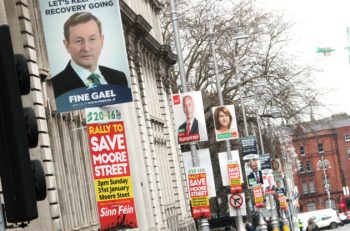
    In 2011 we wrote in this space, “You would think from our recent history of some of the most notoriously bad governance on the planet, that we would have learnt that our political classes need to be replaced. In fact, this election time we see no new ideas”. Sadly democracy in Ireland needs an overhaul every bit as much now as it did in 2011. Village is disappointed at the quality of politics, across the range. It’s easily diagnosed: Fine Gael is open to regressive policies and cronyism. However, at least on its own terms it deserves credit because it has consistently stuck to its agenda of (unimaginative) economic orthodoxy and because Enda Kenny has proved relatively competent, in the face of scepticism, including from this magazine. In 2011, we stated, “ Perhaps it is a unique merit of Fine Gael that if it is elected with a mandate, this time it may actually govern as it has campaigned. The electorate will be able to assess whether what it voted for was what it wanted”. This edition of Village explores at length the extent to which the coalition government delivered on its Programme for Government. It’s a fair test and it shows that, beyond promoting economic stability, the Government has been a disappointment. Labour certainly does not have the Fine Gael appeal of consistency. It never does what its manifestos promise. Worse, a number of its senior TDs have allowed themselves to appear smug and ideologically jaded or even, in Alan Kelly’s case, dangerous. Because of the elasticity of its conscience Labour has long attracted the wrong type of representatives. Fianna Fáil is tainted by its reckless past and the incoherence of its platform. It believes serving the people, parish and business in equal measure is viable. It has learnt little beyond the need to regulate the banks. Sinn Féin’s commitment to a Left agenda is unclear bearing in mind its defining preference for irredentist nationalism over ideology, its centrist pragmatism in the North and its willingness to coalesce with Fianna Fáil. Its performance at local-authority level is not impressive or particularly leftist. It is cultist, and ambivalent about democracy and transparency, and its leaders lie casually about its, and particularly its leader Gerry Adams’, past. Renua seems like a somehow unendearing chip off Fine Gael’s Christian Democratic block, with a penchant for propriety. The Independent Alliance (dubbed Shane Féin) is utterly incoherent of policy and membership. If ex-stockbroker Mr Ross and turfcutter Michael Fitzmaurice ever breathed an atom of the same political air, Village cannot imagine where it was. Village has a weakness for the Social Democrats, whose mild platform is essentially the same as Labour’s, though strangely more pro-business, but whose small membership is more prepossessing. Its antipathy to water taxes is expedient but regrettable. The radical Left offers the huge appeal of integrity and seriousness but its opposition to property taxes is inexcusable, and its focus on opposition to the loathed water taxes rather than a broader anti-inequality platform, including opposition to the iniquities of Nama, corruption and the resurrection of the developer classes has diverted its revolutionary ideology. The Green Party’s policies are often radical, and its agenda mature, but it is not hard-minded and it achieved so little in the last government that it is difficult to be enthusiastic. To the extent that we have not afforded space in this edition of Village to the policies and protagonists of most of these parties, it is because they simply don’t offer enough to justify it. Village believes equality of outcome, sustainability and accountability are the most important policies; and it is difficult to be optimistic about their immediate Irish prospects. Laboured machinations over the fiscal space are ephemeral, though most of the other media address little else. Reflecting the need for a vision of society as well as economy this edition focuses on the coalition’s delivery across a number of departments that promote equality, sustainability and accountability, though we do have articles by Constantin Gurdgiev, Michelle Murphy and Sinead Pentony on the iniquitous handling of the fragile economy. We consider Education, Health, Social Welfare, Environment including climate change, Small Firms policy, and Accountability. These departments make life worth living. We systematically assess whether they achieved the goals set by the Government for each of them when it took office. In the end the conclusion is that they have underperformed. And so therefore has the unimaginative, regressive and stolid Government behind them. Against this backdrop, we would again not presume to advise readers where to direct their votes. However, we can say the non-ideological, non-visionary parties of the pragmatic centre hold little appeal, even when mitigated by somewhat more thoughtful ones. A coalition of the parties of the Left, radical Left and the Greens would, as always, best promote Village’s agenda, if no doubt imperfectly.

    Loading

    Read more

  • Posted in:

    Review 2015 in Village

    January The Minister for Health, Leo Varadkar, reveals he is gay to a receptive Miriam O’Callaghan, becoming the first openly-gay government minister in Ireland. The Irish economy is not some kind of exemplar, says President Michael D Higgins, controversially but magnificently. Mahon tribunal reverses its finding of corruption against Ray Burke because the tribunal never revealed that whistleblower, James Gogarty, had made unsupportable allegations against the likes of Nora Owen, TD, and Supreme Court justice, Seamus Henchy. Nobody names the lax lawyers, who permitted it, or demands return of their fees. SIPTU’s Jack O’Connor sets out principles for a Charter for parties on the Left.   February 13 men aged 50-70 to appear before the bank inquiry; no women. Gardai arrest Paul Murphy, TD, along with three other anti-austerity activists and politicians, leading to public speculation about “political policing”. Former Fianna Fáil minister Pat Carey reveals his homosexuality publicly. The Irish Times announces the reintroduction of a paywall for its website, beginning on February 23. Michael D Higgins gives us another poem. March Solicitor Brian O’Donnell barricades himself into his Palace in Killiney with help from the ironically titled Land League. The Sunday Independent reports that O’Donnell scion, Blaise, didn’t know how rich his parents had made him. Contrariwise, The Mail reports Blaise got a €156m London office block from Dad. Ireland’s rugby year peaks with Six Nations Championship. Belfast County Court finds Asher’s Bakery guilty of discrimination for refusing to bake an ‘Eric’n’Ernie’ cake bearing a pro-gay-marraige slogan. april Joan Burton proposes a cap on the property tax when the freeze on increases start to register, at the end of the year. Minister Alan Kelly to allow builders of one-off houses to opt out of the usual building-control certification requirements. John Fitzgerald writes that borrowing to fund the bank bailout costs around €1bn a year, a small fraction of the total fiscal adjustment of €30bn since 2008. Gerry Adams tells CBS he never pulled a trigger, ordered a murder or set off a bomb during the war in the North. Ed Moloney, of course, disputes this. May A smug Jeremy Paxman, on the verge of retirement, lays into British Labour leader, Ed Miliband, on Newsnight and is overheard at end asking “are you ok, Ed?”. Miliband says “yeah” and wonders if Paxman is himself ok. Broadcaster and political editor of the TV3 television channel, Ursula Halligan, publicly declared her homosexuality and her support for a ‘yes’ vote for marriage for homosexuals and lesbians in the Constitutional marriage equality referendum. Competition Authority finally getting serious over CRH. Mary Harney promised investigation a political generation ago. Broadcasters Bill O’Herlihy and Derek Davis died. Charles, Prince of Wales, and his wife visited the west of Ireland, including Mullaghmore, County Sligo, where his great-uncle, Lord Mountbatten, was murdered by an IRA bomb in 1979. Referendum on two amendments to the Constitution – the 34th (marriage equality) wins; and the 35th (presidential election voting) loses. NY Times and Guardian, Village and Broadsheet. ie publish the Dáil Record of Catherine Murphy’s allegations about Denis O’Brien’s banking arrangments. The Irish Times, Independent, Mail, Sunday Business Post wait for clarification from the courts. June Strong, clear clarification from High Court on the unambiguous existence of the privilege for Dail utterances. Binchy J as predicted clarifies that he never intended, nor could it have been intended, his comments would apply to reporting of utterances in the Dail. Exciting dream team of Catherine Murphy, Stephen Donnelly and Roisin Shortall to form Social Democrat party. RTE tells Atheist Ireland it will reconsider the title of the Angelus Ireland’s poorest kids hit by lone-parent payment cut. “We are not God,” acknowledges Pope Francis, and we shouldn’t “trample his creation underfoot.” The average American woman now weighs 166 pounds — as much as the average 1960s man. Dutch government ordered by court to cut carbon emissions in landmark ruling. Central bank Governor Patrick Honohan explains “the bank guarantee should not have included subordinated debt nor existing senior-term debt”. Joan Burton slams social welfare fraudsters for “giving two fingers to their neighbours”. July The hottest month in history Brian Cowen scathingly tells the banking inquiry his ‘friends and colleagues’ were private people not bankers though doesn’t explain relaptionship with Fintan Drury, or golf. Media consider performance a triumph. Greece votes no to bailout plan but government imposes it anyway. Yanis Varoufakis resigns as Greek Finance Minister. august IS destroys 200 year old temple in Palymyra, Syria. September INBS, Michael Fingleton appears before Oireachtas banking inquiry but is let off hook Radical socialist Jeremy Corbyn elected leader of British Labour Party. October Five adults and five child Travellers die after fire at Carrickmines, Residents object to rehousing of the survivors nearby. Budget will reduce USC but is light on plans for investment. The Archbishop of Dublin, Diarmuid Martin tells a synod of bishops in Rome that Irish people “struggle to understand abstract moral principles” and that the recent debate about same-sex marriage in Ireland has been conducted by lay people in language that traditionally belongs to the Roman Catholic Church: ‘equality, compassion, respect and tolerance’”. November Judge Brian Cregan announces he does not have the legal powers necessary to conduct his inquiry into write-off sales of loans by IBRC do not allow him to. 130 people murdered by IS in Paris. Peter Robinson says he will resign as First Minister. Former Minister Pat Carey resigns after improper media leaks about alleged paedophilia. December IFA President Eddie Downey declares he has been thrown under a bus by his colleagues after it was revealed he received €147,000 annually and CEO, Pat Smith, half a million annually, from often impoverished farmers. David Cameron announces Britain’s intention to bomb IS in Syria.

    Loading

    Read more