Archives
OK
-
-
Posted in:
Stacking Up
by admin
The Stack family were satisfied that the meeting had led to some closure about their father’s murder. That was until the general election
-
-
by admin
The Irish media and national politicians are facilitating cover-ups of a range of issues – from the issues missed by feeble tribunals to Sugarman, Ansbacher, CRH and planning in Donegal
-
Posted in:
Ireland can be Germark
I have been leafing through the Global Youth Development Index 2016 published recently by the Commonwealth Secretariat, London. It deals with the all-round wellbeing of people aged 15 to 29 in 183 countries inside and outside the Commonwealth. It measures the general condition of that national cohort using five criteria: Civic participation, Education, Employment and opportunity, Health and wellbeing, Political participation. It awards marks in each category, totals the marks and provides global rankings. Ireland is found to be in the Very High group, at number 15. For those of us who wish Ireland well or rather the best, that is encouraging. People between 15 and 29 are the critically important part of a population. To have them in a Very High category of all round wellbeing suggests that a good methodology, mutatis mutandis, is being used for the younger cohort and bodes well for the older one. But this Youth Development Index does more than compliment and encourage us. By placing Germany and Denmark in first and second place respectively in its world ranking, it supplies us with concrete indications of how we can do better still. Irish people who want to better the quality of Irish society go about this in two ways. They call for more equality, justice or fairness – values that it is useful to remind us of, but abstractions. Others call for the remedy of particular ills that have arisen such as homelessness, too many people on hospital trolleys or the threat of being taxed for the supply of domestic water; just demands all of them but made because the problems in question are topical. They are not parts of a coherent scheme for overall social betterment. That is what the Youth Development Index enables us to begin working on -by presenting Germany and Denmark as the two best instances in the world of countries that afford life-enhancing conditions for 15-29-year-olds. Those two countries are near at hand so investigation of the social philosophy and institutional arrangements that have won them top marks would be easy. Equipped with that knowledge, it would be possible for us to apply it intelligently to that central 15-29-year-old tranche of our population. And the lessons learned might also be relevant to the younger and older components of the nation. Pursuing this course of action would mean using a method of national social improvement that has a certain history. It is the method that pursues that goal by adopting for the social improvement of one’s own nation something that has functioned to the benefit of another people. That is what many nations did when, one after another, they adopted parliamentary democracy, first from Great Britain then from the United States, or adopted the welfare state invented in Germany in the 1850s. While it is true that various methods are used for measuring the wellbeing of nations, it seems to me that the method used by the Youth Development Index is particularly useful. Some methods measure the amount of money available to the nation, say its GNP, or the proportion of citizens who vote in national elections. The method used by the Youth Development is more telling. It measures the use made of social philosophy, institutional savvy, and available money to produce beneficial effects in key aspects of the lives of those persons who constitute the central, tell-tale cohort of the nation – those key aspects being Civic participation, Education, Employment and opportunity, Health and wellbeing, Political participation. More to the point for useful assessment of national wellbeing it would be difficult to be. The Irish researchers in Germany and Denmark would be concerned, firstly, with absorbing the social philosophies inspiring the two sets of practical arrangements that enabled those countries to come first in the world in the Index; secondly, with proposing—insofar as the national budget would allow—the corresponding institutional adjustments needed in Ireland. Of course, it is not the case that Ireland has not previously sought to improve its way of doing things by importing methods and institutional arrangements from abroad. However, its method of doing this has normally been simply to copy English practice, not because that practice is of outstanding excellence internationally, but simply because England is near at hand and there is a post-colonial habit of following its lead. What I am proposing is a rationally grounded importation of well-attested excellence.
-
Posted in:
Unclaimed Future
Claiming Our Future was ‘waked’ on 10th December in Tailors Hall in Dublin. There was a good attendance, some sadness, and, as ever, a bit of deliberation. It was felt the deceased had had a good life and that longevity was never the appropriate ambition for such a creation. It had a potential that was never fully realised but made a contribution that was worth celebrating, a contribution that should be built on in the future. Claiming Our Future emphasised the need for crosssectoral civil society action for change. Fragmentation between the different parts of civil society has increased as a result of austerity. There is a lack of networking and collaboration between sectors of civil society, more specifically the trade union, community, cultural, global-justice, environmental and cultural sectors. Each finds it difficult to move beyond its own agendas. Cross-sectoral initiatives led by Claiming Our Future included: online campaigns on the minimum wage, gender quotas in politics, and a wealth tax; the creation of an economic equality steering group involving organisations in each sector working on the annual Budget; and a campaign for the introduction of a Financial Transaction Tax. Developing cross-sectoral approaches was not easy. There remain challenges to provide leadership and to sustain commitment, to collaboration. Claiming Our Future brought values centre stage. It was founded in a crowded Industries Hall in the RDS in 2010 with equality, environmental sustainability, accountability, participation, and solidarity identified as its core values. At first values were seen as the link to draw together the different parts of civil society and to enable them to work together, more coherently and more powerfully, for social change. Then these values became the lens through which Claiming Our Future assessed issues and developed positions. Alignment with these values was the test of any key decision. However, it took time before the full importance of values became clear. Values are the motor of social change. They motivate people in the perspectives they hold and the choices they make. Change will come about by finding ways to convince a wider public to give priority to the values of Claiming Our Future. Lobbying the increasingly unresponsive powerful and hoping the mainstream media will carry our ideas are no longer effective enough, for change. We are up against powerful forces in a cultural battle as we seek to have these values prioritised. The individual, the consumer, the market, and wealth get prioritised as values. The advertising industry, the media, the education system and even political discourse provide the skills and the resources that sustain this. Civil society must gear up to compete so that a different set of values gets prioritised. Claiming Our Future promoted deliberation and the creation of public spaces for deliberation. Deliberation events were hosted on ‘an economy for society’, ‘income equality’, ‘political reform’, ‘international development goals’, ‘local resilience’, ‘new forms of energy production, distribution, and consumption’, and our ‘broken politics’. Deliberation was based on an open invitation to participate in developing a position and plan of action on these themes. Participants worked on tables of ten people to debate and build consensus on a position and how to advance that position. A form of consensus voting, developed by the de Borda Institute, was used to find the consensus across all the tables in the hall. This was a powerful means of exploring alternatives to current models of development. Civil society had been found wanting for convincing alternatives when the economic crisis first hit. A tradition of deliberation had to be rebuilt and needs sustaining and further development if alternatives are to be devised and put forward as the crisis changes and evolves. Claiming Our Future worked to bring the activist and the artist together. Dialogues between activists and artists were organised, creative expression was a centrepiece at all deliberation events, and a summer school on the ‘Art of Campaigning’ was organised. This recognised the central role for creativity in action for social change and in convincing people to prioritise different values. Art has the power to move people, to capture their imagination and attention, and to draw them into seeing new perspectives. It enables people to express themselves and to articulate different futures. Activists are challenged to learn to recognise and draw upon their creative talents. Artists are challenged to contribute their skills to issues they care about and to bring a new focus and meaning to their work. It remains to be seen where these different ideas that have been developed and tested by Claiming Our Future will be taken up. The ‘wake’ will, we hope, be the start of something new and ambitious for civil society as it strives, creatively and cross-sectorally, for change. Niall Crowley was convenor of Claming Our Future
-
Posted in:
Legal Change
by Ivana Bacik
Organisations that support victims of domestic violence have been calling for many years for legal reforms to offer greater protection for victims. Victims of domestic violence who are not cohabiting, or do not have a child in common with an abusive partner, are not eligible to apply for court safety orders. Even where they are eligible for legal protection, they often endure long delays in court processes, and they suffer due to the serious lack of co-ordination between different Courts hearing separate applications relating to the same family. It is outrageous for example that issues of custody and access to children may be dealt with by a judge who is unaware of parallel domestic-violence proceedings. Given the right set of facts and a suitable litigant, I believe that there is now potential for legal action to be taken against the State for the failure to provide adequate protection against domestic violence for women and children. This is a case waiting to happen. Such a case could ensure greater awareness of the challenges faced by victims in negotiating legal processes and speedier introduction of the necessary legal reforms. Similar calls for reform of legislation on rape in the interests of victim protection are being made in the wake of the recent O’R case, where the Supreme Court rejected an appeal by a man who had been convicted of raping his mother. The court confirmed the current law that an “honest, though unreasonable, mistake that the woman was consenting is a defence to rape”. Rape crisis centres and others are calling for a statutory definition of ‘consent’ to be included in the current sex offences Bill. They have also argued that legislation on rape should be changed fundamentally, to require that a man should not have a defence to rape where he makes an unreasonable mistake about a woman’s consent. A core problem with the criminal law is that it is generally designed to deal with isolated events. It can be difficult to apply in the context of an ongoing abusive relationship. Garda statistics do not identify repeat callouts, so it is impossible to know how many recorded incidents involve the same individuals. Indeed we know that a great deal of domestic violence goes unreported. However, reporting levels have tended to rise where individual victims and survivors come forward to tell their stories and to highlight the need for action to be taken against abusers. Recent legal reforms such as the use of victim impact statements in sentencing were introduced largely because of brave individuals who spoke out about their experiences as victims and survivors, and the advocacy of others supporting them, like Women’s Aid. Their work has debunked many of the problematic myths about rape and domestic violence. We now have a better understanding of the terrible effects of such offences upon victims. We know that the majority of perpetrators are known to their victims. The sharing of experiences, and the taking of public interest litigation, are both valuable ways of achieving legal and social change. In a book that I edited with my TCD colleague Dr Mary Rogan, recently published as ‘Legal Cases that Changed Ireland’, we asked some individuals who have taken ground-breaking cases to speak about their experiences. These include Máirín de Burca, who won her case before the Supreme Court in 1975 establishing the right of women to serve on juries; and Dr Micheline Sheehy Skeffington, who in 2014 won her Equality Tribunal claim that NUI Galway had discriminated on gender grounds by denying her academic promotion. Their individual stories, based in experiences 40 years apart, are both essentially tales of courage, of brave women whose actions have made our society more equal. The book shows, however, that the law is only one part of the solution when it comes to achieving progressive change. A range of strategies is necessary, including lobbying, advocacy and campaigning work, to bring about change in attitudes and culture. With domestic violence, a whole package of other measures is necessary, beyond legal reform, including better provision of shelters for victims and their children and of adequate resources for support groups across the country. Currently services are not universally available and, in some areas, victims of gender-based violence have no access to shelters or support groups. We need a fundamental change of emphasis, to challenge a culture in which gender-based violence may sometimes be tacitly tolerated. We need to work on changing attitudes among those engaged in perpetrating abuse, in order to prevent it in the first place, rather than constantly trying to mend the damage that abusers do. As the stories told in our book show, true legal and social change can only be achieved through a combination of legal activism, sharing of experiences, advocacy and campaigning work.
-
Posted in:
Genderisory
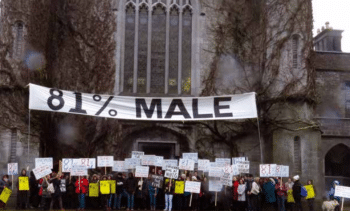
This November marks the second anniversary of my successful gender equality case at the Equality Tribunal against NUI Galway for its failure to appoint me to the post of Senior Lecturer. It was hailed as a landmark case and should have been a call to arms, not just for NUI Galway, but for all third-level institutions. However, the awakening is slow and I doubt that much has changed on the ground – or in attitudes amongst university management. Currently, many staff in NUI Galway are disillusioned and afraid. Few staff feel able to challenge the authorities. Many are in precarious posts or worried they won’t be promoted. Some staff, I gather, have been reprimanded for speaking out. Fear has filtered through to the students. Recently a society was told it could not display images of Jim Browne, the NUI Galway President in its ‘Mr Browne’s Boys’ cartoon T-shirts at a table supporting five women lecturers pursuing similar litigation. Last April a cartoon exhibition to raise funds and awareness about the five women was booked on campus by the Students Union, but was taken down by Security in the middle of the night. My case was a landmark case partly because, despite being in the public service, universities have a lot of autonomy, as they should. However, this has led to a lack of transparency in processes such as the promotion and appointment of academics. This has in turn led to an abuse, or perceived abuse, of power. The universities have been getting away with this for a long time now. However, change comes slowly because university management is not answerable to any board of trustees or shareholders. The governing bodies seem powerless or unwilling to effect change. Ireland has an appalling international record for gender equality in academia. It has been ranked second worst in Europe after Malta for its Glass Ceiling Index in academia. Irish third-level institutions have a lot of catching up to do. The facts were stark in NUI Galway when I took my case in 2009. The proportion of successful applicants was stunningly different for men and women. 50% of male candidates were successful compared to the 6.7% of female candidates who were successful (see Table 1). Summing up twelve points in my favour, the Equality Tribunal ruling highlighted that “perhaps the most significant frailty in the respondent’s [NUI Galway’s] rebuttal” was that in all four recent rounds of promotion to Senior Lecturer combined, men had a one in two and women less than a one in three chance of being promoted. One successful man had not even been eligible to apply. I donated my €70,000 award to five other women who, despite being fully deserving of promotion, had been unsuccessful. Their course of action is far more difficult, with only the High Court as an option because the Equality Tribunal deadline was long past. What I find extraordinary is that the university, instead of conceding errors were made, has chosen to spend large sums of taxpayers’ money fighting these women in the courts through an on-going, protracted and emotionally draining, to say nothing of financially stressful, legal wrangle. The Equality Tribunal ruling specified that NUI Galway should send a report to what is now the Irish Human Rights and Equality Commission within 12 months of the ruling. I recently got hold of this and am stunned at what took them 13 months to deliver. It comprises two parts, the larger part being an appendix. The first part, three pages long, sets the tone in stating that “a review had already been underway” but fails to specify that this ‘review’ was actually completed in 2011, three years before the Equality Tribunal ruling and is in fact referred to in the ruling. The first part goes on to repeat the recommendations from that report and devotes one page to the recommendations for the 2013/14 round of promotions, initiated a year before the ruling. No reference is made to the fact that 20 of the candidates deemed suitable but not promoted in that round appealed and that only 18% of female candidates were promoted compared to 35% of male candidates. The consultant’s report commissioned on the back of these appeals is not available even under Freedom of Information (FOI). There was a burst of outrage in the university on foot of my successful case and the action taken by the five other women. The injustice to the five women was immediately raised at the NUI Galway Údarás (Governing Body). I understand the discussion was heated. However, the minutes of that elevated body are only available under FOI where, as part of the process, any useful information has been redacted. Several heated meetings of the NUI Galway Academic Council, that comprises professors, deans and heads of school, and so is overwhelmingly male, resulted in nothing. It was told it was powerless to change matters. Large numbers of students joined the campaign to support the five women, horrified to learn that they had not been promoted. “I am joining the campaign because [name of one of the five women] is the best lecturer I’ve ever had” was a common refrain. The Students Union and both staff unions gave their full support and 26 student societies signed up in solidarity to the campaign. This support continues. What has happened since? A task force was established with much public fanfare and it delivered its final report in May 2016. This was hard-hitting, if limited, since it did not address the position of the five women or focus on non-academic staff, where matters are even worse. The recommendations of the task force are not faring particularly well. It recommended that 50% of the “major influential” committees should be chaired by women by 2018. However, College Deans (all men) chair such committees and three of them were recently replaced by three more men. The task force suggested a cascade system of promotion. This is being watered down. Although 52% of lecturers are women,