

Culture

Random entry RSS

  • Posted in:

    Geldof and his Rats: across the Irish Sea to the world.

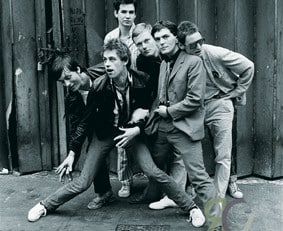
    By Michael Mary Murphy. In the 1970s a new band arrived on the Dublin rock scene. They were called the Boomtown Rats. They sounded like kinetic English rhythm and blues spliced with 1970s Bowie and Roxy Music. They appeared like The Who fronted by Brendan Behan in a borstal breakout, on amphetamines. Geldof claimed the purpose of joining a band was to get “rich, to get famous and to get laid” and it was not long before the Rats delivered for him. Bob Geldof’s subsequent success and global reach have to be contextualised within the social conditions he emerged from. His ascent to a position commanding the attention of world leaders places him in the political realm. Born almost six months after Enda Kenny and twenty three days after Bertie Ahern, it is tempting to imagine which of the three would be recognised as Ireland’s elder statesman. Would the mobile phones of premiers and politicos respond with: “how can I help?”, “what now?” and “delete and block!” respectively? While recognised primarily as a campaigner for the underdeveloped world, he has also amassed an intriguing media empire. His principal business vehicle, Ten Alps, posted revenue close to €100 million in 2008. His television companies produce documentaries which benefit from access to luminaries like Tony Blair, Bill Clinton, Vladimir Putin, Slobodan Milosevic and Ariel Sharon. One contract the firm secured, for educational services to the British government, was worth £10 million. All of this was unexpected when Geldof and his band, the Boomtown Rats, appeared in the barren world of Irish rock in the mid to late 1970s. He has eclipsed the traditional power mongers in Irish life. And on his way up the ladder he didn’t refrain from articulating a desire for their demise. While they quietly, and at times powerfully, attempted to stifle his voice, he railed louder at them. It is safe to assume he enjoys the view from his perch now. And while Ireland has produced another rock star with international political clout, Geldof is the one who speaks more plainly. “Our only crime is that we are successful without connections”, declaimed Bob Geldof in 1980.  At that time  Irish youth were expected to be compliant. Traditional strategies towards the acquisition of power in Ireland involved actually avoiding attention. A safe job or career was your only man. Literally. Combining a spotless profile with membership of one of the two major political parties doubled your chances. How then did Geldof climb the heights while rejecting these paths? In one Hot Press interview Geldof described how he “got his revenge on everybody who’d ever fucked me, which was the entire country in my opinion! My harshest words were reserved for the aforementioned Charles J  Haughey who is, without doubt, the biggest shitehawk Ireland has ever produced”. The Boomtown Rats and the Irish authorities enjoyed a number of skirmishes. A “Late Late Show” appearance where Geldof decried the Irish State and the Catholic Church was a threshold event in modern Irish history. Even in the punk era of 1977-1980 this was practically unheard of. Even now Geldof presents a quixotic character in the world of high finance and world affairs. Yet, with hindsight, his claim that: “our only crime is that we are successful without connections”, can be read as proving that alternative strategies to power are possible. The governance of Ireland in the decade of Geldof’s birth led to a human outflow of over 437,000 people. The future political leaders of the country stayed and gradually made their way to power. Geldof had neither the patience nor the tolerance for this approach. He left the country, yet never abandoned it. His revulsion at the Dublin street racism he witnessed on a recent visit indicates his desire for a pluralist, inclusive society. It was in Britain that he met the conditions necessary for the first stage in his career. The band took the voyage across the Irish Sea, like so many other emigrants, in the hope of better opportunities. The social, economic and cultural realities of life in the Republic of Ireland resulted in a huge loss of domestic talent. The brain drain was accompanied by a talent imbalance. Abroad, this creativity faced three eventualities: it could be silenced (often leading to bitterness and resentment); it could be placed in the service of the emigrant populace; and it could enrich the cultural life of the host nation. The popular music of Britain has been immeasurably enhanced by Irish emigrants and their offspring. Is it possible to imagine popular music minus the Beatles, Oasis, The Smiths and the Sex Pistols? These questions are key to Sean Campbell’s recently published ‘Irish Blood: English Heart’. It is the best book written about Irish music. Significantly it covers second-generation Irish musicians in Britain and is written by a second-generation Irish author. Often the lives of these emigrants were (mis)shaped by the compromises demanded for getting by in the new country. Campbell’s work is suffused with the consequences of these ‘accommodations’. A cultural war necessitates cultural power. Being desirable to the Anglo-American cultural entrepreneurs has historically been the primary determinant of success or failure.. Late-seventies Ireland was not a destination of choice for the major-label talent-scouts. It was not expected to develop or maintain talent. As successful as they were, the twin gods of Irish rock, Rory Gallagher and Phil Lynott, were not seen as representative of the gene pool. There is a simplistic view of the cultural relationship between Ireland and Britain. It credits U2 with single-handedly transforming the image of the Irish in Britain. This ignores the under-documented yet essential gains of Irish cultural entrepreneurs in the era. The case of Geldof and the Boomtown Rats was a key episode in this cultural exchange. It reveals how consumers become producers. And that is the ultimate strategy to power.. For a nation to be taken seriously its cultural products must command respect. And it was in London that many of the difficult steps

    Loading

    Read more