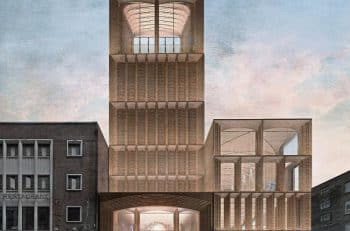
elevation

Random entry RSS

  • Posted in:

    Referee!

    On-side Rugby is religion for Limerick. The city mercifully did not inherit the class exclusivity associated with the sport. In the latter decades of the twentieth century Munster victories, usually over Leinster, sustained Limerick’s morale in the face of prejudice. In gratitude its City and County Council has granted permission for a rugby museum which will shoehorn a seven-storey show-stopper into a Georgian streetscape. With a rugby hero and a billionaire philanthropist tax-exile fronting the project they have the public on side. Does the new class of money and celebrity overrule our planning laws? The Players A new sports museum for Limerick, was announced in December 2016. Its applicants were Rugby World Experience Ltd set up that same year with a registered address in Lucan, Co. Dublin. It has three Directors: Chairman Paul O’Connell, Paul Foley and Sue-Ann Foley. Former Ireland, Munster and Irish Lions captain Paul O’Connell, Limerick native, basso profundo, family giant, Lidl man of squeaky cleanliness is the perfect frontman. Paul Foley is a former Limerick City Council Senior Executive Officer in the Department of Economic and Planning Development. Sue-Ann Foley is the daughter of JP McManus. Limerick’s greatest/richest son, and Chair of the JP McManus Benevolent Fund. The Coach John Patrick ‘JP’ McManus, money-trader and gambler, hails from humble beginnings but has for 30 years been resident in tax-friendly Geneva, Switzerland, while retaining a suite at the Dorchester Hotel in London. He is a doughty force in Limerick, particularly in Limerick City and County Council which even has a hall named after his most famous horse, Istabraq. His charity has funded schools, palliative care units, and every type of local sports clubs. Any criticism against a JP McManus project in Limerick is an attack on Santa Claus. It is McManus’ €10m seed funding that is making this project happen. O’Connell has said the rugby museum was a notion put to him by JP McManus during his playing days, but the idea has gained momentum since he retired. The Dashing Out-Half An unexpected dash for Rugby World Experience was the commissioning of renowned London-based, Irish-born architect Níall McLaughlin, twice shortlisted for the Royal Institute of British Architects Stirling Prize. His work includes the extension to the National History Museum London, the Carmelite Prayer room in St Teresa’s Church Dublin and college buildings in Oxford and Cambridge. Try The museum would be of scintillating contemporary design with, it is hoped, a sensitive palette of materials, mainly brick in keeping with the Georgian aesthetic. However, the architect’s report admits that “the brick selection and brickwork quality will present a challenge and it may be decided to use precast panels”. High Tackle The proposal is for a seven-storey building, 32-metres high (the architect originally intended the tower to be 36 metres in height), with a two-storey portico fronting O’Connell Street, and a two-storey block to the rear. There would be a three-storey block built over the existing Fine’s Jewellers, at the junction of O’Connell Street and Cecil Street. Inside, the development would see the existing buildings’ 1335sqm floor area increased to 2787 sqm “multi-media visitor experience, exhibition and education space”, plus retail (81sqm) and café (83sqm) at ground-floor level. The scheme is context-free: a bold attempt to subvert an aesthetic built up over centuries by breaching the established building height on Limerick’s main street, its beating heart. The design also self-consciously does not replicate the Georgian fenestration rhythm perhaps in an effort to minimise the perception of extra floors. Spear tackle The plan involves the razing of 40 and 41 O’Connell Street, and of 1 Cecil Street, a corner site on two prominent streetscapes within Newtown Pery, Limerick’s Georgian area. The Beautiful Game Lewis’ Topographical Dictionary of 1837 called Limerick’s Newtown Pery “one of the handsomest modern towns in Ireland”. The historic Georgian city is an example of ambitious eighteenth-century Italian-inspired town planning whose integrity should be respected through the retention of the characteristic continuous heights and building-frontage alignment that contributes to a quality unrivalled anywhere in the world, albeit that it has been allowed to dilapidate. Substitution The buildings that stand in the way are not protected but are listed on the National Inventory for Architectural Heritage, an indication that national government thinks they merit protection. There have been some changes to them over the second half of the twentieth century, including the cement-rendering of the façade, the replacement of an earlier shop front and the blocking up of window openings on the side elevation. These could easily be removed. The off-side rule Both sides of this site sit within an Architectural Conservation Area (ACA), protected under Section 81 of the Planning and Development Act 2000-2008 which states that an ACA is: “a place, area, group of structures or townscape, taking account of building lines and heights, that is of special architectural, historical, archaeological, artistic, cultural, scientific, social or technical interest”. ACA protections extend to the carrying out of works to the exterior of a building within the Area regardless of whether or not it’s a protected structure. The aim of designating areas is to protect their “special characteristics and distinctive features” from inappropriate actions. The ‘Statement of Character and Identification of Key Threats’ set out in Chapter 10 of the Limerick City and County Development Plan 2010-2016 notes: “This ACA constitutes the core heart of Limerick City’s Georgian Heritage within the City Centre…The streets of Newtown Pery represent a unique example of eighteenth and nineteenth-century planning in Ireland…The streets leading to The Crescent and Pery Square conform to eighteenth-century town planning, defining the streetscape by their adherence to fixed proportions and ordered harmonious symmetry. They combine to form an architectural heritage of great urbanity and considerable beauty”. This appears damning for McLaughlin’s acontextual, proportionately unfixed, asymetrical and inharmonious effort. But the ACA statement goes on: “The irregularity which emerged in relation to the treatment of heights, facades, and type of buildings combined with the rigid street pattern gives Georgian Limerick a distinct sense of place…All of these

    Loading

    Read more