General

Random entry RSS

  • Posted in:

    Back to the point of Carnsore

    The anti-nuclear festivals at Carnsore Point, 1978-1981, were recalled at a lively and political event called ‘Memory of a Free Festival’ at the Projects Arts Centre in central Dublin which will now tour nationwide for a year By Caroline Hurley The launch event of ‘Memory of A Free Festival’ was held at the Project Arts Centre, on 21 March 2026.‘Memory of a Free Festival’ is a project conceived by Ormston House Cultural Resource Centre, Limerick, in response to the series of Carnsore Point anti-nuclear festivals that took place in Wexford between 1978 and 1981. Organised by a coalition of groups, the festivals were attended a generation ago by tens of thousands of people unhappy about government proposals to build Ireland’s first nuclear power plant. The free festivals laid on music, theatre, food, lectures, workshops and exhibitions. They are testimony to citizen creativity and democratic activism, for which formal recognition is long overdue. ‘Nearly fifty years later, this commemorative touring project features contributions from contemporary artists and original organisers, among others’ Nearly fifty years later, this commemorative touring project features contributions from contemporary artists and original organisers, among others. It will run in various formats and venues for one year, until March 2027, starting with the recent event at the Project Theatre. Fresh Promotion of Nuclear Energy With Europe importing half the energy it uses and prices rising, worsened by AI data centre demand and fossil fuelled wars, pressure for solutions is intense. Voices for nuclear power are growing louder and now count European leaders who, at the Nuclear Energy Summit in Paris on 10 March 2026, backed expansion of nuclear energy, purportedly for greater independence and affordability. the progress made by solar, wind and other far safer, cheaper and faster renewable energy is compelling, especially if the budgets available to nuclear were provided for renewables to develop at the same scale In August 2024, more than 600 civil society groups across the globe working on climate action launched a declaration in Brussels, Belgium, stating that nuclear power expansion is not a solution to the climate crisis, because it is too dangerous, too expensive, and too slow. This definitive position is in line with esteemed international climate solutions organisation, Project Drawdown, which cautions against relying on nuclear power compared to other solutions: “At Project Drawdown, we consider Nuclear Power a ‘regrets’ solution. It has potential to avoid emissions, but carries many concerns as well”. Other arguments against nuclear energy include that it creates public health hazards from radiation and accidents, that it erects obvious military targets in a fractious and sometimes nihilistic world, that there are no safe solutions for nuclear waste after 80 years of its manufacture, and that in contrast, the progress made by solar, wind and other far safer, cheaper and faster renewable energy is compelling, especially if the budgets available to nuclear were provided for renewables to develop at the same scale. See – https://innatenonviolence.org/wp/2024/02/01/nuclear-power-is-a-regrets-industry-some-facts/ As of February 4, 2026 when the latest assessment was made, the time shown by the Doomsday Clock, initiated in 1947 by the Bulletin of the Atomic Scientists, is 85 seconds to midnight; the closest humanity has ever been to symbolic catastrophe. The Bulletin evaluates nuclear-weapons risks, climate change, disruptive technologies like AI and bioweapons, cyber threats, and the state of global governance in evaluating existential precariousness. On 15 March 2026, responding to international events, the British Energy Secretary outlined a package of measures to go “further and faster” in the pursuit of national energy security. The emphasis is on renewables. Top of the list, notably, is support for measures up to recently viewed by state bodies as guerrilla eccentricities suspected of interrupting grid centralisation e.g. making available in the UK for the first time, ‘plug-in solar’, low-cost solar panels available to buy on the high street, to put on balconies or outdoor spaces. Unfortunately, the UK government also naively lists nuclear as an essential green energy, even as built plants remain hazardous for centuries Unfortunately, the UK government also naively lists nuclear as an essential green energy, even as built plants remain hazardous for centuries, with no known effective method to store radioactive waste. Seeing the potential for renewable energies, Nicola Tesla and others had long dreamed, and contributed to the development, of safe free electricity for all; sources of inexhaustible, clean energy. Monopolistic entities and their lobbying arms have repeatedly sabotaged such movements, despite evidence of accumulated harms from fossil fuels and nuclear materials. Several bodies such as Laka and the International Centre for Multi-Generational Legacies of Trauma, track the full list of nuclear and radiation incidents which are reported by national nuclear regulatory agencies to the International Atomic Energy Agency since 1990. They are not negligible. And not counted are many similar accidents before 1990., such as Windscale, Chernobyl, Three Mile Island, and problematic storage sites like Handford. We’re all hot now, already. The European Union recently published advice on which types of defence investments fit its sustainable-finance framework, labelled green or ESG (environment, social, governance). It includes atomic bombs, depleted uranium and white phosphorus On 30 December 2025, the European Union published a Commission Notice to advise on which types of defence investments fit its sustainable-finance framework, labelled green or ESG (environment, social, governance). Lucky investors can now include atomic bombs, depleted uranium and white phosphorus in this category. To claim this Orwellian reclassification measure was taken for climate objectives rather than to boost defence spending, surely fooled few, and roused significant if as yet ineffectual condemnation. What it does show is the accelerating high-level momentum to divert finance into the most destructive artifacts ever made rather than on meaningful social and nature regeneration. These were the themes that drew so many festival goers to protest at Carnsore Point all those years ago. Launch Event at Project Arts Centre Padraig Moore, manager of Ormston House, introduced the touring exhibition, which, after launching at Project Arts Centre, would open at Ormston House on 17 April before moving to

    Loading

    Read more

  • Posted in:

    Margins

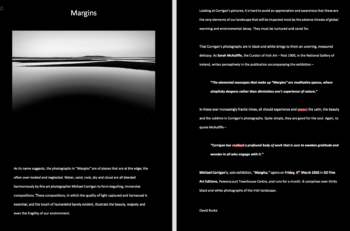
    As its name suggests, the photographs in “Margins” are of places that are at the edge; the often over-looked and neglected. Water, sand, rock, sky and cloud. Michael Corrigan’s, solo exhibition, “Margins,” opens on Friday, 6th March 2026 in SO Fine Art Editions, Powerscourt Townhouse Centre, and runs for a month. It comprises over thirty black and white photographs of the Irish landscape. David Burke

    Loading

    Read more

  • Posted in:

    Humphreys honoured hoax-bombing, domestic-abuser garda with Scott medal

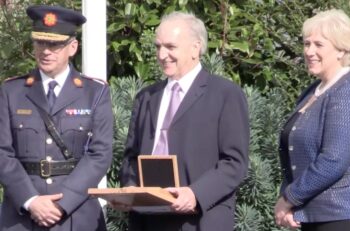
    By Michael Smith published in partnership with the Ditch A former garda who was accused by his wife of serious domestic abuse and of holding a gun to her head at their family home in Donegal was awarded a Scott Medal at a ceremony attended by then acting justice minister and presidential candidate, Heather Humphreys, in September 2021. Former Detective Garda Noel McMahon resigned from the Garda in 2004 after the Morris Tribunal found that he was involved in planting “hoax bombs” and ammunition across the North-West in the early 1990s He and a senior Garda colleague then claimed these as IRA explosives-finds to advance their careers. McMahon purchased illicit drugs which were then placed in the premises of publican Frank Shortt in Quigley’s Point, in County Donegal in October 1994 before a large force of gardaí raided the nightclub. Shortt was charged with allowing his premises to be used for the sale of illegal drugs and, in 1995, was wrongly imprisoned for three years. He later obtained a miscarriage-of-justice certificate and substantial damages from the State. Judge Freddie Morris found that Noel McMahon had lied during his evidence to the tribunal. McMahon faced dismissal from the Garda before he resigned in July, 2004. At the Morris Tribunal hearings, Sheenagh McMahon described how she was subjected to serious abuse by her garda husband who threatened her with his official firearm at their home in Buncrana in 1995. “He put a gun to my head and he told me he would blow my brains out,” she told the Morris tribunal in March 2003 as she recounted the years of abuse she suffered at the hands of her husband. She said that she was wrongfully arrested after Noel McMahon produced a false court Safety Order made against her in 1999 and that her children were placed in care as a result of his actions. She later regained custody of her children and obtained an apology and damages from the State in 2018 over her wrongful arrest. In the apology, lawyers for the State, the Garda, the Minister for Justice and Noel McMahon said in open court that: “The Defendants concede liability on the basis that they accept that the Plaintiff was wrongfully arrested and detained on 30th June, 1999 by reason of the arresting Garda executing a Safety Order produced by the Plaintiff’s husband which in fact had never been issued by the District Court”. Ms McMahon was awarded €20,000 in damages. She refused an offer of an additional €5000 if she would agree to the apology not being read out in court. In its final report, the Morris Tribunal stated that Noel McMahon had threatened a garda colleague with a loaded gun in Buncrana garda station in 1992 and that “nothing was ever done about this incident”. In September 2021, Heather Humphreys, acting Minister for Justice, attended the ceremony during which serving and retired members, including McMahon, were awarded the Scott Medal for bravery during the rescue of businessman, Don Tidey in 1983, after his kidnapping by members of the IRA. Ms Humphreys and Commissioner Drew Harris, with Noel McMahon standing between them, were photographed along with other recipients of the award. The former minister and Fine Gael presidential candidate told those present: “Your actions on that day were truly heroic. You performed your duty as garda members and for that we are thankful. You are honoured with this exceptional award”. 

    Loading

    Read more

  • Posted in:

    The Irish Times: tense little untruths and distortions, and furtive, late corrections

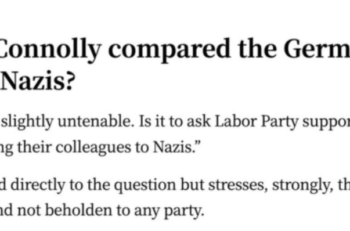
    By Michael Smith If Éirígí were saying it now, the story might have some credence. They are not. Even in 2018, they absolutely did not say she was “a member” The Irish Times’ Ursula Ní Shionnain story is not journalism. It is character assassination. The trick turns on a single verb. In the article itself, the headline reads: “Éirígí said Ursula Ní Shionnain still member in 2018 when employed by Catherine Connolly in Leinster House” https://www.irishtimes.com/politics/2025/10/02/eirigi-says-ursula-ni-shionnain-still-member-in-2018-when-employed-by-catherine-connolly-in-leinster-house/. But in the social preview — the snippet readers see when they share the link — it has: “Éirígí says Ursula Ní Shionnáin still member…”. That one word — ‘says‘ — transforms a stale fragment into a live scandal. If Éirígí were saying it now, the story might have some credence. It might be a real thing that Ursula Ní Shionnain could agree with or deny. They are not. Even in 2018, they absolutely did not say she was “a member”. All that exists is one phrase, describing a painting by “our own Ursula Ní Shionnain.” That is Éirígí claiming her symbolically, because she had been a member who had served time. It is not evidence of membership. Yet the Irish Times translated it into “still a member” without bothering to investigate if — as a matter of fact  — she indeed had still been a member and projected it in the present tense. A non-story dressed up as something, even a scandal. The preview matters. The Irish Times boasts millions of monthly users of its stale and boring take on the world. And it is part of a wider pattern. Consider what happened to Catherine Connolly in the presidential debate. She had been meticulous: she did not compare Germans to Nazis. She used the word parallel, not “comparison”. Even the centrists in ‘The Rest in Politics’ did a feature in the last week on Germany, which is rearming against a background where the AfD is vying for first place in the polls.  She avoided the word Nazi altogether. She knows Germany: she studied the language, lived there, and points simoly to the obvious fact that Germany today is the most striking case of rapid rearmament in Europe. Careful, informed, serious. Kieran Cuddihy’s question was loaded from the start: he asked if she was comparing the Labour Party’s German allies in the SPD to Nazis. Fair enough perhaps, Cuddihy was fairly even-handed and it was just a question. Where it got murky was when Harry McGee reported in the Irish Times that Connolly “did not directly respond”. That was false. Where it got murky was when Harry McGee reported in the Irish Times that Connolly “did not directly respond”. That was false. Village called it out on Twitter on 29 September: “Except that it is untrue that @CatherineGalway ‘did not directly respond to the question’. Connolly expressly denied she’d compared Germans to Nazis. Correction needed.” Twelve hours later, uncorrected, Village’s Twitter account sharpened the charge: “At the time it appeared like an inept mistake … 12 hours on and uncorrected … it begins to look like an untruth — the sort of smear @paulmurphy_TD has referred to and the Irish Times has been at pains to deny. @CatherineGalway traduced”. Two or three days later the piece was furtively changed. No acknowledgement of the mistake.  No correction.  Just the abject amendment. Th pattern is obvious. In one case, the Times twists tense to make Éirígí “say” something they’re not. In the other, it has Connolly ducking a question she in fact answered directly. Both distortions serve the same function: to smear someone more radical than the unserious Irish Times, to police the boundaries of political respectability. The Irish Times once styled itself the paper of record. It retains the smugness such a status would command but it can’t be bothered meeting the standard,. Record-keeping built on sly verbs, on false denials, on half-truths repeated until they pass for fact — that is not even journalism. It is, when in campaign mood, a paper of smear. A paper of tense little lies. Biased.

    Loading

    Read more

  • Posted in:

    The RHA and Sandra Hu:

    Tradition betrayed by poor governance By Michael Smith Founded in 1823 in Dublin, the Royal Hibernian Academy of Arts (RHA) was born from the ambition of 30 Irish artists who petitioned the Crown for a charter of incorporation.  Early leaders were landscape painter William Ashford and architect Francis Johnston. By the end of the 19th century, the RHA stood as Ireland’s pre-eminent institution for promoting visual art.   Over time, the Academy gained a reputation for conservatism, particularly in the early Free State years when it embraced a nationalist realism. It was in reaction to this that the Irish Exhibition of Living Art emerged in 1943 to champion modernism. The RHA’s original premises on Abbey St burnt in 1916 and it demolished its splendid replacement headquarters on Ely Place in the 1960s.  A utilitarian new space was created there in the 1970s with financing from developer Matt Gallagher  and a final design by Arthur Gibney RHA, friend of Charlie Haughey. Finally, after years of debt stress,  in 2009 that space was upgraded to meet the RHA’s  royal aspirations,  and to include a well-regarded School.  It would be difficult to say it has made for an institution that is integral to the cultural life of Ireland.    The RHA is helmed for the moment by Abigail O’Brien, its first female President who was recognised with an honorary Doctorate of Fine Arts in 2019, and was the recipient of a “Woman of the Year” award in the Arts from Irish Tatler; and by Patrick T Murphy, who remembers breaking into the gallery in the early 1980s when the building was a concrete hulk “just to look at the spaces inside because they were so great”. who has served as Director for 28 years. Murphy spent the early part of his career lecturing in the National College of Art and Design, returning to Dublin in 1998 after a decade at the Institute of Contemporary Art in Philadelphia and has long been due to retire in the autumn. O’Brien, whose brother is one of Ireland’s richest men, Denis O’Brien, has announced she will go around the same time. This article explains how relationships between these senior officers and the RHA’s board have collapsed as the protagonists make for the departure lounge.      How it is supposed to work, and how it works in practice   The Academy is a charity that receives core Arts Council funding and operates under a spiffy Royal  Charter which was expensively rewritten a few years ago “for effect” but, according to insiders, without taking aim at deep structural problems.       Formally, the Assembly — comprising the membership — meets four times a year and retains ultimate authority. In practice, the Council, meeting monthly with roughly 8–10 members (several have resigned in recent weeks), functions as the board under company law. The President, Treasurer, Secretary and Keeper sit on Council ex officio, as its officers. They are Dr Abigail O’Brien PRHA, Andrew Folan RHA, Sinéad Ní Mhaonaigh RHA and Rachel Joynt RHA respectively.  Without RHA after your name you will not go far in this berobed world.      Several Council members and officers are now complaining that short tenures, blurred lines of accountability and a culture of informality have crystallised as dysfunction and stasis. Staff report no clear whistleblower route. Fundamental norms of good governance such as care with employment contracts, disciplinary processes and officers not employing staff, have not always been observed. The officers are not always responsive to their Council. There is inadequate guidance from the antique RHA’s bye-laws.      Concentrated power    The RHA now features  an unusually concentrated executive: Patrick Murphy is not only CEO/Director but also in effect Curator which gives him leverage over the RHA’s ever-aspiring artist membership. Admirers describe him as dynamic and artist-focused, with teaching experience and a reputation for ‘looking after’ the staff of roughly twelve. Critics characterise him as a poor manager with lax procurement and informal hiring (“jobs for friends”) practices, and a demonstrated partial aversion to paperwork — he has himself, it is said, no standard employment contract, though he will have inferred rights by law, and little systematic expense oversight. He draws a notable salary of around €120,000. He refused to inform one stakeholder of the salaries of the employees of the RHA as he said he was taking care of that himself. He has grown arrogant and territorial over the years. Artists and employees alike are reluctant to challenge such a powerful  CEO.   Murphy’s long-standing alliance with President O’Brien figures frequently in dispatches. Sources say O’Brien has taken a leading hand in discussions about Murphy’s retirement package and a mooted “RHA West” role in Ballina, proposals some Council members considered to make insufficient logistical sense.      Enter Sandra Hu   Into this culture stepped Sandra Hu, who “sashayed” into the organisation via training in Beijing, New York, Cheltenham Ladies’ College and Trinity College Dublin as ‘front-of-house’ without job advertisement or interview like many before her. Her title and responsibilities shifted — part-time at front-of-house, then — with the benefit of contracts — development co-ordinator, front of house manager and head of sales to front of house manager and head of commerce.  Through no fault of Hu’s, these roles sometimes overlapped with roles held by others, including the poor official Curator, whose job responsibility included sales. In a short period and without elementary process, Hu was catapulted from an entry level position to a prominent position with far-reaching responsibilities which, by all accounts, she discharged well.  She was charismatic, ebullient and gregarious and she generated a stir and perhaps some jealousy.    Colleagues describe her as efficient and hardworking, but increasingly critical of slippage in standards such as some RHA staff’s notoriously deficient starting hours. Hu felt she was not being rewarded for working overtime. She was pointedly excluded from several meetings and sidelined socially. There was an incident where Murphy publicly castigated Hu for bringing coffees to a Council  meeting centring on whether O’Brien had paid for them as President.  One  curator formerly

    Loading

    Read more

  • Posted in:

    Coach abuse knows no borders

    And in Ireland, which has pervasive problems with paedophile abuse and not just in swimming, that is the conversation that must be kept alive By Irvin Muchnick I panicked. “Out of sight, out of mind”, I said. But you heard me say it, you heard and listened — popular unconventional translation of Psalms, 31:22 Perhaps unsurprisingly, on 14 August, the media relations department of America’s ‘newspaper of record’ declined the invitation to tell Village that there will be any addition to its coverage four years ago of an Irish coach who had attained a dubious diversity lottery visa – which a federal judge suggested had been facilitated by the American Swimming Coaches Association – and who thereby traversed the country across three decades, despite having been rejected for citizenship. The reason being that he had lied on his application about his prior criminal indictment in Ireland.  At least the New York Times is consistent. In March 2024, a 277-page congressional commission report, co-authored by sports law experts and Olympic legends such as track and field’s Edwin Moses, recommended restructuring the American youth sports system to stem the scourge of coach abuse. The Times has yet to inform readers of that report’s release and content, either. “We can’t and don’t cover every study, and do not comment on what may or may not publish in future editions”, said Times spokesperson Nicole Taylor. When I pointed out that the congressional commission report had been covered by the Washington Post, USA Today and other outlets, and was a thorough and much-anticipated fulfilment of a legislative mandate to offer the first significant reforms of America’s nearly-half-century-old Olympic and Amateur Sports Act, Taylor doubled down: “We can’t and don’t cover every study, and do not comment on what we may or may not publish in future editions. We’ve covered the issue of abuse and accountability in amateur, professional and Olympic sports with sensitivity and rigour”. According to the poet Wallace Stevens, there are thirteen ways of looking at a blackbird. When it comes to sexual abuse, there are only two. One is not to talk about it. The other is to talk about it. A list which shows the difficulties in bringing border-hopping coach predators to book In that spirit, Village submits for your consideration a list which shows the difficulties not just for law enforcement but for journalists in bringing border-hopping coach predators to book.  Our list drops just as Michael Phelps, perhaps the greatest male swimmer ever, and other American Olympics legends are lambasting the leadership of USA Swimming in the wake of a tepid national team performance at the recent world championships. As Britain’s Guardian notes: “Notably, Phelps’s broadside does not directly address the most damaging area of USA Swimming’s recent history: its handling of sexual abuse, harassment and athlete safeguarding”. Rick Curl In the summer of 2012, an ex-swimmer, now living in Texas in her 40s, was watching the US Olympic Swimming Trials on television. The former Kelley Davies spotted on the pool deck a coach named Rick Curl. In abuse survivor vernacular, this sighting “triggered” her. She chose to speak out to the media, and in the aftermath Curl was banned by USA Swimming and incarcerated in Maryland state prison. Curl had been the founder and co-owner of one of the country’s largest and most prestigious swim programmes, out of several locations in the Washington, D.C., area. He began having sex with Davies, one of his top swimmers, when she was 12, and he molested her throughout her teen years. Around the time Kelley started swimming on an athletic scholarship at the University of Texas – at which point Curl also held the post of coach at the University of Maryland – her mother and father learned details and sought Curl’s prosecution. The Davies parents were advised that their evidence was less than iron-clad for that purpose, and that they should pursue civil action. They achieved a $150,000 financial settlement tied to that bête noire of transparency: a non-disclosure agreement or “NDA”. In utmost quiet, the University of Maryland dismissed Curl. He moved to Australia and coached with Carlile Swimming, the top programme in Sydney. By 2012, presumably calculating that the coast was again clear in the US, he returned to his eponymous club. David Berkoff is an American Hall of Fame swimmer who is rightly credited with being an early whistleblower on abuse. In 2010, about to run for the USA Swimming board as an insurgent, he had told another activist in an email: “Denying knowledge of Rick Curl, Mitch Ivey and others banging their swimmers! It’s a flat out lie. They knew about it because we (coaches and athletes) were all talking about it in the late 1980s and early 1990s. I was told by several of Mitch Ivey’s swimmers that he was sleeping with Lisa Dorman in 1988. I heard the whole Suzette Moran from Pablo Morales over a handful of beers and nearly threw up. I was told Rick Curl was molesting Kelley Davies for years starting when she was 12 by some of the Texas guys. That was the entire reason I formed the abuse subcommittee [at USA Swimming]. I was sick and tired of this crap. No one was standing up. No one was willing to take on these perverts”. When Davies noticed Curl at the 2012 Trials in Omaha, Nebraska, Berkoff was in the stands. By now he had been elected to the USA Swimming board as technical vice president. Anti-abuse activists who thought he was one of their own now were complaining he was a sellout who, once on the inside, was doing little about the problem in the sport’s higher councils. Berkoff defended himself in an interview with the Independent of Missoula, Montana. He said he had had no idea that Curl was coaching at the Trials. Berkoff also disavowed knowledge of Curl’s abuse of Davies. “I don’t know”, Berkoff said. “I heard rumours”. And so, in a rhetorical instant, the circle between “flat out lie” and “rumours” was squared. Alex Pussieldi Alex Pussieldi

    Read more

  • Posted in:

    Journalism and the Genocide notes on the talk given by Audrey Kissane (St Kieran’s Hall, Cloughjordan, Friday 1 August 2025)

    By Caroline Hurley Eloquent enforced absences The evening opened sombrely: the organisers, Cloughjordan Arts and Cloughjordan Palestine Justice informed the assembled crowd, nearly a hundred strong, that Abubaker Abed, the 22-year-old Gazan journalist who had only recently escaped the besieged enclave, would not be attending. His absence, however, was eloquent. News had just reached him of another death within his already devastated family—who remain trapped in Gaza, having already lost forty members to Israel’s annihilating assault. At a previous event, Abubaker had spoken with searing candour about the experience of hunger—not in the abstract, but as endured by himself and witnessed in those he loves. Once destined for a career as a sports commentator, he was drawn inexorably into the theatre of war, compelled to bear witness to horror. His reporting soon attracted the ire of Israeli authorities who warned that his work was becoming “troublesome”; targeted and threatened, he fled. The entry fees and donations from the event were dedicated to supporting him. A musical performance by members of the Lajee cultural tour from the Ayda Refugee Camp in Bethlehem had also been planned, but the now-familiar obstacle of delayed visas rendered their presence impossible. In their absence, a candle was lit, and the room fell into a moment of mindful silence — an act of collective mourning and solidarity. The machinery of dispossession in the West Bank An update was shared on the ongoing wave of evictions and systematic land theft in the West Bank. The tactics of displacement were laid bare: obstruction of harvests, mass sackings, and bureaucratic sabotage that forces Palestinians to complete Kafkaesque documentation in order to prove ownership of their own homes. Access to neighbourhoods is denied through strategically placed street gates; arbitrary detentions proliferate. At the heart of these efforts lies a relentless Israeli ambition to seize full control over Land Registry Area C. https://www.aljazeera.com/wp-content/uploads/2020/01/34008a8c7d3446789674bc79f59d9477_18.jpeg Since June, under what can only be described as an imposed lockdown, over 40,000 Palestinians have been forcibly displaced in just 100 days. One fifth of the West Bank is now designated a military firing zone. Amid this devastation, one beacon of practical resistance remains the Union of Agriculture Workers Committee (UAWC). Trusted by both sides, though not unscathed — their seed bank was damaged in a bombing — UAWC personnel continue to provide water, food, shelter, and building materials to those in greatest need. The international solidarity movement (see: International Solidarity Movement) has witnessed a recent resurgence, particularly across social media platforms. Its Irish counterpart, Pals for Palestine (Pals for Palestine Ireland), has emerged as a growing force. Audrey Kissane: mainstream media’s complicity Audrey Kissane took to the floor with quiet force, introduced as a rare voice in Irish journalism—one unafraid to expose the complicity of mainstream media, not through overt distortion, but by the more insidious method of silence. An independent journalist and media reform advocate, Kissane has garnered wide publication for her work—especially her trenchant critiques of national broadcaster RTÉ’s reporting on Palestine. Her talk was titled with sharp irony: ‘RTÉ: Covering Genocide or Covering Up?’. Kissane’s central contention was stark: in its quest for “balance”, RTÉ has deliberately downplayed the scale of overwhelmingly one-sided Israeli violence. Journalism, she argued, must be the vanguard of truth — not its obfuscation. While even figures like Taoiseach Micheál Martin have acknowledged the likelihood of genocide, RTÉ continues to equivocate, lagging behind even traditionally cautious outlets like The New York Times. She cited mounting evidence—from legal experts, human rights organisations, and damning statements by Israeli officials like Smotrich, Netanyahu, and Ben-Gvir (all now wanted by the ICC). In June 2025, a study linked to Harvard revealed that nearly 400,000 Palestinians in Gaza have been “disappeared” since 7 October 2023 — half of them children. “Framing”,  Kissane explained, “erases victims by painting them as Hamas terrorists”. RTÉ’s editorial loyalties, she argued, appear to lie more with the Israeli narrative and its American backers, such as the CIA, than with international humanitarian law. Worse still, their sources are frequently subject to Israeli military censorship — restrictions never declared to their audience. Such concealment, she insisted, is not merely dishonest but a betrayal of democratic ideals. An absence of effective regulatory oversight has allowed these practices to go unchecked. When questioned, Ireland’s media regulator, Coimisiún na Meán, offered only a generic reply claiming such matters were “outside their remit” — an astounding abdication, especially given its European responsibilities. Kissane condemned the media’s blatant asymmetries in humanisation. Israeli hostages are afforded detailed, empathetic coverage—names, familial context, psychological insights — while Palestinian detainees are rendered faceless, often not even named, and rarely acknowledged as victims of arbitrary detention. The United Nations, she noted, has sounded the alarm on a new Israeli law allowing life sentences for children as young as twelve. Such normalisation of propaganda, Kissane warned, constitutes a crisis of democratic representation. “What should be a critical inflexion point for Ireland is largely ignored”. She referenced The Ditch’s reporting on Israeli intelligence operatives such as Inbal Goldberger and their secretive meetings with Irish ministers, including Jennifer Carroll MacNeill, where strategies were discussed for incorporating the International Holocaust Remembrance Alliance (IHRA) definition of antisemitism into the regulation of international tech companies operating in Ireland. Micheál Martin’s dismissive reaction to The Ditch — a well-regarded independent outlet — was symptomatic of a broader tactic: to frame transparency seekers as “bullies”, a rhetorical sleight-of-hand bordering on corruption. Goldberger’s influence reportedly extends to the review of Irish school textbooks, urging that narratives of oppression be softened to serve future pro-Israeli historiography. The Chair of the Jewish Representative Council, Maurice Cohen, is likewise a regular figure in hate-speech discussions, including in relation to the Occupied Territories Bill. Despite frequent accusations of anti-Israel bias by Ambassador Dana Erlich, Kissane reminded the audience that President Michael D Higgins has publicly refuted the claim that Ireland has a problem with antisemitism. The IHRA definition adopted recently by this government, she warned, dangerously discourages accurate references to Israeli aggression. RTÉ’s

    Loading

    Read more