Archives

OK

Random entry RSS

Loading

  • Posted in:

    The Emperor has no balls

    Depressing as the US election may be for progressives at least it’s spawning some spirited political art from which the rest of us can learn. For example ‘Indecline’ went viral when it erected guerrilla statues overnight of a naked Donald Trump, in several US cities. Each bore the title, ‘The Emperor has no Balls’. Though that much is clear from the works (see right). Arts and culture grasped an immediate relevance in offering a provocative perspective on electoral politics. Less noticed, but still indicative of a desire to heal the splintered resistance, and broker the solidarity that an effective civil society must embody, is the ‘United States Department of Arts and Culture’ (USDAC). It initiated a ‘Super PAC’ for the forthcoming election. In mainstream US politics, Super Political Action Committees (PACs) are used to funnel millions of dollars into election campaigns. These PACs can’t make direct contributions to candidate campaigns or parties. However, they can engage in unlimited political spending independently of the campaigns. They can raise funds from individuals, corporations, unions, and other groups without any legal limit on donation size. The ‘United States Department of Arts and Culture’ (USDAC) plays with the rhetoric of a Federal agency or think tank. It is the engine room for a grassroots action network. Its work is about inciting creativity and social imagination to shape a culture of empathy, equity and belonging. It organises at local and national levels and works with artists and community members to address social issues. It seeks to promote programmes and policies that move art and culture from the margins to the centre of civil society. USDAC aims to power democracy with mass artistic creativity. It has garnered cross-community and crossgeneration traction. Over 170 communities signed up to host events and share stories online in a collective national self-portrait. Cultural Agents are recruited to organize and host ‘Imaginings’, art-steeped community events that have included more than 3000 people. Volunteers come from a pool of 4,500 Citizen Artists. Over 10,000 people have been part of USDAC events in 40 states since late 2013. The USDAC ‘Super PAC’ doesn’t have anything to do with the political spending of the PACs. Its ‘Super PAC’ is a Super Participatory Arts Coalition that nurtures high-impact, low-infrastructure models for building a creative community. It promotes participatory public projects that activate agency, inspire meaningful dialogue, and embody community and equity. These projects could disrupt narratives of hatred. In the midst of a hugely volatile election cycle, they serve as a reminder of what democracy looks like. One of ten models chosen for the Super PAC came from a proposal by ‘Les Agents Provocateurs’ which choreographs flash-mobs to challenge consumerism and reclaim public space. Their plan is to create the same flash-mob performance simultaneously in twenty different cities worldwide. The performance is dancing riot police – they assemble in a public space in riot formation and break into a kind of ‘Chorus Line’ movement, something that resonates for many in our fractious world. Broadway meets the official use of force. Another is ‘Democracy Uncut: A Hearable Dialogue on Race and Social Justice’, a filmmaking technique was used to create meaningful media channels to deal with traditionally polarising topics. This is built on the idea that democracy works best with conversation, which is preferable to riots or tank warfare. It tries to take some of the toughest topics and find ways to bridge the gap between two starkly opposing groups. It has adopted a technique called ‘Question Bridge’ to pose questions, videoing one group at a time, and then letting the opposing group view those questions and reply on video. You take out the noise, the clutter that happens when you get two opposing groups talking at the same time. It ends up with a dialogue you can clearly hear. Finally Sara Taliaferro’s ‘Buffalo Commons Un-Voting Fair’, again for USDAC, is a playful pop-up fair with messages for public officials, historic re-enactments, hugs, zines, and more. There is an ‘un-voting booth’ where you can talk, write, or make art about why you do or don’t vote. The anatomy of democracy in the US has congealed and encrusted. Old mechanisms for participation and meaningful discourse are no longer available. Creativity, arts and culture are evoking new ways to engage. Ireland should emulate. Ed Carroll is the Blue Drum convenor

    Loading

    Read more

  • Posted in:

    Corbin in the light

    Trolls, bullies, and wounded egos stalk Twitter and Facebook. Blocks are interposed. Friends are defriended. The internet is the forum of choice in the most recent Battle of Britain that is Jeremy Corbyn. The mainstream media has joined the battle rather than offer any analysis. Cool perspectives are not available. ‘Corbyn: The Strange Birth of Radical Politics’ by Richard Seymour is not itself always dispassionate. Tony Blair, for example, appears as “an SDP viper in the Labour breast”. Nonetheless, Seymour usefully takes us behind how Corbyn emerged, to explore why he did. This generates lessons for all concerned with advancing a more equal society. Seymour identifies Corbyn as a product of crises in politics, social democracy, and the labour movement. Of course a popular withdrawal from politics is depriving democracy of its lifeblood, participation, across Europe. Voter turnout is on an ongoing downward trend. Membership of political parties has dropped precipitously. This is not a matter of apathy driven by contentment and affluence. Seymour argues rather that it is about deliberate abstention, a rejection of the choice on offer, and the lack of difference between political parties. He concludes “it is not apathy that characterises a growing chunk of the electorate, it is their effective exclusion from political power”. This abstention is particularly evident among young people and those living in poverty or from ethnic minorities who might otherwise be expected to vote Labour. Social democracy has been a “casualty of neo-liberalism”. The strategy of Social Democratic parties had been to fund welfare state commitments from a thriving capitalist economy. However, they ended up embracing austerity policies as economic crisis took hold. Social democracy has not yet been able to present or pursue a convincing alternative economic model. Its economic base has disappeared, and it has “lost its purpose”. A ‘Social Liberalism’ has taken its place, where “the leadership is neo-liberal and the direction of policy is aimed at gradually converting the base to a neo-liberal common sense”. The crisis in the labour movement is seen in falling trade union density, the decline of leftwing groups, the transience of social movements and the sparsity of egalitarian publications. It is presented by Seymour in terms of the impact of Blair on the Labour Party. Under Blair’s ‘third way’, equality was abandoned for meritocracy and welfare shifted from being a safety net to being a lever to get people into paid work. While power had never been vested in party members, party conferences became ever more stage-managed as power was concentrated in a leadership that relied on polling and focus groups for its vision. Seymour suggests “Corbyn is the culmination of a series of defeats for a form of political organisation that seems to be inadequate in today’s world”. He offered real choice, pointed to a different agenda, and practised a new politics. However, he considers that Corbynism is “headed for a defeat of its own”, particularly if progress is not made in the short term in addressing: popular values; party organisation; electoral prospects; and policy. Ideologically, Corbyn’s call for a “kinder politics” is important, particularly on issues of immigration and welfare. Seymour considers, “Corbyn is willing to challenge more than the establishment; he aims to run against popular prejudice and win”. Corbyn must revitalise the Labour party. The influx of new members is encouraging. However, there is a challenge to democratise the party and secure active engagement from members. Corbyn’s electoral strategy aims to “rebuild the core disintegrating vote while motivating abstainers”. Labour’s share of the vote has not grown, though Seymour notes that polling companies weight against young and poor voters on the basis that they don’t turn out, obscuring any rise in support. However, he concludes that Corbyn is “unlikely to recoup enough of Labours electoral losses to carry a general election”. He suggests that there is a contradiction, however, in prioritising this electoral goal in that the “main point of Labour’s existence is to win Labour governments, however much these governments may undermine Labour’s other purposes in the long-term”. For policy the “most pressing task is to demonstrate that there is a coherent alternative economic model”. Corbyn has committed to end austerity and introduce a “People’s Quantitative Easing” with investment in infrastructure, jobs and high-technology industries. This is to be funded by closing tax loopholes, stimulating growth, and spending less on, for example defence projects like Trident. Seymour highlights that this “agenda is not the stuff of which revolutions are made”, but he is not convinced that, if elected, Corbyn would be able to implement these policies anyway. Ireland still awaits its Corbyn, its Sanders or even its Podemos. This book offers some insights as to what a new politics might really look like and the challenges it would inevitably face. By Niall Crowley

    Loading

    Read more

  • Posted in:

    Make Ireland ethical, equal and beatiful; and put economics in its proper place

    EDITORIAL Make Ireland ethical, equal and beautiful; and put economics in its proper place M argrethe Vestager, the European Union’s competition commis – sioner, serves as an inspiration for the main character in 'Borgen', a Danish prime minister who tries to juggle family life. She will know how economic concerns do not drive all agendas, that quality of life is more important than GDP. Apparently she also like to knit elephants in her spare time, because, she says, “they bear no grudge, but they remember well”. The tech world won’t soon forget August 30th 2016: that is when Ms Vestager ordered the Irish government to recover up to €13bn, plus interest of up to another €6bn, in unpaid taxes from Apple. The decision was expected, vested interests had cynically played down the figure and the purposes for which the back taxes – and they are rightfully due, not some windfall – can be put. The Commission concluded that Irish rul- ings in 1991 and 2007 artificially lowered the tax Apple was due to pay, and that although the firm did not break any law, this arrangement was in breach of EU state-aid rules preventing member states from offering preferential treat- ment to particular firms. The spat centres on two Irish-registered sub- sidiaries that hold rights to use Apple’s intellectual property to make and sell its prod- ucts outside the Americas. The commission argues that a dubious profit- allocation deal allowed most of their profits to be moved to a “head office” that existed only on paper and was tax-resident in no country — allowing Apple to shrink its tax rate in Europe to well below 1%. The ruling is the most important—and contro- versial—moment so far in the war on corporate tax avoidance. It is one that has liquidised the moral armature of Ireland’s laissez-faire Fine Gael party. Michael Noonan would rather “defend the integrity of our tax system” than accept a windfall that could transform the coun- try. Something about seeds. It is all part of an impoverished lack of vision. Enda Kenny’s principal vision is to make Ire- land the best little country in the world in which to do business. Our leading politicians have made it clear that the only “absolute red line” in Ireland’s internationals affairs is retaining Ireland’s Corporation Tax Rate of 12.5%. New thinking is required. Ireland is an imagi- native, youthful and dynamic country. It has nothing to fear from pursuing ethical impera- tives and imaginative politics. We do not need to be the slave of the tax-evasive multinational sector. €19bn could change the country, belea- guered after nearly a decade of austerity. It would take a chunk off the national debt, which now stands at €200bn. It could pay for a few years of the Universal Social Charge, which brings in around €4bn a year annually, or the school building programme between 2016 and 2021 currently capitalised at €2.8bn. It would pay for the health system for a year, or perhaps enable a shift to a free National Health System. It could rebalance a society where at the moment the top 1% owns 15% of wealth. There could be no stronger message that Ireland intends to pursue a mature and equitable poli- tics than that it recognises that one of the major beneficiaries of globalism, should pay its debts to the people on whom it depends, and in par- ticular to the beleaguered populus that in important ways has been hung out to dry by global capital. It could be used to address some big goals. To reduce inequality, improve the quality of life, plan a green and efficacious new Ireland with sustainable employment for all and high-qual- ity well-planned housing, revitalising and rebeautifying all the cities and towns of the country. The money should be used to address social, environmental, cultural and governance issues. To make us the best country in the world to live in. We owe nothing to the transient multinational sector. It should pay corporate at taxes at a full and reasonable rate. Ministerial deference to multinationals cannot be justified by any scientific assessment of the consequences of alternative actions. As with burning bondholders, taking our just deserts from Apple would lose us no significant friends but gain us some pride and even respect. Observers would see that expecting justice from our past dealings bespeaks a country that can be relied upon, a mature partner and not a deferential slave to the ungrateful global finan- cial system The judgment is the EU operating at its best. We should grasp it, and sideline any dinosaur who seeks to appeal it. We should take Apple for every dollar it owes us. It will stay in Ireland for the quality of our workforce anyway. Then let’s look to forge a great little country, not a deferential little econ- omy; and move to pursue serious policies in fields other than economics. We may even even- tually start to grow comfortable with the enhanced political and ethical standing that doing the right thing would afford us. Shove your best little country for business obsession 4 September 2016 EDITORIAL    NEWS        Ken Foxe     Frank Connolly     Frank Connolly 12 COVER STORY    Michael Smith     Michael Smith     Anton McCabe     Constantin Gurdgiev    Eoin O’Malley POLITICS     Ronnie Fay     review by Niall Crowley    George Monbiot     Sarah Lennon     Niall Crowley OPINION     Conor Lenihan IDEOLOGY DEBATE     Desmond Fennell     Michael Smith       John Waters MEDIA     Gerard Cunningham CULTURE    Frank Armstrong     Ed Carroll    review by Cormac Deane 

    Loading

    Read more

  • Posted in:

    The local

    General disparagement that anyone concerned with their own patch must be a small-minded xenophobe fuelled the Brexit debate. Such lazy stereotyping of Leave voters by the liberal collective undermines its own self-perception as open-minded. In the midst of this continuing existential maelstrom, my metaphysical GPS has been happily trekking a terrain of books based on the idea of place and our connection to it. The volumes are very different in style, sensibility, and age. But each one possesses a common thread: a love of the local, be it knowledge; the land; or the language we attach to it. This convergence of homegrown thought enveloped a strong environmental message too. The books are a perfect rebuke to anyone who vaingloriously carries a lumpen backpack around the globe (with the associated grotesque carbon footprint) in an effort to accumulate knowledge about the world. The writings prompt questions: why do we disdain knowledge of the wild flowers that grow in our own fields, for example; why do we think learning is only impressive when the flowers grow 6000 miles away? One of the books is by Hubert Butler, who died 25 years ago this year. His relatively littleknown voice is fortunately abloom again in a collection of essays published by Notting Hill Editions called ‘The Eggman and the Fairies’. I am grateful, otherwise I might not have found this tactful and enlightening writer. Butler’s unfussy talent might have been tucked away quietly in his home county of Kilkenny, travelling no further than the libraries of the literati. The central philosophy of Butler’s connection with civic consciousness literally jumps off the page – the engraved quote on the cover reads: “I have always believed that local history is more important than national history. Where life is fully and consciously lived in our own neighbourhood, we are cushioned a little from the impact of great far-off events which should be of only marginal concern to us”. His inherent sense of locus is a refutation to the hate-lacquered acronym NIMBYISM and its implied curtain-twitching malevolence. Instead, Butler’s cipher could read: KYOBISM, Know Your Own Backyard: for there you will find a world of wonder to be getting on with. In his introduction to the book John Banville places Butler alongside Hazlitt, Orwell, and Robert Louis Stevenson in the canon of great essayists. Banville describes him as “the least noisy of writers”, which is delineating as one moves through the pages with Butler, for he seemingly shuffles through places such as the River Nore or Fethard-on-Sea. His markings are usually near to hand, but his mind is always large, pan-European, in spirit. The sensibility can remain broad, even if the eyes are restricted. “These essays appear to be about Russia or Greece or Spain or Yugoslavia, (but) they are really about Ireland”, he writes in the preface, before expounding on subjects as diverse as Wolfe Tone or plans to build ‘a new Geneva’ on the River Suir in Waterford. “I go on believing that the strength to live comes from an understanding of ourselves and our neighbours or the diaspora that has replaced them”. Butler was born in 1900. After an education at Charterhouse in England and St John’s College, Oxford, followed by some travel through Europe, he returned to his birthplace Maidenhall in Kilkenny for the rest of his days. His family was part of the landed gentry, yet he was staunchly Irish, describing himself as part of Ireland’s rich strain of Protestant Republicanism. The essays were written over a period of sixty years for various newspapers and magazines, as he cleaved – to use Banville’s word – steadfastly to the home place. The book is a treasure trove of knowledge, shared with dignity and a deliberate style. The topics are unapologetically indigenous, yet the themes resound universally, in an artful synthesis akin to Orwell’s musing on that quintessential English subject: the per-fect cup of tea. Michael Harkin contrasts markedly to Hubert Butler in background, but when it comes to wit they could have been brothers. Born in Carndonagh, Donegal in 1830, he penned a precious jewel of local history while working as a post office master, ‘Inishowen – its History, Traditions, and Antiquities’ under the nom de plume Maghtochair. “Our legends and traditions are dying, the customs and habits of the olden time are nearly extinct, but in order to preserve some of them from total oblivion I thought it well to gather this collection”, he declares. The book is a tidy volume of rural life and community in microcosm: mixing topography, history, songs, anecdotes, and verse. Just like Butler, Harkin drew beauty and depth and anchored a deep-seated affection, in the local. Presented in gazette format, these segments also appeared initially in a newspaper, The Derry Journal(how many local or regional papers carry such columns today?). The stories were inspired by Harkin’s travels around the Donegal peninsula in a rattling little car, stuffed with books of poetry and prose, collating information from the local seanachies all the while. In Maghtochair, the people in the Big Houses are sidelined. Instead we find monks or clergy, and issues such as the fight for better rights for farmers in rural Ireland: “Was it the landlords who made our valleys smile with plenty and teem with fertility?”, Maghtochair asks pointedly. “Certainly not; it was the peasantry”. A chapter on ‘Illicit Distillation’ is a joy to drink in, combining fact with plenty of fiction in all likelihood. It humorously sends up officialdom’s presumptive interference and folly in trying to reform human nature. He seems to say, “we like things that are bad for us: if you commit to the futility of preventing us from enjoying them, we will only enjoy them even more”. Maghtochair describes “the lynx-eyed constables of the Revenue Board” tilting at windmills with their still-hunting and concludes, not without reason, that the production of contraband Inishowen whiskey “probably will be carried on while light and dark succeed each other”. The imagination flickers at the thought

    Loading

    Read more

  • Posted in:

    Nice

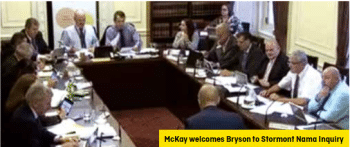
    Newish Northern Ireland First Minister Arlene Foster is in the middle of a successful charm offensive. She is popular, even with some Nationalists. The vortex into normality engulfs ever more of the increasingly hateless political classes despite themselves. We have recently emerged from one of the quietest marching seasons since the Troubles began. Any friction was small-scale. The last highly-contentious parades to survive into the present are the annual July 12th morning and evening parades by Orange lodges and associated bands from Belfast’s Upper Crumlin Road area. These pass the Catholic Ardoyne area. The Parades Commission has refused permission for the return leg of this. In recent years, there has been serious violence on it. This year, there was a short stand-off, then some skirmishing. Only one of the lodges involved in the parade took part in protests. There have been talks between representatives of the Orange Order and Nationalist residents. Both parties, in principle, accept the need for dialogue. Nationalist representatives are willing to accept a march, while Orange representatives accept provocative behaviour is unacceptable. Overall, the great majority of Protestants believe the Loyal Orders have a right to march. However, pointless street violence is a turn-off. There are internal tensions, with a perception that the more intransigent sections of the Orange contingent come from areas with few Catholics. Some Loyalists disparagingly refer to them as ‘seaside Orangemen’, whose intransigence fuels violence around interface areas. Then they go home, leaving community workers on the ground to pick up the pieces. Some Orangemen feel that these drive an agenda of refusing to talk to Nationalist residents – because they don’t have to face the issue in their own areas. Within the Orange community, there is also a tiredness. Many feel ‘protested out’ after long protests at Drumcree in Portadown and Ardoyne were unsuccessful. On the Catholic/Nationalist side there is no great love of Orange. However, there is also an acceptance that marches are a part of life, and no great appetite to oppose them as long as they are properly conducted, and there is consultation. Marching, of course, has been a lively issue in the North, and Ulster, since the Orange Order was established in the 1790s. Even in quiet periods like the early 1950s there were occasional riots in the curtelage of Orange processions. However, what the summer produced was the unexpected. We’re used to Somme-visiting Martin McGuinness taking tea with royalty but no writer would have been bold enough to make up the contact between flag protestor Jamie Bryson and Sinn Féin’s Assembly Finance Committee Chair, Dáithí McKay. Bryson came to prominence as an organiser of protests when Belfast City Council voted to cease flying the Union Jack every day on City Hall. He was against Sinn Féin being in government. However, there he was undoubtedly, exchanging friendly messages with McKay. McKay, one of Sinn Féin’s most able performers, has resigned. Bryson’s limited credibility as a hardliner has been tainted. It is unclear who leaked the messages. Bryson has strenuously denied responsibility. He is, though, the main suspect. The affair has damaged Sinn Féin’s image of discipline and control. Bryson is a loose cannon. He had good information on the actions of NAMA in the North: this obviously came from the anti-Robinson faction in the DUP. If Sinn Féin is established to have been working with him they will look far worse than duplicitous: they will look stupid. It is interesting that Frank Connolly reported in Village last year that Gerry Adams was “telegraphing” messages to ensure Peter Robinson knew that unless he resurrected the suspended executive Sinn Féin would play hard ball on his Nama travails. Meanwhile, this controversy has taken the focus away from the sale of NAMA properties in the North at significantly below value. There is no evidence that former First Minister Peter Robinson engaged in any illegal activity. However, several of those involved in the sales were perceived as close to Robinson. There are still big questions to be answered: the Bryson- McKay controversy has (to date) diverted attention from this. The summer also showed how the Sinn Féin – DUP arrangement is still stable. Foster’s political honeymoon will, naturally, not last but she has people skills that Robinson lacked. It is significant that the DUP did not call for the head of Finance Minister Máirtín Ó Muileoir until late in the day – and is not threatening the Executive on the issue. DUP sources see the Executive as solid. There were unexpected developments on bonfires, too. As expected Sinn Féin posters were burned on Loyalist bonfires round the 12th. They were also burned on a bonfire built by alienated young people in Derry’s Bogside. That youth alienation, across the community, is a bigger threat than the growth of Republican or Loyalist dissidents. By Anton McCabe
    Loading

    Read more