Posted in:
Try Harder Garda
Try Harder Garda
![]()
![]()
by admin
The debate in Ireland about joining NATO, or some sort of an EU military arrangement, is now on the political agenda like never before. Pro-neutrality advocates argue that the country is sleep walking into a military alignment of one sort or another with Western military powers. They point to the fact that US air force planes routinely transport American soldiers to Europe and beyond via Shannon airport as an example of an erosion of our neutrality. The pro-NATO lobby must be encouraged by the acceptance of the activities at Shannon which contrasts sharply with the anger displayed against Russian naval exercises off our coast earlier this year. What is missing from the debate is a discussion about the fact that Ireland has been playing a key role in lethal US military operations for years. Village described them in an article in 2017 which is as relevant now as it was five years ago. The piece can be accessed here: Technology neutralises our neutrality
![]()
by admin
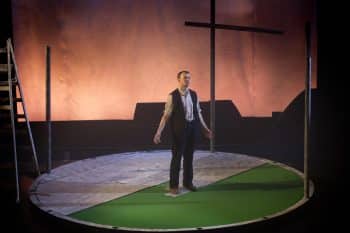
One of Greek tragedy’s foremost concerns is the contemplation of polarities. In a part of Sophocles’s Antigone, Ismene tells her sister, “You have a warm heart for cold things”, In ancient Greek culture, warm things are alive, cold ones dead; but for Antigone, now, the fire of her life and self has its source in that cold thing, her brother’s corpse; and when she gives up her life wanting to bury it, burning with this wish, her heart, dying, becomes cold. The unity of opposites, the separability of truth: Greek tragedy. Antigone wants to bury her brother, Polyneices. The previous night he, with an army, attacking his home city of Thebes which has seven gates, at the seventh, fighting one-on-one against his brother, Eteocles, defending the city, died. With two simultaneous blows, like on a frieze, falling, each killing the other, together at once, they died. Creon, whose role here as in Oedipus is to walk into the ruler’s part when the stage is empty and figure out what must come next, commands that Eteocles should be buried with all honours; but that Polyneices, who after all has just led an army against his own city, must lie bare on the ground to be eaten and waste away. The penalty for burying him is death. Simply, Antigone’s plot is her decision to defy this order, which, because Creon made it, is the law. The pair of Antigone and Creon have captivated among others Hegel, Brecht, Judith Butler and Séamus Heaney. For ancient Athens, a handmaid’s tale sort of city, Antigone was far over the edge just as Creon was too much in the middle. That they were interested, in Athens, in her at all shows this: the pious and the profane, the tyrant and the resistant, need each other in obscure ways; they are dance-partners. In Sophocles’s play there is no better proof of this than the side characters. Antigone’s sister, Ismene, and Creon’s son and Antigone’s husband-to-be, Haemon – stupid, reckless, caught in the middle – are equals of most of us. Teiresias, the blind seer, is like everyone when they know something pays with his powerlessness to alter it. Each is forced to where they end up by this secret, centrifugal thing, this law, which, when Antigone and Creon do not back down from each other (and she knows this better than him and mocks him for it), is what they commit to. ‘You have a warm heart for cold things’. But the play’s best and most elusive opposition is between the action and the chorus: ‘the play’ (characters and dialogue) and the poem, in a special dialect and metre, which a group of dancing and well-dressed paid amateur actors performed between scenes. Maybe it is better to say that the play is between verses of the poem. The chorus has lines such as “There are lots of astounding things and none more astounding than humanity”, and “Wandering far and wide, hope for many people is a dream” and “Love, who sweeps down through herds.”. The chorus, an ideal unity of the civic and religious elements, the poetic and speculative forms of thought, the individual and the group, of which it may be said that the Festival Dionysia in Athens, where the plays were first performed, was a continuous and blundering examination, has ensured that every straightforward attempt at Greek-style tragedy from the Romans to this day feels like a copy of an original. Which makes them hard to adapt. X’ntigone (Zan-ti-guh-nee)’s biggest problem is that it does not decide whether to make the effort. On the one hand, the characters keep the original Greek names, which in modern mouths are like elements of the periodic table rather than words which a parent would call an infant; they discuss offhandedly Thebes, Persians, Oedipus, Laius; on the other, X’ntigone herself (who explains that the X signifies unpredictability, and is an homage based on – a faulty understanding of – ancient Persian mathematics), rejecting all the stories of ancient Greece, loudly and emptily says: “The Master’s Tools Will Never Dismantle The Master’s House.”. The plot is different: the focus is a pandemic with the government and rebels both carrying around strains of the virus in test-tubes to inflict it on each other. Stripped to a discussion between X’ntigone and Creon, who both know all of this, but must repeat it so that the audience do, the play wallows in forced exposition, making its characters seem like they are inventions. Still, it is tough to divine what is going on. It is hard to shake the sense that this play wants everything but achieves nothing – Greek tragedy, Covid-19, Audre Lorde – the worst of all worlds, a play of ticked boxes authored by committee. The actors, Eloise Stevenson and Michael James Ford, do well with what they have. The problem is that the struggle between Creon and X’ntigone does not go anywhere, as if it was Blofeld versus Amanda Gorman in combat boots. X’ntigone is Good, Creon a Supervillain: there are no surprises. Near the beginning, twice, Creon is dismissive about non-binary people; later he even says that “Laius drained the swamp”. The only twists are two “I knew about your plan all along” moments when X’ntigone and Creon each give ‘Order-66’-type instructions to the government and rebels through iProducts. The set and lighting in this production, designed by Ciaran Bagnall, are striking and interesting: for the whole of this production X’ntigone is imprisoned in a glass quarantine-cell. Unfortunately so is the performance. X’ntigone (after Sophocles), written by Darren Murphy and directed by Emma Jordan is playing at the Peacock, Abbey St Dublin 1, from 16 to 26 March 2022
![]()
by admin
The Media’s treatment of the lies: an epic scandal ignored. It was March 1998. The RTE journalist Geraldine Harney informed me that I was to be dismissed by the ISME directors Peter Faulkner and Eoghan Hynes. She was doing the decent thing. Nevertheless, it was a preposterous suggestion and I told her so. However, in June her prediction materialised. Both Hynes and Faulkner demanded my resignation, with threats. The demand being unlawful, I refused to comply. (On 11 August 1998 Mr Hynes privately, by fax, instructed the incoming ISME chair Seamus Butler, a Longford businessman, to get on side with my removal.) In September the Irish Times journalist Barry O’ Keeffe printed a story that I had cheated on my expenses. I was not afforded the opportunity to refute the allegation. He apologised stating that he had been placed under inordinate pressure. There followed a stream of front-page stories in the Sunday Business Post stating in turn that I had stolen a suit, insurance and pension payments, a 1996 bonus and other frauds. In September too Aileen Hickey in Business Plus Magazine ran a cover story, blazoned ‘Gunning for Mulcahy’. As with Miss Harney it predicted the future. The article referenced pending accusations so sensitive that they couldn’t be revealed at that stage. I had no idea of what I was being accused of, or was expected to disprove. (In September Seamus Butler offered me £100,000 to resign with threats that I would “never work in this country again” if I did not oblige.) In October 1998 Irish Irish Independent journalist Gerry Flynn published several intimidatory faxes that I had received from Eoghan Hynes. Flynn had a reputation for being forthright. Initially, the Independent committed to standing by their journalist. They advised, “we will be fighting your case”. However, in the end management paid Mr Hynes £20,000 simply for publishing his abusive faxes. A form of apology was printed. I was damaged. (Nevertheless, in October and November the ISME Finance Committee publicly withdrew the allegations. The ISME members dictated that I was to be fully reinstated by the AGM in April 1999. When Hynes objected, several council members recorded him explaining his corrupt “game plan”. The council member Pat Coen had possession of the tape. His brother was a respected ranking Garda who had been kept in the loop. The tape was my reassurance. I was advised not to react to the daily provocations; to get to the AGM in April.) On Saturday 26 January 1999 I was walking on Killiney beach at 6.05 (PM) with the civil servant Diarmaid Breathnach when my phone went wild. It transpired that Seamus Butler, had announced on RTE’s early evening news that I had been sacked because I had fiddled my expenses. The story was utter nonsense. Butler had been interviewed by his neighbour the Longford-based RTE journalist Kieran Mullooly. I had not been afforded the opportunity to refute the charge. The following day I rang the RTE newsroom. George Lee answered. I registered my complaint – orally – at what had occurred. That evening Pat Coen collapsed and died. The tape was secured by his brother, Garda Sergeant Coen, with whom I later spoke. A year on RTE advised that I should have put my concerns in writing. (In February the Revenue Commissioners attended ISME at Butler’s request. Yet within an hour Revenue walked out believing that they were being used to damage me. On being informed, I arranged to meet the same officials. I provided them with my expenses file and the procedures laid down by Eoghan Hynes which I had followed. They replied, “we were never shown that file”.) The date for my reinstatement was fast approaching. However, at noon on 5 March 1999 Seamus Butler rang the then Irish Independent journalist David Murphy. Butler apologised for “lying” to him the previous day when he had denied removing the audit signatory Don Curry as an ISME director. He was, he said, making good by offering Murphy a scoop. He disclosed that he had called in the Garda in respect of his latest complaint, namely that I had defrauded the EU Commission. I had no prior knowledge of that allegation whatsoever. Aileen Hickey’s prediction had come to pass. (In April two gardaí visited my home. I provided them with evidence of the faxed threats and the £100,000 inducement. I directed them to Sgt Coen and the tape recording, to the Revenue Commissioner’s conclusion, to the ISME auditors and the audit signatories who affirmed the vexatious nature of the complaint. We expected that the fraud squad would charge Butler with, at the least, wasting police time.) On 2 May 1999, as the Garda commenced their investigation, I received a call from the editor of the Irish Times business page Cliff Taylor. He disclosed that he had been invited to the ISME board room the previous Thursday, with the offer of yet another “scoop”, namely that I was to be sacked on 6 May. Consequently, my lawyers threatened an “injunction”. Butler postponed the board meeting of that day. (Nevertheless, on 6 May ISME’s solicitors recorded Ercus Stewart SC stating “the board has been forced to dismiss Frank and that has been done. He should have sought an injunction but he didn’t…The only question now is how much he will be awarded by a court”. Clearly ISME had lied to my then lawyers, Binchys, and their lawyer Ercus Stewart SC.) In November 2005 the daily press reported in passing that the EU courts had penalised Rehab 20 million euros because of its maladministration of European grants.The Department of Enterprise spun the story that that penalty was somehow a win for Ireland. Despite my pleas that something was badly wrong, nobody was inclined to look under the hood. Rehab analogy to ISME What follows is the statement by the National Learning Network, a subsidiary of Rehab in relation to grants under the Human Resources Development
![]()
by admin
In a whitewashed barn decked out with Ulster flags, Union Jacks and pictures of the Queen, their leader in charge of this meeting sat at an old table. He pressed a button on a tape recorder. A voice boomed out: I address you as the commander in chief of the organisation, Silent Defenders. Author Ciarán MacAirt investigates a shadowy Loyalist paramilitary group made up of former RUC Specials and British soldiers. He tracks the gang from a newspaper article in March 1972 through British military intelligence files and on to the streets of Belfast in the bloodiest month of the conflict. The paper trail leads to a sectarian gang of Red Hand Commandos, British soldiers of the Ulster Defence Regiment and a series of murders and attempted mass murders of teenagers in north Belfast. But all is not what it seems as there were other killer gangs on the loose… Who were Northern Ireland’s Silent Defenders as we stared into the abyss in the summer of ’72? Visit Paper Trail to find out >> https://www.papertrail.pro/northern-irelands-silent-defenders/
![]()
Posted in:
by admin
78March/April 2022And whether or not Ireland likes it, on convergence. Two years ago this is what he told the Economistabout Europe: “So, frstly, Europe is gradually losing track of its history… Europe has forgotten that it is a community, by increasingly thinking of itself as a market, with expansion as its end purpose. This is a fundamental mistake, because it has reduced the political scope of its project, essentially since the 1990s. A market is not a community. A community is stronger: it has notions of solidarity, of convergence, which we’ve lost, and of political thought. Secondly, a change in American strategy is taking place; thirdly, the rebalancing of the world goes hand in hand with the rise—over the last 15 years—of China as a power, which creates the risk of bipolarisation and clearly marginalises Europe. And add to the risk of a United States/China “G2” the re-emergence of authoritarian powers on the fringes of Europe, which also weakens us very signifcantly. Finally, added to all this we have an internal European crisis: an economic, social, moral and political crisis that began ten years ago. Europe hasn’t re-lived civil war through armed confict, but has lived through selfsh nationalism. In Europe there has been a north-south divide on economic issues, and east-west on the migration issue, resulting in the resurgence of populism, all over Europe. These two crises—economic and migration—hit the middle classes particularly hard. By raising taxes, by making budgetary adjustments which hurt the middle classes, which I believe was a historic mistake. That’s incidentally what lies behind the rise in extremism throughout Europe. A Europe that has become much less easy to govern”.The Economist gives Macron an 80% chance of re-election. He has said and done what he thinks. It’s good to understand him. History if not ideology is on his side. these matters, has claimed that “Mr Macron has turned into something of a closet socialist”.The most visible evidence of the president channelling his inner Mitterrand is to be found in public spending. When the pandemic struck, Macron undertook to do whatever it took. Since then he spent ten times more last year to keep frms and furloughed workers going than France ever earned in a year from its wealth tax. France was already outspending all the Nordic countries on social programmes, and in indebtedness. Less noticed is a growing body of progressive rights and rules Mr Macron has also introduced: a doubling of guaranteed paternity leave to four weeks, with one week compulsory; fnes for frms that fail to close the gender pay gap.Internationally he has championed progressive multilateral causes, from a global minimum corporate-tax rate (a Macron pledge in 2017) to vaccines for Africa. France’s centre of political gravity has shifted to the right. This, not the left, is where his toughest competition will come from in April’s Presidential election. Macron’s nod to the left is studiously mild by French class-warrior standards, and in line with his intellectual roots. Not surprisingly his policy mix works quite well in practice, even if not in theory. Macron is much more philosophical than any other European leader, contrasting with a long-standing Irish weakness. His thinking, if he wins a second term, may drive the future of the EU. It centres on strength especially globally, on creating a community not a market, on tackling extremism and selfish nationalism and on indulging the disafected centrist middle classes. Four years ago I wrote early in Emmanuel Macron’s French Presidency that he had shown more leadership than the entire rest of the Western world since his election. “He claims to have found a political path between left and right, has made clear in the most elegant ways his disdain for Trump and has bowed to nobody, least of all Vladimir Putin, in sharing truths about international political thuggery”. I had a go at tracing his philosophic infuences largely through Paul Ricoeur of whom he was a protégé. Through Ricoeur essentially Macron is more likely to take an ethical approach, less likely to lie, more likely to keep promises, more likely to seek dialogue, see the other side and understand that two interpretations are possible of an act or situation, to be idealistic and secular.A good topical example is his role of interlocutor with Russia which bespeaks his willingness to see the other side and both his pragmatism and his idealism. He is touting the Russian perspective but is a friend to Ukraine and has made troops available just in case. Inevitably with that philosophical underpinning his overall record is dissonant. Macron has governed to the right of centre though he had promised to be in equal measure right and left of centre. A former investment banker, who scrapped the wealth tax and picked two centre-right prime ministers, he has moaned about the money the state spends on social welfare and does not idealise France’s comprehensivist welfare state. He has introduced looser labour laws into the rigid French system and he presided over the longest strikes since 1968 driven by his proposed pension reforms. He has been tough on security and Islamist extremism. Nevertheless the Economist magazine, not sympathetic on By Michael SmithINTERNATIONALGeneral government spending total, as % of GDP, 2020 or latest available (OECD)Macron – and on
![]()
Posted in:
by admin
76March/April 2022Fragile, vibrant, modern Ukraine faces being overrun by 190,000 Russian troops, driven by an autocrat frustrated at the loss of Russia’s one-time sphere of infuenceBy Michael SmithINTERNATIONALUkraineUkraine may have been a backwater, romanticised originally as the land of the Cossacks, until recently though it is the second biggest country in Europe (after Russia of course), but as of now it is a thriving democracy with a free media and free speech, and a vibrant economy, culture and social life. Kyiv and OdessaI visited Kyiv, Ukraine’s capital, and Odessa, in August 2021. Both are sophisticated, afordable, modern cities with swanky bars full of beautiful people drinking cocktails, artesan IPAs and local champagne; lively parks swarming with rollerskaters; and cinemas showing Hollywood movies. Kyiv, where the average salary is €620 per month, is an IT hub, dotted with high-rise apartments under construction – their ubiquitous realtor-branded photographic hoardings in English showcase the cosmopolitan residents they seek to attract. Odessa is the best-preserved Neo-Classical city in the world with a ritzy beach resort. Odessa has the most stylish restaurants East of Paris. We stayed in the Londonskaya Hotel, a Renaissance style palace built by a French confectioner in 1828 near the steps that feature in Sergei Eisenstein’s revered 1925 movie Battleship Potemkin. He stayed there too.All changed in 2014Ukraine hit the spot after its 2014 ‘Revolution of Dignity’ when protesters at Maidan square in Kyiv ousted the democratically elected president Viktor Yanukovych a thuggish Russian-backed mafoso. By then he had purloined around $100bn, equal to more than half the annual economic output of Ukraine. Leaned on by Putin, in 2013 Yanukovych had abandoned Ukraine’s Association Agreement with the EU and moved to join its Russian-led rival. Yanukovych ordered police to shoot protesters who opposed him. When the crowds swelled, Yanukovych fed to Russia where he remains, poised, allegedly hauling $32 billion dollars in cash across the border in trucks as his power crumbled.History: shared heritageThe shared heritage of Russia and Ukraine goes back more than a thousand years to a time when Kyiv was the capital of the frst Slavic state, Kyivan Rus, the birthplace of both Ukraine and Russia as Vladimir Putin recently asserted: “Russians and Ukrainians are one people”. Ukraine has been carved up down the centuries by marauding empires. Mongols, Polish and Lithuanians in a way that Russia was not. In the 17th century, Russian tsars ruled lands to the east of the Dnieper River as "Left Bank" Ukraine while lands to the west of the Dnieper, or "Right Bank" Ukraine, were ruled by Poland, though in 1793 those lands too were annexed by Russia. A Russifcation policy banned the use of the Ukrainian language, and pressurised Ukrainians to convert to the Russian Orthodox religion. The people were Ukraine: Ireland to Russia’s UKKyiv, 2022 March/April 2022 77generally known as Rusyns or Ruthenians and the ethnonym Ukrainians came into wide use only in the 20th century after the territory of Ukraine obtained distinctive statehood in 1917. Stalin organised a famine that killed millions in the 1930s and shipped in lots of Russian speakers.Ties to RussiaBecause eastern Ukraine came under Russian rule much earlier than western Ukraine, people in the east have stronger ties to Russia, often speak Russian (Russian and Ukrainian share 60% stem words anyway) and have been more likely to support Russian-leaning leaders.Annexation of CrimeaCrimea was occupied and annexed by Russia, irritated by the defenestration of Yanukovych, in 2014, followed shortly after by a separatist uprising in the eastern Ukrainian region of Donbas that resulted in the declaration of the Russian-backed People’s Republics of Luhansk and Donetsk. Ukrainian forces have been fghting pro-Russia rebels in the east since 2014 in a confict that has killed some 14,000 people.Threat of imminent warExploiting its overwhelming military superiority, as Village went to press, Russia had amassed 190,000 troops on Ukraine’s borders and was expected to attack simultaneously on several fronts, from the north-east, the Donbas and Crimea. and Belarus, Airstrikes would underpin a lightning drive south to seize the capital, Kyiv. And encircle Ukraine’s army, neutralising the country and its leaders. The US estimates artillery, missile and bomb strikes and ground clashes could kill 50,000 civilians.WarAs Village went to print Putin had made an angry speech and moved troops into Luhansk and Donetsk which have been armed, fnanced and politically controlled by Russia since 2014. But until now were recognised as part of Ukraine.Putin has also sent his military on a “peacekeeping mission” to Ukraine, meaning that Russia will formally occupy sovereign Ukrainian territory for a second time following the 2014 annexation of Crimea. But in this case, Russia has not annexed the territories. A document signed by Putin on Monday also allows him to establish military bases or place missiles in the territories. The bourses were diving, Germany suspended its Nordstream gas-pipeline collaboration with Russia and Boris Johnson was tearing around fnding Russians to sanction.Invasion of Ukraine could destabilise former Soviet republics such as now independent Estonia, Latvia, Lithuania (EU members), as well as Belarus, Georgia and Ukraine. Irish analogies and infuenceRussia’s relationship to Ukraine is clearly analogous to that of the UK to Ireland: a bigger and far more powerful neighbour, partially shares history, culture and religion with a division on ethnic rather than racial lines. Most Ukrainians are Eastern Orthodox Christians. A significant minority of Ukraine‘s population consider themselves Russian – analogously to the North of Ireland where a majority considers itself British frst and Irish second.It would be preferable if Ukraine signalled it will never join Nato but in any event Ireland should exercise its influence to support Ukraine, a beleaguered but honourable and modern country in retaining its independence from foreign interference and indeed carnage. Such is the foundation of the United Nations. SolutionsIt is forgotten that early in his frst Presidency Putin wanted to join both Nato and the EU – bonds that could now be ofered, long-term. Beyond that, we should use our limited infuence to see that the balance between Nato and
![]()
by admin
March/April 2022 75duplicity. Despite this, we managed once again to hold the line and steer the group’s reports from developer-friendly surrenders to solid conservation manifestos. History repeatsIn 2015 we had worked with then Fianna Fáil Senator Darragh O’Brien drafting his Moore Street Renewal Bill which reimagined the area as primarily a cultural and historic hub. It is a compelling and detailed document. In the 2019 election he stood as a TD, winning a seat and also becoming the Minister for Heritage. I emailed him offering congratulations and requesting an urgent meeting to discuss the Bill. He replied warmly saying we’d be meeting very soon. Since then, despite numerous emails, telephone calls and third-party interventions, O’Brien has not met us. Worse still, Taoiseach Micheál Martin held a behind-closed-doors meeting with Hammerson reps and allowed his praise of their planning application to be used in a company press release to accompany that planning application. A Taoiseach should never comment on a live planning issue.Following the City Council’s recent decision we now face into our second Bord Pleanála oral hearing, perhaps a judicial review, the Supreme Court and if necessary the ECJ. But we have in essence won the battle for Moore Street. Our victory lies in the simple fact, that though shabby, the 1916 terrace still stands. There will be an election quite soon and the main opposition party Sinn Féin has committed to implement the vision we have fought for. Your sense of history need be no more acute than your sense of irony to see parallels between this behaviour and the Rising itself, with Fianna Fáil somehow transformed into collaborators with the old enemy, and the insurrection being fought in windowless rooms. That the stakes are so diferent is the legacy of those who fought and died, around Moore St. The least we can do is properly mark their legacy. The Planning battleBack in 2009, we faced our frst Oral Hearing in a Soviet style conference suite at Dublin’s Gresham Hotel. Unlike Chartered Land we had no planning experts batting for us, but fought hard with an enthusiastic passion. Our case must have imprinted on the inspector as she found in our favour but her recommendation was not followed by her own board. We had to go to court.Some LawIn 2016 on the centenary of the Rising relatives of the 1916 leaders faced the Irish government in the High Court – a strange place, the gimcrack theatrics of its habitués chiming uneasily with its institutional staleness. The state’s appointment of Michael MacDowell as its lead SC was a calculated insult considering his grandfather’s attempt to call of the Rising. Before proceedings started there was an attempt by Hammerson to begin demolishing the terrace, but a spontaneous rallying of campaigners led to it being swiftly occupied while we sat in court. The judge, Max Barrett, seemed something of a maverick, with a background as a solicitor not a barrister. The two-week hearing passed in an indecisive fog of legalese and arcane ritual. On 17 March 2016 Judge Barrett read his judgment. It was framed in an impenetrable language, but the repetition of the term “granting relief” sounded positive. It was only when our solicitor who sat facing me visibly slumped in his chair that I knew something momentous had happened. I asked him: “Have we won?”, He replied “Everything”. Barrett had made much of the site a National Monument. Unfortunately ultimately the Supreme Court was to overturn much of his imaginative and learned judgment.MSAGThe government filibustered by cobbling together the Moore Street Advisory Group, essentially a talking shop for ‘stakeholders’ the MSAG was suffocated by public-service Background The Battle of Moore Street is the longest-running and most successful heritage campaign in this State. The battle is over the site of Ireland’s ‘Alamo’. undeniably the birthplace of our Republic where leaders of the Rising retreated from O’Connell St. In February 2022 it celebrates its twenty-frst birthday facing into a second An Bord Pleanála Oral Hearing following Dublin City Council’s planning permission in January to UK Developer Hammerson to destroy most of the most important modern historic site in Dublin. Modern HistoryIn 1999 there was a planning application to demolish the entire Moore St area. I contacted the National Graves Association who whipped up a campaign to take on the then owner of the site, Chartered Land. What started out as a small-scale campaign to save Number 16 Moore Street where fve signatories of the Proclamation including James Connolly spent their last hours as free men, expanded into a mass movement. Blood descendants of the 1916 executed leaders joined us, lending the campaign a unique authenticity.Over two decades the campaign met fve Taoisigh, seven successive Ministers of Heritage, countless TDs, councillors, planners and public servants. We encountered unbelievable institutional incompetence and dishonesty. Countering this we hosted packed public meetings, and staged street actions and guided walking tours of the ‘battlefeld ’. In September 2021 the campaign launched to widespread public approval our own vision for Moore Street, complete with digital renderings and a scale architectural model. And yet the Government refuses do the proper thing and compulsorily purchase the site. The Battle for Moore StMinister Darragh O’Brien will not discuss Rising relatives’ proposals. Taoiseach Micheál Martin held a behind-closed-doors meeting with Hammerson and supported their scheme though the Taoiseach should never comment on a live planning issueBy Patrick CooneyA little bit of history repeatingENVIRONMENTDarragh O’Briens
![]()