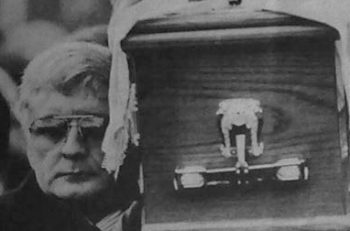
Cathal Goulding

Random entry RSS

  • Posted in:

    Learning to Kill, an exclusive extract from the new book on General Sir Frank Kitson, mastermind of the Dirty War in Ireland.

    Kitson’s first overseas assignment was to Germany in 1946 with the rank of second lieutenant. He remained there for seven years. He found plenty of sport to occupy his spare time such as racing horses in Rhine Army competitions, trout fishing and ‘many wonderful opportunities for shooting … and by shooting I don’t mean plugging holes in targets’, he wrote.’ Playing bridge and attending the opera also helped to pass the time. By 13 September 1949, he had found his vocation and was appointed as an intelligence officer at the HQ of the Armoured Brigade in Germany. Half a world away, in October 1952, the Kenya Land and Freedom Army (KLFA) launched a rebellion against the white European colonist-settlers in their homeland. The British army and the local Kenya Regiment resisted them. The latter included British colonists, local auxiliary militia and some pro-British Kenyans. Later, MI5 was deployed to help suppress the rebellion. The KLFA, also known as the Mau-Mau, consisted of rebel tribesmen from the Kikuyu, Meru, Embu and other Kenyan communities. In July 1953, Kitson was transferred to Kenya ‘to do a job connected with Intelligence’. After seven years, he was glad to be leaving Germany. He was twenty-six. The Mau-Mau rebellion was inspired by a desire on the part of the Kikuyu and other Kenyans to reclaim by armed insurrection land taken from them by the British. Kitson, however, seemed to think that opposition to Britain was inspired in large part through the intercession of witchcraft. He had a rose-tinted view of Britain’s presence in the country: During the half century in which the British had ruled Kenya they had dispelled the fears which had formerly come from raiders, slavers and disease, but the fear of magic was still a powerful force. As I sat at home reading about the witch-doctors and their ways, I too felt that fear, flickering faintly across the four thousand miles which separated me from the Kikuyu. He did not see the Kikuyu as civilised people. Instead, he described how they: relied mainly on magic and therein lay the greatest of all the horrors which beset them. Most witch-doctors were not malign in the sense of wishing harm to their clients. On the contrary, they doubtless did their best. On the other hand they sat in the middle of a web of superstition which bound the whole tribe in thrall to an unseen world of spirits, omens, curses and blood. At this time in his life, Kitson kept a Bible by his bedside. A clue as to the type of Christian he was can be gauged by the fact that on his first Sunday in Nairobi he attended a service in the local Anglican cathedral and wrote later: ‘I sat next to an African woman who had bad halitosis and I was surprised to find that there was no segregation of races into separate parts of the building’. The British campaign against the Mau-Mau was merciless. In 1953, Gen. George Erskine, commander-in-chief of British armed forces in Kenya reported to the secretary of state for war, Anthony Head, that in the early days there had been a ‘great deal of indiscriminate shooting by the Army and Police’ and he was ‘quite certain’ that prisoners had been: beaten to extract information. It is a short step from beating to torture, and I am now sure, although it has taken me some time to realise it, that torture was a feature of many police posts. The method of deployment of the Army in the early days in small detachments working closely with the police … had evil results. … I very much hope it will not be necessary for [Her Majesty’s government] to send out any independent enquiry. If they did so they would have to investigate everything from the beginning of the Emergency and I think the revelation would be shattering. What were these ‘evil results’, the revelation of which would have been ‘shattering’? In Cruel Britannia, A Secret History of Torture, Ian Cobain summarises some of the atrocities in Kenya: Men were whipped, clubbed, subjected to electric shocks, mauled by dogs and chained to vehicles before being dragged around. Some were castrated. The same instruments used to crush testicles were used to remove fingers. It was far from uncommon for men to be beaten to death. Women were sexually violated with bottles, rodents and hot eggs. This all took place against a background of curfews, intern­ment and capital punishment. Over 1,200 Kenyans died dangling at the end of a noose. One of the torture victims was Hussein Onyango Obama who had served with the British army during the Second World War in Burma. When released after six months in detention, he was emaciated, suffering from a lice infestation of his hair and had difficulty walking. He died in 1979. His wife informed journalists that he had told her that the British had ‘sometimes squeezed [his] testicles with parallel metallic rods’. They had also ‘pierced his nails and buttocks with a sharp pin, with his hands and legs tied together with his face facing   down’. Hussein Onyango Obama was the grandfather of Barak Obama. One British officer quoted by David Anderson in ‘Histories of the Hanged’ revealed just how brutal the campaign became. He described how a police officer was interviewing three suspects: … one of them, a tall coal-black bastard, kept grinning at me, real insolent. I slapped him hard, but he kept on grinning at me, so I kicked him in the balls as hard as I could … when he finally got up on his feet he grinned at me again and I snapped. I really did. I stuck my revolver right in his grinning mouth … and I pulled the trigger. His brains went all over the side of the police station. The other two [suspects] were standing there looking blank … so I shot them both … when the sub-inspector drove up, I told him the [suspects]

    Loading

    Read more

  • Posted in:

    Vandalising history. How the truth about Ireland’s Arms Crisis was corrupted by a gang of NI paedophiles, a dissembling Taoiseach, Private Eye magazine in London, some British Intelligence black propagandists as well as an Irish Times reporter who was an ally of the Official IRA.

      By David Burke. Introduction. The story of the Arms Crisis is a perfectly simple one. It only becomes complicated when the lies, fantasies and myths that engulfed it are entertained as if serious. Only two participants in the débacle told the full, accurate and unvarnished truth: Captain James Kelly and Colonel Michael Hefferon, both dutiful officers of Irish Military Intelligence, G2. It is my intention to publish a book next September which will reveal the deepest secret of the affair, aiming to make it even easier to comprehend. For the most part, I have ignored the parallel  story of how the truth was washed away by a flood of hogwash because it does little more than confuse the narrative. However, I will take this opportunity to present some of the more dramatically erroneous materials that made it into print. In other words, this is the story of what did not happen during the Arms Crisis and its aftermath. When the vines of deceit which wrapped themselves around the story are stripped away, what really happened in 1969/1970 becomes clear: James Gibbons, the Minister for Defence, 1969-70, oversaw an operation to import arms which were to be stored in the Republic under Irish Army lock and key. Charles Haughey and Neil Blaney were deeply involved too. Blaney was probably the main protagonist in the affair. Jack Lynch knew about it too. The paedophile, the propagandist and the political correspondent: William McGrath, Hugh Mooney and Dick Walsh. The weapons – which never reached Ireland – were intended to be distributed to certain vulnerable Catholic communities in Northern Ireland but only in the extremely unlikely event of a ‘doomsday’ situation such as a pogrom. Since no ‘doomsday’ scenario in fact occurred, the weapons would have done little more than gather dust and might have become no more than a minor footnote in recent history. All that changed when news of the importation attempt leaked out and all political hell broke loose. History was corrupted by a motley crew comprising a group of paranoid and malicious paedophiles who surrounded Ian Paisley, a cabal of deceitful British Intelligence propaganda experts, a Taoiseach who dissembled under great pressure – as did his minister for defence, a collection of delusional Official Sinn Féin activists, a legion of profoundly ignorant British journalists, and finally Dick Walsh, a secret ally of the Official OIRA in the Irish Times. This ramshackle crew concocted a variety of gobbledygook conspiracy theories. Broadly speaking, they can all be boiled down to a simple and core allegation, namely that the arms were destined for the IRA as part of some sort of dastardly plot involving Charles Haughey. Lying on an industrial scale: Jack Lynch and Jim Gibbons. One of the reasons the Arms Crisis became so confused was because of the hogwash they spouted about it. 1969: INTRODUCING THE EXTREMIST LOYALIST CHILD-RAPIST, ORANGEMAN, BIGOT, THIEF, BOMBER AND TERRORIST WHO INSTIGATED THE FIANNA FÁIL-IRA SMEAR All the trace elements of the Arms Crisis myth can be found in a devious story published in the pro-Paisley newspaper, The Protestant Telegraph, in 1969. A group of extreme Loyalists zealots including ‘Dr’ Ian Paisley, his associate William McGrath, and Paisley’s one-time bodyguard, John McKeague, and one of McKeague’s friends, Alan Campbell, ratcheted up sectarian hatred in the 1960s in tandem with other like-minded bigots. McGrath was a vile creature: a notorious paedophile who would be convicted for child rape in December 1981. The RUC referred to him as ‘The Beast’. McKeague was worse; not only was he a child rapist but his depravity extended further – he became a UVF/Red Hand Commando serial killer and torturer. He would be murdered in February 1982 after he threatened to reveal what he knew about the Kincora Boys Home scandal when it looked like the RUC CID was on the verge of arresting him for rape. Alan Campbell was one of the three men who led the notorious Shankill Defence Association alongside McKeague. Campbell was also the RUC’s chief suspect in the abduction and murder of a ten-year-old boy in 1973 in Belfast. McGrath, McKeague and Paisley Back in April of 1969, McGrath, McKeague, Paisley and other hate-fuelled fanatics mounted a ‘false flag’ bomb campaign in the North, i.e. one they perpetrated but blamed on the IRA and Jack Lynch’s government. The most notorious bomb of the campaign was the one which exploded in the Silent Valley and cut off the water supply to parts of Belfast. At the time the IRA hardly existed and  certainly had no intention of launching any sort of military campaign against the NI State. The allegation that the April 1969 bombs were part of an IRA campaign was circulated in the pro-Paisley newspaper, The Protestant Telegraph. It declared deceitfully that a source “close to [Stormont] Government circles” had informed the paper that a purported “secret dossier” on the Castlereagh electricity sub-station explosion contained: “startling documentation and facts. Original reports suggested that the IRA could have been responsible, but in Parliament no such definite statement would be made…We are told that the Ministry of Home Affairs is examining reports which implicate the Eire Government in the £2 million act of sabotage — By actively precipitating a crisis in Ulster, the Eire Government can make capital, win or lose. The facts, we hope, will be made public, thereby exposing the chicanery of the Dublin regime”. The Irish government ignited the Troubles – if you believe McGrath – by bombing the water supply to Belfast. This picture shows some of the débris left after the Silvent Valley bomb explosion actually perpetrated by supporters of Ian Paisley. William McGrath blamed Fianna Fáil for it. These lies would be laughable but for the vitriol they helped whip up in extreme Loyalist circles. McGrath was the main promoter of the lie. He used the then deputy editor of the Protestant Telegraph, David Browne, as his conduit to plant the story in the paper. Browne had been present at a meeting in

    Loading

    Read more

  • Posted in:

    The Official IRA planned the murders of journalists Ed Moloney and Vincent Browne.

    An Irish Times insider passed a spiked Ed Moloney article about the Official IRA to its commanders, who spread a rumour he was a terrorist, expecting the UDA would murder him. The material was later published by Vincent Browne inspiring plans by the Official IRA to murder him. By David Burke. Ed Moloney A MEETING WITH THE HARD EDGE OF THE UDA’s INNER COUNCIL Shortly after the February 1982 general election, Ed Moloney of the Irish Times found himself standing in a room “in the office of Andy Tyrie at the UDA’s HQ in Gawn Street on the Newtownards Road” with three senior UDA leaders. The trio included John McMichael, a member of the UDA’s Inner Council and Commander of the Ulster Freedom Fighters (UFF), the name the UDA used when it perpetrated assassination, torture and other acts of violence. The name was used so that the UDA itself would not be proscribed. No-one was fooled, least of all the British government and its security services. The second individual was “a very senior member of the Inner Council who is still alive”. Ed Moloney does not want to name him. The third man was Davy Payne, one of the UDA’s most feared killers and torturers. Like the other two, he was a member of its ‘elite’ Inner Council. John McMichael Moloney still recalls how “Payne was to my left. The other two were to my right. Their presence lent considerable authority to what Payne told me, since these three were the UDA’s main military men on the Inner Council”. Ed Moloney survived his encounter with these men. He continued to work as the Northern Editor of the Irish Times and went on to be voted Irish journalist of the year in 1999. Before the encounter with the UDA, he had worked for  Hibernia and Magill. After his time at the Irish Times, he went to work at the Sunday Tribune. He now lives in New York and publishes a blog, ‘The Broken Elbow’. He has contributed to Village. He is also the author of a string of acclaimed books about the Troubles. A CRITIC OF THE WORKERS PARTY During the course of Moloney’s work he had gathered ample evidence that the Official IRA (OIRA) was still in existence despite claims by its political wing, Sinn Féin the Workers Party (SFWP), to the contrary; and, moreover, that it was engaged in a wide range of criminality including bank robberies and extortion. After SFWP won three seats in the February 1982 general election, the party found itself holding the balance of power. The new SFWP TDs voted for Charles Haughey as Taoiseach in a stark choice between him and Garret FitzGerald of Fine Gael. Dick Walsh of the Irish Times, who was an ally of Cathal Goulding, chief of staff of the Official IRA, was appalled by his party’s support for Haughey. He described the development as a “Hitler-Stalin pact of sorts” in the Irish Times. The pact was never destined to last and Haughey’s government would collapse eight months later when the SFWP deputies withdrew their support. After the February 1982 election, Moloney wrote two pieces for the Northern Notebook of  the Irish Times. He has explained to Village  that one part of the series “dealt with the political journey SFWP had taken to power in the South. That part duly appeared on the Saturday as all Northern Notebooks did”. He submitted a second piece which was not published. It  “dealt with the continued existence of the SFWP’s military wing and the various criminal activities it was involved in, including racketeering and paramilitary activity”. This part “never appeared and I was never officially informed nor given any explanation by the Irish Times.  I cannot even say whether my copy was even shown above the level of sub-editor”. Moloney believes that “the real SFWP/OIRA influence was wielded at sub-editor level where stories could be changed and challenged without senior figures even knowing”. Shockingly, someone in the Irish Times – position unknown – passed the article to the Officials behind Moloney’s back. Moloney subsequently handed the research over to Magill, then edited by Vincent Browne, who published a two-part series on SFWP in March and April 1982. The magazine flew off the shelves and sold out completely. This was egregiously embarrassing for SFWP. It later changed its name to the Workers Party (WP) in an effort to distance itself from the whiff of sulphur that clung to the Sinn Féin part of its old name. Vincent Browne (left); Cathal Goulding on the cover of one of the two 1982 Magill articles which incensed the Official IRA; Ed Moloney (right) As Moloney has confirmed to Village, “I certainly gave Vincent the material I had gathered over the years, including material the IT had refused to publish”. THE MACHIAVELLIAN OFFICIAL IRA PLOT TO MURDER ED MOLONEY That the OIRA tried to set Moloney up for murder is not in doubt. The only issue is whether they did so after the publication of the Magill articles, or before. If it was before, it means that the murder attempt was designed to prevent the information he had gathered from reaching the public. If after, it was an act of revenge and a possible attempt to prevent further revelations. The plot was deeply Machiavellian: two Sinn Féin the Workers Party members told the UDA that Moloney was in the INLA. “Since people like Andy Tyrie and John McMichael knew me and doubted the claim, the UDA stayed its hand. The allegation against me was apparently made to the UDA by two members of Sinn Féin the Workers Party” Moloney has told Village that: “I learned about the threat to my life from the late UDA North Belfast Commander Davy Payne who informed me one day that the UDA had been told that I was a member of the INLA but, since people like Andy Tyrie and John McMichael knew me and doubted the claim, the UDA stayed its hand.

    Loading

    Read more