Harper Brown

Random entry RSS

  • Posted in:

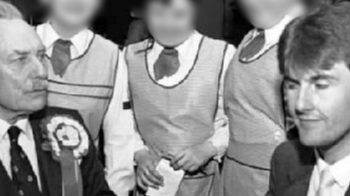
    Sir Jeffrey Donaldson’s mentor was a violent paedophile and a racist with deranged views about the lack of intelligence of women.

    The late Enoch Powell was a racist and a violent paedophile with deranged views about the intelligence of women. He was also a mentor to Sir Jeffrey Donaldson who is about to become the leader of the DUP. Donaldson acted as his election agent, 1982-84. Another of Donaldson’s mentors was the paedophile James Molyneaux. (See JAMES MOLYNEAUX AND THE  KINCORA  SCANDAL.) Powell ran against Ted Heath for the leadership of the Conservative Party in 1966. He left the Tories in 1974 and became the Ulster Unionist Party (UUP) MP for South Down. He remained in Westminster as a Unionist MP until 1987. In the intervening years, the truth about Powell’s involvement in the Anglo-Irish Vice Ring and his abuse of Williamson House and Kincora resident Richard Kerr has become public knowledge. Presumably, Donaldson will now come out and condemn Powell and what he stood for. In the intervening years, the truth about Powell’s involvement in the Anglo-Irish Vice Ring and his abuse of Williamson House and Kincora resident Richard Kerr has become public knowledge. Presumably, Donaldson will now come out and condemn Powell and what he stood for. On his website Donaldson has said that: “My involvement with the Ulster Unionist Party grew as I worked alongside two of the greatest names in Unionism in the 20th century [i.e. Powell and Molyneaux]. Between 1982 and 1984 I worked as Enoch Powell’s constituency agent, successfully spearheading Mr Powell’s election campaigns of 1983 and 1986 when the South Down seat was retained by the fact the constituency contained a natural ‘nationalist’ majority.” Donaldson, who became a political activist at 18, got to know Powell very well. Powell came over to the North most weekends. He usually returned on Monday mornings. One of Donaldson’s tasks was to drive Powell to the airport. The discussions in the car were  “politically orientated,” he has said. “He would talk about Parliament, about the 1974 period leading up to his resignation [from the Conservative Party], about British politics, about American politics. Sometimes, it would be completely different. He was a Greek classical scholar – you would get a lecture on the Elgin marbles. He wanted to help me get a foothold. It was real political apprenticeship”. Powell once tried to make up for Donaldson’s education deficit by gaining him access to a course in Queen’s University. Donaldson left the UUP and joined the DUP in January 2004 at the invitation of Peter Robinson. In 2018 Village published a story about the Anglo-Irish Vice Ring which featured a section on Enoch Powell. That section is reproduced below. 1. ENOCH POWELL AND THE CHURCH OF ENGLAND REVIEW INTO HISTORICAL CHILD SEX ABUSE In 2015, Powell was named in a Church of England review into historical child sex abuse concerning the 1980s. One of its spokespersons told the press that: “The name Enoch Powell was passed to Operation Fernbridge on the instruction of Bishop Paul Butler”. The information originally came from a cleric who has counselled child abuse victims in the 1980s. Last April [2018] Village gave Powell the benefit of the doubt insofar as these claims were concerned. In light of Richard Kerr’s account of his encounters with Powell – revealed here for the first time [i.e. July 2018] – that benefit must now be replaced with outright condemnation. Powell’s sexual interest in younger men was a long-standing trait. In 1937, having graduated with a double first from Cambridge, Powell had become a classics professor at the University of Sydney. He was only 25 and held the post for two years during which he wrote to his parents describing his infatuation with his male students. He told them how he was repelled by his female students, while feeling “an instant and instinctive affection” for Australian males between the ages of 17 and 23. This, he added, might be “deplored, but it cannot be altered”, and therefore had to be “endured – and (alas!) camouflaged”. Somewhere along the line Powell developed an interest in much younger boys. After serving as an intelligence officer during WW2, Powell went into politics and in 1950 became a Tory MP and later served in Cabinet. In 1966 he ran unsuccessfully for the leadership of the Conservative Party against Ted Heath, another paedophile with a taste for young boys. (See Not just Ted Heath: British Establishment paedophilia and its links to Ireland) Powell’s career went into decline after his infamous 1968 ‘rivers of blood’ anti-immigration speech. Eventually, Powell relocated to NI where he became a UUP MP in 1974. After he died in 1998, his friend Canon Eric James, a former chaplain at Trinity College, Cambridge, and Extra Preacher to the Queen, revealed that Powell had confided in him ten years earlier that he had engaged in a homosexual relationship as a young man. Powell gave him a copy of a collection of his poems called ‘First Poems’ (1937). He highlighted some verses where he had “tried to put into words what a homosexual relationship had meant to him”. It had been assumed by many that they had described Powell’s feelings for Barbara Kennedy whom he had taken on his first date with a woman to a music hall in 1948 when he was 35 or 36 years old. Canon James explained that Powell did not identify his male lover but said the relationship was “the most painful thing in my early life’. The individual in question was probably Edward Curtis, a fellow male undergraduate at Cambridge. The Canon revealed he had promised Powell he “would not disclose what he had said to me about the homosexual basis of certain of his poems until after his death. Then it would be a matter of literary history”. One of the lines read as follows: “I love the fire/ In youthful limbs that wakes desire…”. Another of his poems leaves little to the imagination: It described how he, as an “unknowing boy” was “led to sin”. ‘I did not speak, but when I saw you turn And cross your right leg on your left, and fold Your hands around your knee,

    Loading

    Read more

  • Posted in:

    Did Thatcher sanction the Finucane murder? It is now up to PM Boris Johnson and his Home Secretary, Priti Patel, to order a full judicial inquiry into the murder of Patrick Finucane to establish whether or not Margaret Thatcher gave Sir Patrick Walker, Director-General of MI5, the green light to murder him.

    Update: this article was published in October 2019. One year later the British government has refused to carry out a judicial inquiry. One of the stated reasons is that the PSNI and Police Ombudsman are reviewing the case. However, no  review is about to take place. Patrick Finucane’s widow has responded by saying that “as long as there is breath” in her body she will continue to seek answers about her husband’s murder and that the decision by the British government was “quite a shock” and showed “startling arrogance at ignoring the highest court in the land”,  i.e. the UK Supreme Court which has ruled that an inquiry should take place. Mrs Finucane has also pointed out that Brandon Lewis, the Northern Ireland Secretary of State, did not go into any detail about why the decision to refuse the inquiry was made. It  “does seem rather bizarre” she added  “that he [Lewis] is insisting the police [will investigate]” as the PSNI later issued a statement saying there is nothing new to investigate. The Police Ombudsman has no funding for a review. In any event such a review would be pointless and it is a judicial inquiry that is required. Clearly, there are other reasons Lewis and his boss Boris Johnson are blocking an inquiry. Village’s 2019 investigation addressed some of the issues the Tories, MI5 and other elements of the British Establishment are trying to suppress. That article starts here: Introduction: Margaret Thatcher and the cold-blooded murder of an Irish lawyer On 12 February, 1989, the UDA assassinated Patrick Finucane, a highly-regarded Belfast solicitor, at his North Belfast home. Finucane, who was 38-years-old, was shot 14 times by two masked UDA gunmen who sledgehammered their way into his house. His wife Geraldine was also injured during the attack which took place while the couple was enjoying a meal with their young family. In 2019 the Supreme Court in London ruled that the British Government had failed to investigate the murder properly. The only tenable reason for this is because the murder was organised by MI5, the intelligence service attached to the Home Office. A retired Canadian judge, Peter Cory, investigated the murder on behalf of the British State. During his inquiry MI5 officers broke into his office and stole some of the evidence he had accumulated. Cory also told Geraldine Finucane that he had seen a document relevant to her husband’s case which was marked  “for Cabinet eyes only”. Mrs Finucane knows no more. This raises the distinct possibility that her husband’s case was discussed in Whitehall in sinister circumstances before the murder. These revelations formed part of BBC NI’s compelling seven part Spotlight  series,  ‘The Secret History of the Troubles’. They have been ignored by the mainstream British media. Put simply, the finger of blame is now pointing at Margaret Thatcher. It now looks like she gave MI5 the green light to murder a perfectly respectable, law abiding lawyer. If Thatcher  and her circle did not order the murder, why are the Tory top brass so terrified of an inquiry? MI5 was led by Sir Patrick Walker at the time the assassination was planned and executed. If MI5 was involved, it is inconceivable he did not call  the shots – literally. When David Cameron was in 10 Downing Street he told the Finucane family that he could not order a public inquiry into the scandal. When Finucane’s brother Martin asked him why, he turned to Mrs Finucane and said: “Look, the last administration couldn’t deliver an inquiry in your husband’s case and neither can we”. According to Cameron this was because “there are people all around this place, [10 Downing Street], who won’t let it happen”. As he was saying this, he raised a finger and made a circular motion in the air. Theresa May, who was Cameron’s Home Secretary between 2010 and 2016, did not order a proper inquiry either when she took over at 10 Downing Street. The opportunity and duty to do the right thing and call one has passed to Theresa May’s successor, Boris Johnson, and his Home Secretary, Priti Patel. Yet, will they prove every bit as disdainful and corrupt as Blair, Cameron and May and continue the cover-up? Time is fast running out to hear what potentially key living  witnesses have to offer about the Finucane case. The list includes  Thatcher’s then Home Secretary, Douglas Hurd. Born in March 1930, he published a 524 page autobiography in 2003.  Unfortunately, there is no entry under the word “Finucane” in its index. Village  offers him the freedom of this website to inform our readers about what he know about the case, most particularly anything about “cabinet eyes only” documents. The evidence that continues to accumulate points to the probability that Finucane, a skilful lawyer, was targeted by the British State because he had mastered the intricacies of the Diplock Court system in NI and was representing his clients to the best of his very considerable abilities. A lot of Provos were walking free from court. In the mind of Thatcher and others in London, he had to have been a Provo and his death warrant was approved. In these circumstances, the task of assassinating him was passed to Walker and his gang of cutthroats at MI5. However, Finucane was not a Provo. On the contrary, he represented both Republicans and Loyalists. Who ever heard of a Provo securing the freedom of the Loyalist enemy? Moreover, he was married to a Protestant. Finucane was perfectly innocent of any involvement with the IRA although he was vilified as a member after his death. Insofar as the UDA was concerned, the kill-order was issued by Tommy ‘Tucker’ Lyttle, the UDA’s ‘brigadier’ or commander in West Belfast. Ian Hurst, who served with the then top secret Force Reconnaissance Unit (FRU) of the British Army, has stated “with cast iron certainty” that Lyttle was a British agent who was “handled” by the RUC’s Special Branch (RUCSB) using the codename “Rodney Stewart”. Lyttle himself

    Loading

    Read more

  • Posted in:

    The Boy on the Meat Rack

    A Life Derailed, Part 1 of the Story of Alan Kerr; By Joseph de Burca.  INTRODUCTION Alan Kerr was sexually abused by three men at Williamson House, a Belfast Corporation Welfare Department care home in Belfast. He was only six years of age when it started.  One of his abusers was Eric Witchell, the Office-in-Charge of the home. Witchell was a friend of both Joe Mains, the infamous paedophile and Warden of Kincora Boys’ Home and William McGrath, the Housefather at Kincora. Alan is the younger brother of Richard Kerr who has featured heavily in Village during the last two years. Alan did not realise he had a brother until he met Richard at Williamson House when he was six. He also met his sister at it and learned that he had another brother, and two other sisters; moreover, that both of his parents were still alive. Later, he was moved to Shore House where he was abused by another two men, one of whom may have been Witchell’s friend, William McGrath. Alan eventually fled from institutional care for a life on the streets of Belfast but it was no more than jumping out of the frying pan and into the fire. Having been neglected, groomed and abused throughout his childhood, and finding himself desperate for food and shelter while on the run, he fell into the hands of a network of calculating paedophiles who abused him. At one point in time he was manipulated into working for a while at a brothel off the Lisburn Road where boys as young as 13 were made available to Belfast’s paedophile community. Later again, he was trafficked to Birmingham and thence to London by Billy ‘B’, one of his abusers. Out of desperation and with neither an education nor any sort of a qualification, he would end up being exploited as a ‘rent boy’ at Victoria Station;  as  a ‘Dilly boy’ on the ‘Meat Rack’ at Piccadilly Circus;  and for approximately a year in a brothel in Earl’s Court alongside other boys who were younger than him; possibly even as young as 13 or 14. He also had a bizarre encounter with two members of the Royal Family. Alan’s life in London will be described in the next edition of Village. PART 1: A FOG OF FEAR AT BREFFNI NURSERY 1969-1974. ALAN AGED 0-6 INCARCERATING TODDLERS WHO CRIED AT NIGHT IN A PITCH-BLACK BOILER ROOM Alan Kerr was born on 8 May, 1968, and was taken into care at Breffni Nursery when he was only a few months old, sometime in late 1968 or early 1969. There was a lot of sobbing at night time in Breffni, a care home which catered for infants and pre-school children. Alan recalls how, if a child in the dormitory began to cry out loudly at night, some of the more brutal member of the night staff would put the child in a boiler room, well out of earshot. They were often left for hours alone in the pitch black. Alan often found himself crying because he was surrounded by cold strangers; had no family ‘to love me’; and had to cope with the unrelenting stress of a threatening environment. He too ended up in the boiler room on a number of occasions. He recalls one particular night when two of the night staff marched into the dormitory, hauled him out of bed and carried him to it, then pushed him inside and left him alone in the darkness four hours.   PART 2: RAPE AT WILLIAMSON HOUSE 1974-1978. ALAN AGED 6-9   ALAN KERR WAS SEXUALLY ASSAULTED ON HIS FIRST NIGHT AT WILLIAMSON HOUSE. HE WAS ONLY 6 YEARS OLD  A caveat must be entered before we proceed any further: Alan Kerr does not have access to his institutional records from Belfast and therefore cannot provide precise dates. Instead, he has done his best from memory. Alan left Breffni Nursery when he was about six, sometime in 1974, or thereabouts, and took up residence at Williamson House for the next two or three years. He describes it as being ‘worse’ than Breffni. ‘Things did happen there which I still can’t talk about.’ Alan would be abused by men who were not members of the staff at Williamson House; yet more proof of an organised child abuse ring operating in NI at this time. Astonishingly, the existing of a network has been dismissed by a series of lightweight inquiries which were no match for the corresponding heavyweight cover-ups organised by the British Establishment and which have lasted for nearly four decades. The most recent example of this was the mistake riddled Hart Report of January 2017, a document that even manages to contradict itself. ‘The abuse began on my first night at Williamson House when a man climbed into my bunk bed. I didn’t understand what was happening.’ The event was so traumatic, Alan manages to black it out most of the time and certainly prefers not to talk about it. Alan’s brother Richard and his sister were at Williamson House. Prior to his arrival, he had no idea that he had any family. He also discovered he had two other sisters and a brother. Alan, Richard and his sister were together for about a year before Richard was shipped out to Kincora Boys Home, perhaps the most concentrated cesspit of child sex abuse in Ireland at that time. Alan’s sister remained with him at Williamson House. He received his first visit – or at least the first visit he can remember – from his parents at the home. One of Alan’s abusers at Williamson House was Eric Witchell. He was a friend of Joe Mains, the Warden of Kincora, and William McGrath, the Housefather at Kincora. Although Witchell’s title was that of Officer-in-Charge, his responsibilities were confined to one of the two buildings at the institution, each of which was administered separately. Alan was not a resident on Witchell’s wing. Nonetheless, Witchell managed to lure

    Loading

    Read more