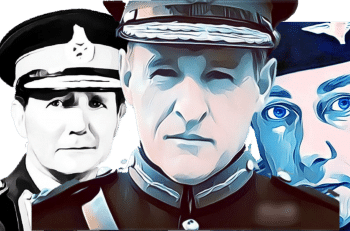
Patrick Finucane

Random entry RSS

  • Posted in:

    The D-G of MI5 who ordered the murder of Patrick Finucane has died.

    By Joseph de Burca 1. Getting away with murder. Sir Patrick Walker was in charge of MI5 when the Belfast solicitor Patrick Finucane was assassinated by MI5 agents. Those agents were handled by the RUC Special Branch on behalf of MI5. They included Tommy Lyttle, Brian Nelson, William Stobie and Ken Barret. The assassination, which was bloody and brutal, was carried out in front of Finucane’s wife and young family. The assassination, which was bloody and brutal, was carried out in front of Finucane’s wife and young family. The Canadian judge who investigated the matter, Peter Cory, told the widow of Patrick Finucane that he had seen documents which emanated from ‘Cabinet’ level about the killing. The most reasonable interpretation of this is that Walker was ordered, or had the sanction of Margaret Thatcher and some of those around her in Whitehall, to murder Finucane. The British State has resisted an inquiry into the Finucane assassination for decades. It has flouted agreements and court orders in so doing. When David Cameron was in 10 Downing Street, he told the Finucane family that he could not order a public inquiry into the scandal. When Finucane’s brother Martin asked him why, he turned to Mrs. Finucane and said: “Look, the last administration couldn’t deliver an inquiry in your husband’s case and neither can we”. According to Cameron this was because “there are people all around this place, [10 Downing Street], who won’t let it happen”. As he was saying this, he raised a finger and made a circular motion in the air. Theresa May, who was Cameron’s Home Secretary between 2010 and 2016, did not order a proper inquiry either whem she became prime minister. Walker’s death will please those in Whitehall who are pulling the strings in the background in resistance to the establishment of a full judicial inquiry into the murder. They are engaged in a tactic of ‘running down the clock’. There are very few people alive now who were directly involved in the plot against Finucane. Village magazine accused Walker of the murder years ago. He was named in one story which has been read more than 22,000 times. He did not sue. He did even seek a right of reply. His silence now condemns him. A full account of the Finucane assassination can be found here, especially at Part 4: Thatcher’s Murder Machine, the British State assassination of Patrick Finucane. By Joseph de Burca. 2. Northern Ireland, counter-terrorism and ‘Death on the Rock’. Walker garnered considerable experience in NI on his way up MI5’s blood soaked greasy pole. He served as assistant to David Ransen, the head of MI5 in NI during the late 1970s. He rose to become the head of MI5’s counter-terrorism division (F Branch), 1984-86. He became Deputy D-G in 1986. He was a bully given to flashes of temper when things went wrong. He was the D-G who oversaw the killing of three members of an IRA active service unit (ASU) in Gibraltar in 1988. That unit was planning the slaughter of a harmless ceremonial band and guard. Suffice it to say, many non-military bystanders and tourists would have been wiped out too. How the IRA planned to equate such a massacre with a ‘just war’ is anyone’s guess. The elimination of the ASU became notorious because the IRA volunteers were on a scouting mission and were unarmed. The SAS men who shot them were acting in tandem with MI5. Carmen Proetta, who witnessed the SAS soldiers in action spoke to the media. Her account contra dicted that of the British government. She was then portrayed in the UK press as a prostitute. No money for guessing who briefed the hacks with that lie. She was later awarded libel damages. One female witness who saw the SAS soldiers in action spoke to the media. Her account contradicted that of the British government. She was then portrayed in the UK press as a prostitute. No money for guessing who briefed the hacks with that lie. She was later awarded libel damages. 3. Protecting paedophile rings. Walker was also in charge of MI5 during the last real heave by British MPs and journalists (such as Paul Foot) to uncover the truth about the vile Kincora Boys’ Home sex abuse scandal. MI5 and MI6 used the home as a ‘honey trap’ to collect ‘compromat’ about Loyalist terrorists and politicians. As a result of the cover-up, the wider paedophile ring of which Kincora was a part survived intact. Kincora was part of the Anglo-Irish Vice Ring which overlapped with a multitude of other similar rings.  An incalculable number of children were raped as a result of Walker’s contribution to the cover-up. An incalculable number of children were raped as a result of Walker’s contribution to the cover-up. Walker undoubtedly knew all about Kincora from his earlier days working in NI as assistant to David Ransen. Furthermore, the FX section of MI5 was responsible for surveillance operations which included telephone tapping, photographing and video taping of MI5 ‘compromat’  targets. At least one Kincora boy was raped by a senior DUP figure on the first floor of the Park Avenue Hotel in Belfast in 1976. He was one of many recorded by MI5 at the venue. While this event took place before Walker took over FX, he would have read all the files and may even have reviewed photographs and videos in the possession of FX as the Kincora scandal became a massive headache for MI5 during the 1980s. By then the DUP figure was in a senior political  position from where he was able to assist the cover-up. This man was an associate of the terrorist, serial killer and paedophile John McKeague. 4. Sailing by the same dark compass as his mentor. Walker was placed in charge of MI5 at the behest of his predecessor, Sir Anton Duff. Duff was another of those who covered up for paedophiles and state assassins. Unfortunately, Walker sailed by the same

    Loading

    Read more

  • Posted in:

    Soldier F and Brigadier Kitson’s elite ‘EFGH’ death squad: a murderous dirty-tricks pattern is emerging which links Bloody Sunday with the actions of paratroopers in Belfast in August 1971. A second soldier involved in both events was ‘mentioned in despatches’ at the behest of Kitson for his alleged bravery in the face of the enemy.

      By David Burke. 1. “No other perpetrator involved would be given anonymity, for some reason Soldier F is a protected species”. In the last week, Colum Eastwood MP, the Leader of the SDLP, named ‘Soldier F’, in the House of Commons, under privilege. ‘Soldier F’ had faced murder charges for his actions on Bloody Sunday which had been dropped. The world now knows that former Lance Corporal Cleary is ‘Soldier F’. He is a small man who joined the Parachute Regiment in 1966. Eastwood said that, “For 50 years he has been granted anonymity and now the government want to grant him an amnesty. No one involved in murder during the Troubles should be granted an amnesty.” After his speech, Eastwood told BBC NI that: “Over the past couple of weeks his name has been plastered on Free Derry Corner, it has gone viral on social media. The people of Derry know his name. There is no reason for him to be granted anonymity. No other perpetrator involved would be given anonymity, for some reason Soldier F is a protected species.” The Speaker of the Commons has confirmed that Eastwood did not abuse parliamentary privilege in naming Cleary. 2. David Cleary’s Killing Spree. On Bloody Sunday in January 1972 Cleary was conveyed into the Bogside at speed in a Saracen vehicle or “pig”. He and his colleagues leapt out of it and took up positions behind a low wall adjacent to a ramp on Kells Walk from where they shot Michael Kelly. Kelly was unarmed and standing at a nearby rubble barricade, a threat to no one. Cleary and three of his colleagues, Corporal E, Private G, Private H, [the EFGH unit] moved into Glenfada Park North, where their killing spree continued. The Saville Inquiry found that Cleary or Private H shot William McKinney dead; also that this unit was responsible for the shot that wounded Joe Mahon,  and that either Cleary or Private G fired the shot that wounded Joe Friel. Saville opined that the EFGH unit also murdered William Wray, injured Joe McMahon, Joe Friel, Michael Quinn and Patrick O’Donnell, and possibly injured Daniel Gillespie. There was no excuse for their behaviour. According to Saville: “In our view none of the soldiers fired in the belief that he might have identified a person in possession of or using or about to use bombs or firearms.” Saville also found that: “The last gunfire casualties were Bernard McGuigan, Patrick Doherty, Patrick Campbell and Daniel McGowan, all shot in the area to the south of Block 2 of the Rossville Flats within a very short time of each other. We are sure that Lance Corporal F [i.e. Cleary] fired at and shot Bernard McGuigan and Patrick Doherty, and it is highly probable that he was also responsible for shooting the other two casualties. This soldier fired across Rossville Street from the Rossville Street entrance way into Glenfada North”. Cleary was a cruel, cynical and clinical killer. He shot Patrick Doherty in the buttock while he was on the ground crawling away from him. As Doherty lay crying out in pain, his life draining away from him, Barney McGuigan, an exceptionally brave and humane man, stepped forward with a white handkerchief looking to help Doherty. Cleary dropped to one knee, aimed his rifle and shot McGuigan in the head. Cleary was a cruel, cynical and clinical killer. He shot Patrick Doherty in the buttock while he was on the ground crawling away from him. As Doherty lay crying out in pain, his life draining away from him, Barney McGuigan, an exceptionally brave and humane man, stepped forward with a white handkerchief looking to help Doherty. Cleary dropped to one knee, aimed his rifle and shot McGuigan in the head. 3. A Pat on the Back: mentioned in despatches. Cleary was “mentioned in dispatches” for confronting the enemies of the Queen in the London Gazette in February 1972. This was a few weeks after Bloody Sunday. The citation was for his alleged courage in Belfast the previous August 1971. The odds are astronomically high that Cleary was one of those involved in the shooting of unarmed and innocent civilians in what became known as the Ballymurphy massacre. It is now beginning to look like Cleary and a group of paratroopers attached to the Support Company of the 1st Battalion of the Parachute Regiment (1 Para) were identified, recruited and groomed to carry out the extermination of civilians in any circumstance, including on occasions when they posed no threat to the British Army. The man in charge of Cleary and his comrades was Colonel Derek Wilford. He is on record as having said that all Catholics support the IRA. Thus, to kill a Catholic was tantamount to killing a supporter or member of the IRA. That attitude was undoubtedly shared by Cleary and others in 1 Para. The contempt and disdain they had for Catholics became grotesquely manifest in the Bogside on Bloody Sunday. Wilford reported to Brigadier (later General) Frank Kitson. Of the pair, Kitson is the far more significant. First, he was the superior officer. Second, Wilford did not take over command of 1 Para until July 1971 by which time the soldiers of 1 Para had been engaged in countless violent confrontations with civilians in Belfast. (The murderous violence of 1 Para did, however, gather momentum after Wilford’s appointment.) Third, Kitson had disclosed the technique of terrorising a community which harboured insurgents in his infamous book ‘Low Intensity Operations’. An analysis which makes sense of what took place in Ballymurphy from a British Army counterinsurgency perspective – and which is based on the content of ‘Low Intensity Operations’ –  can be found at: Brigadier Kitson’s motive for murdering unarmed civilians in Ballymurphy. From the standpoint of the British Army, Kitson’s book should never have been published. However, the author was entitled to 50% of the royalties of the sale thereof and this may account for the indiscretion of publishing

    Loading

    Read more

  • Posted in:

    Dial MI5 for Murder

    HAS SPOOK-TURNED-THRILLER WRITER DAME STELLA RIMMINGTON FORGOTTEN WHAT IS IN MI5’s TOP SECRET FILES? Dame Stella Rimmington has just published another of her bestselling Liz Carlyle spy yarns The Moscow Sleepers in time for the Christmas market. In it, the redoubtable Liz is set against some  very nasty men from Russia. This has all been done ten thousand times in one guise or another. This is all rather a shame because Stella Rimmington, a former Chair of the Judges for the Man Booker Prize, could probably produce a novel of real substance if she really put her mind to it. After all, she was theDirector-General of MI5, December 1991-1994, and spent a career knee deep in all sorts of skulduggery, including snooping on perfectly respectable MPs, trades unionists, civil rights groups and journalists. Since she joined MI5 in the late 1960s and left it in 1996, she must know virtually all of MI5’s most pitch-black secrets, especially those of the Troubles, though you certainly wouldn’t suspect this from her fictional output or her double-whitewashed 2001 memoirs, Open Secret, which may as well be a work of fiction. Rimmington is a dab hand at transforming fact into fiction; whether at a conscious or sub-conscious level is best left to the experts. Incredibly, she believes no one in MI5 ever lifted a finger to thwart the Labour PM Harold Wilson, seen by some in MI5 as a dastardly KGB stooge and traitor. This, despite the fact back that no less a figure than Lord John Hunt, the mighty and all-powerful Cabinet Secretary, 1973-79, acknowledged that it had indeed happened. In August 1996 Hunt told a Channel 4 documentary that, ‘There is no doubt at all that a few, a very few, malcontents in MI5, people who should not have been there in the first place, a lot of them like Peter Wright who were right-wing, malicious and had serious personal grudges, gave vent to these and spread damaging malicious stories about that Labour government.’ THE FORMER TOP SPY WHO DRAWS NO INSPIRATION FROM THE REAL SPY WORLD Unless she was sleep-climbing during her ascent to the top of MI5’s blood-soaked pole, Dame Stella must have heard something along the way about: MI5’s collusion with Loyalists hoods in Northern Ireland such as the Glennane Gang; The MI5-RUC shoot-to-kill scandal that John Stalker, the honest, admirable and principled Deputy Chief Constable of Manchester, investigated in the 1980s, only to be vilified as he edged closer to the truth about MI5’s complicity in the murder of a string of people including Michael Tighe, a 17 year-old with no links to any paramilitary group; The deeply sinister framing of Colin Wallace by Ian Cameron (Wallace wanted to stop MI5-protected child rape at Kincora Boys Home and other dirty tricks) and the pernicious vilification of Fred Holroyd – again perpetrated by Cameron – (Holroyd didn’t want to murder people for MI5); The brutal assassination of the Belfast solicitor Patrick Finucane in 1989 in front of his wife and young children by acknowledged British agents; The setting fire to the offices of that other honest, admirable and principled cop, Sir John Stephens in Belfast in 1990. His office was torched during his investigations of MI5’s exploitation of the UDA as proxy assassins with the aid of Brian Nelson, the Head of the UDA’s Intelligence department; MI5’s network of contacts inside Garda Intelligence; The print journalists in Dublin who were fed stories by HMG’s spooks. Since MI5 co-operated with MI6 in the Republic, Dame Stella must know which journalists had their noses in the trough and who just was rewarded with a pat on the back at meetings of the British-Irish Association or over dinner at the Dublin Embassy; The MI5-Red Hand Commando (RHC) attempt to place a bomb on Charles Haughey’s boat in Dingle harbour in the summer of 1981 when the RHC was led by a serial killing MI5 psychopath called John Dunlop McKeague. Did Stella ever read McKeague’s file? And while we are at it, what about Haughey’s file? Surely Stella she had read it by the time she became D-G at the end of 1991. Haughey didn’t retire as Taoiseach until 11 February 1992. Why hasn’t Stella drawn on any of this remarkable source material for her hitherto run-of-the-mill fiction? Has she forgotten everything in the files? In Open Secret, she wrote – merely in passing it must be stressed that – ‘Loyalist terrorists too had developed their operations and were constantly looking to increase and upgrade their arms and equipment.’ (211) That’s all very fine Stella, but please:   what part did Ian Cameron and all the other psychos in MI5 who served in NI play in helping them; in directing them; in covering-up for them? THE CORRUPTION OF THE SOUL Regrettably, like that other spook-turned-author, John Le Carre, formerly of MI5 and MI6, Stella steers well clear of what HMG’s real-life spooks got up to in Ireland in both her fictional and factual outpourings. For his part, Le Carre has managed to convince himself that he has attempted to ‘explore’ Britain’s ‘psyche’ and that in so doing, ‘it’s Secret Service [was] not an unreasonable place to look’. Regrettably, he never set any of his – admittedly brilliant – novels in an Irish setting. Does he not believe the Troubles had an effect on the British ‘psyche’ or were the crimes of HMG’s spooks just too much to deal with? Anthony Cavendish, who served in both MI5 and MI6, certainly wasn’t afraid to confront the truth. He described in his memoirs, Inside Intelligence, how as ‘the years go by, the lies take over from the truth and morality accepts the other demands which are made on an [intelligence] officer to get the job done’ and that ‘theft, deception, lies, mutilation and even murder are considered if and when necessary’. So, just what is the point of promoting Rimmington on the cover of her Liz Carlyle books as the ‘Former Head of MI5’, if she

    Loading

    Read more