people

Random entry RSS

  • Posted in:

    Make sure of the facts

    There are two dominant interpretations of what’s come to be known as “call-out culture”. Many see it as an effective way of holding people, particularly public figures, to account for objectionable deeds and utterances that their status might otherwise have allowed them get away with. Social media has certainly played a massive role in an accelleration of accountability that is changing the way big organisations function. For the powers-that-be many styles of “cover-up” are simply no longer possible. One individual can go viral with their story in a matter of minutes. However, many others see call-out culture as trial by mob, a return to a medieval mentality, or puritanism in another guise – particularly when applied to individuals rather than institutions. Either way, I think – I hope – everyone can agree people shouldn’t be held to account for things they haven’t actually said or done. Yet over the past year it seems there is a disturbing new trend in the now conglomerated battlegrounds of media and social media. The values of call out culture – the idea that people should be made atone for perceived offence through group-shaming – are no longer a phenomenon of those periphery cultures largely concerned with traditional arenas of cultural theory: questions of gender, minorities, and identity. In 2017, call out culture went mainstream in a big way. I’m not referring to the Hollywood purge, which did aim to address gendered issues, and seems to have been long-overdue. The culture of the call-out – its language, style, mentality – started to intrude into new domains. The standard of offence became radically expanded, and the concept of proportionality (let the punishment fit the crime) went out the window. The most depressingly ridiculous example of this has to be the career ending decision of Barry McElduff to make a short video in a local shop, pretending not to be able to find a loaf of bread which was in fact balanced on his head. The video was posted the night before the, to be fair – fairly inauspicious – date of the 42nd anniversary of the Kingsmills massacre. Kingsmills was one of the most despicable atrocities of The Troubles. A group of workers had been travelling on a bus home from a factory when they were stopped by what was ostensibly a British Army patrol. In one of the most poignant gestures of the Troubles, when the gunmen asked the single Catholic worker to identify himself, his Protestant co-workers tried to prevent him stepping forward, as they believed it to be a loyalist gang targetting Catholics. He identified himself nonetheless, but was spared. It was the 10 Protestant workers who were machine-gunned to death. Another man survived despite having been shot 18 times. After the the video was “called-out” on Twitter, condemnation of Kingsmills seemed immediately to become coterminous with condemnation of McElduff. Defence of McElduff was taken to be defence of the massacre. This is a fixture of this style of thinking – any query as to whether or not the accusation is accurate is taken as defence of the deed that has been alleged. Those who queried the likelihood the then MLA was performing some piece of bizarre Daliesque sectarian performance art, were met with rebuttals reasserting how wicked a deed the massacre was, and that it was no laughing matter. Surely true, but irrelevant to ascertaining whether or not McElduff was actually referencing Kingsmills when he put the loaf on his head. I watched in dismay as a number figures across the political spectrum – some of whom I’ve long admired – rushed to condemn McElduff, refusing to countenance the notion that this was an unfortunate coincidence. His own then ordained leader-to-be, Mary Lou-McDonald proved of the same mind-set as she condemned McElduff’s tweet as “crass”, “stupid”, and “unforgivable”. She of course had not condemned the numerous social media posts prior to this in which McElduff had balanced other comestibles on his head, although there were many – it seems to have been a running pantomime gag for the politician. When someone points me to the sectarian atrocity he was referencing when he took a photo with a Snickers balanced on his scalp, then I’ll believe there was ill-intent. It was instead his young daughter who was left to try and defend her father against the social media onslaught, explaining the photo was taken in the shop she worked in, the family always ate Kingsmills bread, etc etc, to absolutely no avail. Fixed thinking is another aspect of this praxis – no amount of evidence will exhonerate the accused, any defence offered is taken as further evidence of their guilt. What mattered to McDonald was not the facts of the matter, or loyalty to someone who dedicated their life to a political party she joined in the late 1990s, what mattered was assuaging the mob. And this has become the prime directive for many powerful people, not only in politics, but in the media and corporate world. This is regrettable, as another recurring theme is that the outrage is often so loud it entirely obfuscates the circumstances of the original incident. In another example, John Connors drew ire after tweeting that he personally wouldn’t call the police on someone for “robbing bread”. This was then completely conflated with events later that same day, when a stolen digger was used to smash and try to steal the safe from a Lidl which had earlier been looted of food and drink. No amount of clarification could convince many of the call-out crew that Connnors was not trying to downplay or justify an event that hadn’t even happened when he originally tweeted. Thankfully Connors is comparatively invulnerable to these tactics, unlike McElduff his career is not subject to the vicissitudes of political sensitivities. Lest anyone accuse me of being partisan, here’s an example of precisely the same style put to use in the opposite direction. When former Taoiseach Liam Cosgrave died, RTE presenter Sean O’Rourke retold

    Loading

    Read more

  • Posted in:

    Áras Attracta lesson: rights-based model

    On 4 January 2016 I found myself in a court-residents. The review group recommended a move to a room in Castlebar, Co. Mayo. One man and ve women were on trial, charged with assault alleged to have occurred in Áras Attracta. Sitting in the courtroom my hope was to use this experience as part of my own catharsis, having lived through physical abuse in Áras Attracta which is the HSE-run residential centre in Swinford, County Mayo where 96 men and women with intellectual disabilities live. It featured of course in a recent exposé by RTÉ’s Prime Time programme. Bodily integrity, in the context of receiving support for personal care, brings an unspoken vulnerability. Fear is ever-present. Dignity and respect should be basic imperatives. Those of us involved in the rhetoric of human rights and the independent-living movement must remember that our sisters and brothers with learning disabilities are uniquely susceptible to abuse. The material captured on the hidden camera placed by Prime Time’s undercover reporter showed staff shouting, pushing, force-feeding and dragging residents across the floor. The footage was used in evidence in the case by the State prosecutor. The five staff, including nurses and care workers, were found guilty of assault. All but one avoided jail terms. Four were sentenced to community service orders in lieu of prison terms. The fifth was given a prison term of four months which is currently under appeal. The protracted saga of Áras Attracta is a reminder of the slow pace of the State’s apparatus. Two years on from Prime Time’s exposure of what was happening in Áras Attracta an independent review group published the ‘What Matters Most’ report in August with thirteen recommendations and an action plan for all congregated settings. The most pertinent of these was to “accelerate the process of supporting people to move into community living, avoiding transitional arrangements”. The HSE has committed to implementing this and claims that “individual needs assessments have been completed for all residents to identify their future support requirements to live a successful life in the community”. The independent report stated there was “widespread institutional conditioning and control” of people living in Áras Attracta. It found that this was generally imposed for the convenience of staff and management and the model of service was structured to suit staffing constraints rather than the needs and aspirations of residents. The review group recommended a move to a rights-based social model of service delivery in one of its overarching recommendations for Áras Attracta. Most service-providers for people with disabilities are state-funded. They remain institutions where power and control exerted over us and people’s right to independence and choice is denied. The report tells those of us who have to have relationships with service providers nothing new. It con rms unspoken realities. There have been a series of HIQA reports on these services that back up this analysis. The inertia in implementing recommendations from these reports coupled with the lack of rights-based legislation further demonstrates state inertia when it comes to people with disabilities. The Áras Attracta situation merely highlighted the insidious practices that take place in residential institutions. Often there is an inference that somehow people who are abused brought it on ourselves. In the context of Áras Attracta, what was considered, or diagnosed as challenging behaviour could better be described as very challenging circumstances for the residents. There are still over 2,700 people living in congregated settings throughout the country. Residential settings echo a discredited previous era. We suspect, we fear and we know. However, still they continue. Twenty-seven people currently living in Áras Attracta are now waiting to move into new supported accommodation. The Minister for people with disabilities, Finian McGrath, has announced that the Government has provided a dedicated €100m capital fund to facilitate de-congregation over the period 2016-2021. €20m has been provided for 2016 and Áras Attracta has been prioritised to receive funding in this first phase. Action is now needed, not just another report or political promise that will become redundant as time passes and nothing changes. The kernel of the ‘What Matters Most’ report is in the overaching recommendation for Áras Attracta that “The voices of the residents need to be facilitated, listened to and promoted”. Why would you need to make such a recommendation? What has gone so badly wrong that this has to be one of only three overarching recommendations. Fostering the independent voice of the people accessing services, attending to their preferences, and ensuring people know their rights and have access to advocacy services should have been a given. These are the voices that must now determine the future. Rosaleen McDonagh

    Loading

    Read more

  • Posted in:

    Yes to history, no to commemoration

    Commemorations for the centenary of the 1916 Rising are well underway. This anniversary is being marked in a much less sanitised way than previous significant Easter Week commemorations. This is very welcome. For far too long, ceremonies celebrating the 1916 Rising were based on a highly simplified, monochrome account of history: Rebels good, Brits bad, civilians ignored. We did not see pictures of dead bodies. Few official accounts mentioned the deaths of women and children caught in the crossfire. This time around, things are different. The vital research work of many historians and others has contributed greatly to the generation of this more complex understanding of the 1916 Rising. We now know that approximately 488 people were killed during Easter Week. Of these, 40 were children, and over 200 were civilians. There were about 120 British soldiers killed, and 60 rebels. These numbers are as significant as the numbers we have traditionally associated with commemorations marking Easter Week: the seven signatories of the Proclamation, and the 16 men executed. It is timely to reflect on four key themes which should shape, and to some extent are shaping, the centenary commemoration process: de-militarisation; contextualisation; inclusivity; and humanisation. Commemorations should not be over-militaristic, nor should any death or killing be ‘celebrated’. This is even more necessary in the wake of the recent Brussels atrocity which showed the immense human tragedy of mixing religion, politics and violence. The events organised throughout Dublin for Easter Monday under the ‘Reflecting the Rising’ banner were far more in keeping with an inclusive spirit of commemoration, than the military parade that took place on Easter Sunday. In a similar spirit, commemorations should reflect the context of the time. The rise of important social movements, in particular the trade union and suffragette movements, as well the Irish cultural revival, should be marked alongside the nationalist struggle. The commemorations must be inclusive. Where official ceremonies include religious services, these must be carried out with respect for humanists, atheists and people of minority religions. Similarly, commemorations must be inclusive of both women and men. We now know, from the great work of feminist historians, that 77 women involved in the 1916 Rising were arrested along with their male colleagues at the end of Easter Week. Inclusivity also means remembering the many thousands of Irishmen who fought and died in World War I, but whose lives and deaths were not officially commemorated for many decades after independence. Commemorations must become humanised. It is welcome to see this happening in this centenary year. Many official and unofficial events have incorporated the telling of individual eye-witness accounts: some noble, some tragic, some humorous, and some poignant. These include stories like that of Catherine Byrne, who jumped through a side window of the GPO to join the male Volunteers inside. They include that of two-year old Sean Foster, who was shot dead in crossfire while being wheeled in a pram by his mother Katie on Church Street, and whose father had died on the Western Front the year before. In bringing these stories to the fore, we come closer to realising the past and to remembering the dead in a respectful and inclusive way. It is very welcome to see these four themes informing the 2016 commemoration process. Yet it appears that they are not embraced universally. The Glasnevin Cemetery Trust has carried out hugely important work in compiling accurate data on all the 488 people killed during the 1916 Rising. It is constructing a Necrology wall to mark all of their deaths in a non-judgemental fashion. It is unfortunate that some of the 1916 Relatives Association do not support this approach to commemoration. And that there was some scuffling at the recent unveiling. It seems that, for them, even 100 years on, there is still a hierarchy of grief. Those who still seek to elevate some deaths over others are themselves harking back to the old monochrome view of Easter Week. Their view should not prevail. The reality is that the concept of ‘commemoration’ is always problematic. Ultimately, we should not seek to replace ‘history’ with ‘commemoration’. Commemoration is a largely artificial concept, itself tending towards sanitisation. History is messy, complex, ambiguous and contradictory. The history of the 1916 Rising should be marked and remembered in a way that is appropriate to that reality. Accurate historical research, inclusive contextualised events, and vivid eye-witness accounts should replace empty commemorative ceremonies. Our process of marking the 1916 Rising should be de-sanitised, to reflect the real complexity of the history of the struggle for Irish independence. Ivana Bacik

    Loading

    Read more

  • Posted in:

    Band Aid

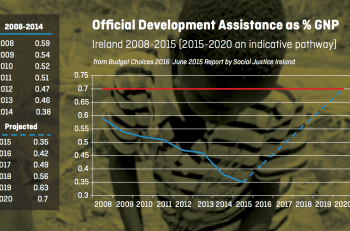
    62 people now own the same wealth as the poorest 3.6 billion people. 1% owns more than 99%. The gaps are widening. Talk of overseas aid may seem like trying to use a sticking plaster to plug a haemorrhage. In a world of trickle up economies with ever growing needs driven by conflict and climate, aid remains critical. Despite the critiques of aid in the past decade, without it, many of the Least Developed Countries, would collapse. This Government is not without achievements in Official Development Assistance (ODA). Following the financial crash in 2009, the aid budget was an easy target and was slashed by 30% in the 2010 budget. Those affected by cuts in the aid budget are not visible and certainly won’t arrive at Leinster House on their tractors. Several Irish NGOs were also downsized and their aid programmes closed as a result. Following that significant cut, however, the aid budget was stabilised at around €600m. This was made possible by cross-party support and opinion polls which showed the tacit support of the public. Over 80% of people in Ireland regularly state they are in favour of aid. They may not raise it on the doorsteps, but they see it as the right thing to do. On the other hand, all OECD countries are committed to giving 0.7% of Gross National Income (GNI) in ODA and we have failed to reach this target. The commitment is a long-standing gold standard in international development and one which many countries had been close to achieving before the financial crash. In 2009, Ireland was giving 0.59% of GNI in ODA. The target, as a percentage, is set up to be cyclical. Countries will give according to their means as their economy expands and contracts. The commitment to reach the 0.7% target was in the Programme for Government of the current Government, with a target date of 2015. However, there has been no real commitment. The economy is now growing yet the aid budget has remained at. We increasingly and significantly lag behind the OECD target. Our aid provision now stands at 0.38% of GNI, the same as in the early 2000s. A new commitment to reaching the target within the life time of the next government is essential. Significant improvements have been made in the quality of Ireland’s aid programme over the lifespan of the current Government. International trends reflect shifts towards concessional lending and private-sector engagement. However, Ireland’s aid programme has become more poverty-focused. This is both in country focus, with one of the highest rates of funds going to Least Developed Countries, and in the types of programmes it funds. The aid programme has bucked the international trend of skewing aid to serve the needs of the donor country and has remained highly poverty-focused. ‘One World, One Future’, the Irish Aid policy, was launched in 2013 following a public consultation. It sets out Ireland’s priorities in overseas development. The commitment to addressing hunger is clear. The current Government spearheaded the drive to address hunger globally and led on international initiatives such as ‘Zero Hunger’ at the UN. It has become a leader in this area and ensured that this initiative was central to the new Sustainable Development Goals signed in New York last September. Questions have been asked, however, about the involvement of Irish Aid in the corporate- backed Global Alliance for Climate Smart Agriculture, which has received much criticism from global civil society, and attempts to link this to the hunger agenda. The biggest gap, however, is the failure to embed the priorities for development in all government departments. While both the Irish Aid Policy, and the ‘Global Island’ policy, the core foreign policy statement, boast commitments to development and human rights as a “whole of government effort”, little has been done to implement it. This incoherence is stark. As Ban Ki Moon, the UN Secretary General said during his visit to Ireland last May: “One cannot be a leader on hunger, without also being a leader on climate change”. Coherence demands that our commitment on global hunger is matched by a commitment to funding programmes for climate adaptation and resilience matched with equal effort to reduce our own emissions. Aid remains essential. However, if aid is to be effective it requires commitment as well as joined-up thinking across all policy areas. This challenge must be addressed by the next Government. Lorna Gold Lorna Gold is Head of Policy and Advocacy with Trócaire

    Loading

    Read more

  • Posted in:

    Get moving on that social housing

    Homelessness was always a winter story and affected individuals only. Now it’s an all-year narrative and the homeless are no longer just isolated individuals -although they are still there – but families, in all their forms and colour. Our recent research for the Housing Agency report, ‘Family experiences of path- ways into homelessness – the families’perspective’, sheds some light on the causes,consequences and features of these unwelcome developments. The research was basedon interviews with a sample of 30 families,including a mixture of family types (couples and one-parent households with children of differing ages, as well as families from minority – Traveller and migrant – backgrounds). The human story was com- pelling. Both of us, ‘seasoned’ researchers long involved in the homeless field, were shocked by the conditions and circumstances in which the families found themselves. Some were homeless for months, but for others it was years. We met families living for months in one room of a hotel. Others lived in damp basements and rooms, with heat turned on for only a few hours a day. Most of the families we met no longer had possessions, apart from those they could put in a suitcase. They were broke, having used up whatever savings they had. Parents were distressed, despairing, humiliated – often eg under curfew – but absolutely determined to ensure their children survived the experience. At a policy level there were clear findings. Almost all the families had lived in private rented accommodation: none were dispossessed mortgage-holders. Many had been in private rented accommodation that they liked, some in the same home, for long periods, whilst others moved around frequently.The problem was that this time, when they left or were evicted (the euphemistic term is ‘issued with a Notice of Termination’), they could not find an affordable alternative. They could not get back in. They typically called prospective landlords, or called door-to-door, 50, 60 times only to find the accommodation already gone, or, more likely, to be assailed with “no rent allowance here”. For some, leaving or being evicted was a sudden and brutal process: eg a violent ex-partner turning up and causing trouble, a ratinvasion or the roof falling in. For the majority, though their departure was the landlord deciding to get more rent from tenants. For tenants told to leave, the one thing theyneeded more than anything else was a reference for the next landlord, so they did not argue. Campaigns for tenants to be ‘better informed’ of their ‘rights’, when they have almost none, overlook the inequality of power. With little new housing built in recent years and a dearth of social housing, which can be traced to 1987, a previous austerity period and its cuts in spending on local authority housing, our rising population has put more pressure on accommodation. The bottom of the private rental market gets ‘squeezed’, and those on low incomes are squeezed out. As demand rises, landlords know that they can charge more. Rents move higher and higher above the rent supplement levels that the Department of Social Protection pays, putting them out of reach of those on low incomes. The introduction of the Homeless Housing Assistance Payment (HAP) which permits a 20% increase in rent supplement marks a welcome recognition that rent supplement levels are no longer adequate. The homeless families to whom we spoke had many ideas on how to solve the homelessness crisis, including the opening up of boarded-up local authority homes. For them(and we should listen), local authority accommodation was the ultimate solution, offering security, acceptable standards and affordable rent. The Social Housing Strategy 2020 – a six-year plan to address social-housing needs – commits to the provision of 35,000 new social-housing units, over half (18,000 units) of which are due to come on stream by the end of 2017, with the remainder (17,000 units) scheduled for completion by the end of 2020 at a cost of €3.8bn.While the requirement is clearly immediate, a useful additional measure has been the introduction of a Ministerial direction which requires named local authorities to allocate up to half of available social housing units to homeless (and other special needs) households for the first six months of 2015. Notably, no-one we spoke to expected to get back to private rented accommodation, ever. Kathy Walsh and Brian Harvey Kathy Walsh is Director of KW Research and Associates Ltd, and an experienced social researcher and strategic thinker with expertise in equality and integration.

    Loading

    Read more