


Politics

Random entry RSS

  • Posted in:

    An enduring solution to poverty and inequality: Site Value Tax.

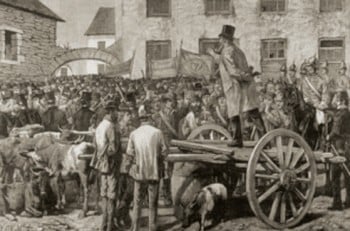
    By Emer ó Siochrú. The design and manner of introduction of the household charge exposed the mindset of the Department of Finance which believes that simplicity (€100 per dwelling owner with almost no exceptions) was more important than fairness for public compliance with a new tax.  It appears Irish people are not that simple-minded and have demanded instead that their acceptance of a new tax depends instead on its equity and effectiveness. Land and Site Value Tax is the inheritor of a long and honorable tradition of land reform in Ireland; it is not a new idea but a forgotten idea.  James Fintan Lawlor, a leading member of Young Ireland in the 1848 rebellions wrote “I hold and maintain that the entire soil of a country belongs of right to the entire people of that country, and is the lawful property, not of any one class, but of the nation at large, in full effective possession” and that the people should decide that rents  “should be paid to themselves, the people, for public purposes, and for behoof and benefit of them, the entire  general people”. Lawlor in turn influenced Michael Davitt who led the land struggle at the end of the 19th century.  Davitt was  influenced by the American economic reformer, Henry George, writer of the best-selling book Progress and Poverty  which held that the ownership of land was of less importance than the nature of its ownership.  Henry George did not believe that State ownership of the land was necessary or even desirable and in this he differed markedly from Socialists.  According to George, by fairly taxing the unearned income from land, the community could recapture that part which was its common inheritance and in so doing entirely eliminate the need for other taxes on productive activity. Henry George visited Ireland during the land struggles of the 1880s and found vindication for his theories in the the call for ‘tenant right’  or the three Fs of  Fair rent, Fixity of tenure and Free sale of tenant improvements.  Michael Davitt wrote in 1902 that he would … abolish land monopoly by simply taxing all land, exclusive of improvements, up to its full value…In other words, I would recognise private property in the results of labour, and not in land.  The land struggle started out well with a nuanced understanding of the nature of land ownership and how rights, responsibilities and revenues might be most efficiently and equitably assigned.   But before long tenant ‘right to buy’ became the single dominating issue and the interests of others ignored.  Davitt feared that  “increasing the number of those holding private property in land”  is “simply landlordism in another form”.  He also worried  that  peasant proprietorship “excludes the (agricultural) labourers from all hope of being able to elevate themselves from their present degraded condition”. The Land Act of 1903 set in place the process of redistribution of farmland from the mainly Anglo-Irish landlords to their mainly Catholic head tenants by compulsory acquisition or its threat.  Whereas in 1870 only three percent of Irish farmers owned their land, by 1908, this figure was 50 percent. By the early 1920s, the figure was at 70 percent. The Congested Districts Board was then set up to consolidate fragmented landholdings of the ‘clachan’ villagers into the isolated farmhouses that many rural dwellers now insist are the traditional settlement pattern. Pádraig Pearse, writing after the major part of the land redistribution had been accomplished, plainly felt that the job was incomplete and supported Lalor’s call for “land for the people and not just for the farmers”.  The Land Commission of the new Free State and later Republic worked to little effect into the 1960s to increase agricultural productivity by acquiring under-performing farmers’ land to transfer to more efficient or more deserving farmers.  It was a highly politicised process in which Cumann na nGadheal / Fine Gael and Fianna Fáil failed to find an equitable and efficient system to apportion the nation’s land.  In a system where apportioning rights was restricted to the blunt instrument of ownership and possession of land on a finite island, only wide-scale emigration of the disinherited underwrote such redistribution as was possible.   The land issue had apparently been solved insofar as the problem had changed to that of emigration and perennial under-development. It was 50 years before the land question was addressed again by the Irish economist Raymond Crotty in his largely forgotten book Irish Agricultural Production, in 1966.  Crotty’s first love was farming and he only took up economics to understand why the conventional agricultural advice yielded such disappointing results. Challenging received wisdom, Crotty sought out the data to develop his own theories of Irish economic development from first principles.  He concluded finally that the land vested in the occupying farmers by the various Land acts was on “exceedingly favourable” terms and this fact was the root cause of the under-development of Irish agricultural in later years: “The decrease in farmers’ rental payments, which followed the fixing of judicial rents and the vesting of property in the tenants following upon reductions brought about by the organised agitation of the Land League, gave grounds for expecting that “the magic of property” would “turn land into gold”. Irish farmers did not strive to maximise the productivity of their land by hiring and investing: it was more profitable and less risky for them to let the land do the work fattening cattle and sheep for sale on the hoof.  The low level of farm output contrasted sharply with other similar countries such as Denmark where many more people worked the land and processed the output, and where wages and living conditions were considerably higher than in Ireland. The measure Crotty proposed to rectify this state of affairs was an annual tax on farm land based on its full conacre rental value. Crotty believed that prioritising the welfare of land-owners over the welfare of the people of Ireland as  a whole was morally indefensible and economically

    Loading

    Read more

  • Posted in:

    In the bath Economist.

    The Irish economist doffed his Copeland suit and tie and dropped manfully if a little droopily into the bath. Why couldn’t everything be like irisheconomy.ie he wondered. Right and in writing and with lots of economists, even Colm McCarthy sometimes, and no other people. He loved Colm McCarthy. Big and gruff and no nonsense. All Man really. Not that economic man wasn’t quite manly himself, he noted, in the bubbles (he wondered fleetingly if you could meter bubbles). He’d once had a funny dream about Colm McCarthy and Dan O’Brien otherwise he was generally fairly normal. He hated women. They couldn’t understand economics. Endogenous growth theory. Money. That’s why there were no women economists. Except Marian Finnegan and Marie Hunt he reminded himself. Counting things and putting them up in graphs. Did he think about tax too much? That’s what all his girlfriends had said, before they er moved on. And the latest one was beginning to complain whenever he said austerity. Still, where were they now, he simpered, catching a flash of the Rolex below, tight on his manly arm in the bubbles. He had membership rights on irisheconomy.ie and three times every day he’d find somewhere, using different names, to write “as usual another great piece from Colm McCarthy”. Always the same: three times a day. His wiener poked over the fusty waters. Well, hello. David McWilliams, what must it be like to be David McWilliams? Everything, the books, the hedge-fund, perfect family, Dalkey Book Fair, named everything: Breakfast Roll Man, Bouncy Castle Man, Pope’s Children. He also loved Gurdgiev. Funny Russian Man but brilliant. He’d once asked the barber on Merrion Row to “give him a Gurdgiev” and had been thrown out. Now he got his mother to do it – so proud of him – and kept what was actually not a bad mane of hair: more Ronan Lyons than Ben Bernanke, in between a Gurdgiev and a McWilliams. How big was McWilliams’ Rolex though, he laughed, his floppy hair matted through the Head’n’ Shoulders. Despite his intellectual security the potage below kept bringing him back to bubbles and what he’d used to believe about them. We are not on course for a crash. The fundamentals are sound. All those expensive reports he’d produced in the boom. The holidays in Phuket. A helicopter was flying in his head. Would anyone read them, catch him out? All will be well – if we don’t meddle in the property market. Marc Coleman had actually said that and he’d been ok by just keeping on saying he’d not been completely and foolishly wrong. He’d never said anything as bad as that, or at least not put it in writing, not for his current employer anyway. At least not for years. He’d once been attacked on Kildare St by the dregs of a Socialist Workers Party rally after he’d been at a symposium in the Great Room in the Shelbourne about Milton Friedman where he’d shared a cigarette with Colm (though he hadn’t at that stage actually got his name right). The worst thing about and you and him mate, one of them had blared, hot and furious in his face, is you’re just wrong. Nasty. Some people just didn’t get austerity. Had to be done. Confidence. Markets. Reality. His real ambition was to get on to a state board, something manly like the Dublin Airport Authority. What if they offered something like the Abbey or the women’s council? What was it Colm had said? Anger is not an Option. No is a leap in the dark that we can’t afford. All Man. No multi-syllables or foreign words. Was austerity a foreign word? Richard Tol now there was someone who spoke truth to power (albeit his beard thing was too much), though Irish economist had a lot of respect for the ESRI. You had to. “It is likely that Ireland’s standard of living, which is already one of the highest in the world, will show some further relative improvement in the coming decade. As the very substantial investment in infrastructure begins to come on stream, this too will enhance the quality of life for many residents. With the prospect of a return to full employment after the current difficulties and a substantial rise in the resources available for household consumption, the next decade should see relatively steady economic progress in terms of living standards”. If only everyone thought like economists, he thought. Measure everything. At least everything that economists understand. Money really. If you can’t measure it I don’t want to hear about it. The science that measures human behaviour as a relationship between ends and scarce means which have alternative uses. Except if the ends are about the environment or quality of life. You can’t measure a bleeding heart he mused. Sell it off. Money, money , money that’s all he could think of; ends: what a bleedin rubbish concept. Money. Counting it and getting more of it for him and the people he knew. Everything else was just handbags really. Our forecast for real GDP growth in 2008. Five percent. It was his boss the Professor who’d made him say it. He’d said it was possible it would be much less. Admittedly he’d called it an infinitely unlikely scenario but he’d said it. That was five years ago now. Nobody had caught him out and now nobody would. Austerity. Markets. Confidence. He pulled the plastic plug and watched his dirtied waters first pitch, and then slurp and gyre into the vortex and out into oblivion. His face convulsed in a thick-lipped rictus smirk. No man in any bath in Ireland was again more confident. Or more wrong.

    Loading

    Read more

  • Posted in:

    New workplace anti-discrimination service is disappointing.

    By Rachel Mullen. Minister Richard Bruton has unveiled his proposals for merging the existing five employment redress fora into one two-tiered structure. The blueprint for the new ‘Workplace Relations Service’ announced by the Minister aims for it to be ‘world class’. However, from an equality perspective, the proposals of the Minister seem to fall well short. The Equality Tribunal is to be merged within this new Workplace Relations Service. The starting point for the Minister in developing a ‘world-class’ structure should be to address issues of under-reporting and accessibility. In Ireland there are remarkably high levels of under-reporting of incidents of discrimination on grounds such as race, gender, marital status, disability and age. Data from the CSO, analysed by the ESRI and the Equality Authority in 2008, found that 12% of the Irish population over 18 years felt they had experienced discrimination in the preceding two years and 71% of these had experienced discrimination on more than one occasion. Only 6%, however, took any formal action. Accessibility is key to ensuring the new Workplace Relations Service does not further aggravate this under-reporting. Some of what is being proposed, however, gives cause for concern. The Equality Tribunal is committed to accessibility in a number of unique ways. Equality Officers dealing with cases before the Tribunal are required to play a more proactive and investigative role than in a traditional ‘court’ setting. This investigative role is the cornerstone of the equality legislation and means that claimants do not have to present complex legal arguments or require legal representation. The Blueprint proposals, however, suggest that adjudicators will simply hear cases rather than investigate them.  Thus the body will be less accessible and claimants will be more likely to require legal representation. There is a proposal to introduce a fee of €50 for making a complaint. This will be a deterrent to groups with limited resources. This is particularly problematic in cases of discrimination relating to access to employment, dismissal and access to goods and services. The Blueprint usefully underscores the need to develop a culture of compliance among employers. This is vital in a context of under-reporting. However, it does not refer to the critical requirements of proportionate, effective and dissuasive remedies. Unless remedies are dissuasive, employers and service providers will not change their discriminatory practices. A serious gap in the Blueprint is the absence of any mention of what is proposed regarding complaints under the Equal Status Acts, which prohibits discrimination against the public in the provision of goods and services. There is a danger that equal status cases could be transferred to the District Court. This would significantly undermine the efficacy of our equality legislation by diminishing access to justice for claimants. In 2003, cases under the Equal Status Acts involving licensed premises were moved to the District Court. The result was an almost total elimination of complaints under the Acts. The adversarial nature of the District Court is in direct contrast to the more informal investigative model applied in the Equality Tribunal. There is a greater likelihood that claimants will require legal representation. There is no provision for granting civil legal aid in such cases. The procedures in the Equality Tribunal allow for claimants to be represented by an NGO or a trade union. In contrast there is no broad right of representation allowed in the District Court. Claimants before the District Court can also be liable for the costs incurred by the other party if they lose. This is not the case for parties seeking redress in the Equality Tribunal. Finally the Blueprint makes no reference to a number of rights contained in equality legislation and EU equality Directives. These include the shifting of the burden of proof once a prima facie case has been established and the rights of people with disabilities to reasonable accommodation. The Minister’s commitment to deliver a world-class Work Relations Service is welcome. He will not achieve it if he fails to address the hard-learnt and specific lessons of a generation spent grappling with the protection of equality rights. Rachel Mullen is Co-ordinator of the Equality and Rights Alliance.

    Loading

    Read more

  • Posted in:

    Bland and stage-managed.

    By Suzy Byrne. Party conference season concludes this month with Sinn Féin meeting in Killarney.  The three party conferences televised so far this year have shown little hope for policy debate and analysis in political parties or even the harnessing of new ideas. This year Fine Gael had Ministers and Oireachtas members sitting uncomfortably on pieces of soft furnishing on a stage in the National Convention Centre.  The party MEP, and former television reporter and editor, Máiréad McGuinness, moderated. She was told off-microphone by Minister for State Brian Hayes that her work was a “tour de force”. There were no kites flown by Ministers with new policy initiatives. Instead, members proposed bland pre-screened motions. Ministers and TDs remembered to mention the list of the things done so far in government whilst not appearing triumphant.  Those proposing motions remembered to thank or congratulate the Minister during the speech and to speak to the motion which didn’t criticise the party or its role in government. When the TV cameras turned off, the conference divided into workshops where the exercise was repeated. The workshop has become another tool for party hierarchies to give the illusion of more hands-on contact between party leadership and members. The invitation of NGOs and other experts to speak reduces even further the possibilities for ordinary members to question their leaders on policy and national issues.  Meanwhile, the real reason many attend conference was revealed – the election for positions on the national executive of the party was cranking up. The Labour conference (they don’t call it an Ard Fheis) was equally closely managed, on and off screen.  Motions which were not supported by the party leadership, and which had managed to get through an internal committee (a feat in itself), were recommended to be referred back to the party’s Central Council. This meant they would never see the light of day again.  Rather than be voted on by the membership the particular Minister could indicate what was wanted; and a vote would take place on that recommendation rather than a full debate and free vote amongst delegates. The mini-riot, which took place outside the conference centre on the Saturday afternoon, meant that for some time many delegates were forced to remain in the conference hall.  This didn’t help Brendan Howlin in his very obvious attempts to get a motion on preventing the sale of semi-state agencies rejected. Although not broadcast on television, these proceedings were transmitted online. Heckling and booing from the floor forced the chair of the conference to put the motion to a vote and it was passed. However, such a motion when passed doesn’t actually mean anything either.  Political parties can hide behind the Programme for Government and, in the case of this particular FG/Labour government, there is the added (imaginary?) prophylactic of the Memorandum of Understanding with the Troika. Another tactic for stifling debate is putting contentious motions on to the agenda for Sunday morning when delegates have either left for home or are too hungover, either to speak or to listen. The motions are either not moved or time runs out and they are referred back. This happened at the Labour conference with a motion calling for a special conference to be held in 2013 to reflect on the Programme for Government. This was referred back into the safety of the Black Hole of the Central Council. Parties with more than seven TDs get two hours of off-peak TV coverage. This has now turned into a very long party political broadcast. Leaders then get an additional 30 minutes of comment-free broadcast of their speech to conference. Over the years this has become less introspective and more about addressing the nation after spinning the wheel and before the Nine O’ Clock News. Members who are not public representatives, especially if they never wish to be, are increasingly silenced in the presentation of motions.  TDs propose motions from branches to get their face on the TV, despite it being highly unlikely they wrote the motion. RTÉ attempted to cease coverage of party conferences in 2002 citing few viewers, cost and the lack of political debate. The parties successfully argued for it to remain and continue to manipulate conference agendas and coverage, and, many argue, to curtail internal party debate. Dull. Suzy Byrne is a political blogger at Mamanpoulet.com

    Loading

    Read more