

Asymmetry cannot be replaced in an afternoon
By Leila Keeney
Readers of Village will understand that the importance of a subject is not measured by its apparent scale. So here goes.
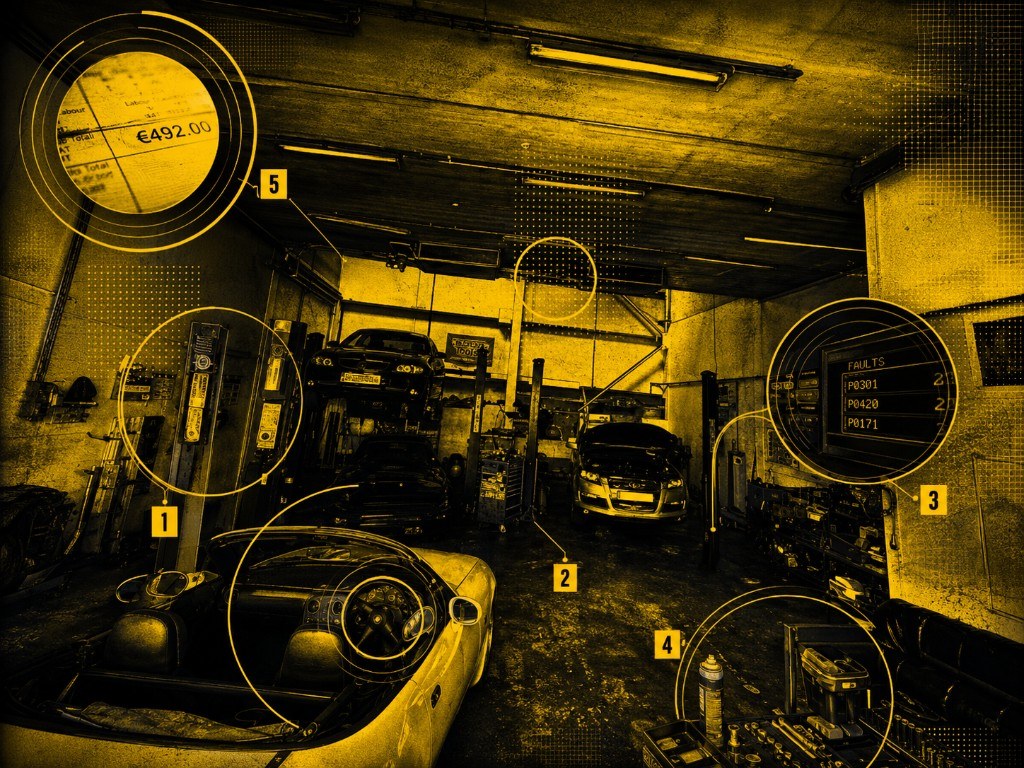
In July 2025, I entered Sweeney’s Garage on Bridgefoot Street, in inner city Dublin, as a learner driver in a Ford Fiesta, with an intermittent indicator fault.
I left with a €492 bill, a part that replaced a piece that independent mechanics later concluded was not faulty, and an experience that forced me to confront questions extending far beyond automotive repair.
The conventional interpretation would be simple. A customer disputes a mechanic’s diagnosis. An invoice is challenged. A disagreement follows. It turns out Ireland’s motorists are spending hundreds of euro on diagnostics they cannot independently verify.
The €492 repair failed. A later mechanic diagnosed a blown fuse, found the original switch fully functional, and noted that the replacement still retained its “peel off” sticker.
I no longer believe that simplistic exegesis valid and it doesn’t matter anyway.
When I entered the garage, I entered as a young female learner driver. I possessed almost no technical knowledge. The mechanic possessed all of it.
The interaction was not between equals.
The action was skewed by the phallogocentricity of key components: the indicator, the fuse, almost every tool, the mechanic’s tone, perhaps the very Ford Fiesta.
The literature is confirmatory and unanimous.
The philosopher Sandra Harding argues that knowledge is shaped by social position. The mechanic and the learner driver occupy radically different standpoints. What appears routine and obvious to one may appear opaque and coercive to the other.
The sociologist Pierre Bourdieu would have recognised my situation immediately. Expertise is a form of capital. The garage is not a repair facility but a site where specialised knowledge becomes power. Technical language, institutional authority, the torque wrench, the breaker bar, the pry bar, the jack handle, the exhaust pipe and the driveshaft combine to create what Bourdieu called symbolic domination. Gender as always amplified the imbalance.
Simone de Beauvoir argued that women have historically been positioned as the “Other”, while authority, rationality and technical competence have been coded as masculine. These assumptions often operate beneath conscious awareness.
The experience for me was not one of participation but observation. Diagnoses arrived fully formed. And charges.
Political philosopher Nancy Fraser calls this a failure of participatory parity.
The philosopher Michel Foucault argued that power and knowledge are inseparable. Knowledge creates authority. Authority creates legitimacy. Legitimacy discourages challenge. The result is a self-reinforcing system in which expertise becomes increasingly difficult to question. Whether the indicators ever functioned is ultimately a secondary question. The real issue is whether signalling itself privileges certain forms of directional knowledge over others.
The garage is just one example. There are lawyers, banks, landlords and government departments.
Citizens are repeatedly required to trust systems they cannot independently evaluate.
Expertise is indispensable.
The problem arises when expertise ceases to recognise its own power.
This was in truth about whose account counted.
Fricker gave that phenomenon a name. Bourdieu explained how it operates. Harding explained why it persists. Dorothy Smith explained how it feels. Fraser explained why it matters. Young explained why it is political. Marx and Freud saw how everything, including psychology is determined.
Of course Irish law increasingly reflects concerns long identified by critical theorists. The Sale of Goods and Supply of Services Act requires reasonable care and skill. Modern consumer law emphasises transparency and informed consent before commercial decisions are made. GDPR is built around principles of transparency, purpose limitation and meaningful consent. These are hardly the point.
Nor is resolution of the indicator fault.
Because the deeper issue will subsist, the unequal distribution of authority itself.
And unlike a blown fuse, asymmetry is not something that can be replaced in an afternoon.
