

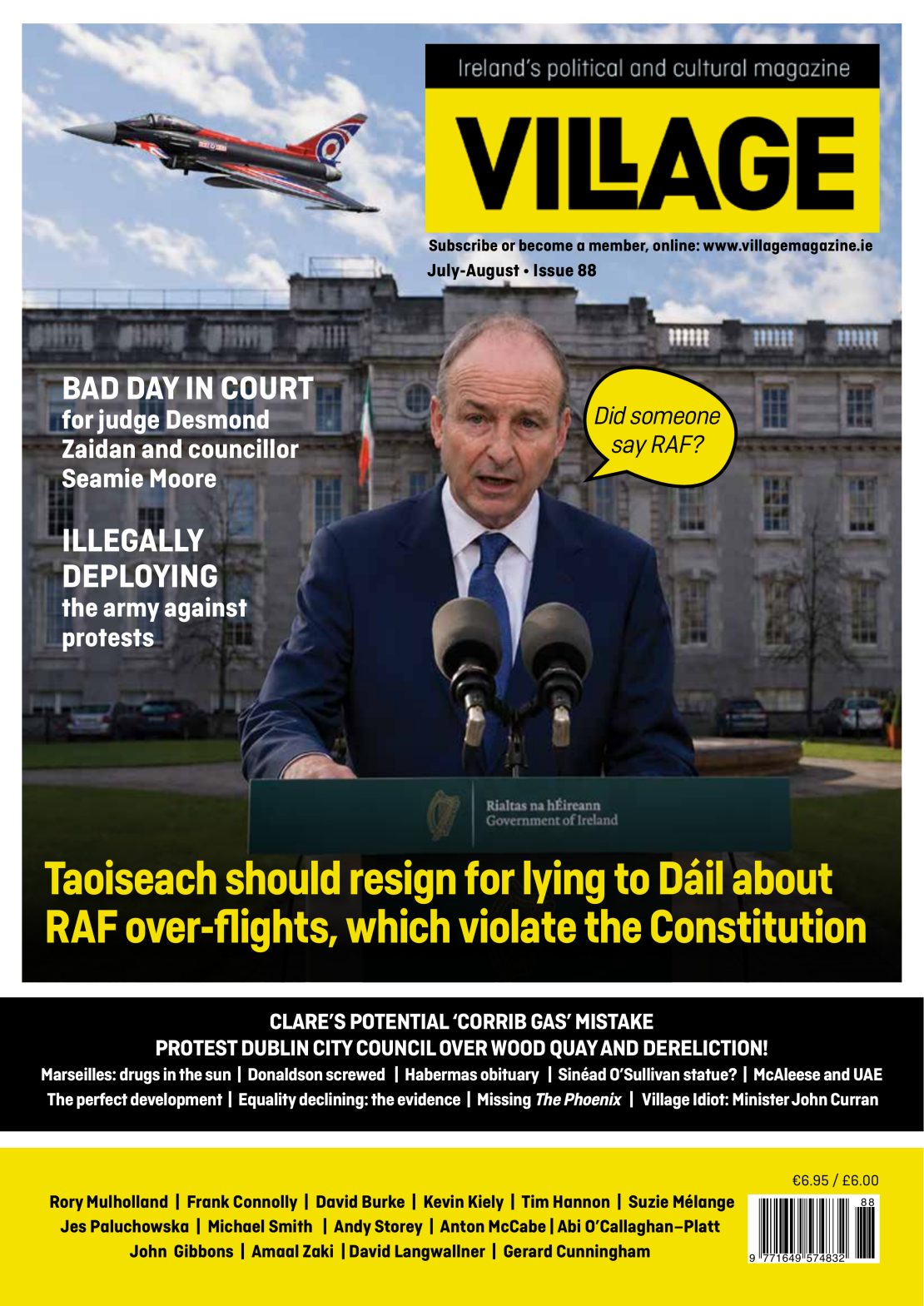
Coveney and Martin lied to the Dáil on a fundamental matter of state
In the absence of a credible air defence capability by the Defence Forces we cannot be seen to obstruct operations that could prevents [sic] loss of innocent lives particularly in light of the events in the United States on 11th Sept last
Craughwell legal action seeking elusive Irish agreement with RAF
Village has seen most of the documents that feature in Senator Gerard Craughwell’s High Court affidavit signed for his proceedings seeking to get the government to reveal its agreement with the UK Air Command. The agreement allows the Royal Air Force (RAF) to overfly Ireland. The agreement, which the government is aggressively keeping from the public eye, provides for RAF operations in Irish airspace and not just for specific interdictions.
The documents damningly undermine ministerial statements over the last several years concerning arrangements between Ireland and the RAF.
Irish military said we couldn’t be seen to obstruct RAF operations
The military was gung-ho for such arrangements. Village has seen a letter from the then Army Chief of Staff, Lieutenant General CE Mangan, addressed to the Secretary General of the Department of Defence, David O’Callaghan, in 2002. It states: “In the absence of a credible air defence capability by the Defence Forces we cannot be seen to obstruct operations that could prevents [sic] loss of innocent lives particularly in light of the events in the United States on 11th Sept last”.
Mangan helpfully added that “there are no military objections to the attached proposal and the defence forces would be prepared to assist in any way open to it in this matter and whatever mechanisms are agreed can only be in the best interests of this country in the long term”.
British ambassador had noted UK aircraft would be unable to intercept a rogue aircraft
The correspondence followed a telling letter from the then British Ambassador, Sir Ivor Roberts, to the Minister for Foreign Affairs, Brian Cowen, in which he noted “At present our aircraft would be unable to intercept and investigate a rogue aircraft approach from the Atlantic until it had left Irish airspace”. The ambassador considered that: “this difficulty would be reduced considerably if we could agree a mechanism whereby UK military aircraft including fighters refuelling and Airborne Early Warning aircraft could enter Irish airspace to investigate a potential rogue aircraft. Such a mechanism would be used only in exceptional circumstances and with explicit authorisation from an agency nominated by your government the purpose of entering Irish airspace would be to investigate a suspected rogue aircraft only: no further action would be taken until it left Irish airspace”.
UK ambassador notes existing mechanism for granting over-flights to UK military aircraft would not be fast enough
The ambassador then revealed the extraordinary underlying position — the existence of an overflight mechanism… Roberts proceeded: “Clearly the existing mechanism for granting over-flights to UK military aircraft would not be fast enough for this kind of scenario”. And then he spoke of improving this procedure further: “As an addition to the current procedure we would like to discuss with you the development of a streamlined procedure which would enable our aircraft to intercept rogue aircraft”.
Memorandum of Understanding shows underlying co-operative realities
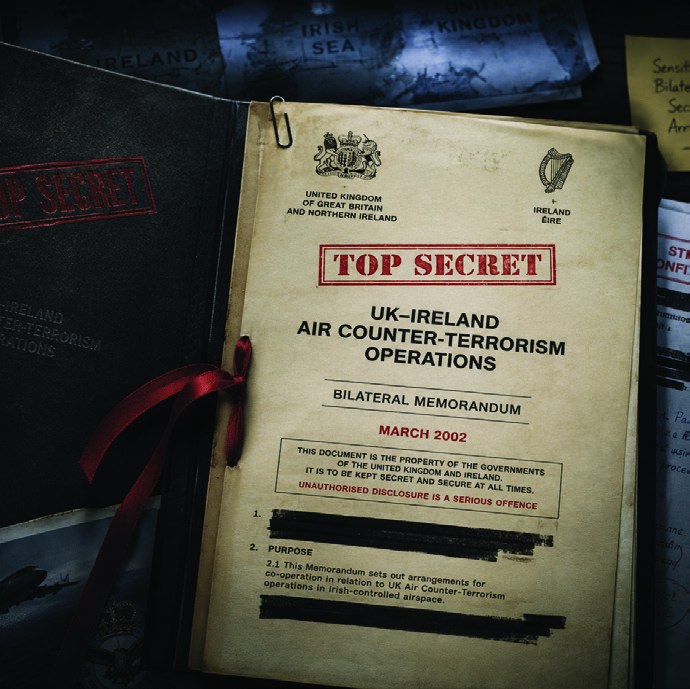
Village has also seen a 2015 archly titled “memorandum of understanding”, updated from 2002. It concerns counter-terror operations in Irish-controlled airspace and Operation ADANA, an exercise said to have tested those arrangements.
The memorandum, which goes out of its way to deny it has legal effect or is an international agreement, is between the respective ministries of defence in Ireland and the UK (the “Participants”) and signed by Ministers Simon Coveney and Michael Fallon, in 2015.
The memorandum gives insights into the ambitions of UK and Irish militaries for interdependence. It acknowledges the “depth of ongoing interaction and interdependence between our two countries In ensuring the relative security of our respective territories and our citizens and in this regard progressing the defence related issues as outlined in the [agreed] Work Programme 2013/2015” as well as “the long standing cooperative arrangements already in place for military staff meetings in support of the mutual exchange of information and experience including on training between the armed forces of the Participants to support capability development, mutual understanding and operational capability for crisis management”.
Surprisingly too, the memorandum refers to adherence to NATO standards: the Participants are “committed to ensuring ongoing interoperability between the Participants and crisis management in particular through implementation of and adherence to NATO standards”. This is unclearly written but seems to allow a deep organisational integration on NATO lines.
For those who think the memorandum’s scope limited it says the Participants will endeavour to enhance co-operation in “such other areas or activities as may be decided upon or noted by the Participants”.
Letter confirms agreement between the UK (including HQ Air Command (RAF)) and Ireland, on UK Air Counter-Terrorism operations (Op ADANA) in Irish air spaces
Village also obtained a 2015 communication from Wing Commander Philip Grant, then Staff Officer Grade 1 (Directorate of Operations UK), to Lieutenant Colonel Jaimie Norman, then Military Assistant to the UK Secretary of State for Defence, who is now a Brigadier.
This noted:
“The agreement between the UK and Ireland on UK Air Counter-Terrorism operations (Op ADANA) within Irish aerospace has been updated”. Clearly there is an important agreement that has not entered the public domain. The agreement was in play to the extent that in 2025 it was updated.
The communication then went on:
“Given the Memorandum of Understanding on General Defence Cooperation between the UK Ministry of Defence (MOD) and the Department of Defence Ireland which the Secretary of State signed on his visit to Ireland on January 19th 2015, we agreed that the Secretary of State may wish to be aware of the following:
• the agreement between the UK and Ireland on UK Air Counter-Terrorism operations (Op ADANA) in Irish air spaces between HQ Air Command [RAF HQ], UK National Air Traffic Services and the Irish Aviation Authority
• An inwards visit by members of the Irish Aviation Authority (IAA) [Village has seen the RAF plan for the visit which envisaged that the IAA’s Gwen Morgan and Declan Mangan would travel by taxi and an itinerary which was not certain whether the document would need to be signed] to the National Air Defence Operations Centre (NADOC), RAF High Wycombe has been arranged for the 2nd June this visit will enable the NADOC to run a simulated Op ADANA exercise to test the updated agreement and will reinforce both the MOD’s and the RAF’s already established links with the Irish Aviation Authority
• This is the first time such an exercise has been undertaken with the Irish Aviation Authority; it will achieve a task set by the Parliamentary Under-Secretary following a meeting with his counterpart last year [Parliamentary Secretary/Parliamentary Under-Secretary aware]. The timing of the inwards visit has been a planned ahead of the UK Ireland military-military talks in early June.
• In accordance with the Defence Secretary’s direction the MOD now provides a report to the Irish government through normal diplomatic channels on Russian Strategic Aviation activity operating/ routing in the vicinity of Ireland”.
As to lies, in Ireland the Code of Conduct for Office Holders states:
It is of paramount importance that office holders give accurate and truthful information to the Houses of the Oireachtas.
Paramount suggests a high value. There is a convention that ministers resign if they lie to the Oireachtas.

The issue for Simon Coveney
The former minister whose statements appear most directly impugned in light of the documentary record is Simon Coveney of Fine Gael.
Appearing before the Joint Oireachtas Committee on Foreign Affairs and Defence in July 2022, he said as Minister for Defence: “We do not have overflight arrangements with the RAF, to be clear”.
Yet the British Ambassador had referred to an “existing mechanism” for RAF overflights. That mechanism was not merely an internal administrative process but an agreed bilateral mechanism, reflected in the memorandum and associated procedures, governing RAF overflights in Irish-controlled airspace. An agreed bilateral overflight mechanism of that kind is, in ordinary language, an overflight arrangement. The Minister’s categorical denial therefore appeared to be untrue. It therefore looked like a lie.
Coveney continued by explaining that the RAF would have to apply to Ireland if it had an emergency reason to enter Irish-controlled airspace and that notification procedures existed. His explanation appeared to describe the very arrangements he had just denied.
Micheál Martin, as Tánaiste: “Ireland is not relying on anybody to patrol our airspace”
British Ambassador Roberts: “Clearly the existing mechanism for granting over-flights to UK military aircraft would not be fast enough”

The issue for the current Taoiseach
The more constitutionally significant issue, however, concerns Micheál Martin of Fianna Fáil.
As Tánaiste and Minister for Defence, responding on 9 May 2023 to reports of the arrangements, Martin misled reporters.
According to RTÉ he told them: “Ireland is not relying on anybody to patrol our airspace”. That too was misleading: if the RAF is overflying our airspace and has an agreed role in responding to aircraft entering Irish-controlled airspace in circumstances where Ireland lacked the capability to respond itself, that would seem to be the RAF patrolling our airspace.
Martin described the reports as: “inaccurate in terms of interdiction” while declining to elaborate further because of “national security issues”. Since the British ambassador had sought to “agree a mechanism whereby UK military aircraft including fighters refuelling and Airborne Early Warning aircraft could enter Irish airspace to investigate a potential rogue aircraft” and the Irish military had had no objection, this seems to have been a lie too.
These were not casual observations. They were public statements by the minister with responsibility for defence policy after the issue had become one of major public controversy.
One week later, the matter came before Dáil Éireann.
Sinn Féin TD Matt Carthy reminded the House of Simon Coveney’s earlier evidence:
“He told the Oireachtas Committee on Foreign Affairs and Defence that ‘We do not have overflight arrangements with the RAF, to be clear.’ Is that a remark the Tánaiste would make and stand over?”.
Martin replied:
“I don’t see anything in that that needs correction of the Dáil record”.
If the documents quoted at great length above are ultimately authenticated and shown to establish the arrangements alleged, this exchange would be exposed as a disgraceful verbal cover-up, leaving the Dáil with a materially incomplete understanding of the State’s position.
Most likely excuse does not stand up
Perhaps ministers were using technical, legal or operational terminology. “Overflight arrangements” or “mechanisms” and mid-air “interdiction”, “interception” and “counter-terror operations” are not necessarily identical concepts. But “arrangements” must surely cover all the other terms. Moreover Martin had every opportunity to explain if Coveney had been speaking in a narrow technical sense. His obligation is to be “truthful”.
His answer was dishonesty to the Dáil. Martin’s answer was not an impromptu media salvo. It was a considered answer given in Parliament after the controversy had fully emerged and after the precise wording of the earlier ministerial statement had been put before him.
The issue is therefore not whether lawyers can now identify subtle distinctions between different operational terms. It is whether Parliament was left with a materially accurate understanding of the State’s arrangements with the Royal Air Force.
The issue is not whether cooperation with the United Kingdom made operational sense. Ireland has long lacked fighter aircraft and comprehensive interceptor capability. Few informed observers have doubted that practical arrangements would exist to address exceptional terroristic threats.
Trust and honesty
The issue is trust in honesty.
Varadkar and Harris circumspect
Other leaders dealt more circumspectly with questions. Leo Varadkar’s statements appear materially different. Rather than denying that arrangements existed, he accepted that Ireland had “arrangements for certain scenarios” while maintaining they were consistent with Government policy.
Simon Harris’s public comments have largely acknowledged Ireland’s limited air-defence capability and the need to strengthen it. The new affidavit does not appear to place those statements under comparable pressure.
The focus therefore remains on Simon Coveney’s categorical denial and Micheál Martin’s subsequent endorsement of it.
It’s a constitutional violation as the international agreement was never laid before the House
The constitutional implications extend beyond politics.
Article 29.5.1 of the Constitution provides that “every international agreement to which the State becomes a party shall be laid before Dáil Éireann”, subject to an exception for agreements or conventions of a technical and administrative character. Since it’s hardly a nod and a wink, it seems like an international agreement, even if the argument can be made that the ‘memorandum of agreement’ is not.
That is why the issue is not simply whether Coveney or Martin used loose language: the State may have long been adhering to arrangements with a foreign military power while ministers gave the Oireachtas a materially different impression of the State’s commitments.
Ministers giving — or worse repeating — a clear, categorical statement to the House, knowing — or reckless as to whether — it is materially false, particularly on a matter within their own responsibility, as Deputies Coveney and Martin did; and blatantly misleading the press, as now-Taoiseach lose credibility in office.
Most of the media is well disposed to judicious compromises on Ireland’s neutrality. So most of the reporting fudges the issue of who is lying, as well of course, of what is going on, in the skies and in the courts.
But in a functioning democracy the leader of a State which defines itself existentially as neutral should not survive if he has misled parliament about documents that compromise that neutrality and failed to ensure an international agreement was put before its representative chamber. Micheál Martin did and should resign (or be removed).
In a functioning democracy, the leader of a state which defines itself existentially as neutral should not survive if he has misled parliament about documents that compromise that neutrality and failed to ensure an international agreement was put before its representative chamber
