• Posted in:

    Israel Politik: Illegal settlement

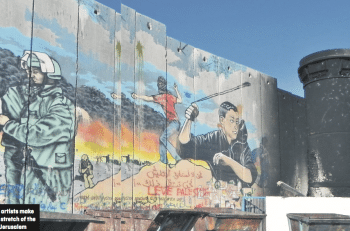
    After completing his Ph.D in the University of Pennsylvania, the former Palestinian foreign minister, Nabil Shaath, lectured in financial economics at the elite Ivy League Wharton School in the US. Among his students was a brash undergraduate named Donald Trump who did little study, flunked his exams and was expelled from the university. With the help of his very rich father, Trump was readmitted and, despite his poor academic credentials, went on to greater things. “He was not a good student. He dropped out and his academic standard did not come up to scratch. I was teaching advanced corporate finance and he flunked the courses. The idea of this man as President of the US to me shows the decline of American civilisation”. Some half a century later, Trump is leading the latest assault on the historic right of the Palestinian people to their own land, including international recognition of Jerusalem as the capital of their independent state. Last December, President Trump confirmed that he intended to move the US embassy in Israel from Tel Aviv to Jerusalem in a move that deeply angered the Arab world while elating many Israelis who have long had their sights on ultimate control of the holy city, which has been traditionally shared by Muslim, Christian and Jewish religions. The decision to move the embassy to Jerusalem was authorised by the US Congress some years ago but was put on hold by President Barack Obama, who believed the decision could only hamper efforts to find a lasting peace in the region and, in particular, the achievement of a two-state solution with east Jerusalem as capital of Palestine. For the Palestinian president, Mahmoud Abbas, and for Nabil Shaath who acts as foreign relations advisor to him, this divisive action by the Trump administration has confirmed a view they have long held privately: that the US cannot be considered as an honest broker in the search for a just solution to the Middle-East crisis, arguably one of the world’s most egregious human rights scandals. Over recent weeks, 35 Palestinian people have been killed and over 1500 injured by live rounds fired by Israeli army snipers from behind a fortified security fence erected in Gaza. Each Friday thousands of people from the besieged and almost destroyed Gaza Strip have protested for their “Right to Return” to the lands from which they and their families were expelled during the Nakba or catastrophe when the state of Israel was declared in 1948, and over the decades since. The policy of the government led by Benjamin Netanyahu and of the Israeli Defence Forces (IDF) is that the right-to-return protests must be resisted with maximum force, including by the killing of unarmed activists and the maiming of thousands. Already overstretched and under-resourced Gazan hospitals have been unable to cope with the recent slaughter, while their efforts to transfer shooting victims with serious injuries to hospitals in the West Bank have been obstructed by the IDF. Two young men who each had had a leg amputated after suffering severe bullet wounds lost their other leg after doctors were prevented by Israeli authorities from transferring them from Gaza to better-equipped hospitals for treatment. The reason they were refused access to urgent medical care in Ramallah was because their “medical condition is a function of their participation in the disturbances”, the Israeli authorities confirmed. One of the young men, Yousef Karnez, said that he was a trainee journalist and was holding a camera at the demonstration which he sought to document. “I got two bullets. One hit my left leg and crushed it and the other hit my right leg, where it gravely injured my shin. Doctors have already amputated my left leg and I am begging; I don’t want to lost my other leg,”, he pleaded in the days after he was shot in early April. A young journalist, Yaser Murtaja, who was wearing a white ‘Press’ sign on his chest during the same protest on 6t April, was shot dead by IDF snipers and wrongly accused by the Israeli defence minister, Avigdor Lieberman, of being a member of Hamas who had been operating a ‘spy drone’ before he was killed. His claims were denied by the International Federation of Journalists who said that Murtaja had worked for both national and international media over recent years including for the BBC and Al Jazeera, and that his company Ain Media had been funded by the US Agency for International Development. His production company had used drones for aerial filming and he was due to start a new job with the Norwegian Refugee Council two days after he was shot. Nabil Shaath, a Gazan, believes the people of the strip are desperate and the large ‘Right to Return’ protests are a reflection of their appalling living conditions. The electricity in Gaza, where some 2.5 million Palestinians live, is turned off for sixteen hours each day, there is no clean water, and there are severe shortages of food and medical supplies. Efforts to establish a unity government across the West Bank, east Jerusalem and Gaza which commenced last year have so far been unsuccessful due to the inability of the Palestinian Authority (PA) and Fatah (the political organisation led by President Mahmoud Abbas) and Hamas to reach agreement. At the core of their disagreement is the refusal of Hamas, which took political power in Gaza following elections in 2006, to cede control of security to a new government of Palestine. “We have a presidential system in Palestine and the President is in charge of security and foreign relations,” Shaath explains. “Hamas was elected in Gaza in 2006 by popular vote and we accepted that mandate. However, the PA remains responsible for ensuring that the people of Gaza have sufficient finance to cover the costs of education, health, water and electricity. We have now said to Hamas that we can only continue to pay the bills if they agree to complete discussions for a unity government that will include security”. This

    Loading

    Read more

  • Posted in:

    Drastic Plastic Profligacy

    For years, it was widely ignored, even as the evidence grew more and more overwhelming. Reports had been flooding in from some of the remotest places on Earth, from the middle of the Pacific Ocean to the North Pole. Researchers found its impact was hammering every ecosystem, disrupting natural processes and spreading havoc across the living world. Then, slowly at first, the message began to resonate well beyond the usual narrow circles of scientists and environmental NGOs. The public’s ears pricked up, the media began to look deeply into the story and politicians, ever eager to follow the crowd, jumped aboard and began to huff about taking action, stepping up to the plate, not standing idly by, etc. And so, slowly, after scandalous decades of neglect and indifference, the wheels of change began their inexorable shift. The task ahead remained Herculean but at least many societies could be said to be engaged, and from there, anything is possible. I would like at this point to claim the preceding paragraphs are a description of how humanity has finally – hopelessly late – begun to grapple with the existential ecological crunch of which emissions-fuelled climate change is the most obvious manifestation. Sadly, this is not the case. The belated public response is instead to the plague of plastic pollution that has reached such an epidemic point that even the usual defenders of the free market haven’t bothered to construct a phoney ‘alternative’ narrative to beguile the media and stymie political action. The extent to which a carelessly used and discarded by-product of global industrialisation has come to present such a potent threat to the web of life on Earth has been known in scientific circles for many years. Marine biologists in particular have been trying with little success to draw attention to the rising tide of plastic pollution and its deeply insidious effects. Perhaps it was only when it became obvious that the human food-chain is also compromised did the wider public really start to sit up and take note. Plastic marine debris is now described as: “one of the most pervasive pollution problems facing the world’s oceans and waterways”, by the US National Oceanic and Atmospheric Administration. Around a million tons of plastics, comprising tens of billions of individual pieces, is now produced globally every week. Perhaps a tenth is ever recycled. People come and people go, but plastics persist. Complex polymers, under the influence of UV radiation and sea water, break down into near-microscopic monomers that enter at the base of the food chain, being ingested in their trillions by the vast shoals of tiny organisms that support and underpin the entire marine web of life. As these creatures are eaten, ever increasing amounts of toxic plastic pollutants are concentrated in the next level of the chain, and so on, until creatures at the apex, from sharks, dolphins whales and sea birds, are carrying catastrophic levels of toxins. Consider that every square mile of the surface of every sea and ocean on Earth contains around 50,000 pieces of plastic debris and you begin to get a grasp of the scale of the crisis. And, with the equivalent of a full dump truck of new plastic waste entering the world’s waterways every minute, it is manifestly clear that nothing short of a radical, global response will suffice if we are to have any chance of stemming the toxic tide of plastic pollution before it is too late. Ireland’s response has been mixed. Back in 2002, the then government introduced a modest tax on the purchase of single-use plastic bags handed out in their millions at supermarket checkouts and elsewhere. Industry critics said it was unfair, too expensive to administer, would never work etc. etc. They were all proved wrong when, within 12-18 months of its introduction, the quantity of single-use plastic bags fell by some 90%. Even more unexpectedly, the public actually supported the tax, and this support was maintained when it was increased to ensure compliance. Ireland found itself, for a short time, in the unusual position of being a global leader on an environmental issue. Success would, however, be short-lived. In the intervening decade and more, ever more plastics have made their way into our lives. It’s not unusual to find apples being sold on a plastic mat, with cellophane wrapping and perhaps an outer layer of another plastic. Milk went, in the space of just a few decades, from being sold in reusable glass bottles to in recyclable paper tetrapaks to now being largely sold in heavy plastic jugs. Meanwhile, tiny plastic yogurt pots are sold with more wrapping than yogurt. The ubiquitous ‘take-away’ coffee cup is constructed with a plastic inner lining, making the entire cup (and its plastic lid) unrecoverable. Ireland is in fact the EU’s number one per capita producer of plastic waste. Irish people account for 61kg annually – this is nearly 50% above the EU average. Repak, the industry-funded recycling group, boasts of our high levels of recycling relative to other countries, but this begs the question: what exactly happens to all this material? The short answer is that, in 2016, 95% of all Irish plastic waste was shipped to China for ‘recycling’. Conveniently for us, far lower environmental standards apply in much of China, so quite what happens to our so-called recycled waste remains unclear (China has since shut its doors to western wastes, which will now have to be dealt with much closer to home). I was involved in a recent radio debate on the issue of plastics hosted by Newstalk. Repak CEO, Seamus Clancy explained in glowing terms some of the achievements of the industry. He instanced a decline of several grams in the average weight of a plastic drinks bottle as demonstrating the industry’s determination to reduce waste. What Clancy was less forthcoming was on the total number of plastic bottles in circulation. The weight of an individual bottle is almost immaterial when overall volumes continue to increase rapidly. An

    Loading

    Read more

  • Posted in:

    Life and death on Abbey Street

    All of life is on Abbey Street, the street where I work. Stepping out of the school, humming a tune to myself, in spite of the rain, heart beating with a secret joy, I imagine my self as a smooth stone, skimming over the the grey current of the day, towards the green granite horizon of Easons. A Chinese man is smoking outside Ladbrokes, mauling betting slips, each one like a love letter from an old flame, stories that ended at the first hurdle. Five euro on Heartache each way. My heart is beating with a secret joy. I cross over to Connolly’s window and admire the sculpture of shoes, precarious heels, and wonder how it feels to walk half a foot taller than you are. I see the Collins bus in front of Wynn’s Hotel drawing its breath before heading for Carrickmacross. A Spanish man with a large blue umbrella is explaining to a group of giddy teenagers all about 1916 and where they can buy cheap clothes; Penneys. Leaning on a roadwork barricade, smoking in the morning, breathing out a thousand spirals of associations, I could dream on this street corner forever, my heart is beating with a secret joy. Recalling, how a year ago, the city was slowly having its stitches removed, its wounds healing, being filled with tar and cement. Ghost light rail vehicles crawling on new tracks, testing her unclogged arteries. Strange passenger-less carriages, new blood cells, flowing through the veins of O’Connell and Parnell. For over a year it had been open heart surgery on the streets of Dublin. Teams of hard-hat medics making incisions on her asphalt skin, extracting bales of cable and huge yellow tubes from her drill-blasted bowels. The city was a vast operating theatre. The patient stretched from Stephen’s Green to the Ambassador Theatre and there, Parnell reminded over-worked junior doctors who were tarmacking her torn flesh: “No Man has the right to fix the boundary to the march of a nation…”. Dawson Street was like intensive care, reduced to one lane; just enough to let the blood of commerce flow to the gaping tills that gurgle profit like mouth wash. High mesh fences erected all around to protect the patient’s ruptured modesty. Deep scar tissue on Westmoreland Street, trainee doctors sweeping débris on O’ Connell Street, consultants and surgeons pummelling it with diggers and drills. Dublin was bleeding with dust, its arms stitched on Abbey Street by nurses in luminous overalls and a dressage team tending the city’s scars behind a plastic green mesh in front of the GPO. Then I see her laid on the ground, wearing a duffle coat, two sizes too large, half my age, skin, milk-pale and purple with the cold. Chicken-carcass cheekbones, crutches by her side. Behind her, a garish poster for a family-sized Supermac pizza; above her a man, weeping, pushing her chest, “I’m losin’ her, I’m fuckin losin’ her… will ye come back to me..?”. Traffic lights change and hundreds of shoes and shopping bags pass by. My heart had beaten with a secret joy and hers is stopping, ignored in a public place; overdose. A friend with a ploughed line of stitches on his cheek balances on a crutch calling an ambulance. The blue umbrella bobs now in the distance above a sea of scalps. Drizzle speckles her face and I can see the flash of ambulance scissoring the grey sky before I hear the siren, like lightning before thunder. Blue paramedic gloves draw a sheet over her face and the last she sees of this world is a fever dream of shoes passing at the level of her sunken eyes and a huge pizza slice being cut from a family meal deal, lassos of melted cheese the last thing she could cling to. A Red Line Luas tram passes, pressed tight with faces and brown-paper shopping bags, the bell rings to signal its crossing over O’ Connell St; the ambulance wails down Abbey St, all that is left is her rain-sodden cardboard death-bed outside Supermacs. Traffic lights change again and a thousand shoes hurry by; nothing to see here. Billy O’hAnluain

    Loading

    Read more

  • Posted in:

    Robocobra Quartet

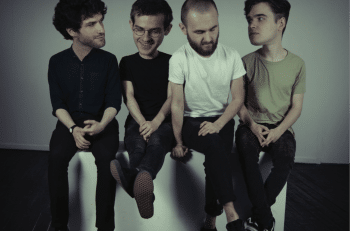
    Robocobra Quartet have been blazing a trail over the past few years. For artists, comparisons to admired figures can trepidate more than they motivate. Once a revered name is uttered and invoked in connection with an upcoming band, it becomes ineradicable from press releases, rehashed by gig promoters over social media, and used as an easy point of reference for journos and DJs with the luxury of only a few minutes’ research ahead of features. Your writer has the unfortunate honour of laying this burden on Belfast outfit Robocobra Quartet. While not, in fact, a quartet, but an assembly of musicians available on a given night, this constant shifting of sonic tectonics merely adds to the band’s unpredictability: a jarring and exciting racket that spurred a passing reference in a UK publication a number of years backto“Fugazi meets Charles Mingus”. Now a second album, ‘Plays Hard to Get’ is due on vinyl and digital formats in May, and as we get settled into a chat, the well-mannered and appealingly chipper Chris Ryan, speechifying drummer and bandleader, relates, with a wry smile, how this designation followed them as far as college radio in the United States while on tour there. But while it is exceptionally hard not to draw comparisons to sonic trailblazers past while pondering the angular, aggro jazz of Robocobra, the same seeming fluidity that applies to their musical broadsides extended across the range of the creative and production processes of their upcoming full-length. “There was definitely a much more blurred line between writing and recording on this one. Any time you commit something to recording, it always comes out a little different from imagined. In producing it, I wanted to respond to those changes and improvise just as much in the mixing and editing as in the actual performing. When you leave things malleable, it allows for the musicians to respond strongly and take ownership of their performances”. Material that’s aired in the run-up to the new record’s release has seen the band extend its range and explore the weird Venn diagram of sounds and textures available to them, especially in terms of jazz instrumentation and arrangement. “That’s interesting, I think the album is just much more extreme in all directions. It has some of the most gentle performances we’ve done but also some of the most dissonant violent noises we’ve ever made. Just a wider emotional-dynamic-range I guess”. Themes of alienation and trepidation are holdovers from the band’s first record, the embracingly-monikered ‘Music for All Occasions’, however modernity – in all its pettiness, distance and squalor are filtered through Ryan’s personality, experiences and spat-out verbiage throughout. While social commentary is no doubt at the heart of Robocobra Quartet’s music, the vitriol with which themes and concepts are thrown at the listener come from that certain place. “I find that I tend to get the most negative or dismal parts of my personality out through the lyrics, which kind of ‘cleanses’ me for real-life interactions, where I tend to be generally happy and polite. It’s hard to think about how something looks or feels when you’re in it, and even though the album is mastered and off to the vinyl plant, I still feel very much ‘in it’. Ask me again in about a year and maybe I’ll have a more eloquent response!”. With ‘Music for All Occasions’ now firmly in the rearview mirror for Ryan and associates, the conversation turns briefly to how he feels about the album now that he’s had some time to live with the finished product. Staying true to form and reflecting the band’s forward-looking nature, however, Ryan is eager to relate his experience in creating it to the grand vision he has for the new platter. “We definitely did that one a lot quicker than this record. There’s more of a simplicity to ‘Music For All Occasions’, but this album is much more layered. Some of my favourite albums offer you new things to hear with each listen, even after years. There’s a lot of the orchestration on this album that is somewhat buried, or momentary, to offer that kind of effect. There are drum machines, and string sections, and voices all over the place that are only really audible on headphones. Jeez… some mix engineer, eh?”. He laughs. The state of independent, experimental and otherwise ‘difficult’ music all over the island is one of rude health, across the genre spectrum. Hailing from a vital and busy Belfast scene that has carved a new identity for itself in recent years with precision post-punk and fearless experimentation, Ryan has a more nuanced take on the current upswing in noises and the people making them. “There are people doing beautiful things of their own volition all over the place, at all times. It’s usually the work of individuals with a will to make cool things, so I think it’s better to prop up those individuals, than thank the collective consciousness, which I think doesn’t really exist. Everything is in waves though, and I think even when things look terrible there are still people out there working hard and expressing themselves”. Off the back of the release of the new record, the band is touring the mainland UK and the continent throughout the summer, building on a live reputation that sees them neatly skewer the live demographics between the regular gig-going scene for noisy rock and the fringes of jazz-festival infrastructure. Balancing, as often, on the line between sincerity and irony, Ryan is quite specific about his thoughts heading into the fray. “There’s a really pretty petrol station in the north of England called Tebay Services on the M6 that is a little like paradise. That will be nice, especially in June which is when we’re on the UK leg. There are also a few promoters that we’ve worked with a few times before so it will be nice to say hello again and see how they’ve grown and changed. We’re just dipping our toes into mainland Europe at

    Loading

    Read more

  • Posted in:

    50 years since 1968

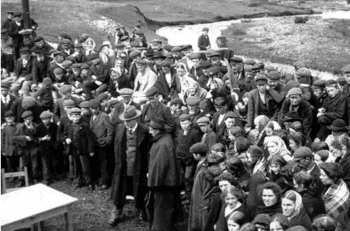
    Not a week has gone by in 2018 Ireland without several street demonstrations, especially about abortion and the housing crisis. In France, protesting is part of the vernacular. Riots are common: just look at 1789 and 1968. Ireland and France share a reputation for feistiness. A comparison between Irish and French demonstrations could be instructive. “What do we want? Public housing! When do we want it? Now!”. More than 10,000 people are currently home- less in Ireland. The demonstration I attended, organised by the National Homeless and Housing Coalition, on 7 April was good-natured: festive and serene. People played and sang music as they marched. The Garda seemed engaged and smiled while overseeing the demonstration: a safe protest. It appeared the crowd was representative of the general population, as perhaps you might want. It started at the Garden of Remembrance and ended in front of the Custom House in Dublin in light rain, as cheerful as the weather allowed. Its effectiveness was its mainstream attendance; there was no danger here. It would, I reflected, be different: more fractious, less representative, angrier – in France. Ireland fights for Human Rights At the moment Ireland is in arms over: abortion, education, sex education, health, animal welfare, drugs. But I have the sense that some of these campaigns are not mainstream, even as protests. Certainly the Water Protests were successful, albeit the underlying political message (no new taxes?) and symbolic value were not too clear. Abortion is a long-standing divisive issue in Ireland, symbolising the hegemony and, later, decline of the Catholic Church. Protests date back to 1983 when an unwise blanket prohibition was approved in a referendum. In May there will be a rerun. There are many events, debates and demonstrations on both sides, with pro-choice as fashionable politically as pro-life must have been a generation ago. The demonstration I attended in April was ‘pro-choice’- for ‘Equality, Freedom and Choice’, organised by Rosa. The rally was jubilant and confident, almost over-confident. The Daddy of all modern Irish marches is the PAYE protests from 1979-1980. Around 700,000 Dubliners marched against the stifling ‘Pay As You Earn’ tax. The BBC called it “the largest peaceful protest in post-war Europe”. But I sense things have changed since then. There is no longer an Ireland the sense that the regime is fundamentally at odds with its electorate. Perhaps it’s because the country now mostly complies with international norms or is fast moving in that direction; perhaps it’s because the country is simply much wealthier and has never been so confident. In 2003, Irish anti-war protesters organised a demonstration for peace in Iraq. The British and Americans had invaded Iraq. 100,000 walked on the streets of Dublin. It was a thoroughly internationalist protest. In 2006, a violent demonstration took place in Dublin’s O’Connell Street. For some reason Northern Unionists wanted to organise a ‘Love Ulster’ Parade to honour the victims of the IRA. A counter demonstration materialised and a riot started. Several Molotov cocktails were thrown and cars were burnt. A total amount of 14 persons were wounded and 41 arrested by Garda. Locals put the intense violence down to the alien influence of recalcitrant Northerners: it didn’t symptomise a new riot mentality. These kinds of demonstrations are pretty rare in Ireland compared to in France, where there are wide-ranging politically-driven strikes and demonstrations every year. Governments can fall as a result of demonstration culture in France. If France had had an international bailout that was forcibly inflicted on the population; if France had had the iniquities of Nama bailing out the richest failed developers there would have been strikes and riots. A country’s protest mentality varies from generation to generation. We’ll put down the Irish monster meetings and boycotts of the nineteenth century as the fruits of a different era. Where a country is colonised and not run for the benefit of the majority – or a significant minority – wideranging subversion is to be expected. In Ireland it culminated in the Easter Rising in 1916 and the War of Independence 1919-21. In the North of course discrimination against Catholics fuelled a later whirlwind. In the Bogside riots of 1969, eight people were killed, a majority Catholic, and over 150 homes destroyed; and the IRA campaign resulted in 1696 deaths. But, though important, this all speaks little to the modern-day Republic of Ireland.   France, protest pioneer French demonstrations have been well-known and lethal since at least the 18th century with a sustained and celebrated (though not of course by Edmund Burke) historic riot: the French Revolution, facilitating a declaration of the rights of man and changing forever the notion of the political establishment. In the twenty-first century, protests are still an important political phenomenon. France has been a global leader in dissent. The rockstar of street opposition was May 1968 when strikes and demonstrations led by students and workers and the occupation of universities and factories across France brought the entire economy of France to its knees and political leaders feared civil war or revolution. The moribund government itself ceased to function for a while after President Charles de Gaulle secretly fled France for a few hours in Germany. ‘68 changed France’s democracy: the super-annuated President De Gaulle resigned, the Assemblée Nationale was dissolved, and government committees were formed to restructure secondary schooling, universities, the film industry, the theatre and the news media. The Grenelle Accord gave better conditions for the unemployed, a 35% increase in the minimum wage and a fourth week of paid leave for those in employment. Mentalities started to change too with a sexual revolution from the young. Mixed schools became more common. 1968 sundered a post-War France of austerity, conservatism and asceticism. Nevertheless the movement succeeded “as a social revolution, not as a political one”. President of the Republic (2007-12) Nicolas Sarkozy famously denounced May 1968 as the source of contemporary France’s problems. The student revolts against bourgeois society introduced a “relativism”, he argued, that undermined national identity, the spirit of

    Loading

    Read more

  • Posted in:

    Island of Tyreland

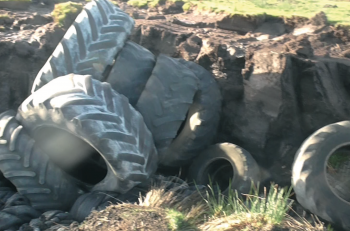
    Carndonagh is an area of outstanding natural beauty that nestles in the shadow of the Grinlieve Mountain, only eight kilometres from the designated Natura 2000 sites, Trawbreaga Bay Spa and the North Innishowen Coast. Safeguarded by the 1992 Habitats Directive both these ecological wonders are home to protected animal species and diverse wetlands. Outwardly this area seems idyllic and well-protected; however, on 4 December 2011 Sunday Life newspaper exposed Meenyollan, Carndonagh, as the location of a vast illegal tyre dump fed by KF Tyres, Corody Road, Derry (top right). The landowner, Michael McLaughlin, was also claimed to be complicit in the dumping. Nearly ten million tyres had been buried, unregulated, in the period 2008-2011 alone. At least one for everyone in the audience. It has made Carndonagh Europe’s largest illegal tyre dump. Following the Sunday Life exposé in 2011, Donegal County Council promised robust enforcement including an extensive cleanup operation. KF Tyres should have been made responsible in whole or in part for the cleanup operation Donegal County Council promised. However, seven years on, there is still clear evidence of tyres being illegally buried at this location and there is little evidence of a cleanup. The pristine fields, underpinned by tyres which leach into the meandering water table, contrast starkly with the surrounding boglands and call to mind previous violations and unseen toxicity (bottom right). Although it is difficult to find out the exact composition of a tyre, and there are lots of different types most of them include synthetic carcinogens, solvents and heavy metals, for example. KF Tyres and Michael McLaughlin escaped prosecution and in fact subsequently applied for and were granted a range of permits and planning permissions by both Donegal County Council and the Northern Ireland Environment Agency (NIEA) allowing them to legally operate at the same site. These incongruous decisions, some of which were granted in breach of the legally-man-dated sequence, reduced the promised enforcement to no more than knuckle raps. After an abortive attempt by planning consultant Jim Harley to get McLaughlin’s development deemed “exempt” from planning permission, an unlikely new wheeze was to tout it as land reclamation with secondary drainage benefit. Yet still the terms of the new permits permissions have been flouted. Photographic evidence clearly shows that illegal dumping is still going on at the site. In 2018 KF Tyres and Michael McLaughlin are still controversially involved on this site, while Donegal County Council behaves as if it is unaware of this. In 2015, Planning Permission was obtained for the use of 8448 tyres in 105 bales (80 tyres per bale) over a five- year period, suggesting even what Donegal County Council considers reasonable has been overwhelmed by illegal dumping on a much greater – indeed unconscionable – scale.   The photographic evidence (left) shows that neither McLaughlin nor KF Tyres appear to be compliant with the terms of the planning permission, which demands that the tyres that are used be baled, not loose (left, bottom right); nor do they seem to care. Moreover, Donegal County Council evidently does not appear to know what is going on. For example, after the Sunday Life article in 2011, Donegal County Council promised an investigation and robust enforcement. However, in January 2012, mere weeks after the article, Donegal County Council granted McLaughlin a five-year Waste Management Facility permit (WMP) (top right). Why? No planning permission had been granted though one is mandatory before a WMP can be issued. Without the requisite planning permission all tyres taken to Cardonagh around that time continued to be transported and dumped illegally. Jim Harley, formerly of Harley Planning Consultants, has figured in strong criticisms levelled against the Donegal County Council planning department when he worked there a decade ago. These are currently being reviewed by a senior counsel on behalf of the Department of Housing, Planning and Local Government. Harley acted as a planning consultant for McLaughlin when he was granted planning permission in November 2015. There was one condition: that he apply for a WMP. But there was an existing WMP that had been issued illegally. It was illegal precisely because it should not have been issued before planning permission was granted. The Sunday Life article stated in 2011 that KF Tyres had a WCP (waste carriers permit) with Donegal County Council to collect “end of life tyres” but it had no permission to bury tyres at Carndonagh. It is yet another anomaly that KF Tyres obtained a valid Waste Carriers Licence for the South in 2011 but no planning permission or commensurate licence for the site it operated from in Derry. It is strange that Donegal County Council neglected to contact the NIEA about KF Tyres in 2011. The NIEA went on to grant Ken Ferguson a WMP (bottom right) allegedly oblivious to the illegal dumping. This information would have been immeasurably beneficial in averting the current situation. Donegal County Council should have been monitoring the site, verifying the number of tyres being buried both by KF Tyres and McLaughlin. No assessment appears to have been made, north or south of the border, of how many Trans Frontier shipments (TFS) and what tonnage of tyres, KF Tyres declared to the NIEA it had transported between 2012 and 2015.   It is not clear how many physical border and site inspections were made by Donegal County Council and the NIEA during this period. As stated both the WMPs (previous page) were granted under Appendix II of the EU Waste Frame Directive 2008/98EC: recovery operations. R10-Land Treatment resulting in benefit to agriculture or ecological improvement; R13 – storage of waste pending (right). Amazingly there is no reference to waste tyres or indeed anything like rubber within this directive, nor to the burial of solid waste in any form. Land reclamation using tyres is deemed dangerous and illegal in Northern Ireland , but not in the Republic – yet both countries are bound by the same European Directives. Given the toxicity of tyres and the stringent legislation on their

    Loading

    Read more

  • Posted in:

    Ireland, Italy and the Disclosures Tribunal

    Leonardo Sciascia was an Italian political journalist, an elected radical member of parliament and the most prominent anti-mafia critic. All of this features in his famous detective novels which are in fact anti-detective novels or works of political observation. Coupled with his masterly analysis of the assassination by the Red Brigade of the Christian Democrat conciliator and former Prime Minister Aldo Moro they amount to a sustained critique of Italian and Sicilian political and cultural life. They reflect the complex interstices of corruption and collusion between extreme-right-wing Catholicism, organised crime and the shadowy self-protection syndicates of big business, politics, a malevolent state bureaucracy and crime. His books show the lethal effects of innuendo, smoke, mirrors and sighs, the nefarious rumour mill, shadows. Sciascia was a specialist in the mafia and he demonstrated how they kill and destroy. First they isolate, disempower and then denigrate. They in effect demonise their prey. And those who seek to investigate them, such as Judge Giovanni Falcone, who act on principle are destroyed in the process. This is exquisitely detailed in ‘Equal Danger’, his best book. In Sciascia’s fiction, it is the detective, not the murderer, who is isolated and suspected. Ironically in the end Sciascia attacked the crusading judges as putting civil rights at stake in an article, when he was dying, that irredeemably punctured his reputation, by attacking Falcone as a celebrity judge. This is deeply relevant to Ireland. Our mafia are our corrupt politicians, bankers and lawyers and the toxic relationship of our shadow state of governance between the police and the justice department. Those who challenge corruption or blow the whistle are reputationally destroyed, personally attacked, framed, driven to self-destruction or simply disposed of. Ireland is Italy and “equal danger” a cautionary text. The smearing of the state knows no boundaries and frequent collusion with Tulsa a criminal conspiracy maintained by many lawyers who should be disbarred. Another Sciascia theme, particularly evident in his most famous text, ‘The day of the Owl’ is the Sicilian trait of anomie or indifference. A shrug of the shoulders. It is what it is. Life moves on. Principle, justice and the truth are a waste of time. In controlled societies such as Ireland and Italy Sciascia’s books show the lethal effects of innuendo, smoke, mirrors and sighs, the nefarious rumour mill, shadows, in Italy trivialisation amounts to a resigned admission that the victims of crime had it coming to them in some obscure way. It betrays a desire for yourself not to go the same way. Being principled in an unprincipled society is very difficult. We know more than 10 black sacks of shredding left the office of the Commissioner under the supervision of a superintendent who has given evidence twice already to the Tribunal. The phone of the two past heads of national intelligence, Callinan and Ms. O’Sullivan are gone…vanished, destroyed. Yet no issue of the destruction of crucial evidence seems to be of concern to the Tribunal. It was the husband of the former Commissioner O’Sullivan who was appointed to take charge of the investigation into Superintendent Taylor. The phone of the Superintendent was taken but that crucial evidence too is lost. It seems to be simply a matter of no consequence. A judge whose orientation in private practice was prosecutorial and who, on the bench, has been somewhat indulgent of changes to evidential exclusionary rules to the advantage of fact-gathering gardaí, risks steering a Tribunal away from the glaringly obvious criminality of the highest level of the Department of Justice and the police. Moreover Maurice McCabe is represented at the Tribunal by former Minister for Justice Michael McDowell SC, a long-time and visceral political defender of the police and law and order. If I were McCabe I would contemplate refreshing my legal representation and wonder how the now ascendant narrative is that a cock-up rather than obvious state criminality smeared him. He should dwell on whether it was in fact appropriate for him to concede that the evidence established that the inclusion of the false allegation against him of rape in the 2013 Tusla report “was some form of cut and paste error”, and that the error was not the result of any deliberate action or ill will. And he should consider how the damning evidence of the press secretary Dave Taylor was not addressed first, as the Tribunal’s first module, as dictated by the terms of reference; and how the sequence of modules was altered so the less clearcut Tusla model was heard first. Instead the Tribunal opened with an arbitrarily selected series of smokescreen narratives implying a cock-up by Tulsa, and culpability for outlying zealot Callinan perhaps. Noel Waters, former Secretary General of the Department of Justice, has suffered from amnesia. In his evidence to the Tribunal he declared he could not remember, on nearly 50 occasions. Most damningly, he spoke to Nóirín O’Sullivan at a crucial moment during the O’Higgins Commission which in 2015 was looking at allegations of poor policing in Cavan/ Monaghan made by Sergeant McCabe, phone records indicate. However, neither Waters nor O’Sullivan can remember the 14-minute call on May 15, 2015. The crucial moment was when O’Sullivan’s lawyers were asked by the commission to confirm that they had been instructed to attack Sergeant McCabe’s motivation, and the commission adjourned briefly so that she could be contacted. The Tribunal had previously heard that O’Sullivan “sought time to speak to the Department of Justice” before confirming her original instructions. The Department has maintained neither it nor then Minister for Justice Frances Fitzgerald had prior knowledge of, or input into, the legal strategy. Waters said he could not remember the call, and insisted the Department had played no role in the strategy. When it was put to him by Tribunal counsel, Diarmaid McGuinness SC, that it was reasonable to assume he and O’Sullivan discussed what was occurring at O’Higgins that day, Waters replied: “I have to say in response that I have no recollection of that at all”.

    Loading

    Read more

  • Posted in:

    Avoiding League Relegation

    In Ireland, North and South. In the last 50 years no pub or shop has changed its language from English to Irish. In recent years, in the last pockets of the Gaeltacht, the young people have been switching to English. Clearly, the time has come for the Gaelic League, Conradh na Gaeilge, to take its last, this time decisive, action to save Irish, our ancestral language, from becoming a revered dead language like Latin, and instead keep it for the future spoken, written and joked in by thousands. The Gaelic League’s original aim in its glory days when it nourished the mind of the Irish Revolution was to make Irish again the language of the entire nation. After Independence, as the League realised that this was not going to happen, its aim became to preserve the Gaeltacht and to ensure that through the schools system and its own classes many thousands in the rest of Ireland would be able to speak and write Irish. That last aim has succeeded and it is now time to reap the harvest and put it to use. Many individuals, North and South, in many different occupations are now able to speak and write Irish well, and because they are in many different occupations they possess the Irish language more fully than the merely rural Gaeltacht did. In many cases, North and South, these persons amount to families where Irish is the family language. The League must seek out, for a start, 1500 of these people from the general population North and South and the Gaeltacht remnants; people who would pledge to speak and write Irish with each other and, if they have children, as their family language. Each of them above the age of twelve would wear a discreet badge to identify themselves to others. That for a start. Then each year, the elected committee of this community, which might call itself Na Caomhnóirí (Guardians), would hold an all-Ireland rally to coincide with Oireachtas na Gaeilge. Spaced through-out the year. Four regional committees would organise provincial gatherings. At these various coming togethers, they would discuss and decide what joint ventures – publications etc, – they would engage in. Na Caomhnóirí would call for new applicants and hold an annual entrance examination as a big public event. That annual event would give the secondary Gaelscoileanna and the university courses in Irish a concrete and prestigious goal to aim at. The entrance exam would be held each year until the number of members would reach 10,000. In this way, whatever else happens, the future of Irish as a spoken and written language would be assured into the future – into the new civilisation which will succeed the disintegrating European civilisation. And in that achievement the Gaelscoileanna, as feeder schools, would have a concrete goal to aim at. Unless action along these lines is taken, the so-called Irish language movement will plough ahead without any concrete goal to aim at and with diminishing support from a State that has lost interest. Probably TG4 and Raidió na Gaeltachta would continue for a while to broadcast and Irish would be spoken occasionally in the Dáil and as a cúpla focal at formal dinners. Latin, too, has its news media on the internet, and English football results are broadcast on radio in Latin. At important ceremonies of the Vatican and of many universities formal Latin is spoken. But because Latin is not spoken and joked in every day by a substantial living community, it is reckoned to be a dead language. To save Irish from becoming that and the League from becoming a historical curiosity, it is necessary to act decisively now in the manner I have outlined. Desmond Fennell Dr Desmond Fennell’s latest book is his autobiography ‘About Being Normal: My Life in Abnormal Circumstances’ (Somerville Press).

    Loading

    Read more

  • Posted in:

    Some devils got him

    The Westminster terrorist attack on 22 March of last year, by lone attacker, Khalid Masood (52), who drove a car into pedestrians and fatally stabbed PC Keith Palmer, is not the first time that terrorists have selected the Palace of Westminster, and its surrounds, to perpetrate an act of violence. 39 years ago, on 30 March 1979, the Irish National Liberation Army (INLA) murdered Airey Neave, Conservative MP and Margaret Thatcher’s shadow secretary of state for Northern Ireland, in a devastating car bomb attack. Apart from reaffirming Thatcher’s determination to defeat Republican paramilitaries, Neave’s assassination robbed the Conservative Party of one of its most open-minded, albeit controversial, thinkers on Northern Ireland. By the standards of the day, Neave was a remarkable figure. On the one hand, he was a public figure: war-hero, writer, barrister and politician. He had escaped from Colditz, a Nazi prisoner of war camp during the Second World War; was the author of five semi-autobiographical books; established a practice at the bar; and was Conservative Party MP for Abington, 1953-1979. On the other hand, he was an elusive and secretive individual, retaining close links to the British Secret Intelligence Service throughout his adult life. During the Second World War he worked for MI9, a subsidiary of MI6, later holding the rank of commanding officer of the Intelligence School 9, Territorial Army (TA). Neave’s greatest contribution to political life came in the autumn of his career, following his promotion as shadow secretary of state for Northern Ireland in 1975. Neave’s appointment to Thatcher’s shadow cabinet, in the wake of her election as leader of the Conservative Party in February 1975, had important ramifications for the Conservative Party’s Northern Ireland policy. From the moment he took up his new shadow cabinet portfolio, until his murder by the INLA, Neave’s “first priority”, as he noted in April 1978, was to defeat Republican terrorism. Although often preoccupied by security-related issues, and despite misguided arguments to the contrary, Neave remained committed to finding a workable solution in the hope of ending direct rule in Northern Ireland. As a pragmatist, confronted by the political reality that the mainstream political parties in Northern Ireland could not agree on the terms of devolution, he instead championed reform of local government in Northern Ireland, as an interim measure. By initially supporting the establishment of his so-called ‘Council of State’, subsequently followed by a proposal to create one or more Regional Councils in Northern Ireland, Neave sought to end, as he phrased it in November 1977, `’civil servants’ paradise`’, which existed under direct rule. Unfortunately, Neave’s assassination by the INLA robbed him of the opportunity to implement his proposals to reform local government in Northern Ireland.   New archival material from Neave’s personal papers and the National Archives of the UK iliuminate the events of 30 March 1979. Neave commenced his working day, like any other. Following breakfast, he left his at at Westminster Gardens, got into his powder-blue Vauxhall Cavalier saloon, and made the short journey to the houses of Parliament, the Palace of Westminster. His morning was spent preparing for the forthcoming British general election (scheduled for 3 May) and dealing with day-to-day constituency matters. Following lunch, he decided to stop for the day and return home to spend time with his wife Diana. It was in the members’ lobby that Neave held his last conversations, chatting to colleagues before crossing to the members’ exit and taking the lift to the five- floor underground car-park to pick up his car. At 2.58p.m., an enormous explosion engulfed New Palace Yard. Soon after, as Neave’s sole biographer Paul Routledge wrote, smoke was seen billowing from the smouldering wreckage of a Vauxhall car on the ramp leading up from the MP’s underground car-park. It was a “haunting image”, with sheets of headed house of Commons writing paper “blowing gently in the breeze”, recalled Lord Lexden, Neave’s former political advisor on Northern Ireland. Police officers rushed to the scene and came upon an unidentifiable man, dressed in a black coat and striped trousers. Initially, the victim was believed to be Alan Lee Williams, a Labour MP. In fact, in the car lay sixty-three-year-old Neave. Surveying the burning wreckage, the mangled frame of the car and the glassless windows, it was apparent that some type of bomb had exploded. “He’s still alive! Clear the area!”, a policeman shouted. Within minutes, an ambulance crew arrived to find the still unidentified figure, who was breathing, slumped over the steering wheel, his face burned beyond recognition. A doctor, nurse and firefighters soon joined the entourage, before Neave, with his right leg blown off below the knee, was eventually freed after half an hour. He was quickly taken to Westminster Hospital where he underwent emergency surgery. It was too late. Neave died on the operating table. Thatcher received news of Neave’s murder while preparing for a party-political general-election broadcast at BBC headquarters. Her first thought was reportedly: “Please God, don’t let it be Airey”. When it was confirmed that Neave was indeed the victim Thatcher was described as “numb with shock”. Later that day she informed a BBC reporter that “… some devils got him and they must never, never, never be allowed to triumph, they must never prevail”. Following Neave’s murder, attention immediately turned to who had perpetrated this brutal crime. Initially, the Provisional Irish Republican Army (PIRA) claimed responsibility. In fact, the real perpetrators were the INLA. Formed in 1975, with a pledge to establish a “republican and socialist” state, the movement had previously been known as the People’s Liberation Army, having sprung up in late 1974, when the Official IRA attacked members of the newly formed Irish Republican Socialist Party (IRSP). At the time of Neave’s death, it was believed that the INLA had approximately 60 active members. The INLA basked in the publicity following Neave’s murder. A spokesperson for the terrorist organisation said that Neave’s assassination “had a tonic effect in Northern Ireland where there had been celebrations in Belfast,

    Loading

    Read more