• Posted in:

    IR FU(EU)

    The nineteenth Six Nations tournament begins on February 3 but one man who won’t feature is Simon Zebo. It was announced in October that Zebo will be leaving Munster at the end of this season and moving to Paris to play for Racing 92 in the French Top 14 league. The announcement of his planned move abroad resulted in Zebo being excluded from the November Tests series, and now his exclusion from the Six Nations Squad. Joe Schmidt claimed at the official launch of this year’s championship that Zebo has been left out of the squad due to his form rather than the fact that he is about to leave the country, with prodigious Leinster young gun Jordan Larmour his preferred option as reserve. Larmour could well be a fullback great, but Zebo still has plenty to offer his national team as he is only 27 years old and in his prime. The IRFU has a policy, which the current Irish management helped to devise, of only selecting home-based players. This is in part to safeguard provincial rugby and as a way of preventing the top players accepting lucrative contracts with foreign teams. This policy has only come into play in recent years, in part due to the struggles Ireland had with Johnny Sexton during the 2014 and 2015 Six Nations Campaigns when he played for Racing 92 – Zebo’s home from June 2018. Sexton missed vital training sessions as he had to report back to Paris for the two rest-week periods during the Six Nations and to play club games in France: not ideal preparation despite the fact that Ireland was victorious in both of these campaigns. It is something Schmidt is wary of ever repeating. Zebo is Munster’s all-time leading try-scorer, and has become an established member of the Irish squad in recent years, scoring 9 tries in his 35 caps for Ireland. He played all but 5 minutes of the 2017 Six Nations Championship. There has been a clamour for Zebo to be brought back into the squad for the Six Nations but Joe Schmidt and the IRFU have stuck firm. There are a number of other players who ply their trade abroad who could easily be picked for the squad if the policy were to be scrapped, such as Donnacha Ryan at Racing 92, Tadhg Beirne at the Scarlets, Ian Madigan at Bristol and Marty Moore at Wasps. The policy appears to breach the legal requirement of Freedom of Movement and Residence for persons in the EU or, at the very least, its spirit. Freedom of movement and residence for persons in the EU is the cornerstone of the internal market and indeed of European Union citizenship, which originated in the Treaty of Maastricht in 1992. Today, the provisions governing the free movement of persons are laid down in Directive 2004/38/EC on the right of EU citizens and their family members to move and reside freely within the territory of the Member States. Restrictions are only permitted if they are a proportionate response to an inherent need in a sport. One need only look to how ludicrous it would be to impose the same restriction on soccer players to detect a lack of proportion. Zebo, and all the other players who could theoretically be picked by Ireland if the IRFU’s policy were to be changed, are being blocked from significant earning potential. While many people might not have too much sympathy for the players considering they are highly paid and get to enjoy sport for a living, it is worth noting that the Irish players will not receive match or training fees from the IRFU, but a Grand Slam win would see each of them receive a bonus of over €70,000. By excluding Zebo from the team due to his move to France, the IRFU are directly affecting his earning potential from winning, and also from additional sponsorship opportunities that come with being included in the national team. Remarkably, English players get a much better deal: they will earn £22,000 per game from match fees, training fees and image rights. This means that for any team member who appears in all five games will be guaranteed to be paid £110,000 each. The result is that Zebo has been ruled out of international consideration and has now sacrificed any dreams he may have had to represent Ireland in the 2019 World Cup in Japan. Ireland kick off this campaign against the French in Paris – a fixture we have only won three times in 46 years. A player of Zebo’s quality and skills could have been the key to unlocking the French defence. In fact we can expect a fourth win to be added come 3 February – due to the current state of the French team. In the long run the IRFU policy seems to serve Irish rugby well, irrespective of the EU Spirit. The top players are incentivised to stay in Ireland, their game time gets managed punctiliously and they are always made available by their clubs for training camps, no matter what time of year. Another benefit for Irish rugby is the Prodigal Son pardon that is bestowed upon anyone who returns to an Irish provincial team – they can be immediately included for the national side. This can act as a major incentive as there are examples where individuals came back to Irish teams much improved from the time spent away from home in a different environment learning from new coaches and strategies. Tommy Bowe developed immensely from his time in Wales, and look out for Tadhg Beirne once he leaves Scarlets for Munster next season. He appears to have slipped through the cracks for Leinster, he has been nominated for European Player of the Year and has dramatically enhanced his performance level due to the freedom he is allowed in the Scarlets team. Ireland look set to be the best placed team to push favourites England all the way in this year’s

    Loading

    Read more

  • Posted in:

    Villager February 2018

    Listen up around what they’re at Villager likes nothing more than a shafted preposition. Most of the articles that come in to this magazine are from academics writing ‘around’ their subjects. They go into Village’s file of death along with cover letters for CVs that sign off cheers. So he was thrilled to see the Irish Times say of Nama that is lending €384m to allow developers to “build out projects”. Zagantagonism It’s been a bad month for Rugby schools. Paddy Jackson, the Kiely’s set-to, the illicit publication of the letter from Eunan O’Carroll. And now Frank Armstrong. The editor and half the Champagne socialists/ environmentalists whose whimsies fill the pages of Village have been taken aback by young Armstrong and his piece in the current edition ripping apart Gonzaga College, alma mater to non-conformist and unbulliable egos of all sorts, from Ranelagh right as far as Bray. Hypocrisy on Equality Talking of which it was amusing to see Michael McDowell bemoaning inequality – “the rich getting far richer” in the Sunday Business Post where he ties down an, unpaid, column. When he had power he was largely an agent for liberalism – and inequality, even claiming the economy “demands inequality in some respects”. In 2004 he told the Eonomist Survey of Ireland that he “sees inequality as an inevitable part of the society of incentives that Ireland has, thankfully, become”. He was quoted by The Economist magazine as offering a robust defence of the gap between rich and poor in Ireland. And he told the Irish Catholic that “a dynamic liberal economy like ours demands flexibility and inequality in some respects to function”. It was such inequality “which provides incentives”. He said: “As far as I am concerned liberal politics and liberal economics go together. In a liberal society, equality of opportunity is an equal opportunity to become unequal. A society which legislates and controls in every way to create some sort of mathematical equality just doesn’t work”. In his pomp he believed: “Driven to a complete extreme, the current rights’ culture and equality notion would create a feudal society”. McDowell sat at the Cabinet table for a decade while the country was run – to disastrous long-term effect – in the interests of elites and cartels, including the legal one he still feeds off. McDowell pulled the plug on the Citizen Traveller campaign when it dared to be controversial. He delayed and censored the reports of his department’s own inspector of prisons, Judge Dermot Kinlan. Dodgy Donegal There is still no sign of a date for the High Court case being taken by Michael McLoone, former County Manager in Donegal, represented by barrister Michael McDowell, over a 2014 Village article titled ‘Dodgy Donegal Planning’, alleging improper behaviour in Donegal County Council’s treatment of planning matters. Nor is there any sign of the Department of the Environment’s report into the activities detailed in the impugned Village article, though it has been promised for years. Loughinisland threats Village has received correspondence from the Hawthorns, Ronnie and Hilary saying they will take legal action over the naming, in these pages, of Ronnie as chief suspect for the Loughinisland massacre in 1994 when six Catholics watching a world cup match were gunned down in a pub. The Hawthorns’ concern vacillates between defamation and privacy. But they seem to be having trouble getting anything beyond a few emails together. Colgan threats And Michael Colgan has apparently initiated proceedings against Village for “defamation of character”, though Village hasn’t been served with anything so we’re not really sure. Colgan alleges a recent editorial implied he was guilty of serious crimes and rape. Village claims it was accusing him of harassment. Unthreatening After all that hassle Villager often wonders if it isn’t better to just say nothing. Then you can become as popular as William and Kate, Royal heirs in waiting, who have literally never saidanything anyone can remember. Kith and Quinn Villager never gets cross, never raises his voice. But he hates those Quinns. Complaints by Sean Quinn jnr and his wife Karen Woods about a recent failure to pay some of their €100,000 annual living expenses should be seen in the context of a “scheme of misappropriation on a grand scale”, the High Court has been told. Some €10m has been extracted from a company in India “and we don’t know where that has gone”, Barry O’Donnell SC, for the special liquidators of Irish Bank Resolution Corporation, said. Documentation from India and Hong Kong showed “a scheme of misappropriation” was executed, over time and especially in 2010, at the instigation, and for the benefit, of members of the Quinn family. The transactions at issue “have never been explained” and while the family maintain they had no idea what was going on, that is “wholly implausible”, he said. This, and the fact Quinn and his wife are receiving close to €100,000 annually in living expenses, was of concern to the bank and it was “imperative” the matters were addressed. Villager absolutely begrudges them their 100k. If he had his way the radical left would have picketed the likes of the Quinns instead of faffing around harassing water-meter installers. And he wants to know where Peter Darragh Quinn, a nephew of the bankrupt former billionaire, on the run five years after an arrest warrant was issued for him, is. Ireland biggest environmental mess by a landslide In July 2008, the Court of Justice of the European Union (CJEU) ruled that Ireland had failed to carry out a proper assessment for the 70 turbine Derrybrien wind farm which was built in the early 2000s. The Government has yet to carry out the assessment on the site. The construction work on the wind farm led to a 2km landslide in October 2003, which the Commission itself has called “environmentally devastating”. The incident caused 450,000 cubic meters of peat to slide down the mountainside, which was washed into the local river systems. The European Commission has now requested that the

    Loading

    Read more

  • Posted in:

    Labour starts to rebuild

    Is the Irish Labour party finished, is a question that’s been asked for nearly as long as the party has existed. In the last year or so however, or more accurately since a couple of years into the Fine Gael-led coalition, the party’s tail-spinning poll numbers have started to feel symptomatic of a terminal decline. The old question has a new urgency. The regular Irish Times’ poll with Ipsos/MRBI hasn’t placed Labour over 10% since February 2013. The same poll has yet to rise above the benchmark set in February last year, when the party’s support bottomed out at 6.6% in the general election. On some level, the party recognises that the negative association with the last government isn’t going away in a hurry. Asked whether Labour’s problems might stem from increased competition on the left, Councillor Martina Genockey, recently selected as the party’s candidate in Dublin South-West, is quick to retort that no, “our biggest problem is that we were in government for five years”. Abatement of hostility? “People are still seeing things through that lens”, she says. A year on from the nadir of Labour’s worst general election result, policy proposals are still met on the doorstep with shouts of “you didn’t do this when you were in government, you didn’t do that”. That isn’t to say that canvassing is as rough as it once was. The increased amiability on doorsteps is a recurring line in conversations with the new array of candidates. “I wouldn’t say there’s a swing to Labour”, says Andrew Montague, selected to run in Dublin North-West, “but the anger against Labour has dissipated”. Ged Nash, elected to the Seanad and selected in April to run for his old Dáil seat in Louth, says that “there’s been an abatement of the hostility experienced on the doors”. That the polls have, if anything, gone in the wrong direction since the election, misses the point, says Kevin Humphreys, also a Senator. “Don’t necessarily expect movement in the polls”. Labour, he says, are focussing on 15-20 winnable constituencies, such that national opinion polls may not reflect the party’s strength. How credible is this? According to a spokesperson for the parliamentary party, plans are well underway for the next election, whenever it comes. The plan is to contest a minimum of 30 out of 39 constituencies. All selection conventions are intended to be completed by Christmas, with conventions already on the cards to select Brendan Howlin, Alan Kelly, Seán Sherlock, Brendan Ryan and in Meath West, newcomer Tracy McElhenny. A draft manifesto has been prepared, a fundraising drive is underway, while a membership recruitment drive is ongoing, said the spokesperson. The stated aim of party leader Howlin has been to double the party’s Dáil representation at the next election. Achieving that, bringing Labour to around 14 seats, would see it back around its historical average. That’s when the real rebuild could begin, you might think. Labour’s problem lies partially in its vote distribution, says Adrian Kavanagh, a lecturer in political geography at Maynooth University. Until not that long ago, Labour’s real base was in rural Leinster and Munster, and not necessarily in Dublin. That changed after the amalgamation with Democratic Left in 1999. “The change in the last number of years is in the loss of traditional working-class areas”, says Kavanagh. The party’s result last year saw it shrink back to a core of largely personal votes in rural Leinster and Munster – with the likes of Howlin in Wexford, Willie Penrose in Longford- Westmeath, and Alan Kelly in Tipperary clinging on. This leaves the party in a precarious position as regards vote share. Its vote is more thinly spread than that of Solidarity-People Before Profit, who won only one less seat on a lower vote total. If Labour falls a few percentage points below the 6.6% from last year, “they’ll struggle to win any seats” says Kavanagh – his analysis of the most recent Sunday Business Post poll has Labour winning only one, with Brendan Howlin in Wexford perhaps the sole survivor. Such is the geographical distribution of Labour’s vote, this could come about even as Solidarity- People Before Profit leapfrog them to 7 seats, still on a lower vote share. On the other hand, if Labour go up a few percentage points, “then it’d be possible to get back up to the mid-teens in terms of seats, which is quite a respectable result”. Separate, and socialist? Fairly or not, the primary accusation that’s been levelled at Labour in the years since it entered government has been that it turned away from its working-class base, with the consequences being felt at the ballot box. Joan Burton, the then-leader, lost more than 3,000 votes at the 2016 election. Party figures are reluctant to give credence to this viewpoint – Labour stepped up in the national interest, they still say. According to Nash, Labour’s “unique selling point is that we’re prepared to put our money where our mouth is”, minus a harmful obsession with being “philosophically pure”. Humphreys rejects the idea that Labour’s social democratic roots were abandoned, and emphasises the traditional idea that the party has a record of delivery. “Protest, not People: is all those on the hard left are good for”. Labour are in many ways dealing with an old problem, says DCU academic Eoin O’Malley. “They’re not radical enough for lots of people, while at the same time, they’re a bit too radical for a lot of people in centrist Ireland”. Furthermore, says O’Malley, “as pragmatic as the Labour Party is, it damaged them as a brand to go into government”. Better in 2011, would have been to lean on Fianna Fáil to prop up a Fine Gael government, sailing into 2016 as the uncontested leader of the opposition for the first time in its history. Counter-factuals are fine but what should the party be doing? The party has taken the implications of its diminished representation seriously – rewriting the party constitution, re-energising ordinary supporters and, says

    Loading

    Read more

  • Posted in:

    Discovering Casement

    It is today widely believed that between Casement’s arrest and execution in 1916 the Black Diaries now held in the UK National Archives were clandestinely shown to in uential persons in order to disarm appeals for his reprieve. This belief was once again articulated by law professor Sean McConville on 2 June, 1916 at a Casement event in London when he stated to a TV audience of millions “…the diaries were circulated in London … Blackwell … was circulating these diaries at a time when Casement’s fate had not nally been decided …”. The original sources of this belief, however, are the books written by Rene MacColl BL, Reid, Roger Sawyer, Brian Inglis and Séamus Ó Síocháin. These volumes comprise more than 2,000 pages and at an average of two years of research for each study, we have around ten years research. Strangely, in these 2,000 pages there is not a single verifiable instance recorded of the diaries in the National Archives being shown to anyone in that period. How can this be? It is not credible that these authors of research overlooked this crucial aspect after ten years. If they found instances of the diaries being shown in that period, then it seems they withheld that vital information from their readers. Since this is not credible, we must assume that none of them found any instance of the diaries being shown in that period. It is well attested that typescript pages were circulated in that period and that a large quantity of these eventually found their way to Singleton-Gates who published them in Paris in 1959. But Casement did not type those pages. What would constitute a proof of authenticity of the diaries held in the National Archives? There are no witnesses to Casement’s authorship and there have been no rigorous and impartial scientific tests. The only evidence that has been adduced in favour of authenticity is a resemblance in handwriting. The attempts at corroboration in July 1916 are not evidence of authorship. But perhaps the question about authenticity is a false trail. In the period from 25 April to 3 August the British authorities claimed to be in possession of the five bound volumes now held in the UK National Archives. However, there is no verifiable record that these volumes were shown to anyone in that period. Rather than show the diaries, the Intelligence chiefs had decided to prepare typescript pages and to show these to influential persons, journalists, editors, politicians, churchmen and others. They told these persons that the typescript pages were authentic copies of original diaries written by Casement. They failed to provide any proof that the typescript pages were copies of anything written by anyone. The proof which they did not provide would have been exhibition of the bound volume diaries now in the UK National Archives. No explanation has ever been proposed for this failure. Today there are five bound volumes in the UK National Archives. Their existence today does not prove their existence in the period 25 April to 3 August 1916. That the bound volume diaries were not shown in that period means there was some impediment to showing them. The protagonists – Blackwell, Thomson, Hall, Smith and others – had the strongest of motives for showing the bound volume diaries which they said had been discovered but they did not do so. The impediment certainly existed and it was such that these powerful men neither jointly nor singly could overcome it. Therefore it was out-with their joint power to show the bound volume diaries in that period. This circumstance indicates that the impediment could not have been overcome by anyone in England at that time – not even by the monarch. In this regard these powerful men had touched the limit of theirhuman power. The question is therefore not about forgery or authenticity but about the material existence of the bound volume diaries at that time. The absence of verifiable evidence that the bound volume diaries existed before August 3, 1916 means that questions about authenticity are meaningless. What first requires to be proved is their existence in that period before August 3. Those who claim the typescripts were true copies have now had 100 years to produce evidence of the existence of the bound volumes in that period. That they have not produced the necessary evidence indicates that they too have been unable to overcome the impediment which defeated their powerful predecessors, Thomson, Smith, Hall etc. In these circumstances an impartial court of law would decide to act as if the bound volume diaries did not exist at that timeand would dismiss a case for their authenticity as being un-tryable. The case for the typescripts being copies at that time could not be tested or proved without verifiable independent evidence that the bound volumes existed before August 3. Thus the case in favour of the material existence of the bound volume diaries before August 3 rests entirely on the word of Thomson, Hall, Blackwell, Smith and others and these are the people who at that time were circulating typescripts which depicted Casement as “addicted to the grossest sodomitical practices”. These persons can only be considered as hostile witnesses by virtue of their uncontested behaviour. There are no neutral witnesses who testified to seeing at that time any of the bound-volume diaries now in the UK National Archives. Absence of proof of existence of the bound volumes at that time entails that no proof of their authenticity can be derived. That no proof of authenticity can be derived entails that – until such proof of existence is provided – the veracity or falsity of the typescripts cannot be considered. Ei incumbit probatio qui dicit, non qui negat; the onus of proof rests on the accuser, not on the defence. If questions about authenticity are meaningless due to lack of conclusive evidence after 100 years, claims favouring authenticity do not rest upon verifiable facts or upon independent testimony. Therefore such claims rest upon

    Loading

    Read more

  • Posted in:

    Braced for Brexit

    Back in the 1960s I once stood on the plinth of Nelson’s column in Trafalgar Square, London, between Landseer’s lions, at a Connolly Association rally against anti-Catholic discrimination by the Northern Ireland Stormont regime. Lots of people were waving tricolours. Forty years later I spoke again in the same spot, at an anti-EU rally organised by the Democracy Movement, one of Britain’s EU-critical bodies, before a sea of little Union Jacks. I smiled to myself. Here were the English discovering the drawbacks of being ruled by foreigners, by people they did not elect, and how EU laws had come to have primacy over those of their own Parliament. They were reacting against losing their democracy and national independence. British Euroscepticism is largely English nationalism. The political psychology of the governing élites in England and Ireland is very different, not least in their attitudes to the EU. The lack of self-confidence of the Irish élite is shown by their continual anxiety to be seen as ‘good Europeans”’. Hence for example Enda Kenny’s boast that our recent modest economic improvement has “restored our reputation in Europe”. I was at the EU summit in Gothenburg, Sweden, a few days after Irish voters rejected the EU’s Treaty of Nice in 2001. The then Taoiseach, Bertie Ahern, was virtually beating his breast there as he explained apologetically to the international media how Irish voters were mistaken, but they would have a chance to change their minds in a second referendum – which of course duly happened. By contrast England’s governing élite has the psychology of a ruling power. For centuries they backed the second strongest powers of Europe against the strongest, thereby preventing any one power dominating the continent. When the EU came along after World War II they joined it in the hope of either prising France and Germany apart or else of being co-opted by the Franco-Germans as an equal partner to run ‘Europe’ as a triumvirate. Both hopes have proved illusory. Hence English disillusion with the EU. They never shared the Euro-federalist visions of the continentals – something that former Commission President Jacques Delors expressed when he said in 1993: “We’re not here to make a single market – that doesn’t interest me – but to make a political union”. Prime Minister Cameron wants to stick with the EU. But most of his party and large swathes of British public opinion see the EU as a low-growth economic area mired in recession, with a dysfunctional currency and high unemployment. They want to regain their freedom of action, especially over trade, by leaving. They want to develop trade and investment links with the five continents and the far-flung English-speaking world. The obvious power imbalance between the two sides would make it extraordinary if the “Leave” people were to prevail over the “Remain-Ins” in the Brexit referendum. On the one side are the British Government, the American Government, the German and 25 other EU Governments, Wall Street, the CBI, the TUC, the British Labour Party, the Brussels Commission, the European Movement, most EU-based High Finance and Transnational Corporations, plus in Ireland all the parties in the Oireachtas. On the other side is a diverse and sometimes quarrelsome range of groups and individuals on the Left, Right and Centre of British affairs, united only by their desire to get back their right to make their own laws, control their own borders and that their Government should decide independently its relations with other countries. It would be unrealistic though to think that a “Remain-in” vote in June will decisively settle the matter. It is likely merely to delay the inevitable divorce, for the interests of the continentals and the island Britons are just too fundamentally opposed. And what of the Celtic fringe? Contrary to the received wisdom there could well be a substantial “Leave” vote in those areas too. If the UK as a whole votes to leave, will Scotland want to break away from the rest of the UK in order to remain in the EU, abolish sterling and adopt the euro – that being a requirement for all newly acceding States to the EU? It is very doubtful. The Irish media have not yet picked up on one big downside for Irish people of the deal David Cameron concluded in Brussels before he launched his referendum. This is the implication of the EU agreement that if the UK votes to remain, new immigrants to the UK are liable to have lower social benefits for some years than those already there. It will be impossible under EU law to differentiate between Irish immigrants on the one hand and non-Irish ones on the other. This means that new Irish immigrants to Britain or the North must face cuts in social bene ts too if the “Remain” side wins. This proposal will not affect Irish people already settled in the UK, but solidarity with their fellow countrymen and women should still cause lots of them to vote Leave. If a booming British economy, freed of EU regulation, becomes the Singapore of Europe outside the EU, which is perfectly possible, it can only benefit Ireland economically. Lurid scenarios are being painted of the consequences of Britain leaving the EU while Ireland remains in it. If Brexit happens some uncertainty is inevitable for a year or two, but it will not be the end of the world. Free trade will continue between Ireland and the UK under all realistic “Leave” scenarios, so there will be no customs posts on the North-South border within Ireland, no passport controls or anything like that. Such claims are simply scaremongering, part of “Project Fear”. What of Northern Ireland in the event of Brexit? Over the past decade the UK has paid over £150 billion to the EU budget – far more than it has got back. It sends £350 million to Brussels every week. This is some ten times the Northern Ireland schools budget. EU subsidies to the North in the form of

    Loading

    Read more

  • Posted in:

    The Irish Times won its struggle for trust on the Centenary

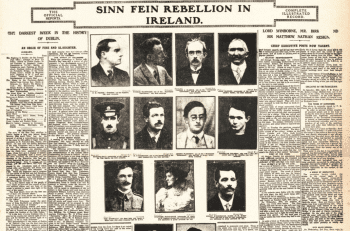
    The Irish Times has had a mixed 1916 commemoration. Even its own audiences seem hardwired to expect a certain bias from the newspaper of reference, but one particular decision – or probably a non-decision no one ever thought to check for unfortunate implications – certainly didn’t help. For its 1916 anniversary issue the paper produced a replica cover from 100 years ago, but decided to cut the original banner headline: ‘Sinn Fein Rebellion In Ireland’. The page-two explanation – that broadsheets aren’t what they used to be, and the resized 2016 dimensions (half the size of the 1916 original) meant the original would no longer t in its entirety and, although it had been shrunk somewhat, any further reduction in print size would render it unreadable, and something had to go… convinced some, but left others unimpressed. If space was the only issue, then why leave two mastheads on the front page, one modern and one vintage? Assuming the plausible explanation that it was a design decision, and nothing more, the online row it generated speaks much about the perceived trust issues the paper has with its audience. Irish Times journalists are prone to complain that their paper is often held to a higher standard than others, and that may be the case, but it is also a backhanded compliment. Its readers expect more from it, and are therefore more inclined to complain when it does not live up to expectations. The Irish imes garners complaints because what the Irish Times says matters to its in a way that most other newspapers do not. Being an opinion leader comes with a price. Twitter media accounts come in two avours. There are those that engage, joining in conversations with followers over the stories of the day, even on occasion adding their contributions to the joke of the day on the medium, and there are those that broadcast, casting their bread upon the waters for others to consume, but never acknowledging that the audience is talking back. Irish Times’ editor Kevin O’Sullivan falls into the latter category. His twitter stream is a list of links to articles he finds it worth highlighting, mostly from his own publication, occasionally from farther afield. While it is assumed that O’Sullivan curates his own Twitter account, he does not engage with his followers online, or share his thoughts on the news of the day, beyond a brief “interesting” or “scintillating” appended to a story link. And since he does not share his thoughts in detail, the only insight into the thinking of the man helming the paper of record derives from the stories he deems worthy of sharing. Irish Times 1916 coverage, as highlighted by its editor in the period from Patrick’s Day to the end of Easter Week, was colourful and varied, with thinkpieces by regular and occasional columnists (Fintan O’Toole on Shaw and Casement; Niall O’Dowd on the American input to rebellion; though oddly, no one expurgating the German contribution). Beyond this, the Irish Times chose to reproduce a letter from Francis Sheehy-Skef ngton to Thomas MacDonagh making a case for pacifism, an offbeat Q&A by cynical Frank McNally: “To question the Rising is to be found guilty of unIrish activity”, Eunan O’Halpin was mean about the Proclamation (“a speech not a Proclamation”), atheist Donald Clarke goaded that it didn’t need to be atheistic, and Miriam Lord wished fervently that we could hold an Easter party every year. Diarmuid Ferriter appeared here and there with as usual more good history than acute insight. Some ideas that sounded like cringe-inducing embarrassments, such as the new proclamations created by schoolkids, generated genuine wonder. What does it say of a modern nation if children are calling for an end to homelessness while ministers hide behind constitutional guarantees of private property? On the new-media side, a particular highlight must be the Irish Times’ Women’s Podcast on Margaret Skinnider, volunteer, sniper, school- teacher, trade unionist, and would-be hotel bomber (of the Shelbourne – the newspaper’s readers may have pondered that it might as well have been the Irish Times itself). The Irish Times has even produced a book called unexcitingly the ‘Irish Times Book of the 1916 Rising’. And then there was its own 2016 Proclamation, with dodgy prose: “First among our values is the belief that every citizen must have both [sic] the legal, civic [sic] and political rights necessary for full citizenship”, but a progressive core: “we commit our governments to a continuing process of reducing inequality”. If schoolchildren came out with a simple vision of an Ireland where no one is homeless, the Irish Times’ editorial proclamation for 2016, attempting to cherish all its children equally, had the look of a family Christmas tree, with everyone adding their favourite bauble to the decorations until it became top-heavy, over-owing with good wishes, inclusiveness, and a feelgood spirit that made it look like an out-of-shape heavyweight next to the Spartan declaration of a century ago. Perhaps a little like the Irish Times itself. Gerard Cunningham

    Loading

    Read more

  • Posted in:

    Independence in a Vassal State

    In his 1976 poem, ‘A Part of Speech’, Joseph Brodsky says Russian narratives of the future and of history are informed by language, not facts. “… and when “the future” is uttered, swarms of mice rush out of the Russian language and gnaw a piece of ripened memory which is twice as hole-ridden as real cheese”. Current events in Ireland import his observations to our own milieu. March and April mark the peak of the Centennial celebrations season in Ireland – the months of remembering, interpreting and occasionally re-writing the already troubled historical narratives of the nation to reflect the distant 1916 Easter Rising. The ripened memory is hole-ridden by interpretations and narrations, though the factual history of the event could easily be explained in simple timelines. Thus the focus of many analysts has drifted from the original Easter Rebellion to the future. The culmination of this was a rather simple, yet far-reaching, observation by President Michael D Higgins that modern Ireland is a society that has yet to achieve the core perceived objectives of the Rising: the story of Ireland is still being told. This notion of Irish sovereign incompleteness, one hundred years from the Rising, is an important and complex one. To some, extracting relevance from the Rising means projecting historical myopia into an evolving future: the ideal of national independence defined by physical boundaries. Nationalist rhetoric, historically apt, but backward-looking, has been one of the significant themes in the Centenary. For others, including myself, relevance is less about the ideals of the original Rebellion, and more about the nature of the Irish state and its elites within the context of the modern reality, framed forcefully by the memory of the Global Financial Crisis. Put simply, irrespective of the wishes of the 1916 leaders and the generations of Irish national leaders who followed them today’s Ireland is, economically-speaking, a vassal state, dependent on fortunes, choices and policies determined well beyond our shores. Perhaps the saddest part of this truth is that this state of affairs is the direct outcome of the willful co-opting of Irish elites by our external masters: the technocracies of Europe and the Multinational Corporations. As in 1916, today Ireland has little control over its own destiny. And just as in 1916, there is only a small minority of the Irish people willing to confront this reality. No matter what the Irish President declares about the ‘Irish story’ being a continuing saga, we are subjects of the world order that our leaders, aided by the silent majority of us, have not the will to alter. Still less the capacity. Over the hundred years that separate the Easter Rebellion and today, Ireland has travelled an impressive path of economic growth – a path that is still new but which is celebrated today as our major achievement. However, attributing the economic success of today to the struggle for independence in the past is a false narrative. Apart from the fact that on average Irish citizens were doing well before the Rising, asserting Ireland’s economic independence from the UK required a period of painful and exceptionally protracted misery that stretched from the Rebellion into the early 1970s. When we finally did get growth to ourish, we squandered its fruits. And though we have growth it has not yielded independence. The economic renaissance after 1973, attributed to TK Whitaker-promoted economic openness and FDI-focused development, did not mark meaningful economic sovereignty for the country. Rather it represented a shift in Irish economic dependency from reluctant participation in UK-centric trade, investment and labour markets to an enthusiastic embrace of the EU as an opportunity for the beggarthy-neighbour model of tax arbitrage policies and to comprehensive prostration to corporate markets, first represented by the ‘civilised’ foreign direct investors, lately – by the blackmail-wielding bondholders and vultures. The overall outcome was belated prosperity, but also atrophying leadership. Economic growth came with policy de a- tion through Social Partnership, the perceived and real demands of FDI, and reliance on the importation of social, cultural and economic ideas (and institutions) from the EU. A nation once subjugated to the UK found itself subjugated to a virulent blend of nationalism and religion and, finally, to yet another set of hegemonies.By the end of the 1990s, the Irish model of commerce, traditionally defined by the triumvirate of the local councilor, local priest and local bank manager presiding over economic resources gave way to the Social Partnership model where those three agents were supplemented by a motley crew of social and business groups and state bureaucrats whose sole preoccupation was to make sure that the wishes of the MNCs and Brussels were not trampled by mere local selfishness. The fruits of 100 years of striving for independence is an economic culture of dependency. Which, in cold and impersonal language of economic statistics, looks like this: In 2014, Ireland spent more than the EU and euro-area average as a percentage of GNP – 0.87-0.88% – on social housing, against the Euro area’s roughly 0.72%. In return, we got a spiralling homelessness crisis and a ratcheting length and duration of social housing queues. We posted the second highest GDP per capita figure, based on EU purchasing power parity, but only average (for the euro area) levels of actual real individual consumption. We got the fastest growing economy in the EU, with OECD-topping investment figures. But we also have average or below average growth rates in construction spending (+3.1% in the first nine months of 2015 compared to the same period of 2014) and our companies’ investments in machinery and equipment was down almost 18%. In fact, January- September 2015, total investment growth, excluding intellectual property – domain of smoke and mirrors generated by the tax-shifting MNCs – was down 9.5%, just as official total investment figures for the economy were up 26.8%. Consider the following simple exercise. We used to believe that the true state of the Irish economy was described by our Gross National Product (GNP) because, unlike GDP, it ‘accounts’ for profit

    Loading

    Read more

  • Posted in:

    Yes to history, no to commemoration

    Commemorations for the centenary of the 1916 Rising are well underway. This anniversary is being marked in a much less sanitised way than previous significant Easter Week commemorations. This is very welcome. For far too long, ceremonies celebrating the 1916 Rising were based on a highly simplified, monochrome account of history: Rebels good, Brits bad, civilians ignored. We did not see pictures of dead bodies. Few official accounts mentioned the deaths of women and children caught in the crossfire. This time around, things are different. The vital research work of many historians and others has contributed greatly to the generation of this more complex understanding of the 1916 Rising. We now know that approximately 488 people were killed during Easter Week. Of these, 40 were children, and over 200 were civilians. There were about 120 British soldiers killed, and 60 rebels. These numbers are as significant as the numbers we have traditionally associated with commemorations marking Easter Week: the seven signatories of the Proclamation, and the 16 men executed. It is timely to reflect on four key themes which should shape, and to some extent are shaping, the centenary commemoration process: de-militarisation; contextualisation; inclusivity; and humanisation. Commemorations should not be over-militaristic, nor should any death or killing be ‘celebrated’. This is even more necessary in the wake of the recent Brussels atrocity which showed the immense human tragedy of mixing religion, politics and violence. The events organised throughout Dublin for Easter Monday under the ‘Reflecting the Rising’ banner were far more in keeping with an inclusive spirit of commemoration, than the military parade that took place on Easter Sunday. In a similar spirit, commemorations should reflect the context of the time. The rise of important social movements, in particular the trade union and suffragette movements, as well the Irish cultural revival, should be marked alongside the nationalist struggle. The commemorations must be inclusive. Where official ceremonies include religious services, these must be carried out with respect for humanists, atheists and people of minority religions. Similarly, commemorations must be inclusive of both women and men. We now know, from the great work of feminist historians, that 77 women involved in the 1916 Rising were arrested along with their male colleagues at the end of Easter Week. Inclusivity also means remembering the many thousands of Irishmen who fought and died in World War I, but whose lives and deaths were not officially commemorated for many decades after independence. Commemorations must become humanised. It is welcome to see this happening in this centenary year. Many official and unofficial events have incorporated the telling of individual eye-witness accounts: some noble, some tragic, some humorous, and some poignant. These include stories like that of Catherine Byrne, who jumped through a side window of the GPO to join the male Volunteers inside. They include that of two-year old Sean Foster, who was shot dead in crossfire while being wheeled in a pram by his mother Katie on Church Street, and whose father had died on the Western Front the year before. In bringing these stories to the fore, we come closer to realising the past and to remembering the dead in a respectful and inclusive way. It is very welcome to see these four themes informing the 2016 commemoration process. Yet it appears that they are not embraced universally. The Glasnevin Cemetery Trust has carried out hugely important work in compiling accurate data on all the 488 people killed during the 1916 Rising. It is constructing a Necrology wall to mark all of their deaths in a non-judgemental fashion. It is unfortunate that some of the 1916 Relatives Association do not support this approach to commemoration. And that there was some scuffling at the recent unveiling. It seems that, for them, even 100 years on, there is still a hierarchy of grief. Those who still seek to elevate some deaths over others are themselves harking back to the old monochrome view of Easter Week. Their view should not prevail. The reality is that the concept of ‘commemoration’ is always problematic. Ultimately, we should not seek to replace ‘history’ with ‘commemoration’. Commemoration is a largely artificial concept, itself tending towards sanitisation. History is messy, complex, ambiguous and contradictory. The history of the 1916 Rising should be marked and remembered in a way that is appropriate to that reality. Accurate historical research, inclusive contextualised events, and vivid eye-witness accounts should replace empty commemorative ceremonies. Our process of marking the 1916 Rising should be de-sanitised, to reflect the real complexity of the history of the struggle for Irish independence. Ivana Bacik

    Loading

    Read more

  • Posted in:

    Re-Ligion!

    Michel A aq (1910-1989) was the principal ideologue of the pan-Arabist Ba’ath Socialist party which still rules Syria, as it previously did Iraq under Saddam Hussein. Although born Christian, he believed Islam to be proof of Arab genius and allegedly converted before his death in Baghdad. The Arabs were a motley collection of illiterate warring tribes inhabiting the Arabian Peninsula until the Prophet Muhammed (570-632 CE) and his successors built an enduring empire with extraordinary speed. The early Muslims were not only successful warriors conquering territory from Spain to Persia but also projected a ‘soft’ power allowing them to convert subjugated peoples. The era brought great advances in philosophy, art and mathematics and was marked by a tolerance unknown in Christendom. The Qu’ran itself was the first book written in Arabic, and according to the historian Albert Hourani Muslims believe Arabic is revealed in it; it certainly ushered in a great era of literacy. It is perhaps unsurprising that contemporary Arabic political movements have expressed themselves in the idiom of Islam however diverse that inheritance is. Furthermore the failures of Arab nationalism especially under Egypt’s Gamal Abdel Nasser (1918-70) appeared to make Political Islam the answer to the project of throwing off the economic and cultural shackles of imperialism, and confronting Israel. The brutalisation of the Middle East through internal repression and outside intervention has shaped the emergence of ISIS, but its unsophisticated ideology has an historical trajectory. Likewise Christianity has had a lasting influence on the idea of Irishness: first because Christianity’s arrival in Ireland brought with it literacy (Ogham script hardly qualifies) that generated a seismic cultural awakening; second, and another source of pride, Irish Christians performed vital missions in restoring Christianity to Britain and other parts of Europe; third, the Reformation in Britain occurred simultaneously with its second wave of colonisation of Ireland, creating an effective method of creating a ruling caste; fourth, the decline of the Gaelic language left Catholicism as the most obvious point of cultural differentiation between the Irish and English. Thus in George Moore’s novel ‘The Lake’ Father Moran opines: “Religion in Ireland was another form of love of country and if Catholics were intolerant to every form of heresy, it was because they instinctively felt that the questioning of any dogma would mean some slight subsidence from the idea of nationality that held the people together”. He continues: “Like the ancient Jews, the Irish believed that the faith of their forefathers could bring them into their ultimate inheritance”. Moore himself eventually renounced Catholicism, just like the main character in the novel Father Gogarty who says: “my moral ideas were not my own. They were borrowed from others and badly assimilated”. Gogarty bemoans the Church’s attitude to women, recalling how “at Maynooth the tradition was always to despise women”. Well before Irish independence in 1922 the Catholic Church held a firm hold over Irish society especially in the crucial sphere of education. Maynooth was estab- lished in 1795 and Irish primary education had become increasingly denominational by the end of the nineteenth century. To some extent this suited the British administration as it recognised the Church as a force of conservatism that would protect private property against social revolutionaries. James Joyce also violently repudiated Catholicism. He wrote to Nora Barnacle in 1904: “Six years ago I left the Catholic Church, hating it most fervently … Now I make war upon it by what I write and say and do. I cannot enter the social order except as a vagabond”. In ‘Portrait’ he resolves: “I will not serve that in which I no longer believe, whether it calls itself my home, my fatherland, or my church: and I will try to express myself in some mode of life or art as freely as I can and as wholly as I can, using for my defence the only arms I allow myself to use – silence, exile and cunning”. It took artists of the stature of Joyce and Moore to escape their Catholic upbringings. Unfortunately most of the revolutionary generation rapidly conformed and thereby stamped out the pluralism, feminism and even vegetarianism that animated the more free-thinking period before hostilities began. One of the most powerful ministers in the first government, Kevin O’Higgins, remarked: “we were probably the most conservative-minded revolutionaries that ever put through a revolution”. That it should have been an ‘Easter Rising’ that kicked off the affair is revealing. There was an obtuse connection drawn between the crucifixion and resurrection of Jesus and the blood sacrifice and emergence of an Irish nation state. Remarkably, in the wake of the Rising such illustrious revolutionaries as Roger Casement, Countess Marckievicz and James Connolly converted to Catholicism. The Civil War between two children squabbling over the spoils of a new state imported no relevance for the relationship with the Church. Observers were already noting the “sombre bodyguard of priests” surrounding de Valera as he ascended political platforms in the early 1920s; and the first Cumann na nGaedheal administration (1922-32) alienated many erst- while progressive supporters, including WB Yeats, by bringing in a ban against divorce in 1925. We now know that the Catholic Church was virtually untouchable in its position of power in Ireland until the 1990s when the staggering effect of sexual repression and a culture of impunity became apparent. The same-sex marriage referendum last year affirmed that the once vice-like grip was no more: only Roscommon voted against the proposal, despite the Church’s opposition. It remains firmly entrenched in education but such is the prevailing distrust for priests in particular that this situation is unlikely to endure much longer. Moreover, Irish people are no longer drawn to the priest’s house or convent as they were in droves. The Church simply does not have the personnel to project its message any longer. Of course there are residual defenders of Catholic conservatism in the Iona Institute and the broader Pro-Life movement. But the abuse scandals seem to have changed most Irish people’s outlook and the Pro-Life movement now looks

    Loading

    Read more