

The anti-nuclear festivals at Carnsore Point, 1978-1981, were recalled at a lively and political event called ‘Memory of a Free Festival’ at the Projects Arts Centre in central Dublin which will now tour nationwide for a year
By Caroline Hurley
The launch event of ‘Memory of A Free Festival’ was held at the Project Arts Centre, on 21 March 2026.
‘Memory of a Free Festival’ is a project conceived by Ormston House Cultural Resource Centre, Limerick, in response to the series of Carnsore Point anti-nuclear festivals that took place in Wexford between 1978 and 1981.
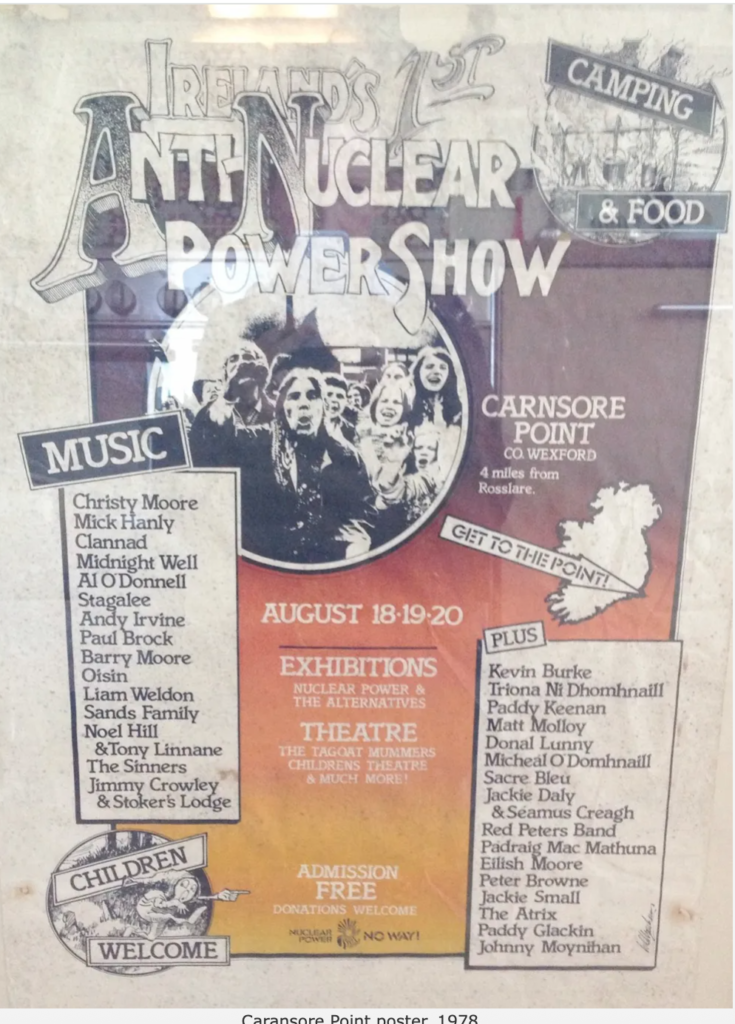
Organised by a coalition of groups, the festivals were attended a generation ago by tens of thousands of people unhappy about government proposals to build Ireland’s first nuclear power plant. The free festivals laid on music, theatre, food, lectures, workshops and exhibitions. They are testimony to citizen creativity and democratic activism, for which formal recognition is long overdue.
‘Nearly fifty years later, this commemorative touring project features contributions from contemporary artists and original organisers, among others’
Nearly fifty years later, this commemorative touring project features contributions from contemporary artists and original organisers, among others. It will run in various formats and venues for one year, until March 2027, starting with the recent event at the Project Theatre.
Fresh Promotion of Nuclear Energy
With Europe importing half the energy it uses and prices rising, worsened by AI data centre demand and fossil fuelled wars, pressure for solutions is intense. Voices for nuclear power are growing louder and now count European leaders who, at the Nuclear Energy Summit in Paris on 10 March 2026, backed expansion of nuclear energy, purportedly for greater independence and affordability.
the progress made by solar, wind and other far safer, cheaper and faster renewable energy is compelling, especially if the budgets available to nuclear were provided for renewables to develop at the same scale
In August 2024, more than 600 civil society groups across the globe working on climate action launched a declaration in Brussels, Belgium, stating that nuclear power expansion is not a solution to the climate crisis, because it is too dangerous, too expensive, and too slow. This definitive position is in line with esteemed international climate solutions organisation, Project Drawdown, which cautions against relying on nuclear power compared to other solutions: “At Project Drawdown, we consider Nuclear Power a ‘regrets’ solution. It has potential to avoid emissions, but carries many concerns as well”. Other arguments against nuclear energy include that it creates public health hazards from radiation and accidents, that it erects obvious military targets in a fractious and sometimes nihilistic world, that there are no safe solutions for nuclear waste after 80 years of its manufacture, and that in contrast, the progress made by solar, wind and other far safer, cheaper and faster renewable energy is compelling, especially if the budgets available to nuclear were provided for renewables to develop at the same scale. See – https://innatenonviolence.org/wp/2024/02/01/nuclear-power-is-a-regrets-industry-some-facts/
As of February 4, 2026 when the latest assessment was made, the time shown by the Doomsday Clock, initiated in 1947 by the Bulletin of the Atomic Scientists, is 85 seconds to midnight; the closest humanity has ever been to symbolic catastrophe. The Bulletin evaluates nuclear-weapons risks, climate change, disruptive technologies like AI and bioweapons, cyber threats, and the state of global governance in evaluating existential precariousness.
On 15 March 2026, responding to international events, the British Energy Secretary outlined a package of measures to go “further and faster” in the pursuit of national energy security. The emphasis is on renewables. Top of the list, notably, is support for measures up to recently viewed by state bodies as guerrilla eccentricities suspected of interrupting grid centralisation e.g. making available in the UK for the first time, ‘plug-in solar’, low-cost solar panels available to buy on the high street, to put on balconies or outdoor spaces.
Unfortunately, the UK government also naively lists nuclear as an essential green energy, even as built plants remain hazardous for centuries
Unfortunately, the UK government also naively lists nuclear as an essential green energy, even as built plants remain hazardous for centuries, with no known effective method to store radioactive waste.
Seeing the potential for renewable energies, Nicola Tesla and others had long dreamed, and contributed to the development, of safe free electricity for all; sources of inexhaustible, clean energy.
Monopolistic entities and their lobbying arms have repeatedly sabotaged such movements, despite evidence of accumulated harms from fossil fuels and nuclear materials. Several bodies such as Laka and the International Centre for Multi-Generational Legacies of Trauma, track the full list of nuclear and radiation incidents which are reported by national nuclear regulatory agencies to the International Atomic Energy Agency since 1990.
They are not negligible. And not counted are many similar accidents before 1990., such as Windscale, Chernobyl, Three Mile Island, and problematic storage sites like Handford. We’re all hot now, already.
The European Union recently published advice on which types of defence investments fit its sustainable-finance framework, labelled green or ESG (environment, social, governance). It includes atomic bombs, depleted uranium and white phosphorus
On 30 December 2025, the European Union published a Commission Notice to advise on which types of defence investments fit its sustainable-finance framework, labelled green or ESG (environment, social, governance).
Lucky investors can now include atomic bombs, depleted uranium and white phosphorus in this category. To claim this Orwellian reclassification measure was taken for climate objectives rather than to boost defence spending, surely fooled few, and roused significant if as yet ineffectual condemnation.
What it does show is the accelerating high-level momentum to divert finance into the most destructive artifacts ever made rather than on meaningful social and nature regeneration.
These were the themes that drew so many festival goers to protest at Carnsore Point all those years ago.
Launch Event at Project Arts Centre
Padraig Moore, manager of Ormston House, introduced the touring exhibition, which, after launching at Project Arts Centre, would open at Ormston House on 17 April before moving to Wexford Arts Centre, and Uillinn: West Cork Arts Centre, with local variations at each venue.
Attention was drawn to the international logo, the Smiling Sun, designed by 21-year-old Danish activist Anne Lund in 1975, featuring a smiling sun surrounded by the message, ‘NUCLEAR POWER? NO THANKS’ in yellow, red and black. As requested in 1979 by the Irish Anti-Nuclear Movement, an Irish language version of the logo was produced which, from early March 2026, is being displayed on a billboard affixed to external Project Arts Centre walls.
Another original design by William Finnie in 1978, the Hand symbol representing renewable energy alternatives, also became popular and iconic. It is being used as the entry stamp for these commemorative events. Mr Finnie was one of quite a few of those present, who managed to ‘get to the Point’ nearly fifty years ago. Support from The Arts Council of Ireland, Limerick Arts Office, and archive offices, was acknowledged.
In a schedule tweak to the programme, original footage from the 1978 and 1979 festivals filmed by Ken Lynam of West London Media Workshops, on what was then a pioneering camera, the Sony Rover, was screened first.
There were clips of the crowds, musicians, marquees, surrounding farmland, and the beach. There was footage from an adapted play, Drink The Mercury, in the tradition of drama for social change, put on during the festivals and as a fundraiser, starring Susie Kennedy.
Organisers and speakers shown included Dr. Robert Blackith, Trinity College professor; Petra Kelly, German Green Party star; Frank Connolly, later investigative journalist for the Business Post and now Village; Ursula Barry, later UCD lecturer; Dr. David Nowlem, local GP; Brendan Howlin, later Irish Labour Party leader, and Joe Carroll of the Irish Congress of Trade Unions (ICTU).
After remarking the organic synchrony, largely between strangers, evident in the coordination of the festivals, achieved without the benefit of smartphones or the internet, Padraig Moore then chaired a discussion between journalist Frank Connolly, actress Susie Kennedy, and (his father) musician Christy Moore, all of whom were instrumental to the success of the festivals. Three photographs taken by Derek Speirs served as the backdrop.
Frank Connolly sketched the genesis of the festivals, with anecdotes. The absence of film footage of the first day was as a result of the London camera crew being detained under suspicion for one night at Holyhead. He outlined the evolving government policy in the 1970s to contract with Westinghouse for the construction of a nuclear plant at Carnsore Point, Wexford, away from dense populations, and near the sea, for cooling water.
The Fianna Fáil government led by Jack Lynch, with Des O’Malley, then Minister for Industry, were on a mission to “bring Irish industry into the future”. Word of this threat prompted Irish Friends of the Earth to hold a public meeting, in line with global mobilising about similar issues. This initiative attracted the interest of other groups. From then on, no time was wasted.
Local landowners, also unhappy about the government plans, were directly approached, and a rallying site negotiated. While authorities tried various ploys to stymie efforts, such as cutting off water access, funds raised from a series of Dublin gigs meant alternative means of supply could be obtained.
A train (CIE) was specially hired for the occasion. Farmers cleaned out their pig lorries to transport passengers to the venue. Sound was managed by Clannad’s Nicky Ryan; available thanks to a Carnsore resident who allowed a domestic electricity supply to be connected to the festival audiovisual cables. True to their word, a hundred volunteers combed the grass for litter at the end, leaving the land as they found it.
Susie Kennedy then spoke about her involvement. A member of the Children’s Tea Company with the Sheridan brothers, Neil Jordan & co, and part of Nora Hayes theatre team, she was passionate about using art for public expression and protest. They toured schools and put on roadshows, including an anti-nuclear roadshow.
Based on a true story of toxic mining pollution from Japan, and parodying Ireland’s emerging energy policy, with a protagonist named Deadly O’ Manley, the play, ‘Drink the Mercury’, toured fourteen community venues, offering free concerts and a bookshop, and relying on people’s generosity for bed and board. Leaflets were distributed to all households about what to do after a nuclear accident, it was recalled. Peter Clark, the driver supplied with the bus was one of the many converted, after initial trepidation; so much so he became Moving Hearts’ driver.
As Christy Moore put it: “once touched by the festivals, “no one ever completely got off that bus”
As Christy Moore put it, once touched by the festivals, “no one ever completely got off that bus”. The impact was for life. The lesson is, we can do it again. He recalled being instantly swayed by Frank Connolly and friends at a pub meeting. They took inspiration from the Ballisodare Folk and Traditional Music Festival headlining The Bothy Band in August 1977. Described as “as much a sociological phenomenon as a musical one”, getting this project off the ground had demanded d.i.y. inventiveness to advertise, book, beg, and borrow.
When the RTÉ camera crew showed up at Carnsore, their position in front of the stage blocked everyone’s view, as if symbolic of State power.
There was no trouble, but rather instances of undercover and drug-squad police being escorted away by attendees!
Chris de Burgh, unrecognised, asked for a mic spot, was reluctantly humoured, and blew the audience away, with hits like ‘Don’t Pay The Ferryman’. Perhaps the song most associated with the festivals, ‘The Ballad of Nuke Power/ House Down In Carne’, as performed and recorded by Christy Moore, was composed by local Wexford man, Jim ‘Doc’ Whelan. Other songs, such as ‘The Workers Are Being Used Again’, and ‘The Sun Is Burning’, by Ian Campbell, also caught the mood.
Frank Connolly recalled the late 1970s in Ireland as a time of high unemployment, few gender rights, and war in Northern Ireland. As a researcher in RTÉ for The Late Late Show specials, he helped convene the pivotal panel debate on nuclear energy . The Taoiseach’s wife, Maureen Lynch, complained. Presenter Gay Byrne’s brother Al was brought in to adjudicate, and sided with the people. Sinn Féin’s Danny Morrison gave his backing. Irish Times journalist Dick Grogan wrote a sympathetic article, attracting more interest. The contemporaneous cinema run of ‘The China Syndrome’ added to the publicity.
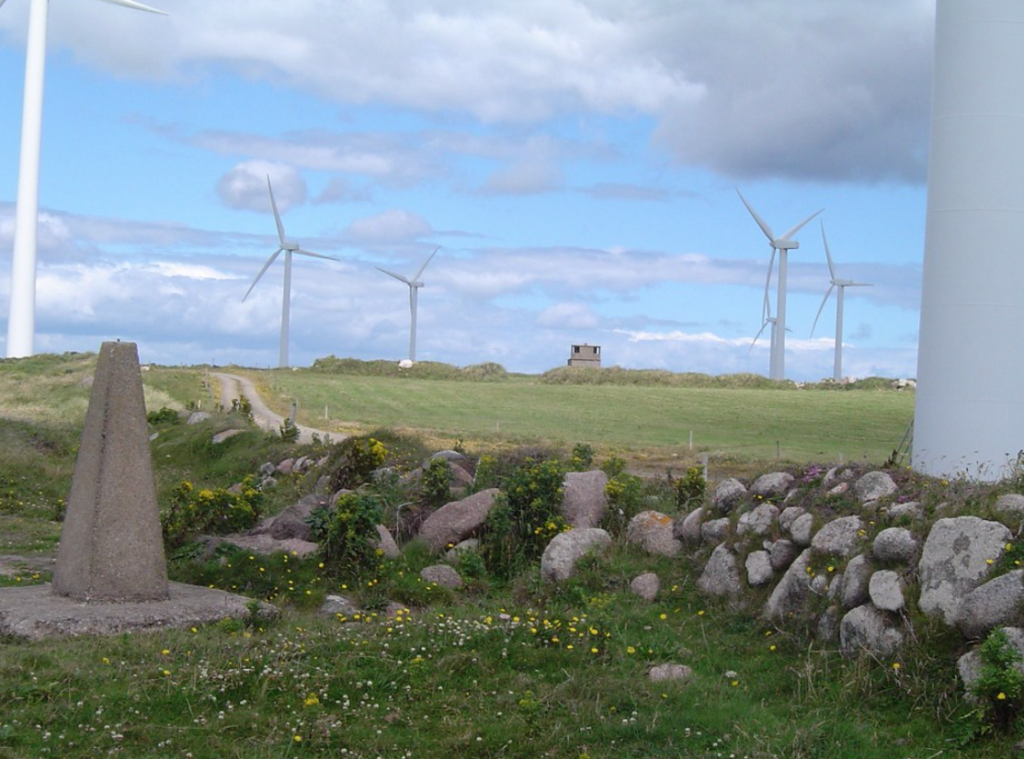
After an intermission, University of Limerick graduate Caimin Walsh introduced the direct artistic contributions scheduled. His role has been key to realising the touring exhibition. He gave credit to the Simon Dalby Papers, an archive residing in the Glucksman Library. University of Limerick, including various associated literature and artwork depicting the nuclear question in Ireland from the 1970s. Featured artists Orla Barry, Brian Duggan and Alanna O’Kelly will exhibit these redolent works again during the tour. Before a viewing of some of her new film work, KODAK MOON, Wexford resident Orla Barry said she was glad to be living near a wind farm, now operating at the Carnsore Point site, rather than a nuclear station.
Carnsore Point 2008
Alanna O’Kelly spoke about the former Grapevine Arts Centre, Dublin, publicly supporting the protests, before some of her piece, ‘Chantdown Greenham Common’, a sound screening, was played. Installation artist Brian Duggan stressed the amazing punk creativity unleashed at the Carnsore festivals. A vibrant performance by artist Michelle Doyle aka Rising Damp drew the afternoon to a close.
More details: https://projectartscentre.ie/events/memory-of-a-free-festival/ https://ormstonhouse.com/memory-of-a-free-festival/
