A review of ‘The Irish Diaspora – Tales of Emigration, Exile and Imperialism’ by Turtle Bunbury
by admin
A review of ‘The Irish Diaspora – Tales of Emigration, Exile and Imperialism’ by Turtle Bunbury
by admin
The British Government purchased Mountbatten’s archive for the benefit of historians (allegedly) but has locked it away. It may include details about his links to paedophile networks including the Anglo-Irish Vice Ring.
by admin
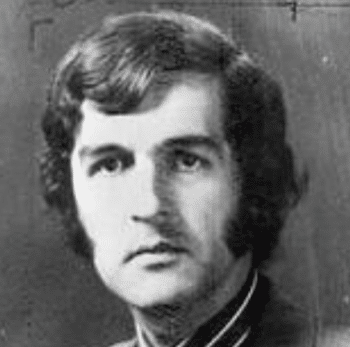
By David Burke. Brigadier (later General) Frank Edward Kitson is alive and well and living in Devon. He is the individual responsible for the Ballymurphy massacre. He was the Brigadier of 39 Brigade – that is to say he was the officer in charge of all British soldiers in Belfast during the Ballymurphy massacre. His accomplice was Colonel Derek Wilford, the former commander of 1 Para who is alive, alert and living in Belgium. Kitson joined the Rifle Brigade in January 1945. He would rise to become General Sir Frank Kitson, GBE, KCB, MC & Bar, DL and serve as Commander-in-Chief UK Land Forces from 1982 to 1985, and as aide-de-camp to Elizabeth II from 1983 to 1985. Along the way, he fought the Mau-Mau in Kenya for which he was awarded the Military Cross. He then took on communist rebels in Malaya and helped suppress a revolt in Oman. While fighting in the colonies, he formulated a horrifying counterinsurgency policy which he outlined in his notorious book ‘Low Intensity Operations’. In attempting to counter subversion it is necessary to take account of three separate elements. The first two constitute the target proper, that is to say the Party or Front and its cells and committees on the one hand, and the armed groups who are supporting them and being supported by them on the other. They may be said to constitute the head and body of a fish. The third element is the population and this represents the water in which the fish swims. Fish vary from place to place in accordance with the sort of water in which they are designed to live, and the same can be said of subversive organisations. If a fish has got to be destroyed it can be attacked directly by rod or net, providing it is in the sort of position which gives these methods a chance of success. But if rod and net cannot succeed by themselves it may be necessary to do something to the water which will force the fish into a position where it can be caught. Conceivably it might be necessary to kill the fish by polluting the water, but this is unlikely to be a desirable course of action. (page 49.) The Ballymurphy atrocity makes perfect sense in the context of this tactic. The IRA were the ‘fish’ he sought to eradicate. The streets and estates of Belfast were the ‘water’ in which they swam. The now confirmed FACT that the Ballymurphy murder victims were not in the IRA, had no connection to the IRA and were not any sort of a threat to the British Army mattered not a jot to Kitson or Derek Wilford, the commander of 1 Para. The Ballymurphy massacre makes perfect sense if it was part of a plan by Kitson to unleash his brutes in the hope of terrorising Ballymurphy generally so the locals would turn against the Official and Provisional IRA. Why else would separate groups of soldiers have targeted unarmed and peaceful civilians and murdered them in cold blood? One of them was a mother out looking for her children. Why else would separate groups of soldiers have targeted unarmed and peaceful civilians and murdered them in cold blood? One of them was a mother out looking for her children. Wilford’s defence is that he never became aware of the deaths. Kitson failed to recall the events either, when he appeared at the Saville Inquiry into Bloody Sunday. Both men are liars. They cannot dare tell the truth for it would destroy their reputations and that of other luminaries in the Ministry of Defence and British Army. Wilford went on to perpetrate the Bloody Sunday massacre the following January. Kitson’s dark role in that affair has yet to come to light. Kitson should now be stripped of his many awards as should Wilford. They should then face a rigorous interrogation about their activities on the days during which the murder spree took place. Mike Jackson, a captain with 1 Para, should also be stripped of his honours for vilifying the Ballymurphy murder victims as gunmen and terrorists. He also rose to become Commander-in-Chief UK Land Forces. David Burke is the author of ‘Kitson’s Irish War’. It can be purchased here: https://www.mercierpress.ie/irish-books/kitson-s-irish-war/ OTHER STORIES ABOUT BLOODY SUNDAY, THE BALLYMURPHY MASSACRE, BRIGADIER FRANK KITSON AND COLONEL DEREK WILFORD ON THIS WEBSITE: The covert plan to smash the IRA in Derry on Bloody Sunday by David Burke Soldier F’s Bloody Sunday secrets. David Cleary knows enough to blackmail the British government. Learning to kill Colin Wallace: Bloody Sunday, a very personal perspective Lying like a trooper. Internment, murder and vilification. Did Brigadier Kitson instigate the Ballymurphy massacre smear campaign? Where was Soldier F and his ‘gallant’ death squad during it? Another bloody mess. Frank Kitson’s contribution to the wars in Afghanistan and Iraq. 300,000 have died in Afghanistan since 1979. Lying like a trooper. Internment, murder and vilification. Did Brigadier Kitson instigate the Ballymurphy massacre smear campaign? Where was Soldier F and his ‘gallant’ death squad during it? A Foul Unfinished Business. The shortcomings of, and plots against, Saville’s Bloody Sunday Inquiry. Kitson’s Private Army: the thugs, killers and racists who terrorised Belfast and Derry. Soldier F was one of their number. Soldier F and Brigadier Kitson’s elite ‘EFGH’ death squad: a murderous dirty-tricks pattern is emerging which links Ballymurphy with Bloody Sunday. A second soldier involved in both events was ‘mentioned in despatches’ at the behest of Kitson for his alleged bravery in the face of the enemy. Mentioned in Despatches. Brigadier Kitson and Soldier F were honoured in the London Gazette for their gallantry in the face of the enemy during the internment swoops of August 1971. Soldier F, the heartless Bloody Sunday killer, is named. Mission accomplished. The unscrupulous judge who covered-up the Bloody Sunday murders. Soldier F and other paratroopers have been protected by the British State for five decades. None of them now face prosecution. This perversion of justice began with the connivance of
Posted in:
by admin
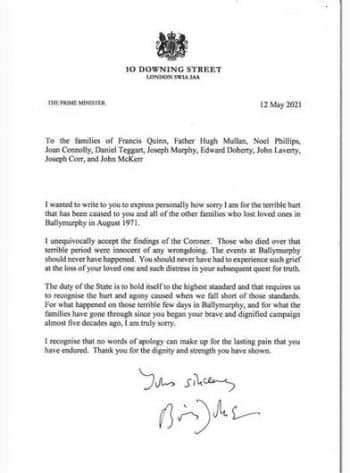
Ballymurphy, the UK government’s proposals to deal with legacy issues, and the dogs on the streets. By Christopher Stanley, litigation consultant. Statute of Limitations In London today (11 May 2021), the British government set out its legislative agenda by way of the Queen’s Speech to the House of Lords. Unexpectedly, the British government remains intent on its ambitions to stop investigating Conflict-related Legacy deaths in Northern Ireland and to introduce a Statute of Limitations so that British army veterans will not face prosecution. The details of the proposals remain to be published. The British government also proposed to ‘review’ the Human Rights Act 1998 and legislate to restrict access to Judicial Review. In Belfast today, Mrs Justice Keegan delivered her verdict in The Ballymurphy Massacre Inquest into the deaths of ten civilians shot by the British army in 1971. The judge found there had been a disproportionate use of force and the shootings violated Article 2 of the ECHR (the right to life). She said “All the deceased were entirely innocent of any wrongdoings on the day in question”. Whilst the verdict of an inquest cannot attribute criminal responsibility or civil liability, the verdict can prompt an investigation by the prosecuting authority. The Legacy of the Past – the Conflict – in Northern Ireland continues to shape the present and determine the future. In 2014 there was the possibility that the past could be ‘dealt with’ or ‘policed’ by way of The Stormont House Agreement and its mechanisms of investigation and truth-recovery. A mixture of Transitional Justice, Truth and Reconciliation, Hard Law and Soft Justice. In 2021 that model was abandoned by the British government by way of its New Decade New Approach proposal. Today it is apparent that the British government wants to cease contentious investigations into contentious deaths and rely upon truth-recovery mechanisms, Hard Law trumped by Soft Justice. Truth Not all relatives of victims or survivors of the Conflict want the same thing. But access to the truth is one binding want. How the truth is achieved, if it can be, is the point of contest. Once the truth is ‘out’ what should be done with it? How can truth assist securing peace when “peace comes dropping slow” (Yeats). In one way establishing a narrative of the Conflict which can be accepted across the communities in Northern Ireland contributes to cementing and securing the peace which was secured by way of the Belfast-Good Friday Agreement 1998 (GFA). But the truth is oft contested or denied by what Ian Cobain has described as The History Thieves. And truth has consequences: it cannot simply be archived by those very same History Thieves. It was dirty The Conflict in Northern Ireland was fought by three sides: Republicans, Loyalist and the British state. This is not a pernicious counter-narrative, as the exposure of collusion has pointed to, but rather a telling truth about the last Colonial adventure of the British Empire fought on the Narrow Ground of Ulster. This last bloody campaign, Britain’s Dirty War as Martin Dillon described it, has left both a human-rights deficit in Northern Ireland, which the GFA seeks to address, and a Legacy of state-sponsored terror by way of collusion with both Republicans and Loyalists depending on the political temperature at a particular juncture or the security constituency policy prevailing at prevailing point in time (the two not necessarily aligned). The difficult question for Westminster politicians and Whitehall civil servants is that a Statute of Limitations for crimes committed during the Conflict before 1998 offends the letter and spirit of the GFA. Who will it apply to – To those British army veterans responsible for the Ballymurphy Massacre? To the Birmingham Pub Bombers? To Albert ‘Ginger’ Baker? To John Downey? – to paramilitaries, agents and informers, old soldiers? Not a witch-hunt The word ‘witchhunt’ has been used a lot in relation to the prosecution of British army veterans. It started to be used following the ‘persecution’ of British soldiers accused of crimes committed during the Iraq and Afghanistan ‘campaigns’. It is now extended to apply to British soldiers who served in Northern Ireland. A witchhunt implies a form of collective hysteria against a particular group – ‘hounding’ Let us be clear: the number of prosecutions taken against former soldiers who served in Northern Ireland is low the decisions to prosecute in these cases were taken by independent law officers applying evidential thresholds. Who are the vicitms? The accused or the accusers? No hierarchy of victims In Northern Ireland there is a legislation which ensures there is no hierarchy of victims: A victim is “Someone who is or has been physically or psychologically injured as a result of or in consequence of a conflict-related incident” (The Victims and Survivors (Northern Ireland) Order 2006 Section 3(1)(a). The proposals of the British government will create a hierachy of victims (already in place regarding the eligibility criteria for the ‘Troubles’ Pension). The Statute of Limitation proposals from the British government will create a de facto amnesty for perpetrators of Conflict-related criminality. Will this limitation also apply to state agents and informers employed by the British security forces? Will this limitation also apply to Republican and Loyalist paramilitaries who remain alive? Whether these proposals violate the UK’s obligations under the ECHR seems of little consequence to the British government. HMG is intent on ‘reviewing’ the Human Rights Act 1998 and intends to limiting access to Judicial Review, as announced in today Queen’s Speech. Judicial Review is the legal application to challenge Executive decision-making. Judicial Review is a mechanism by which human rights concerns can be bought before the independent judiciary and which has been used extensively in Conflict-related Legacy litigation in Northern Ireland. Retribution not core demand One of the consequences of the process of truth-recovery can be a demand for retribution. But that is only one consequence of the process and it is not a core demand for the majority of relatives of victims and survivors. Their demand is to know why and to know who – who
by admin
By David Burke. The denial of justice for political gain. Next week will see the release of the long-awaited inquest report into the Ballymurphy massacre during which British soldiers killed and wounded a large number of unarmed civilians in Belfast. The atrocity took place after the introduction of internment in August of 1971. Adding insult to inqury, the victims were vilified as gunmen and terrorists. A documentary entitled ‘The Ballymurphy Precedent’ will be broadcast on Channel 4 on Wednesday 12 May. It contains detailed re-enactments of the actions of Kitson’s and Wilford’s troops. RTE will also be showing it at a date yet to be determined. Meanwhile, the British Government led by Boris Johnson proposes to grant all British soldiers implicated in murder in Northern Ireland immunity from prosecution, contrary to the Stormont House Agreement. Incredible as this may seem in Ireland and across the globe, it has enhanced Boris Johnson’s standing in the eyes of large numbers of the British electorate. Johnson has also set himself on a collision course with the Irish Government. Taoiseach Micheál Martin has stated that: “There is an agreement in place with the British government, with the parties in Northern Ireland and indeed with victims’ groups and that is the Stormont House Agreement of 2014 and that any move from it would amount to ‘a unilateral breach of trust”’. He added: “For us the victims are the priority and the victims remain the priority. There has to be adherence to that agreement. If people have new ideas to present they have to involve all of the parties, and above all the concerns of victims irrespective of who committed the atrocities. People must be held accountable”. Johnson’s Minister for Veterans, John Mercer MP, resigned last month in protest at what then looked like the British Government’s reluctance to change the law to prevent the prosecution of British soldiers accused of murder in Northern Ireland. In his resignation statement, he said he was stepping down to “try and shift UK Government position towards looking after these people and preventing the repeated and vexatious nature of litigation against those who served is a huge task”. There have been further developments and insights into the free rein afforded to British soldiers in Northern Ireland to shoot at human targets. Last week the trial of two paratroopers accused of shooting Official IRA volunteer Joe McCann while he ran away from them collapsed. Judge James O’Hara pointed out that: “At that time, in fact until late 1973, an understanding was in place between the RUC and the Army whereby the RUC did not arrest and question, or even take witness statements from, soldiers involved in shootings such as this one. This appalling practice was designed, at least in part, to protect soldiers from being prosecuted and in very large measure it succeeded.“ Her Majesty’s Killers. The Ballymurphy Inquest report may not address the roles played in the massacre by two of the most notorious British soldiers to set foot in Northern Ireland during the Troubles, Brigadier Frank Kitson and Colonel Derek Wilford. Kitson is a counterinsurgency expert who had served in Malaya, Kenya, Cyprus and the Oman before he was sent to Northern Ireland as the brigadier in charge of the 39 Brigade area which included Belfast, 1970-72. He set up the Mobile Reaction Force (MRF) which carried out the murder of a series of unarmed civilians in Belfast in the early 1970s. Kitson’s own pen has long since exposed him as a racist and anti-Catholic bigot. He committed perjury at the Saville Inquiry into Bloody Sunday (January 1972) on an industrial scale. Wilford assumed command of 1 Para on 21 July 1971. 1 Para formed part of 39 Brigade. Wilford believes that virtually all Catholics in Northern Ireland are IRA supporters, and has said as much in public. He had served with the SAS for two years and trained with American paratroopers at Fort Bragg, the US Army Special Forces School before coming to Ireland. He was also a veteran of Malaya and Aden. He joined the Parachute Regiment as a company commander in 1969. Perceived as a bit of a loner, he was given to reading the classics, in their original Latin. The number of unarmed Catholic civilians murdered by 1 Para reached unprecedented levels after Wilford’s arrival. Many were shot in the back or while lying on the ground. He reported directly to Kitson. The number of unarmed Catholic civilians murdered by 1 Para reached unprecedented levels after Wilford’s arrival. Many were shot in the back or while lying on the ground. He reported directly to Kitson. Both men are still alive and unrepentant at the multiple deaths caused by their troops including those who died during the Ballymurphy massacre. Wilford took 1 Para to Derry early the following year, an event that resulted in Bloody Sunday. Wilford committed perjury at the Widgery and Saville inquiries into Bloody Sunday. He has also admitted lying to the press. He is the keeper of many secrets about that massacre. While Wilford presents himself as an officer who has always been loyal to the paratroopers who served under him on Bloody Sunday, the truth is that he has thrown them to the wolves to save his own skin. One of them is facing murder charges for his actions on Bloody Sunday. Meanwhile, Wilford cowers in Belgium. While Wilford presents himself as an officer who has always been loyal to the paratroopers who served under him on Bloody Sunday, the truth is that he has thrown them to the wolves to save his own skin. One of them is facing murder charges for his actions on Bloody Sunday. Meanwhile, Wilford cowers in Belgium. Operation Demetrius was the code name ascribed to internment which commenced on 9 August 191. 342 people were swept up on that day and taken to to makeshift camps in a series of dawn swoops by the British Army. 105 were released after two days. Instead of
Posted in:
by admin
How I grew to see that without broad Marxism the arts and its unserious, networked and commodified lit-libs are for sale. An extract from the essay ‘Being a Marxist Poet in the Twenty-First Century’ by Kevin Higgins. More than a quarter of a century ago a man-child called Kevin retired from politics as he turned twenty seven. He had joined the then somewhat notorious Trotskyist group, the Militant Tendency[i], at the age of fifteen. After twelve years of activism, which began in membership of Galway West Labour Youth the month the Falklands War kicked off and fizzled like the saddest of fireworks in London in the aftermath of Mrs Thatcher’s Poll Tax, against which he had been a somewhat obsessively focused campaigner, it was over. “Retirement” was the face-saving word he used to describe his departure from politics. From the inside it felt like a personal tragedy. And it was. After more than a decade as a fiercely loyal ‘comrade’, Kevin had had enough of Militant and they had had enough of him. Dialectics being the contradictory beasts they are, a total exit from active politics may have been the best thing that could possibly have happened to him right then. But it didn’t feel like that to him. Instead of world socialist revolution, with which history had refused to oblige him, the spectres haunting the little part of Europe with which Kevin was then mostly concerned were, from his point of view, disappointing: Tony Blair and the Celtic Tiger, which got given its name the same year Blair became UK Labour leader: 1994. Kevin sloped back to Galway from London via the Holyhead ferry that April with a mouthful of bad teeth: he wasn’t much of a one for looking after himself then. Though he would march to defend the NHS for other people until his shoes disintegrated; he did not partake of such services himself. Kevin arrived in Galway with no particular plans, apart from a notion that he might do something artistic. Not artistic in the prettifying sense: he had no interest in describing the rocks around Connemara and the like. Indeed, he had little interest in any kind of beauty. Or so he thought. He wanted to express things he had been unable to say during his years as a (partly-self-appointed) leader of the vanguard of the North London semi-lumpen proletariat. Mostly, this would involve going into some detail about all the people and ideas and institutions he was against. It was no small list. High on it was his endlessly-self-sacrificing former self, who had worked himself some of the way towards a possible early grave, in an attempt to fight the political tide of the early 1990s that was, in the end, more about masochism than socialism. By “doing something artistic”, he meant stuff to do with words – songs, poems, maybe plays, novels… In the last years of his activism, when he was Chair of Enfield Against The Poll Tax in the North London Borough then represented in the House of Commons by, among others, Michael Portillo[ii],he had become increasingly focused on how best to say what needed to be said. It wasn’t enough to say it. It had to be said well. And, if possible, said wittily. He didn’t know it at the time but writing political letters with a satirical bent to the local papers in Enfield in the very early 1990s was his beginning as a poet. This Kevin, who was of course me, hoped to escape politics via poetry but also harboured illusions that he might somehow find a way of combining the two. It is a contradiction I have been working out ever since. From the inside it has felt more to be a case of this obvious contradiction working itself out using me as a somewhat extreme public example. Of late this contradiction has grown starker and as a result perhaps been somewhat resolved. In the course of my work as a poet, I regularly meet those strange creatures, the literary liberals, who ascribe to themselves every progressive and humane value while at the same time apparently finding no place in their imaginations for even the possibility of a world not run in the interests of Jeff Bezos, Elon Musk, and Apple Inc. They are the sort of people who, if they didn’t necessarily agree with her, would at least have understood where artist Tracy Emin was coming from when she called David Cameron’s coalition of 2010-15 “the best government…that we’ve ever had”. Politically, Emin may be an ignoramus. But her incontinent mouth is useful since it makes her spell out what others in the arts are only brave enough to occasionally think. It has been my experience that, post-2008, most established literary creatives cannot imagine as possible a world in which a substantial percentage of the populations of countries such as Ireland, Britain, and the United States don’t live in Victorian levels of poverty. Just look at the queues of homeless being fed each Friday night outside the GPO in Dublin by the charity, Muslim Sisters of Éire. Despite such images, the idea of properly taxing the super-wealthy, and making sure they don’t find a way of avoiding that tax, is seen by your average sensible member of the literary classes as a notion only seriously held by annoying teenagers and people who think it’s still 1975. According to this broad school of thought, if it can be called thought, there never was any other possible solution to 2008 but spending less on the lower orders and using that money to bail out JP Morgan, Anglo-Irish, and the Royal Bank of Scotland in the hope that the pre-slump status quo could somehow be restored. So your average literary stuffed jacket, or pants-suit, tends to quietly cut characters such as Varadkar, Obama, and Cameron a huge amount of slack. As long as they give them things like a side of same-sex marriage to go with all those hungry schoolchildren
by admin
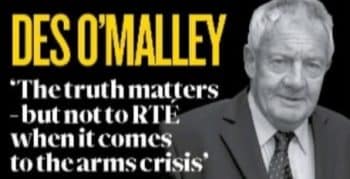
By Sean Brennan. The documentary titled ‘Gun Plot’ which was shown on RTE 1 last night was fascinating television. The RTE production team should be commended for this brilliant documentary on a very important and significant political and legal event which occurred 50 years ago but has not been properly addressed by the media up until now. These events in 1969 and 1970 shaped politics in Ireland forever and also had a huge impact on how the troubles in Northern Ireland unfolded after 1970. What was very compelling was the fact that the documentary included the actual tape recordings of the second trial. This was the first time that an Irish court hearing was tape recorded. It was the judge, Mr. Justice Henchy, who ordered the hearings to be recorded. It is important to remember that the actual transcripts of the trial have been lost. The fact that the transcripts of the most important criminal trial in the history of the state are lost is incredible and some might even say sinister. In summary, RTE have performed a great service to the citizens of this country and historians in that they have finally portrayed much of what really happened in 1969 and 1970 but was previously hidden, concerning the events that are commonly referred to as the Arms Crisis and the Arms Trials in 1970. The documentary highlighted certain facts that suggest that Taoiseach Jack Lynch and Jim Gibbons, the then Minister for Defence, had a much greater knowledge and involvement in the plan to import arms for a possible distribution to Nationalists in Derry and Belfast in extreme circumstances than was ever admitted by Lynch and Gibbons. The programme refers to the Army Directive of 6th February 1970. This directive was issued by the Minister for Defence, Jim Gibbons to the Army Chief of Staff, General Sean McEoin, in the presence of Colonel Michael Hefferon, the Head of Military Intelligence on 6th February 1970. The directive stated that the Minister had been instructed by the Government to direct the Chief of Staff to prepare the army for incursions into Northern Ireland and to make surplus arms available for distribution to Nationalist in Northern Ireland for defensive purposes. The documentary also covers the events on 2nd April 1970 when it was feared that the Nationalist population in Ballymurphy in Belfast would be left defenceless against armed and arson attacks by loyalist mobs and B Specials and would be slaughtered. Arising out of the instructions which were given to the Minister for Defence which resulted in the Army Directive dated 6th February 1970 mentioned in the last paragraph, the Minister issued an order for the army to transport army weapons from an army barracks in Dublin to the army barracks in Dundalk so as to ensure that these weapons could be distributed in a short space of time to the defenceless Nationalists in Belfast in the event of them being subject to murderous assault and arsonist attacks. A total of 500 Irish Army rifles were transported in Irish Army lorries to Dundalk. This was exactly the type of situation which was envisaged in the Army Directive dated 6th February 1970. As it transpired, the expected loyalist attacks on the Nationalists in Ballymurphy did not materialise. Of the 500 rifles transported to Dundalk, only 350 were immediately returned to the barracks in Dublin. The remaining 150 rifles were kept in Dundalk pending the arrival of arms to be imported from the Continent. Unlike the army rifles which were sent to Dundalk, these imported arms could not be indentifiable and traced back to the Irish Army. The purpose of importing unidentifiable arms was to avoid or at least mitigate the possibility of damage to our diplomatic relations with the UK. After all it was part of the Government’s emergency plans to supply arms to UK citizens in Northern Ireland which was part of the UK. This could be regarded as an act of war. Secrecy was therefore critically important. Only Jim Gibbons could have ordered the Army to deposit 150 rifles in Dundalk after the rest of the arms were returned to Dublin. This was hidden from the jury at the Arms Trials. Only Jim Gibbons could have ordered the Army to deposit 150 rifles in Dundalk after the rest of the arms were returned to Dublin. This was hidden from the jury at the Arms Trials. The documentary also dealt with the army training camp in Fort Dunree , Co. Donegal. Men from Derry were inducted into the FCA and trained in the use of arms in Fort Dunree. This training was called off temporarily when the media got word of it. It was obvious that the people who were being trained into the use of arms might be supplied with arms to use in extreme circumstances as otherwise the training would have been pointless. It was obvious that the people who were being trained into the use of arms might be supplied with arms to use in extreme circumstances as otherwise the training would have been pointless. The documentary also mentions the meeting in Mount Carmel Hospital in October 1969 when the Secretary of the Department of Justice, Peter Berry informed the Taoiseach Jack Lynch that Captain Kelly met Northerners in Bailieboro, Co Cavan to discuss the importation of arms. Berry had been briefed by the Special Branch about the Bailieboro meeting and regarded it of such importance that he asked Jack Lynch to come to visit him in Mount Carmel so that he could tell Lynch face to face about what he had been told about the Bailieboro meeting. Lynch always denied that Berry told him about the Bailieboro meeting and the discussions concerning the importation of arms. The documentary was measured and overall it suggests that Captain Kelly and John Kelly believed that they were participants in a legal government sanctioned plan to import arms for the defence of Nationalist in Northern Ireland in the event of a