Archives

OK

Random entry RSS

Loading

  • Posted in:

    Crying politically-correct Wolf.

    Note: This article has been updated since publication in May’s Village magazine. The Irish courts recently awarded €75,000 damages for a defamatory comment published on Facebook. Digital Rights Ireland described this judgment as a “wake-up call for a lot of people” that the law of the land also applies online. When did we reach this tipping point? When did some people start to feel entitled to casually publish defamatory smears that have no basis in reality? I strongly support freedom of expression about ideas, including the right to blaspheme and  robustly to criticise and ridicule harmful ideas. I also support reasonable limits to freedom of expression in order to protect people as opposed to ideas, including laws against defamation and incitement to violence and to other crimes. From an ethical perspective, I encourage civil discourse over online rage and hate. We live in a topsy turvy ethical world where people casually spread ridiculous personal smears, including that LGBT campaigner Peter Tatchell is homophobic, feminist Germaine Greer is misogynistic, comedian Ricky Gervais is transphobic, and Richard Dawkins is whatever defamatory smear emerges from the roll of your dice. Gerry Adams was unjustly labelled a racist because of a tweet that he wrote about a movie. While I and others have strongly criticised Gerry Adams for his involvement with the IRA, we should not allow this to justify unrelated personal smears about him. We should defend the rights of those with whom we disagree as well as those with whom we agree. I have been called racist for saying that two thirds of Catholics live in the global south, fascist for opposing thugs assaulting people on the streets of Dublin, and the political silencing word of ‘Islamophobic’ for saying that anti-Muslim bigotry is bad and criticism of Islam is good. Atheist Ireland has been targeted with disgusting smears that cross lines even by today’s online standards, which have finally caused us to realise that some people online simply cannot be reasoned with. These smears are not only unjust to the people being smeared, and subject to the laws of defamation, but they also dilute the power of important words, and leave us with no useful words to describe actual incidents of hatred and bigotry against vulnerable people. They are the modern warning of the boy who called wolf. They often depend on using words in an ideological way, in order to try to force people to accept their biased assumptions before even starting the discussion. At a recent Rationalist International Conference in Tallinn, Estonia, sexual rights activist and philosopher Tommi Paalanen of Finland argued that we should define words in ways that are coherent, universal and inclusive, with clear and justified boundaries, and free from ideological assumptions that tilt the discussion. For example, ‘conversion therapy’ for gay people is not therapy and does not convert. ‘Safe spaces’ assume other spaces are not safe. ‘Cultural appropriation’ as an idea leads to ethnic purity not free cultural exchange. Calling ‘micro-aggressions’ a violent act diminishes the concept of violence. Saying that ‘you cannot question our experiences’ or you must ‘check your privilege’ serve to silence discussion. The worst smears typically come from people on the authoritarian left of the political spectrum. They know how everybody else should think and behave, and it is not enough to agree with most of what they say. Any disagreement justifies personal abuse and defamation. If you are only 99% along their ideological pathway, they will dial the personal abuse up to eleven about the 1% on which you might differ. They also do not understand satire, and will typically respond to this statement by arguing about the one-percent figure, you fuckhead. There are at least four ways that these smears can spread. The first way is where an individual, like American shock-blogger PZ Myers, spends years spreading hatred of people. For example, when Richard Dawkins wrote in his memoir that he was sexually abused as a child with little long-term effects, Myers outrageously wrote that Dawkins “seems to have developed a callous indifference to the sexual abuse of children”. Thankfully Myers’ blog network imploded last year when some of its bloggers finally turned on each other, like a mix between ‘Reservoir Dogs’ and ‘the Little Shop of Horrors’. A second way is when unco-ordinated Internet mobs unjustly attack an individual, like British scientist Tim Hunt, and the defamation spreads spontaneously online, and then into mainstream media. This is an extension of the idea that it takes religion to cause good people to do bad things. Hunt gave an impromptu short speech at the World Conference of Science Journalists in Seoul, in which he said that scientists should work in gender-segregated labs, because the trouble with “girls” is that they cause men to fall in love with them and cry. He was publicly smeared as a misogynist and had to resign from his position as an honorary professor with the University College London’s Faculty of Life Sciences, and from the Royal Society’s Biological Sciences Awards Committee. These smears were spread online mostly by decent people who believed the original story, and who believed that they were doing good by exposing somebody who they believed was bad, or at least who had engaged in bad behaviour. The mainstream media, who should have had more responsible editorial checks and balances, spread the smears uncritically. But the people spreading the smears were mistaken. Painstaking research by English author and politician, Louise Mensch, later revealed that Hunt, and other audience members, were smiling; that Hunt ended his toast with congratulations to women in science, and a wish that nothing would hold them back; that Hunt was mocking himself, using an ironic tone to do so; and that he had sat down to laughter and applause. A third way is in university campuses, where students unions or college authorities ‘de-platform’ or ‘disinvite’ people from speaking engagements. The supposed reason is to prevent these people from spreading beliefs that the censors believe to be harmful,

    Loading

    Read more

  • Posted in:

    What about ye down there?

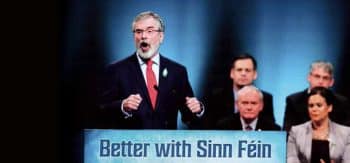
    Welcome to my world in the North, for a minute or two. For half a decade, the worthy burghers of South Dublin and suchlike places have had to suffer the horror of Gerry Adams in the Dáil, doing unspeakable things in two official languages. Bad enough but now you have a variant of the whole Northern political system, probably smuggled down in Adams’ beard. So now it is not possible to write Irish political fantasy any more. Reality is far more fantastical. The North has taken you over. Your two big parties have come together, just like ours did a decade ago. They will, of course, go through the motions of the occasional spat. They’ll keep a visceral and useless hold on their history but primarily they will always stick together. Particularly when it’ll about the prime business of their politics – freezing others out. Fantasy as reality started with the Sinn Féin- DUP deal in 2007. Nobody would have imagined that before… well, 2007. Suddenly, they didn’t just hate each other or even just work together – Paisley and McGuinness enjoyed each other. We of the hard left regularly used to say that Fine Gael and Fianna Fáil would be driven together. We never believed, truth be told, that we would ever see it but it sounded appropriately deprecatory. The fierceness and depth of their enmity could match anything between Sinn Féin and the DUP. So take it from a Nordie who’s seen it before – your election was supposed to be about changing the government – but now it’s been revealed as the Opposition re-electing the Government. At least, we in the North know that our Assembly election is about slightly rearranging the furniture. That’s why so many of us have stopped voting. Parties go up or down a couple of seats, there are personnel changes in a few constituencies, but the Executive remains the same – because the legislation says it has to stay the same. Since 1998, we have been told that the political arrangement in the North is an even greater thing than sliced Ormo. It has solved all our problems. Apparently, we Northerners aren’t mature enough to have an opposition. Now, Southerners are finding the same. You have no opposition except the once-dreaded Shinners, though having been house-trained at Stormont they are generally behaving themselves in the political litter tray that is Leinster House than they once did up here: the Anti-Austerity Alliance-People Before Profit: and a small number of left-wing independents. The forces to the left have real talent, but lack numbers. There’s something about what’s happening that makes some of us glad you’ve been bitten. We’ve had a sectarian political system imposed on us. All Assembly members have to designate as ‘Unionist’, ‘Nationalist’, or ‘Other’. ‘Others’ are second-class members. The thinking was that anything other than the historical bog standard might be dangerous. Presumably there was a patronising sense from our international betters that, left to their own devices, Nordie lawmakers would declare as scientologists or moonies, or Bombers. “Key decisions requiring cross-community support will be designated in advance…including election of the Chair of the Assembly, the First Minister and Deputy First Minister, standing orders and budget allocations”, according to the Good Friday Agreement. “In other cases such decisions could be triggered by a petition of concern brought by a significant minority of Assembly members”. On the surface, that looks good. The North has a history of discrimination against the Catholic minority. In fact we moved from bigotry to political fantasy without stopping off at popular democracy. Thirty members are needed to launch a ‘petition of concern’. So, for example, the DUP lodged a petition of concern to stop us getting third-party objections to planning applications. Sinn Féin launched one to defend the A5 Dual Carriageway, the North’s biggestever road building project, over which there are big environmental questions. Imagine ‘Others’ some day gain a majority in the Assembly, for a (Village pipe-dream) Eamonn McCann/Greens Coalition Government. But they would be second-class political citizens. On the current legislation, they could be vetoed by Unionists and/or Nationalists. At least you still have a viable opposition. We don’t: the big two are dragging their feet on installing any provisions. Ok, we have a small opposition. Usually he’s called Jim Allister. He is one man, but he opposes so much that he can’t always land the killer blows. Now, there’s another piece of political fantasy. Allister used to be a leading light in the DUP. He was so loyal to Ian Paisley that his questioning Paisley was as improbable as Paisley going into government with Sinn Féin. Once or twice the opposition has been Stephen Agnew of the Greens. Agnew is more focused than Allister, but lacks Allister’s Northern ability to get under the skin of opponents and really vex them. So here’s another fantasy: the conservative Allister and leftish environmentalist Agnew are co-operating as The Opposition. Think Ronan Mullen and Eamon Ryan, if you can.

    Loading

    Read more

  • Posted in:

    In fairness to Flood

    In his lengthy critique of the planning tribunal and its first sole member, Justice Feargus Flood, in the April edition of Village, Anthony Harris manages to avoid any mention of why his former client and Dublin assistant city and county manager, the late George Redmond, was the subject of corruption findings by the inquiry. He correctly recounts why most of these findings were withdrawn from the second and third reports of the tribunal following High Court and Supreme Court decisions although the final report, which includes adverse findings against Redmond, remains in place. The withdrawal of corruption, and other, findings against Redmond, Ray Burke, Joseph Murphy junior, Michael Bailey and others was prompted by a judgment of the Supreme Court in 2010 arising from the successful case taken by Joseph Murphy Structural Engineers against the Flood tribunal. In that case, it was determined that Justice Flood was not empowered to find parties guilty of the crime of hindering and obstructing him. Any such findings were removed. Harris quotes the Supreme Court judgment in the JMSE case as supporting his view that Justice Flood had “concealed without justification” evidence which was “patently relevant” to his inquiries and, “on one tenable view, explosive”. This is a reference to a decision made by Justice Flood to redact allegations made by key witness, James Gogarty, including statements he made in taped interviews with me in 1996 and 1997 before the tribunal was established. Harris recounts the Supreme Court judgment of the late Justice Adrian Hardiman in relation to the 1999 decision by Justice Flood to redact the Gogarty documents. “He [the Tribunal’s counsel] then referred to the Tribunal’s “need to limit collateral credibility issues: they redacted the documents”, Hardiman said. According to Harris, “‘the need to limit collateral credibility issues’ is counsel-speak for an admission that Justice Flood’s purpose was to conceal the fact that Gogarty was, at worst, a serial liar”. He dismisses the claim by the tribunal that Flood and his team believed the redactions were justified as some of the allegations made by Gogarty were not relevant to its inquiries and were defamatory of individuals who were not the subject of its investigation. In 2005, in a case brought by Cork developer, Owen O’Callaghan, against the tribunal, it was ruled that the tribunal’s modus operandi of withholding documents which could have been used by other parties to test the credibility of a key witness was unconstitutional and from then the tribunal changed its policy. It is not my role to defend the decisions and actions of the tribunal in 1999 or since, or indeed the integrity of its first key witness, James Gogarty, but I can provide some detail on the circumstances which led to Flood’s decision to withhold some of the “explosive” material from circulation. During a series of taped interviews, Gogarty made a wide range of allegations against his former employers, JMSE, Ray Burke, Michael Bailey, Redmond and others which were subsequently aired in his signed affidavit and at public hearings of the tribunal. When the tribunal was established I was summoned to appear as a witness and to submit, in advance, any relevant material related to a series of articles I published on the Gogarty claims and other planning matters in the Sunday Business Post over the previous three years. In reply and with the advice of lawyers acting for the newspaper, I submitted that the tapes and transcripts contained allegations which were potentially defamatory of a number of people, including two senior politicians and a senior judge, and suggested that it might use only contents which were directly relevant to the tribunal’s terms of reference. It was not in my power to limit what the tribunal decided or did with the material. I put some of the claims to the individuals, including the politicians named on tape, and they were roundly denied. For the record, I also put many of the claims made by Gogarty to Redmond, Burke, JMSE and Michael Bailey. They were also denied. However, the tribunal came up with evidence that supported much of what Gogarty alleged in those interviews and in his later, colourful, public evidence. Redmond was found to have received multiples of his public salary in payments from builders and other business interests. He was sensationally arrested on his return from the Isle of Man in February 1998 carrying a suitcase with over £300,000 in cash. The tribunal has been forced to withdraw many of its findings against a range of individuals, including Redmond although not those contained in the final report concerning his ‘double act’ dealings with Liam Lawlor. That does not mean that he is suddenly on the road to canonisation. Perhaps Mr Harris can give more detail on where Redmond got these sums of money, and indeed what precisely his conceded role in concerted planning corruption, was.

    Loading

    Read more

  • Posted in:

    THIS IS NOW A COPY AND IS TO BE DELETED IN DUE COURSE: THE BATTLE FOR ST MATTHEW’S, JUNE 1970: THE UNPUBLISHED PAMPHLET. The British Army created a vacuum, someone had to step in.

    Introduction by Kieran Glennon In the immediate aftermath of the violence that erupted in Belfast in August 1969, Citizens’ Defence Committees (CDCs) were formed in many nationalist areas; barricades were hastily erected and patrols of vigilantes armed with clubs were organised to ensure that loyalist mobs, the B Specials and the RUC were all kept at bay. Within days, a co-ordinating group was established to link the individual CDCs, the Central Citizens’ Defence Committee (CCDC); its first chairman was Jim Sullivan, who was also Adjutant of the IRA’s Belfast Brigade. Jim Sullivan, Adjutant of Belfast IRA and first chairman of Central Citizens’ Defence Committee (CCDC) By early 1970, Sullivan had been deposed and replaced as chairman by Tom Conaty, a fruit and vegetable merchant from west Belfast. Conaty’s closest ally on the CCDC was Canon Pádraig Murphy, the administrator of St Peter’s Cathedral in the Lower Falls. Paddy Devlin MP had remained the CCDC’s secretary since its inception. Fifty years ago this month, at the end of June 1970, the Provisional IRA made their first armed appearance on the streets of Belfast, in conjunction with armed members of the local CDC, in what came to be known as the Battle of St Matthew’s. In Ballymacarrett in the east of the city, more commonly known today as the Short Strand, three people were killed in the worst night of violence since August 1969. At that time, Tom Henry – a nom de plume – was self-employed as a researcher and was commissioned by Conaty and Murphy to write a history of St Matthew’s church for the diocese of Down and Connor. Also at that time, Conaty and Murphy were welcome at Army HQ, Lisburn as representing the Bishop of Down and Connor, Doctor William Philbin. Canon Padraig Murphy and Major General Tony Dyball Henry was given access to parish records at St Matthew’s as well as written statements from witnesses who were present there during that night. However, despite their central involvement in the battle, Henry did not knowingly interview any members of the IRA or their local auxiliaries. Fearful of the police scrutiny that would inevitably follow the pamphlet’s publication, he took the view that what he didn’t know couldn’t be got out of him, even under torture. So, while there is one reference in his text to “armed defenders”, the initials “IRA” are not mentioned. Henry completed his pamphlet in April 1971 and concluded that on the night, the British Army had failed to honour written agreements given to the Ballymacarrett CDC for the defence of the area if attacked. In view of this conclusion, he believed the pamphlet would not be well received. This conclusion did not suit Conaty and Murphy. At the time, they were trying to position the CCDC as the spokesmen for moderate nationalists; their efforts to develop a close relationship with Army HQ in Lisburn would receive a frosty response if they were to publish an account of the debacle that was critical of the Army. Tom Conaty, Chairman of the CCDC: commissioned the pamphlet but its conclusions would have threatened his relationship with British Army HQ, Lisburn. I have known Tom Henry for many years and know him to be a man of impeccable integrity: he was not about to change his conclusion to suit the positions of Conaty and Murphy. A copy of the manuscript was shown to Henry Kelly, then northern correspondent of the Irish Times whose opinion, as he informed Henry, was that the pamphlet would never see the light of day. That remark turned out to be prophetic. It is notable that while the confrontation became known as the Battle of St Matthew’s, Henry entitled his pamphlet the “Battle for St Matthew’s”; the distinction is subtle, but probably reflects more closely what happened on the night. Historian Andrew Boyd had a copy of the manuscript and donated it to the Linen Hall Library in Belfast, considering it to be an important historical document. Although it was referenced in the book Belfast and Derry in Revolt, by Simon Prince and Geoffrey Warner, the full text has never before been published. Included as a prologue, as they form an essential foundation for Henry’s conclusion, are the verbatim texts of the documents supplied by the Army to the Ballymacarrett CDC in September 1969; also included are excerpts from written responses to the Army and RUC by the CDC and their legal advisor. Taken together, these constitute the “Joint Military and Police Security Plan for Ballymacarrett.” Like the pamphlet itself, they have never previously been published. The early chapters of the pamphlet provide context for the events of June 1970. Chapter 3 outlines previous attacks made on St Matthew’s in the course of the pogrom of 1920-22. Chapter 4 recounts the opposition to the planned building of a Catholic church elsewhere in east Belfast in the 1930s, illustrating that sectarian hatred was directed, not just at St Matthew’s in particular, but at Catholic churches in general. Chapter 5 details correspondence between the Bishop of Down and Connor, William Philbin, and the chairman of the Sirocco Works at Bridge End, near St Matthew’s, concerning the extent of religious discrimination in employment at the firm – overturning such discrimination was one of the key objectives of the Civil Rights movement, to which unionism took such violent exception. What happened during the Battle for St Matthew’s undoubtedly flowed from what had happened before – but what ultimately transpired was not inevitable. Kieran Glennon is the author of ‘From Pogrom to Civil War, Tom Glennon and the Belfast IRA’. Although he is not from the area, two of his great grandparents were married in St Matthews. In 1920, his grandfather, as a member of the IRA, did picket duty at the church to protect it from sectarian attack. Prologue: September 1969 On 12th September 1969, the Ballymacarrett Citizens’ Defence Committee (CDC) met with the British Army and RUC to discuss security in the area; the next

    Loading

    Read more

  • Posted in:

    Irish goes West

    ‘The Left-Handed Gun’ is not a film that many people will have heard of, let alone seen. It’s a 1958 Western, starring Paul Newman and directed by Arthur Penn. And it was on TG4 a couple of Friday nights back. TG4’s weekly ‘An Western’ has been a quiet staple of Irish television for some years now. As happens frequently on TG4, the films are screened in their original language, without subtitles. Presumably the thinking is that during the adverts and continuity announcements that intersperse this English-language film, viewers will passively absorb the Irish language, and so the station fulfill its remit. The wry phrase ‘An Western’ suggests that the Western occupies a regular landmark in a weekly or monthly calendar, as in ‘the Sunday papers’. We understand that the ‘An’ is not making a large categorical claim, as in ‘the novel’ or ‘the youth of today’. We get this, because nearly all of us understand a little Irish, even if it is only the equivalent of the workaday word “The”. It’s a good example of how cleverly TG4 pitches Irish at a population whose feelings towards the language range through hostility, indifference and shame (about the perceived parochialism of the Gaeilgoirism, and about our communal failure to speak the language). ‘The Left-Handed Gun’ is a telling of the story, or rather myth, of Pat Garrett and Billy the Kid. Hollywood has gone over this material dozens of times over the years, and in other versions, Billy the Kid has been played by Emilio Estevez, Kris Kristofferson, Roy Rogers, the famous WWII veteran Audie Murphy and Val Kilmer, to name just a few. Newman’s version of Billy the Kid as a tortured and inarticulate soul is of its time, the late 1950s, and it is reminiscent of James Dean (who was initially slated for the role) or the young Marlon Brando. Did they speak Irish under those huge American skies? It is difficult to get a clear historical perspective on the Western because it seems now to be such a cultural relic. It goes through periodic revivals — successful titles from 2015 include ‘The Revenant’, ‘The Hateful Eight’ and TG4’s ‘An Klondike’ (there’s that ‘An’ again). But if anything these revivals reinforce the sense of something in need of revival. Of course, the same might be said of that other cultural relic, the Irish language. The 19th century seems like an awfully long time ago, but trans-Atlantic migrants of the time were highly mobile, flexible and internationalised providers of labour. In the words of historian Sidney Pollard, they were the “shock troops of the Industrial Revolution”.   The homesteaders, cowboys and bounty hunters of the Western were at the vanguard of industrialised globalisation, long-distance mass transport, users of the innovations of standardised gunsmithing, telegraphy and international postal systems, installing industrialised agriculture to feed thrusting megacities, mining the land and bringing genocidal carnage to its native populations. Westerns, viewed in this way, are stories of modernity, colonisation, dispossession and language death. Who watches Westerns now? And why? At least part of the pleasure to be got from them is in their status as relics. An older segment of the viewing public will take comfort in that weekly treat of ‘The’ Western. The films that are broadcast by TG4 are predominantly from the 1950s and the 1960s, and it is not hard to imagine these Irish viewers experiencing a thrill of cinematic nostalgia, and yearning for mid-century American optimism, as they watch these long-forgotten and long-remembered stories. These films are from the tail end of the relatively naive period of the Western, before a wave of revisionist Westerns (for example, ‘Little Big Man’, ‘The Outlaw Josey Wales’, ‘McCabe and Mrs Miller’, ‘The Wild Bunch’, all the way up to the excellent HBO series ‘Deadwood’) that finally began to acknowledge that the wide open spaces of the frontier were wide and open because they had just been forcibly emptied of millions of natives. There is a strong sense of a premodern innocence in the dirty-faced boyish violence and strongheadedness that we see in the whiskeydrinking and saloon-fighting, the standing up to magnates and crooked sheriffs, the cattlewrangling, the gunslinging, the awkward kissing of schoolmistresses and farmgirls, and the optimistic setting up ranches and mines. The darkness of smallpox and influenza, landgrabs and broken treaties, massacres and slavery, is exactly the kind of detail that foundation myths of simple heroism and melodrama are intended to blot out of the historical consciousness. In ‘The Left-Handed Gun’, Billy the Kid is a crazed outsider whose origins are murky. He lies that he is from Kansas City, before innocently revealing that he is a fluent Spanish speaker. This locates him much further to the south, and it makes an outsider of him among the English-speaking white cattlemen, who are led by the gentle, religious-minded ‘Englishman’, who gifts the illiterate Billy a book. When the Englishman is killed, Billy’s chance to enter civilised, book-reading society is taken from him, and the trail of revenge that he embarks on is the entire plot of the movie. Hunted by the law, Billy takes refuge with a Mexican smith, whom we first see crafting a rifle by hand. The fantasy that the eminently modern, industrial object of a rifle could be made by hand encapsulates the Western’s double task of telling the story of the extermination of non-industrial civilisations by industrialised civilisations, while indulging in the fantasy that the whole thing was a moral encounter that happened in a technological historical vacuum. But the Western is often a tragedy, and ‘The Left-Handed Gun’ complies in this respect. The Western hero is typically a man of violence who is a social misfit, unable to settle down with the woman who patiently waits for him, and incapable of putting down roots. In the end, he rides off into the sunset or is killed because the fast encroaching modern world does not have a place for him. Billy the Kid cannot conform, and being

    Loading

    Read more

  • Posted in:

    GEMMAD as hell

    Independent investigative journalist, Gemma O’Doherty, has slammed a culture of fear in Irish newsrooms and a stifling environment, as media ownership is concentrated in fewer hands. Speaking at the the Newsocracy conference organised by MEP Nessa Childers in partnership with the Institute For Future Media and Journalism (FUJO) at Dublin City University, O’Doherty addressed the topic ‘When Journalists become Spin Doctors’. O’Doherty, who wrote for the Irish Independent for 17 years, is currently working on a series of documentaries on unsolved Irish murders, including the disappearance of Mary Boyle, Ireland’s youngest missing person. “Most politicians have neither the courage nor the backbone to tackle the critical issue of media ownership in our country, which is having such a harmful effect on the public interest and democracy”, O’Doherty told the gathering. O’Doherty was made compulsorily redundant by the Irish Independent in August 2013 following an investigation into the garda-penalty-points scandal, during which she called at the home of the former Irish police commissioner, Martin Callinan. She later settled her case for unfair dismissal at the unemployment appeals tribunal. “If liberty means anything at all, it means the right to tell people what they do not want to hear”, she said. “Journalism in Ireland is in crisis, and this is primarily because ownership of so much of the media has been allowed to fall into the hands of so few. A culture of fear has consumed certain newsrooms, creating a stifling environment where some reporters behave less like dogged agents of the public interest, and more like compliant diplomats, spinning for the powers-that-be as if their jobs depended on it”. “They choose to ignore the true function of our still-noble vocation, to hold power to account, to comfort the afflicted and afflict the comfortable, to defend the public’s right to know, and to seek the truth and report it. A robust, independent, adversarial press is the lifeblood of a functioning state and a free society. But in Ireland in 2016 we have nothing close to that”. O’Doherty said that it would be necessary to “smash the cosy cartel that exists between the press, politicians and the police in this country, because it is so harmful to the public good”. “In order to tackle these incestuous relationships, we must talk about the elephant in the room. The fact that the pet-name of the biggest owner in Irish media is ‘Redacted’ says it all. One big voice has far too much power and prominence in our small country. Let’s just look at some of the ways Denis O’Brien has tried to limit press freedom and free speech in our country. O’Doherty noted the proposed “journalists’ charter” introduced at INM in 2013, the court case last year which led (temporarily) to several media outlets being unwilling to report a speech covered by Oireachtas privilege, and said that Transparency International had reported O’Brien to the UN for making legal threats against journalists. “Is it healthy for democracy”, O’Doherty asked, “that someone who takes such an interest in silencing our right to speak be in control of so much of our media? I don’t think so”. O’Doherty also criticised “the lazy propaganda that RTÉ pumps into Irish households night after night”. “There is no doubt that a culture of institutional complacency now dominates RTÉ, where some presenters earn more than David Cameron and Barack Obama, and no one wants to tell us what some of the senior management earn”. “But for me, their greatest failure has been how they have shut the door in the faces of victims. Victims who have damning stories to tell, especially those who have suffered at the hands of An Garda Síochána. O’Doherty said in the case of Mary Boyle, a six-year-old girl who disappeared and was believed murdered in 1977, the authorities “refused to bring the chief suspect in the case4 to justice, amid allegations of garda corruption and political interference”. She said that when she visited a US Congressman in Washington to highlight the case along with Mary Boyle’s sister Ann Doherty RTÉ, “despite countless requests”, refused to inform the public of the visit. And she charged that the national public broadcaster also ignored visits to Stormont, Westminster, and Brussels, and a case against the state instigated by Ann Doherty.

    Loading

    Read more

  • Posted in:

    Our Dependent Data Protection Commissioner

    A complaint to the European Commission about the lack of independence of the Irish data protection commissioner could cost the State thousands of euros in daily fines if upheld. POD, the Primary Online Database, wasn’t supposed to be a problem for the government. A single database maintained by the Department of Education containing the full details of every student in the system seemed a perfectly reasonable idea. Who doesn’t love a database to improve efficiency? But when the idea first went public early in 2015, and people who weren’t inside the civilservice and political bubble had a look at it, awkward questions were raised. On 7 January 2015, Elaine Edwards reported in the Irish Times that the details of all pupils would be retained until their 30th birthdays, long after they had completed primary education. The following day, the paper reported that education minister Jan O’Sullivan was “willing to examine” the 30-year rule. A few weeks later, the paper reported on discussions between the Data Protection Commissioner and the Department of Education on the database, while minister Jan O’Sullivan said data would be held for 30 years to ensure “that we have the full maximum data that we need”, a meaningless word-salad. In early February, it emerged that POD had poorly-thought-out ethnic classifications. In short, “White Irish” was a category, but pupils who were not white could not be classified as Irish, only as “Black African” or “other Black background”. That same month, the department rolled out its heavy guns, threatening to defund schools which did not provide data on all their pupils. Further questions were raised over other items sought by POD. PPS numbers; religion; and records of physical or mental issues, learning problems and disabilities, were all sensitive personal information, some of all of which could be shared with the Department of Social Protection, the Health Services Executive, or the National Council for Special Education. By the end of March 2015, the Department began a climbdown, reducing the retention period to until pupils’ 19th birthdays. In June 2015, the Data Protection Commissioner found POD was unlawful, and would require new legislation, by way of statutory instruments. Dublin solicitor Simon McGarr, a father of two primary school-aged children, was one of several people with questions about the project, believing it to be excessive retention of data, much of which was being used for purposes other than that for which it was collected. After phone calls to his local school and then the department failed to provide satisfactory answers, he submitted a series of Freedom of Information requests to the department. The requests were initially refused, and it took until March of this year to have the appeals heard. By this stage, the department had also reluctantly conceded that POD was not compulsory, and could not be linked to school funding. All of the department’s FOI refusals were overturned, with one exception. The Information Commissioner decided that legal advice to the Data Protection Commissioner, which it had shared with the department of education, was privileged communication. That refusal, and the detail it reveals about the communications and decision-making processes involved in POD, have now prompted McGarr to make a complaint to the European Commission. “Here is my complaint”, says McGarr: “It is a requirement, both under domestic Irish data protection regulations and more importantly under article 8.3 of the Charter of Fundamental Rights, that every state ensures that its citizens have access to an independent data-protection authority. I, it turns out on examination of these documents, have never had access to an independent data protection authority. Therefore I am making my complaint both in relation to the data protection commissioner’s behaviour, and about Ireland and the Attorney General’s behaviour as well”. It turned out they were giving the department legal advice which the department relied upon, which was the basis they relied upon for the legislative justification for POD. Therefore the people doing the investigating are the people who came up with the idea in the first place. “This is about my two kids. I wouldn’t have ground on and on like this if the Department of Education had responded properly when the problems arose or the DPC had been able to independently assess my complaint in a timely way,” McGarr added. If the commission finds that Ireland has failed in its duties under European law, it can take a case to the European Court of Justice, and apply daily fines – until an independent data protection authority is created.

    Loading

    Read more

  • Posted in:

    Stalin/out

    That there was something altogether more disturbing about Hitler’s Germany than Stalin’s Russia is often assumed. Perhaps it derived from disappointment at Germany, the most intellectually and industrially-advanced country of its time, being led by an individual whose core belief was the annihilation of a substantial ethno-religious minority. By comparison the aspirational ends of Stalinism are, superficially at least, universal and even Utopian. The case of Germany suggests that intellectual progress does not dovetail with moral development. But at least the defeat of Nazism has consigned Far Right ideology in Germany and the rest of Europe to the political periphery since World War II. The Cold War ended when Mikhail Gorbachev unilaterally stopped projecting Soviet power and the populations of its empire rose up to gain independence. But the descent into anarchy of some of these territories has engendered a conviction, in Russia, that aspects of the ruthless means employed by Stalin are always required for stability and prosperity. The conduct of the West, both in its approach to Russia and a wider flouting of international law, has not helped matters. Nothing approximating the scale of statesponsored terror is being unleashed in Russia today but there is nonetheless evidence of an attitude to human rights that departs from values ascendant in most of the rest of Europe. A case can be made for Stalinism being more terrifying than Hitler’s Nazism, precisely because the former emerged as victor in the apocalyptic struggle between the two monsters. It was a victory of a system that embraced industrial development and rationality, over one that advocated a primitive way of life for a chosen people fusing cultish spirituality with vicious juvenile biology. There were of course unforgivable excesses on the Allied side too, in particular the firebombing of Dresden and the unnecessary use of the Atomic bomb against Japan which was on the brink of surrender, as laid out by Gar Alperowitz in his book, ‘The Decision to Use the Atomic Bomb’ (1995). The political elites of America and Britain have not confronted their wicked pasts – America still refuses to apologise for Hiroshima and Nagasaki, though Obama had an exquisite opportunity to on his recent visit – and their foreign policies in recent decades are connected to an historical amnesia that foreshadowed the decision to invade Iraq in 2003, a decision which Noam Chomsky recently described as “the crime of the century”. Instructively, George W Bush installed a bust of Winston Churchill inside his White House office as he embarked on his ‘crusade’ against terror, reaching back to history for vindication. Churchill himself had ordered the use of poison gas against Iraqis in the 1920s. Of course the schemes of Hitler and his Nazi party were more diabolically hair-brained than his opponents’. Leading Nazis sought ‘Lebensraum’ in order to restore the Germanic people to the soil in what was a rejection of urban modernity. In Hitler’s ‘Mein Kampf’ George Orwell found: “a horrible brainless Empire in which, essentially, nothing ever happens except the training of young men for war and the endless breeding of fresh cannon-fodder”. The notion of Hitler’s primary lieutenant and SS leader Heinrich Himmler – that Aryans were not evolved from monkeys or apes like other races, but had come down to earth from the heavens, where they had been preserved in ice from the beginning of time – was dangerously eccentric. He also established a meteorology division which was given the task of proving this cosmic ice theory. The Nazis came very close to winning the war. Britain could easily have been brought to heel if Churchill had not stood firm against a vacillating Tory party. Hitler’s decision not to complete his victory – after the defeat of the British Expeditionary Force in France in May 1940 – before turning his attention to the Eastern Front was an enormous blunder, as was declaring war on the isolationist United States after the Japanese bombed Pearl Harbour in December 1941. If Hitler had been victorious, the plight of all of Europeans would have been insufferable for a time at least. The Holocaust may have been completed and many more enslaved. But surely contradictions would have begun to emerge among the Nazis especially as Hitler had allowed competing agencies including the SS, the army and the Party to develop. Blind loyalty to the Fuehrer might have dissipated as the spoils were devoured. The triumph of a profoundly irrational ideology might have brought chaos in the absence of wartime exigencies especially if a policy of compulsory re-ruralisation was rolled out. Hitler certainly harnessed Germany’s industrial might, especially through Alfred Speer’s planning agency, but only when defeat began to loom. With victory, theories about ‘cosmic ice’ might have become ascendant and the Nazis empire might be expected to have been beset by slave revolts. The dormant humanity of the German people might have awoken. A more dynamic society and economy such as the United States’ would surely have surpassed the Nazi Empire and there was no sign that Germany was close to developing Atomic technology, which required the employment of over a million men at enormous expense in the United States. We know that Stalin and his not much less unsavoury predecessor Lenin (not to mention Trotsky who was characteristically ruthless) also liquidated vast numbers to advance their cause, more than the Nazis even. One estimate (RJ Rummel) is that in the seventy years after 1917, the Soviet regime killed 61,911,000 people. State terror was foremost from the start. In August 1918 Lenin issued the following order: “1. Hang (and I mean hang so that the people can see) not less than 100 known kulaks, rich men, bloodsuckers. 2. Publish their names. 3. Take all their grain away from them. 4. Identify hostages as we described in our telegram yesterday. Do this so that for hundreds of miles around the people can see, tremble, know and cry: they are killing and will go on killing the bloodsucking kulaks. Cable that you have received

    Loading

    Read more