Archives

OK

Random entry RSS

Loading

  • Posted in:

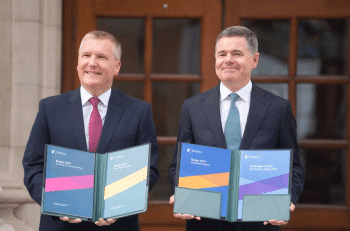
    Conor Lenihan interviewed Michael McGrath on the eve of the budget. The Minister for Finance is but days away from his first budget but he’s on top of his brief and cool, except when it comes to Health overruns. 

    The background is €65bn in budget surpluses between now and 2026.  However, the ESRi is forecasting negative GDP growth of 1.6% for the year and there was a shock fall in corporation tax of €1bn in August, down 23% in the third quarter of 2023.  Meanwhile  Sinn Féin is expecting to wrest some of the levers of budgetary power next year.  Overall, it seems likely McGrath’s budget will be cautious, reducing taxes by €1.15bn including lowering the lowest Universal Social Charge rate from 2% to 1% at a cost of about €300m, and the highest rate from 4.5% to 4%, and increasing the wage at which the tax rate is 40% from €40,000 to €41,500, costing €400m.  There will be spending increases of around €5.25bn, as well as a non-core package of temporary spending, mostly on Ukrainian refugees, Brexit and Covid of  €4bn, and a final cost-of living package of perhaps €3bn. It is likely to provide for social welfare increases of only €12 weekly at a cost of €350m annually.  McGrath is from, in his own words, a “humble“ background. His father was a labourer and he was the first of his family to go to university where he earned a first-class honours in his Commerce degree. Later he worked as an accountant at KPMG where he met his wife Sarah, also an accountant.   From 1999 to now  he has climbed the Fianna Fáil political ladder from Town Council to which he was elected at just 23 years of age, to County Council and then in 2007 into Leinster House as a TD for Cork South Central— a competitive constituency he shares with his older colleague and party leader Micheál Martin.  He walks a difficult tightrope of simultaneous loyalty to Martin and the demands of competing with his colleague to retain the party’s second seat. In recent years he has been touted as a possible successor to Martin. McGrath is frequently described as conservative on social and economic issues. He was pro-life on the abortion issue but prefers to define himself as a “centrist” in political terms. Some newspapers over the summer headlined him as “ Mr Cautious.” This is hardly a surprise as it is the default setting for a Minister for Finance.  In my interview with him, I asked McGrath about Health, indigenous industry, the public finances and coalition with Sinn Féin. Health McGrath confesses to being “brassed off“ at the seventh annual spending over-run in eight years at the HSE, this time of an extraordinary nearly €2bn out of a total budget package of€11bn: “front line workers in the health service are working in difficult circumstances. Spending over-runs are a cause of great frustration”. It is understood they have reduced the scope for new health initiatives such as extending free GP care and improving mental-health and disability services, as well of course as scandalising other more scrupulous government departnments.  There have been overruns in all the country’s acute hospitals of 15-22%; inflation in medical supplies is 21%, rising to 31% in laboratory supplies. McGrath warns that this all “points to a need for reform at a whole lot of levels, not least in their systems; and there’s an urgent need for an integrated financial management system in the HSE”. He insists health executives must apply discipline to keep within their budgets.   He tells me:  “One of the frustrations I had when I was Minister for Public Expenditure was trying to get a handle on the underlying position within Health because you had cash-based reporting and then you had accruals-based reporting. These were very different and it wasn’t always possible to get a tight reconciliation so you could fully understand what was the underlying position.  He also notes technology deficits. “I do think we have to invest in more in digitalisation and we are undoubtedly laggards in that regard in health services”. He considers that “accurate and timely reporting of data is where you start in getting a handle on expenditure patterns and plans are now in place to invest in such a system and that is an urgent reform that we need to  deliver quickly”. I ask him how quickly, given that the HSE was established to bring professionalism to the provision of these services and he says “my understanding is it will take a number of years”.   He thinks the new consultants’ contract will help and he notes the difficulties of Covid, the increase in acute presentations in the health system and general health-services inflation. I ask him if this means he’s saying it’s okay if the HSE overruns next year but he is firm: “No we’re certainly not saying that at all”. Tax receipts The Summer Economic Statement which set out the parameters for the budget stressed the perils of relying on the billions being thrown the exchequer’s way by a small number of giant multinationals. McGrath has spent the last year tracing out three new initiatives that will take these once-off tax receipts and use them for continued construction of public infrastructure, providing for the future pension needs of a rapidly ageing population, and paying down our massive public debt attributable to both Covid and the financial crisis that began in 2008. The fact that he can afford these prudential plans is testimony to the country’s continued success at luring foreign direct investment (FDI). “We need to ensure we’re not forced again into what happened 15 years ago, where capital expenditure was smashed by 60%. We need to invest in infrastructure through the cycle  –  by creating a contra-cyclical fund to smooth out the investment cycle”.   These new funds are the product of the good times and McGrath seems determined to put them on a proper legislative footing so that they cannot be casually raided by future ministers when the economy takes a turn for the worse.  Advancing indigenous industry McGrath is keen to recognise the end of the Foreign Direct Investment bonanza years while pointing to the threats

    Loading

    Read more

  • Posted in:

    Michael McGrath: Mild centrist in frenetic and fractious times.

    Michael Smith conducted a wide ranging interview with the Minister for Finance, on the eve of the Budget MS: How were you influenced by your childhood? MMG: We’re all a reflection of where we come from and our childhood experience.  I had a fantastic childhood and come from a very humble background. And I suppose I was really determined growing up to take the opportunities that I had and which my parents didn’t have by virtue of their own life experience and their journey.  I think it’d be a hunger and a drive to do well but also it gave me a very good sense of perspective about what’s most important in life and it definitely helped to lead me to a life of public service. Because I think there’s great meaning and great value from public service and I get huge enjoyment from it; and I think that concern can be traced back to my background. MS: What do you consider your main achievements in politics so far? MMG: I really think it’s for others to come to a view about what your achievements are and for me much of the satisfaction comes from the quiet, private moments that you have interacting with constituents in your office on sometimes extremely sensitive and personal issues and helping them through those issues; and I know I and my team have changed lives for the better in many, many instances. MS: Could you mention an instance of that? MMG: In our role you come across all kinds of circumstances: serious illness and bereavement and tragedy and financial difficulty  — just instances where the system has  let somebody down. I have had cases including just recognition of birth certs and recognition of parentage — things like, that that have been really life changing for people.  I believe in giving people opportunity and working with others in a spirit of co-operation and collaboration; being decent and having good values in that sense MS: How would you describe your political philosophy and  your vision for Ireland? MMG: You know it would be it would be centrist by nature.  I believe in giving people opportunity and working with others in a spirit of co-operation and collaboration; being decent and having good values in that sense. And so my philosophy is a pragmatic one but it is it is certainly about working towards a country that is fair and that affords opportunity to people.  MS: And a vision for Ireland specifically? MMG: I think there is very good economic opportunity in Ireland and I think we have work to do to bring the quality of our services up to match where our economy is at and where public expectations are rightly high, particularly in housing and that is undoubtedly the number one domestic priority as far as I’m concerned. MS: Who are your political heroes, nationally and internationally? MMG: Brian Lenihan had a huge influence on me. I did work closely with him in those latter years. I was only a backbench TD, newly elected but came from a financial background and so Brian would have taken me into to confidence.  I’m very proud to have a portrait of him hanging in my office in the Department of Finance because I have a huge amount of regard and respect for him. MS: Anyone internationally? MMG: No, I’ll leave it at Brian.  I’m happy with the one. MS: So just in terms of your political philosophy or your politics would it be fair to describe you, as has been done, as socially and economically conservative? MMG: I’m not really into labels. Judge me by my response on any given issue. I don’t think I’m conservative when it comes to ambition for Ireland and the need that I see for us to improve the services we provide. I get very frustrated at the experience of many families who have a child with a disability. I just think we can do far better. I’m not conservative when it comes to people and this country. We are the person that we are. MS: Do you believe in equality and if so what type? MMG:  I believe in human dignity and respect for each other and I think that is evidenced by my approach to politics. I can work well with people and because I respect others I respect difference and I absolutely believe in equality in all respects. MS: Would you be more inclined to equality of outcome or equality of opportunity? MMG: I think equality of opportunity is one that we can most assure. I think through our policy decisions and safety nets we have and the supports that are in place and providing resources in disadvantaged areas. I think you can go a long way to providing equality of opportunity. You can certainly aim for it.  I think guaranteeing equality of outcome is not really possible because there are so many variables involved in that but I do think that you can go a long way as a country to making sure there’s an opportunity for everyone and I think we have made progress in that regard but there are communities now that they feel they are that behind and I think that is work we have to do better on.  MS: How would you define the ideological differences between FF, FG and SF? MMG: I’d prefer to speak about Fianna Fáil and who were are rather than defining us relative to other parties.  We’re a centre-left party. We believe in giving people opportunities through education and employment and support for the most vulnerable.  We believe in investment in education and we believe in the enterprise company. This will be reflected in the decisions that I make in the budget. MS: What do you consider the major dangers to the economy? Is there a danger of  an Irish or a global recession, near-term? MMG: I think the biggest immediate danger to the health of the global economy is the

    Loading

    Read more

  • Posted in:

    The Brendan O’Connor Show: revisiting analysis of RTÉ’s Newspaper Panel: Professional classes over weekend brunch… safe and a bit incestuous, with little diversity,  but with equal numbers of women unlike with Marian. By Mark Cullinane.

    “Professionals over weekend brunch… formulaic and incestuous” was the unsparing verdict of Village in 2014 when contributor Rónán Lynch cast an analytical eye over the RTÉ flagship weekend radio Marian Finucane show, focusing on the Sunday programme’s newspaper review slot.  Lynch’s review of guest contributors on that mainstay of Sunday radio was a straightforward but apt piece of media analysis, not just because of its findings but because of the clarifying power of the slot itself as the basis for critical analysis of the underlying logics that inform the selection of on-air contributors for public service broadcast radio.  The top 25 most frequently used contributors themselves make up almost a full third of appearances The hour-long and typically four-to-five-person panel, after all, is a format not comparable to other journalist-led ‘hard’ news or current affairs programming where strong professional and genre conventions limit the pool of potential voices heard and faces seen to those endowed with formal authority, suitably accredited expertise or an individual proximity to developments covered in the news. The buttoned-down atmosphere of the newspaper review panel, less beholden to the dictates of balance, is an unusual one in broadcasting terms in being in theory at least open to anyone capable of perusing a newspaper and selecting a story or two as a jumping-off point for discussion on contemporary developments.  Lynch’s analysis of the composition of programme panels over the course of a full year revealed how this broad discretion enjoyed by the programme producers was, in practice, wielded strikingly narrowly. He highlighted in particular the overwhelming preponderance in its 250-odd guest appearances of contributors drawn from the ranks of the upper professional classes in general and in particular the favouring of other journalists and “professionally articulate agents of monied interests” of various hues, including public relations. The on-air results, he concluded, were conversations about the news that, shorn of due representation from wider strata of society, often exuded an insider-ish, cosy and unchallenging feel. With a generational changing of the guard at the show since host Marian Finucane’s death in early 2020, Village thought it opportune to once again measure this barometer of RTÉ’s appetite for representational range.  By conventional metrics of success, the programme itself has gone from strength to strength since the appointment of new host, Sunday Independent columnist Brendan O’Connor, who has maintained the outsized audience share built up by Finucane and kept both weekend editions of the programme close to the very top of national radio programme popularity rankings. And though opinions will vary on the personal appeal of O’Connor as a commentator in his own right, the organisation will no doubt feel that his proven ability to attract large audiences, combined with his assured broadcasting style and savvy navigation of the vagaries of broadcasting speech regulations make him a safe pair of hands well worth the hefty quarter of a million a year investment.    The show has maintained its pre-eminence in a radio market that has proved surprisingly resilient amid a welter of disruption and audience fragmentation in the media industries, yet the changed cultural environment in which broadcast journalism also now operates has posed increasing challenges of its own which are every bit as tricky to weather as changing media-consumption habits. As a more sceptical and media-savvy population increasingly concerns itself with a host of vexed questions of mediated representation, like to whom is the national megaphone passed, on what criteria of inclusion and in the service of what conception of balance, media incumbents generally (and in particular national public service broadcasters with universalist obligations) have been forced to take diversity more seriously.  Over the last five years, such pressures have seen at RTÉ the elevation of diversity and inclusion to the formal status of major organisational objective. Its first dedicated action plan on the topic in 2018 articulates, in the worthy if grandiose style of such things, a series of commitments and associated cross-organisational actions to transform RTÉ into no less than a ‘leader in diversity and inclusion, both on and off air”, with a view to “ensuring our audiences recognise themselves in us, and us in them”. Five years into RTÉ’s diversity drive – a plan whose implementation would be aided in part by more systematic internal monitoring of programme output – it was perhaps surprising to learn that Village would once again have to spin up its own spreadsheet software for this fresh analysis of programme panellists; the production team citing a lack of time and resources to share a list of contributors used. Our own list, then, covers a period encompassing the entire three-and-a-half-year Brendan O’Connor era of the programme, and comprises a total of 819 separate appearances by newspaper-review contributors across all 183 Sunday editions of the programme. It, and accompanying methodological notes are available on request to all readers who may wish to browse, scrutinise or remix the data in ways that we haven’t the space to explore here. It is in the area of gender balance that the most significant and obvious improvement in contributor diversity since Village last ran the rule over the numbers is apparent, with a considerably more even 54% (male) to 46% (female) split across the period as a whole when compared to the 65% (male) to 35% (female) result found in 2014. Much of the headway appears to have been recent: discount the first year’s worth of contributors in 2020 and the result from subsequent years is very close to the sought-for goal of parity of gender representation. Welcome signs of progress then, but gender balance is the area where Irish media have made the most progress generally – if still typically on a voluntary basis. Other “diversity characteristics” earmarked for substantive remedial responses by RTÉ and elsewhere in the media industries, such as race and ethnicity, disability and sexual orientation, remain for various reasons much further down the pecking order. Though not the focus of this analysis, a cursory look at the hundreds of names in

    Loading

    Read more

  • Posted in:

    Unannounced special advisers push total salaries towards €6 million

    By Conor O’Carroll The Department of Education has confirmed to Village Magazine that three as-yet-unannounced special advisers are employed at the department. Áine Doyle and Eoin Murphy are employed as special advisers to Minister of Education, Norma Foley TD, while Diane O’Gorman is employed as a special adviser to Minister of State, Josepha Madigan TD, a department spokesperson said. None of these appointments have been publicly notified in Iris Oifigiúil, or through the release of the statutory instrument confirming their appointment. They also don’t appear on the government’s list of special advisers. No explanation was given for why the advisers, which are required to be officially reappointed following the rotation of Taoiseach last December, have not been made public yet. Another special adviser appointed in April has also yet to see any official announcement. Eoin Delaney, special adviser to the Minister of State at the Department of Foreign Affairs, Seán Fleming TD, was appointed on April 10th and given a salary of almost €75,000. Despite the lack of public announcement, Delaney appears to have begun advising, accompanying Fleming on a visit to Killeshin National School in Laois a few days after he was appointed. A spokesperson for the Department of Foreign Affairs said, “Mr Delaney’s appointment has progressed through the standard process as required by [Section 11(1) of the Public Service Management Act (1997) and the Ministerial Appointments for the 33rd Dáil guidelines]”. “The order for his appointment has been finalised and will now proceed for official approval and publication”, they continued. Last month, following the announcement of Taoiseach Leo Varadkar’s eighth special adviser, Village reported that a substantial delay often exists between appointment and official announcement. This trend continued recently, when two more announcements were made, confirming special advisers for Minister for Further and Higher Education, Simon Harris TD and Minister of State at the Department of Finance, Jennifer Carroll MacNeill TD.  Official notice of these appointments was provided, however, in the case of the Department of Further and Higher Education, no statutory instrument (and name of the appointee) has followed. Over six weeks have elapsed since the official notice in the July 28th edition of Iris Oifigiúil. No explanation was given for this delay by a department spokesperson, stating that “it is expected that the relevant Statutory Instrument will be finalised shortly”. As for the Department of Finance, the statutory instrument was released, showing that Stephen Foley, Jennifer Carroll MacNeill’s new adviser, was appointed on 13 March 2023 and announced 151 days later. A spokesperson for the Department of Finance said that “there was an administrative oversight within the Department of Finance HR” that led to the delay. They claimed that “HR was not aware a separate statutory instrument was required for the specific individual to be named”. These new appointments, along with those from the Department of Education, bring the total number of special advisers to 60. It is also unknown how much the new appointees will earn, though the current average salary for special advisers stands at over €100,000. Following queries made by Village Magazine in July as to why three special advisers – Patrick Cluskey, Fiach Kelly, and Jim D’Arcy – had not been added to the official government list, a spokesperson committed to updating the list to reflect the uncovered appointments. At the time of writing, however, the list has still not been updated and is now also missing a further six special adviser appointments. The salaries of these nine appointments are likely to push the total cost towards €6 million annually, though the true figure won’t be revealed until the government updates their list. The current rules surrounding special advisers stipulate that Ministers, other than the Taoiseach, Tánaiste and party leaders, may not appoint more than two special advisers. The appointment of Simon Harris’ new adviser brings every government minister to the maximum of two special advisers. The rules also state that Ministers of State may only appoint one special adviser, though appointing two is permitted provided that they regularly attend meetings of the Government. Just two Ministers of State, Hildegarde Naughton TD (Department of the Taoiseach – Chief Whip) and Pippa Hackett TD (Department of Agriculture) have appointed two special advisers, with ten others settling for just one.

    Loading

    Read more

  • Posted in:

    “The thought of being homeless again is terrifying, it gives me nightmares”: Students struggle for college accommodation

    By Ava Liange After two consecutive years of COVID-19, online learning and postponed exams, the housing crisis is once again the main obstacle that prevents students from pursuing their studies. With the start of the new academic year just around the corner, it is becoming increasingly challenging for students to find accommodation near universities. Many are confronted with the choice of commuting several hours a day to access their course, paying extortionate rent for on-campus accommodation, or turning to unregulated ‘digs’ accommodation. Faced with these choices, sacrifices on affordability and living conditions are often made. “We’ve had to deal with mould and rodents”, Jamie Clarke, an Atlantic Technological University (ATU) student, explained to Village Magazine. “[Our landlord] said he’d paint the house with anti-mould paint and call in an exterminator, but they never came back to check in and it didn’t work so we had to deal with it ourselves”. The housing crisis has become a great source of anxiety for students “Every summer it’s like a déjà vu all over again as we wonder just how much worse matters can get”, says Molly Greenough, President of the Students’ Union at University College Dublin (UCD), following the release of their latest Accommodation Report. According to the new figures, around two-thirds of students pay up to €750 a month for student accommodation, considerably higher than a national average of €469 cited in a recent Higher Education Authority study. “The acute shortage of beds is starting to have a seriously worrying impact on the pursuit of education”, continued Greenough, with the report highlighting how many students are forced into the private rental market where they pay market rates and compete with working professionals. Due to inflationary pressures on the rental market and a lack of options for on-campus accommodation, more and more students are drawn to ‘digs’, where students rent a room in a house where the landlord lives. While often times cheaper than the alternative, these arrangements leave the students with very few rights. ‘Digs’ don’t fall under the remit of the Residential Tenancies Board meaning there are no minimum physical standards that the property must comply with and the restrictions on rent increases for other private rented accommodation do not apply. Students have reported being denied access to facilities or certain areas of the house, landlords invading their privacy by entering their room unannounced or when they aren’t there, and being hit with unnotified rent increases. One student living in ‘digs’ last year described the experience as being treated like a burden rather than a person, while others said they felt “infantilised”. The impact of this search for accommodation can be draining on students’ mental health. “There’s just a period of time when you’re searching for a house, and you’re losing time you could use doing assignments”, says Jamie. “It definitely affects your energy levels and how you’re able to focus on things”, he continues. On top of affecting their studies, the housing crisis has become a source of anxiety for students. “The thought of being homeless again is terrifying”, says Brigid MacBrough, another student from ATU, “it gives me nightmares”. Students who have to commute spend a large amount of time and money each day and find themselves exposed to anxiety as well, “The last year of college I tried to find accommodation, but I couldn’t so I had to commute for three hours a day”, says Dawid Blasevac, a former student. “I hated it, that on top of stressing about finishing the course and the stress of finding a job after. I did feel incredibly garbage after each day”. Many students are forced into the private rental market where they pay market rates and compete with working professionals There seems little sign of improvement either, according to Aiobhe O’Brien, Welfare Officer at the University College of Cork. This crisis is a burden “for students at any given year”, she explains. “It is becoming an increasing problem because nothing is changing, it’s getting worse on the number of rooms but also on how much they’re charging per room…there are so many scams, landlords say they’re out of the country and just ask for the money”. The lack of options leaves some students wondering whether they would be better served going abroad to study. Brigid is one student who has concerns about continuing with her studies. While thinking of doing a master’s in Dublin she “considered going abroad because the cost of living as a whole would still be cheaper”. With the housing crisis having reached a point where students have to choose whether they want to move abroad to pursue their studies or do so in Ireland at an excruciating price, it’s clear that something has to change soon before Ireland loses another generation of young people to emigration.

    Loading

    Read more