

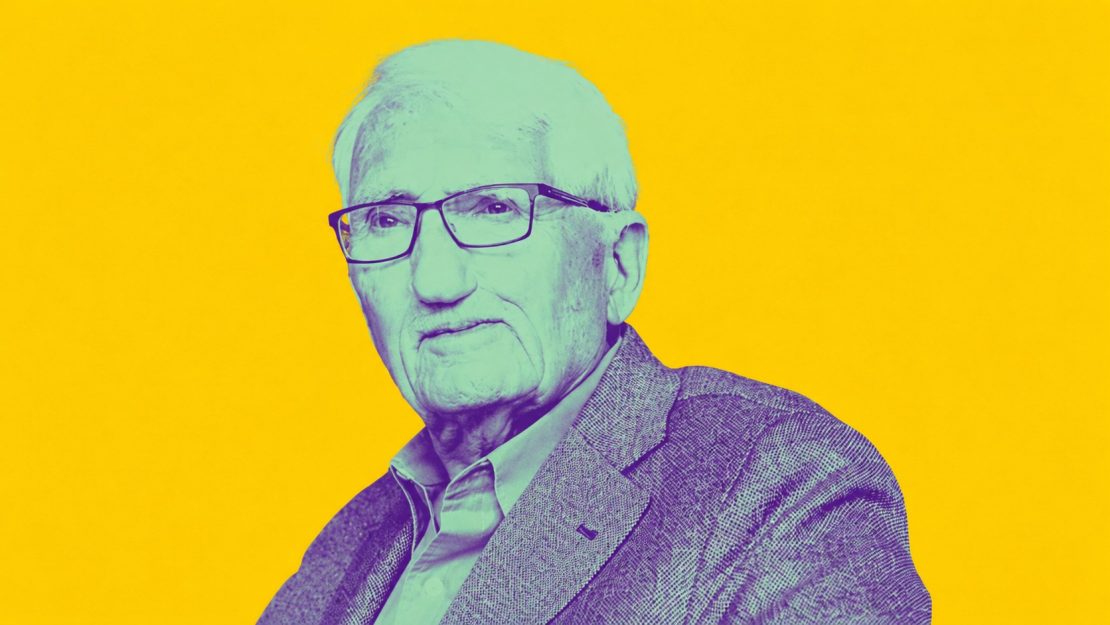
For more than six decades, Jürgen Habermas defended the power of reasoned dialogue against authoritarianism, consumerism and political cynicism
When the greatest mind on the planet dies, it would be ignorant not to write a proper obituary. Jürgen Habermas is dead at 96, and the obituaries in the established papers — not just in Ireland — did not properly understand why, or what, is lost.
Born in Düsseldorf in 1929, into a Protestant milieu shaped by institutional discipline and moral seriousness, Habermas’s early life bore the marks of Germany’s catastrophe. As a teenager he passed through the structures of the Hitler Youth, not unusually for his generation, and came of age amid the collapse of the Nazi state. The post-war confrontation with the Holocaust, forced upon the German population through Allied documentation, left a permanent intellectual and moral imprint. It is impossible to understand his later insistence on law, reason, and communicative accountability without grasping that formative rupture. As a child, he endured bullying and isolation due to a cleft palate that left him unable to speak clearly after surgery. The experience shaped his admirable lifelong discomfort with public speaking and television.
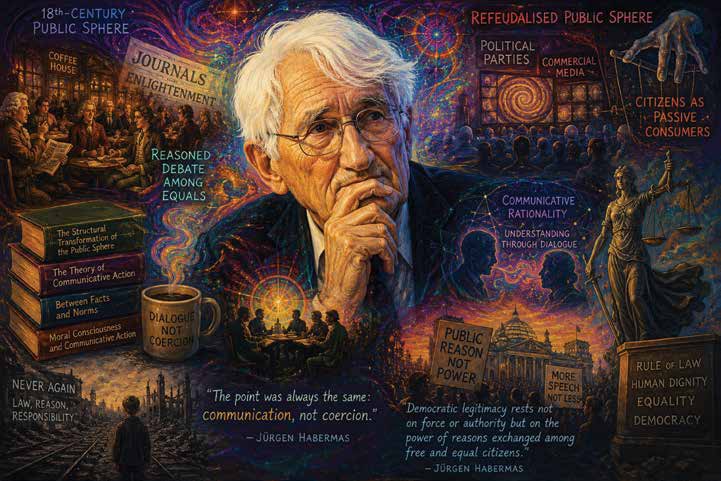
His intellectual formation bespoke Critical Theory, and for a period he was aligned with the Frankfurt School. Yet he ultimately broke from its postmodern and relativist tendencies, becoming instead the most rigorous defender of Enlightenment rationality in the late twentieth century. He remained throughout his life a socialist — in the proper sense — but one committed to reconstructing, rather than abandoning, reason.
His career reflected that seriousness. He held chairs at Heidelberg and Frankfurt, and later directed the Max Planck Institute in Starnberg. But institutional position mattered less than the compelling scope of the project: to recover the conditions under which rational public life might still be possible in advanced capitalist societies.
Two works define that project. ‘The Structural Transformation of the Public Sphere’ (1962) traced the emergence — and subsequent corrosion — of bourgeois public discourse. ‘The Theory of Communicative Action’ (1981) provided the philosophical architecture: a theory of rationality grounded not in time-serving instrumental calculation, but in the structures of language, mutual understanding, and justification.
From this emerged his central claim: that the Enlightenment is not exhausted, but unfinished, a project requiring reconstruction rather than neglect or repudiation at the ever-ready hands of technocratic reduction or postmodern fragmentation.
As a member of the flakhelfer generation, those pressed into service in the dying phase of the war, he was among the last thinkers whose intellectual life was directly shaped by the moral collapse of Europe. That experience explains the consistency of his commitments: a lifelong insistence on the rule of law as a bulwark against extremism, and a refusal to treat politics as merely technical administration.
Thus, though often sharply critical of the post-war West German state, his critique remained constructive. He advocated a third way between conservatism and doctrinaire Marxism, rejecting both technocratic managerialism and the relativism that hollowed out normative judgement. His focus remained on equality, dignity and, above all, legality grounded in public reason.
Still, he never endorsed law uncritically. He was initially sceptical of the German Constitutional Court’s expansive jurisprudence, viewing judge-led law as potentially paternalistic. His instinct lay with democratic participation, civil disobedience included, and with the reinvention of the public sphere as the site of legitimacy.
He emphasised direct democracy and resisted the steady migration of power toward technocrats. The legislative sphere, for him, remained the core constitutional actor. Negative liberties, he argued, must be reconstituted as positive capacities for participation within a unified political community.
From the early 1960s onward, however, his position evolved. Influenced by decisions such as the Lüth case, he came to recognise the productive role of constitutional adjudication, particularly where rights radiated into private law and imposed positive obligations — especially in the protection of speech.
And speech is now denuded, or traduced, by the internet worldwide.
Even so, he remained wary of judicial supremacy, and unlike Dworkin never invested judges with ultimate moral authority. He was a philosopher who became a lawyer. Dworkin was the obverse, leading him to take rights seriously and to greater, and wiser confidence that the judiciary was, as Bickel put it, the least dangerous branch of government.
Habermas of course rejected Natural Law, the medium of Catholic philosophy, outright, “devoid of any and every convincing philosophical justification”, as he damningly put it.
His critique of technocracy was relentless. Between 1961 and 1964 he diagnosed a democratic deficit in West Germany: a state devolving into administration, scientisation, and economic calculation, incapable of engaging ethical questions about the good life. In modelling itself on the natural sciences, politics risked reducing human beings to objects rather than subjects of history.
The result is now familiar: surveillance capitalism.
What he termed “decisionism”, a politics severed from ethical reasoning, could only be countered by restoring the role of reason in public life. Technical knowledge must be translated into practical judgement; otherwise, power remains irrational in substance, however efficient in form.
The public sphere is the site of that translation. Without it, democratic legitimacy collapses into managerial control.
The point was always the same: communication, not coercion.
Habermas argued that elites, by reframing moral and political questions as technical problems, systematically displaced public reasoning. In doing so, they masked the value-laden character of decision-making, in the service of advanced capitalism.
Today’s bureaucratic class — austerity merchants and growth absolutists — are the diminished heirs of that technocratic turn, committed to expansion without limit while ignoring ecological breakdown and the re-emergence of corporatist authoritarianism.
He recognised the present moment immediately: mass surveillance, algorithmic mediation, the fragmentation of discourse, and the reconstitution of identity through digital systems. None of this is emancipatory.
Nor did he accept the prevailing illusion that automation delivers freedom. As he understood, against Marcuse, technological development without normative grounding intensifies domination rather than alleviating it.
From 1968 onward, his central concept was communicative action. Against both Right and Left, he argued that politics cannot dispense with ethical legitimation. Social coordination must be grounded in shared understanding, not merely strategic success.
Throughout his long career, Habermas remained committed to a distinctly dialogical vision of human life. Echoing the example of Socrates, he saw inquiry as a cooperative endeavour grounded in equality, mutual respect, and a readiness to acknowledge uncertainty. His philosophical work sought to recover these conditions for modern societies, arguing that democratic legitimacy rests not on force or authority but on the power of reasons exchanged among free and equal citizens. In an age marked by polarisation and distrust, Habermas never abandoned the conviction that a more humane future begins with the simple but demanding task of learning to converse with one another.
Language is the medium of that possibility. In every act of communication, speakers raise implicit validity claims — claims that can only be redeemed in conditions approximating an “ideal speech situation”, free from coercion and distortion.
This is not utopian abstraction but a regulative ideal: a standard against which actual communication can be judged and criticised.
His theory of discourse ethics follows directly. Rational agreement is possible only where participants are equal, free from domination, sincere in expression, and open to challenge. Without these conditions, communication degenerates into manipulation.
That degeneration is now systemic.
The digital public sphere has not extended deliberation but displaced it. In place of reasoned exchange we have outrage, fragmentation, and algorithmic amplification — a structural negation of the very conditions Habermas identified as necessary for democratic life.
He remained, nonetheless, committed to democratic renewal. Civil disobedience, properly grounded, was for him a vital corrective — a way of restoring legitimacy when institutions drift from their normative foundations. Following Rawls, he saw it as principled, public, and non-violent.
That distinction has collapsed in contemporary politics, where protest is alternately suppressed or captured by extremism. He rejected both authoritarianism and nationalism.
From the 1970s onward, he rejected both reactionary nostalgia and fashionable radicalism. He dismissed “radical chic” and categorised ideological tendencies with precision: antimodernist, premodernist, and postmodernist. Against all three, he placed communicative rationality — reason, in public, under conditions of equality.
He advocated communicative rationality — reason, in public, under conditions of equality.
There is, in truth, little point arguing with those who reject those conditions entirely.
Democracy’s health was his underlying concern, the 18th century coffee house his model for the public sphere, though he regretted its demise under pressure from political parties and mass media.
His model of democracy depended on the interaction of three domains: civil society, the mediated public sphere, and institutional decision-making. When functioning properly, these generate considered public opinion capable of guiding legislation.
That system is now degraded at every level.
In later life, he turned to religion: not as a believer, but as a theorist of its social, human function. He argued that secular societies must remain open to the ethical resources of religious traditions, while insisting that such traditions translate themselves into publicly accessible reason. In dialogue with figures such as Joseph Ratzinger, he explored the possibility of a shared moral language across belief and non-belief.
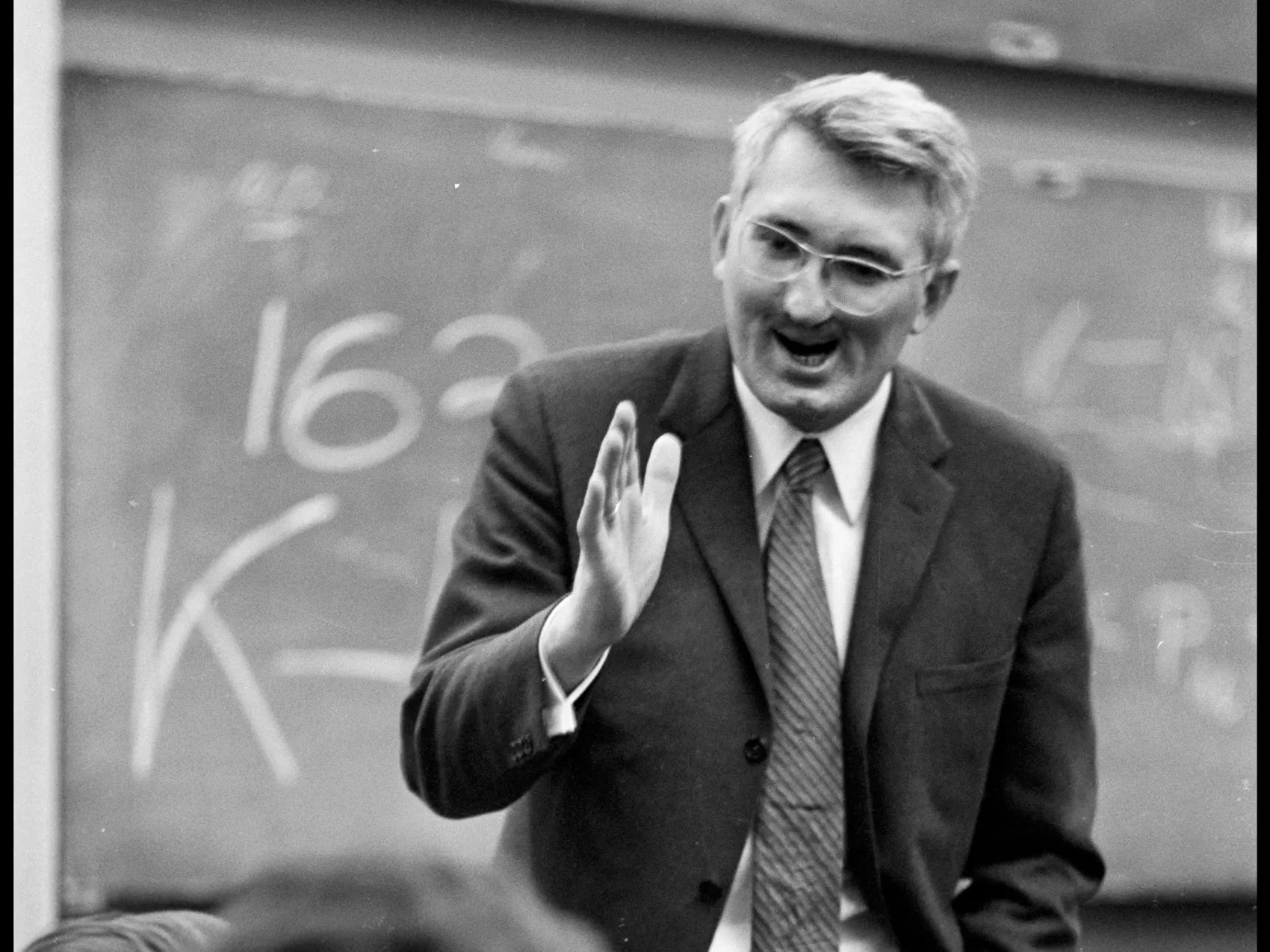
The point was always the same: communication, not coercion.
Habermas was the last great thinker of the Enlightenment, and certainly Europe’s leading public intellectual, and his death coincides with the near-total eclipse of the conditions he spent a lifetime defending.
Growth is not a value. Externalities matter — unless we abandon the human altogether.
What remains are the ideas: a framework for rational, equal, undominated communication, still available, though increasingly unrealised. We must learn to disagree, he says.
His was a great mind, and he took it on the most significant intellectual voyage. He dies when all he has opposed has come to pass.
He dies when all he opposed has come to pass.
