Recently Hot and News

Random entry RSS

  • Posted in:

    Aarhus: State drags feet on legal costs in environmental cases.

    By Kieran Fitzpatrick. The Aarhus Convention aims to protect the environment and proclaims the public to be the best guardian of the environment. There are three strands to the convention: 1) Access to information; 2)Public participation; and 3) Access to justice to review environment-related decisions or to enforce environmental law. Ireland was the last member of the EU to ratify Aarhus and became eligible for ‘Communications’ subsequent to October 2013. This delay comes from the apparent reluctance of the Irish government to deal with the issue of prohibitive legal costs. The EU Commission prosecuted Ireland in 2007 for failing to comply with an Aarhus-related EU directive. The European Court of Justice (ECJ) ruled in 2009 that Ireland had failed to ensure that legal costs (relating to environmental legal actions) were not prohibitively expensive. Special Costs Regime – Catch 22 Ireland responded by passing legislation in 2010, the effect of which was to alter the legal-costs rules from the prevailing English Rule (losing litigant pays winner’s costs) to the American Rule (each side pays their own costs) for legal actions that relate to an EU directive implementing certain Aarhus compliance measures. Ostensibly, the special costs regime (SCR) means that a party could at least represent herself, without being threatened with a huge adverse legal costs bill, if she failed in her legal action. However, there is a Catch 22 in the SCR. To determine that a civil action falls under the ambit of the SCR, the applicant must risk an adverse legal costs award in making the application for such a declaration. This trap became stark in one case – an application by Dymphna Maher to the High Court in 2012. Judge Hedigan in refusing the application effectively said that the Catch 22 arguably “acts in such a way as to nullify the State’s efforts to comply with its obligation to ensure that costs in certain planning matters are not prohibitive”. The SCR can be scuppered if (i) the claim is frivolous or vexatious, (ii) the applicant conducts her litigation in a manner disapproved of by the court, or (iii) the applicant acts in contempt of court. The second of these conditions introduces a huge level of fear due to the lack of clarity as to how this sanction might be implemented. The third item, “contempt of court”, also introduces uncertainty, as became evident in the European Court of Human Rights (ECHR) case of The Sunday Times v UK [1979] (the Thalidomide case). The UK introduced “contempt of court” legislation in 1981 giving clarity to the various offences encompassed, but Ireland did no such thing. So Ireland’s attempt to comply with the 2009 ECJ decision against it, was to introduce a SCR with a Catch 22, plus other unpredictable adverse outcomes, any of which could leave an applicant with a life-ruinous legal bill. This hardly meets the ECJ’s demand that litigants be assured that costs are not prohibitive “with all the requisite clarity and precision”. In any event, the American Rule should not be seen as a complete solution to the problem of prohibitive legal costs for the following reasons: 1.    An applicant may not always have the wherewithal to initiate legal proceedings as a lay litigant. 2.    Many environment-related legal actions inevitably fall under the ambit of EU law, which can result in a reference to the ECJ. The rules of procedure of the ECJ require that any applicant must be represented by a lawyer before the ECJ. In these circumstances, an applicant must give consideration to the employment of a lawyer. Own Lawyer’s fees A litigant who hires a lawyer to represent her can be in a tricky position when she comes to deal with the legal bill issued by her lawyer, at the end of proceedings. If she receives a surprisingly high legal bill, she is left with two choices: (a)    Complain to the Law Society. The outcome of this process is generally not published; so it fails to comply with the demands of Aarhus that “Each Party shall …. establish a clear, transparent and consistent framework to implement the provisions of this Convention.”   or (b)    Avail of the Taxation process (or legal costs adjudication) for solicitor/own-client costs. However, this also lacks transparency and operates rules that are unfair to complainants: (i)    Unless the complainant can show that she has been overcharged by at least one sixth, she must pay the ‘costs of the hearing’. (ii)    The complainant must pay an 8% stamp duty, if she fails to prove she has been overcharged by one sixth. (iii)    There is no published database of outcomes so that a complainant is blinded as to what is a fair fee of her lawyer, and is left more vulnerable to being ensnared by the one-sixth rule. These rules illustrate the failure of government to bring in “a transparent framework” to constrain legal costs; arguably the most important demand of Aarhus. These pro-lawyer rules also violate “equality before the law” requirements as well as other human rights. Equality under law is broken on two grounds: first, a client is treated differently to a solicitor in the matter of a contractual dispute. Second, solicitors are treated differently to other professionals, such as doctors or dentists in their contractual right to be paid professional fees. Dentists, for example, don’t enjoy the deterrent effect of a “one sixth rule” plus an 8% stamp duty on their fees. Dentists cannot overcharge with any degree of impunity. The US Supreme court ruled that imposing different legal rules on one party to litigation as opposed to another party, particularly on arbitrary grounds, violates the equal-protection clause of the US Constitution (GULF v ELLIS [1897]). The “one-sixth” rule allows solicitors to overcharge clients  by about 17% with impunity (as costs of a hearing will likely be about 9% of adjudicated costs, plus 8% stamp duty), without any effective remedy – violating Article 13 ECHR in addition to Protocol 1 of the ECHR (relating to property rights). The above hurdles

    Loading

    Read more

  • Posted in:

    Enduring Irish sculpture

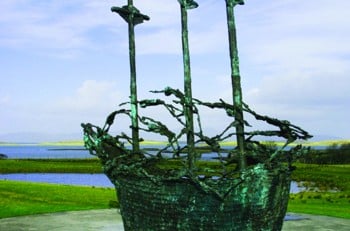
    By Kevin Kiely. Public sculpture in Ireland includes many monstrosities that are heavy and clumpy in their use of materials and ultimately non-artistic. The heavy-gang includes Edward Delaney, John Behan, Rowan Gillespie and Conor Fallon, but there are plenty of others. Delaney is egregious; his ‘Wolfe Tone’ and ‘Thomas Davis’ are part of street-lore. Tone begat ‘Tone-henge’ and Davis, with his attendant figures, is ‘the piddlers on the Green’. They are objects of public derision, and the critical establishment alone consistently pays them homage. Leading art critics Roisín Kennedy, Judith Hill and Peter Murray never question the numbing monolithic dullness. Murray has claimed that Tone and Davis “convey an earthy solidity, a connection with the earth, emphasised by their heavy legs”. Eamon Delaney in ‘Breaking the Mould’, a lengthy paean to his father Edward Delaney, not surprisingly supports Murray who eulogises his Davis as representing “a farmer in from the fields: a man off the bog and on to a pedestal”. The Davis statue does not reflect this, nor does it invoke the Davis of history. Eamon Delaney lauds his father’s ‘Davis’ as superior to works by John Henry Foley: “there is none of the shrill theatre of Grattan, or the arrogant certainty of Burke”. This bludgeoning is untenable. Foley may be eighteenth-century but his O’Connell, Grattan, Burke and Goldsmith retain a transcendent beauty, elegance, and imaginative artistry in execution, expression and realism. Tone and Davis are excessively bulky and heavy. Delaney quotes Aidan Dunne who finds Tone and Davis “frayed by mortality and uncertainty”. But imprecision is Dunne’s actual medium: artspeak. The problem is that in-depth criticism of sculpture is nowhere found. The Irish Arts Review and the Irish Times are not really in the business of criticism. Circa, and magazines like it, feature art and artists, exalted and carefully ‘criticised’ using quotations from international art critics. Circa’s presumption to interrogate is spurious. When  (recently) the magazine asked the question: “What is the role and value of art criticism at present?”, it passed responsibility, by replying with a question: ‘What art?’ Meanwhile, the RHA and commissioned artists link arms, laughing all the way to the pork barrel in this porcine climate of plastic criticism. You will not find any adverse critiques of John Behan’s ‘Famine Ship’ that faces Croagh Patrick where the heavy ghost-figures shrouding the three heavy masts are what can only be honestly described as gate-like. ‘The Flight of the Earls’ (Rathmullan, County. Donegal) with its three Irish chieftains on a gangplank of bronze, waving ‘goodbye’ is not evocative in any way of this major historical event. Behan fails the Famine as subject matter, and fails ‘The Flight of the Earls’. He simply does not find any artistic pitch that could be said to be sublime, haunting, or even satisfying. ‘The Flight of the Earls’ was funded by A.J. O’Reilly and in general funding is plentiful, boosted by the OPW and its capital fund. In 2012 this amounted to €352 million. The OPW has a design and project management service for public-sector building, heritage and art projects. Arts Council payments to sculpture in 2010 amounted to €410,000. County councils play their part in commissioning public works. The Per Cent for Art Scheme, since 1997, “approves the inclusion in budgets for all publicly funded capital construction projects up to 1% as funding for an art project”. The maximum for projects over €12 million is an art budget of €64,000. Public sculpture is generally administered by time-servers without a critical faculty, people like the selection panels, the RHA, and the artists who have lent their names to the pervasive lugubriousness. Alex Pentek’s ‘Rabbit’ on the Ashbourne Road (in Meath) cost €64,000 and has no distinguishing features whatsoever. In essence it is a giant rusty rabbit that any sheet-metal worker or gate-maker could have designed far more subtly and much more cheaply. Pentek is responsible too for ‘Hedgehog’ costing €113,000 along the Gorey Bypass. ‘Rabbit’ and ‘Hedgehog’ are vaguely figurative though their artistic merit is better described as figmentary. The eight-metre-long, four-and-a-half-metre-tall hedgehog is also funded by Per Cent for Art. Pentek’s ‘Violin’ on the N5 by-pass around Longford evokes a minimum of imagination to make it a whole. ‘Perpetual Motion’ by Rachael Joynt and Remco de Fouw is a familiar giant ball with road markings outside Naas. The obvious visual statement may be fun, but is innocuous. It is meant to be art. ‘Dancing at the Crossroads’ on the Carrickmacross Bypass by David Annand is grotesque. “Inspired” by the words “cavorting on mile-high stilts” from a poem by Patrick Kavanagh, it depicts three ‘green’ life-size adults crudely attached to tilted stilts. Debased. Figurative iconic sculpture is problematical as exemplified by ‘Joe Dolan’ by Carol Payne. The thickness and density of the statue with an outstretched arm makes Dolan a lumpish Irish tenor not the show-band star of Mullingar. Rory Gallagher in Ballyshannon and Phil Lynnot in Dublin are better iconic renderings. Rory is in a Chuck Berry hunched pose with guitar. Lynnot’s bronzed chic-look with guitar is a stylised effort. Joyce’s bust in the Green and full-length treatment on Talbot Street by Marjorie Fitzgibbon are both clumsy, heavy and dull – little wonder Dubliners call the latter ‘the prick with the stick’. It cannot compare to the Swiss Joyce in Fluntern Cemetery by Milton Hebald, imaginatively provocative with the cane, book and cigarette midst the cemetery that now holds him. ‘Brendan Behan’ on the Royal Canal by John Coll fails in realist resemblance. The ‘narrative’ of ‘Behan’ looking at a sculpted blackbird perched on the bronze bench is sentimental. The reference to “The Auld Triangle” from ‘The Quare Fellow’ is awkward, using four triangles welded to the bench. Coll’s ‘Patrick Kavanagh’ is equally ludicrous. The fact that the hands and shoes approximate lifesize dimensions is no claim to artistry. Coll disastrously follows Fitzgibbon’s style which is far better done by her in now peripatetic ‘Molly Malone’ ‘the tart with the cart’. The gurrier versions expose the triteness, even

    Loading

    Read more

  • Posted in:

    Ireland raw, happy and dysfunctional.

    By Shirley Clerkin. While viewing the images in The Photo Album of Ireland exhibition, currently showing in the Gallery of Photography in Dublin’s Temple Bar, it occurred to me that we know exactly who we are. We just do not always want to admit it, or show it. Photos can make judgements just like words; on a baby: “She’s a wee dote”, or on a good-looking girl: “You would stand to look at her” or on one with confidence “She thinks a lot of herself, that one”. God forbid the family tree would be let down with a “Would you look at the state of her ” or even worse: “It was far from that she was reared”. I am one of those women that was doted on in my chubby, baby years, all softness and pallor. It was okay to be outrageously babyish, as I was in fact a baby. I was an awkward teenager, less doted upon, spotty and pasty (and oft reminded of this). But God, I tried to rise above it all, based on a piece of information I gleaned from a documentary on the human brain which said that humans only used 10% of their grey and white matter. I determined to use more of mine to make up the gap. As a result of my diligence I was fifteen when I found myself on a boat to Station island, Lough Derg, County Donegal to work on St Patrick’s Purgatory. The boatman, Michael, was a hardy, fair (he insisted strawberry blond) fella, with ruddy cheeks and strong arms to match his accent so naturally I bit his head off, as I was a bit above my station with nerves. It was a good come down, working on the island. The nun in charge immediately put me on the back foot and pulled the rug from under my carefully tended confidence, by insisting that I was days late for my duty.  Thankfully though, not a bare one, as staff could wear shoes, unlike the pilgrims. Then she befuddled me with tales of how she had lost six pounds since arriving on the island a week or so previously. I was well put out, and thought I better hold tightly onto my few bob in case someone nicked it. It took me a right while to realise that she was talking about her weight, and subconsciously I suppose, she wanted me to commiserate with her or more likely congratulate her on her figure. You might have stood to look at her. Only she was a nun. Then of course, I made the mistake of climbing down off my salt pillar and striking up a friendship with the boatman, who was only a lad himself. I was found fraternising with the pilgrims one day when some of them were looking for directions. Next thing, I was moved from my post in the Priests and Staff kitchen, to the laundry. Pulling yards of sopping wet sheets from industrial washing machines was not easier than cutting cabbage and carrots by hand for coleslaw. But I had further to fall yet. My career prospects on the island were cut short with a “You know what you’ve done” accusation by the chief-nun. I never found out what I did; but at the time I thought it might have involved the disappearing ice-cream (but that wasn’t me). Only in later years, while in fact talking to a Magnum Photographer about the island one night at the Prix Pictet photographic exhibition in Dublin, did he hit upon a reason for my expulsion. It wasn’t what I had done at all, he said, provocatively. They all wanted to sleep with you. You were stirring up suppressed feelings in others. They needed someone to blame. On reflection, I think he was on to something. As a permanent reminder of those short but luminous few weeks, my likeness was taken and is in the 1988 book ‘On Lough Derg’ by photographer Liam Blake and Deirdre Purcell.  Grinning together with my friend Bernie, I am standing there holding a copy of ‘To Light a Penny Candle’ by Maeve Binchy. If you saw that picture, you would not know the story, but you would glimpse us, two young girls in baggy t-shirts, and see something that the photographer wanted to say. We pestered Blake to take our photo, which he did very grudgingly. Only afterwards probably did he notice my reading material and then he saw that it would made the cut. Unlike Blake’s photo of us on the island, most of the photos in The Photo Album of Ireland exhibition are taken by family members for private use, and have come from biscuit tins or carefully sheathed leather-bound albums. They are frozen memories: moments, often so carefully choreographed to give the best impression that it is what they don’t show, that sometimes makes the viewer wonder. The project team invited people to share their family photographs, to look at the social history of Ireland from the viewpoint of family. Sontag in her 1977 book ‘On Photography’ wrote, “Through photographs, each family constructs a portrait-chronicle of itself – a portable kit of images that bears witness to its connectedness”. My father took part in the project, and shared old black-and-white images of our extended family and some of his extensive slide collection, covering happy and sad times from the 1970s on the border. A 1940 image of my thoroughly modern grandmother pictured in trousers with a bicycle, blown up to almost full-size on one gallery wall shrank time for me, although she died in 1976. Written on the back of the tiny original she had written “What will J.J. [my grandfather] think of this?”. The invention of cheap cameras like the Box Brownie made photography a democratic medium. A documented, chronicled life became possible for many, un-reliant on expensive portraiture and family archives. Photographs of the Irish, whether here or abroad, new or old, allow us as individuals

    Loading

    Read more

  • Posted in:

    Isis crisis

    Frank Armstrong Iraq came shuddering back into the news this summer after the spectacular conquest by ISIS (The Islamic State of Iraq and the Levant, now preferring the term ‘The Islamic State’) of Mosul, the country’s second city. This was closely followed by the fall of Tikrit, Saddam Hussein’s birthplace, and threats to a petrified Baghdad itself. As Village went to press it was being reported that 500 of the majority ethnic Kurds had been slaughtered in Sinjar with some buried alive and 300 women kidnapped as slaves. The region is bracing itself for further US and possibly British intervention in defence of displaced and murdered minorities, including many stranded on the slopes of Mount Sinjar. The scale of the carnage is untold. The New Yorker quotes an Iraqi named Karim: “In one day, they killed more than two thousand Yazidi in Sinjar, and the whole world says, ‘Save Gaza, save Gaza’. ISIS has laid claim to global leadership of the Muslim ‘Umma’, declaring its elusive leader Abu Bakr Al-Baghdadi the new caliph, a position relinquished by the Ottoman Emperor in 1924. The organisation also sought to repudiate the nefarious 1916 Sykes-Picot Treaty, long viewed by Arabs as the first, among many, betrayals by Western powers of the region’s right to self-determination. Sykes-Picot was a secret Anglo-French agreement signed during World War I which agreed to the dismemberment of the former Ottoman Empire and its apportionment between the British and French at the expense of their erstwhile Arab allies. The violent contagion of Syria’s internal conflict spread beyond its borders, reviving Iraq’s seemingly immutable sectarian division between Sunni and Shi’a. But simplistic Western analysis of these conflicts often serves to reinforce destructive sectarian identities. In Iraq as elsewhere, identity is plastic. 75% of Iraq’s population of over 31 million is Arabic-speaking with Kurds constituting the bulk of the other ethno-linguistic groups including, for example, 650,000 Yazidis. Muslim Arab Iraqis may in different circumstances define their identity as Arab in common with other Arab people. They could also assert an Islamic identity but this is complicated by the division between the Shi’a majority and Sunni minority. They could also claim to be simply Iraqi in common with those living within the borders of Iraq. To complicate matters further many Iraqis actually identify most clearly with their tribe. The artificiality of Iraq’s borders has made the task of maintaining the integrity of the Iraqi state a bloody business. ISIS seems to be skilfully forging an Arab-Islamic identity more focused than Al-Qaeda’s global pretensions. But ISIS is unlikely to advance much further in Iraq due to the presence in that country of a substantial Shi’a majority. In terms of the Sunni-Shi’i divide a survey of Iraqi history reveals shifting allegiances. The foremost historian of early twentieth century Iraq, Hanna Batatu records how “under the Ottomans Iraq consisted to no little extent of distinct, self-absorbed, feebly interconnected societies”. This social stratification was given legal recognition by the Millet system of communal representation, though unlike Jews and Christians the Shi’a, who were considered heretical Muslims, were not accorded this privilege, and were forced to operate under Sunni sharia law. Nonetheless, firm social boundaries divided the Sunni and Shi’a communities: “Socially they seldom mixed, and as a rule did not intermarry. In mixed cities they lived in separate quarters and led their own separate lives”. After the First World War, the British became rulers of the new state of Iraq whose borders were an artificial construct born of imperialist designs on the country’s oil reserves, and cloaked by a League of Nations Mandate. The first colonial administrators regarded the Sunni as a more rational branch of Islam and a Sunni King, Faysal, was installed as king after independence was finally granted in 1932. According to the historian David Pool it was believed that “the result of Shi’a involvement in political office could only be theocratic, fanatical, xenophobic rule”. The British thus carried over Ottoman social stratifications into the post-colonial era by keeping the Shi’a at a remove from the resources of an increasingly oil-rich state. As a result, despite amounting to 55 percent of the population, during the monarchy the Shi’a filled a mere 22 percent of government posts, while only four of 23 of Iraq’s prime ministers were Shi’a. Moreover, invisible obstacles were mounted to exclude Shi’a from membership of the Military Academy making it impossible for them to become officers. But despite the persistence of Sunni dominance Iraqi society was moving away from the legacy of empire and colonialism: by the 1940s Sunnis were giving their daughters in marriage to Shi‘a “when only a few decades before the impediment to such intermarriage seemed insurmountable”. In a bloody 1958 coup King Faisal II, along with other members of family, was executed. The resolution of Iraq’s internal contradictions seemed to express itself in the half-Arab-Sunni, half-Kurdish Shi‘i parentage of General Qasim, prime minister of Iraq from 1958-1963. This period, however, represented a false dawn as the genuine and widespread hopes for a radical break with the past and for the creation of a more open society that were awakened by the events of 1958 were gradually disappointed in the following decade. During the monarchy and beyond, many Shi’a had identified with the pan-Arab cause. Arab Nationalist parties contained Shi’a. So did the Ba‘th Party, which as late as 1963 had a majority of Shi’a in its top command and probably among its active membership. However, the prevalence of Shi’a membership of the Communist Party was taken by many Sunni propagandists as evidence of their opposition to the pan-Arab cause. The popularity of Marxism was connected to the decline in religious participation in the 1950s among the Shi’a. This decline can be discerned in both the ‘popular’ and the ‘juristic’ forms of the religion; with the decreased fervour of the ritual Muharram observances, and a drop in the numbers of religious scholars. Under Qasim there was evidence that the state was taking a ‘secularising’ path: family law

    Loading

    Read more

  • Posted in:

    Arts Council still relegates participation to consumption

      By Niall Crowley. Sheila Pratschke, chairperson of the Arts Council, has boldly declared that the Arts Council needs “to conceive of our activities in a different way. We can’t keep shrinking to fit the budget. We have to be more imaginative and proactive”. This ambition is now being tested as the Arts Council publishes the report of a steering group established to review its work as a first step in developing a strategic plan. The central proposal is that the Arts Council should  reposition itself as “the development agency for the arts focussed on the public good”. While the report suggests this is a “transformation”, it cannot really be seen as much more than a shift in emphasis from its previous branding as ‘The Arts Council Funding the Arts’. There is some focus on what a development agency would do – profile the needs of arts areas within its mandate, identify priority areas for strategic action and influence the environment for the arts. There is little focus on what this developmental role might seek to achieve. The Arts Council would become an informed lobbyist for the needs of the arts with its current funding role expanded to embrace policy and research activities. This might well be proactive but it is less than imaginative. The review emphasises a focus on the “public” and the “public good”. However, it fails to acknowledge the different publics that exist – other than ‘young people’ and ‘children’. Deploying the artless and depressing, if telltale, jargon of the administrator the proposals suggest placing “the public at the centre of the new Arts Council mission statement” but fail to develop any analysis of the implications of the inequalities and divisions in our society for the role of the Arts Council. The report acknowledges “large sections of the population, chiefly defined by socio-economic circumstances, but critically related to educational attainment, do not engage in the arts”. However, it makes no proposals on how to respond to this inequality other than for the Arts Council to “identify children and young people as a primary strategic priority” so as to “broaden the socio-economic profile of those engaging with the arts”. One challenging finding in the review is that “there seems little emphasis on engagement and participation as a fundamental and valued aspect of the arts in Irish society”. This apparent call to recognise the creativity of people, as opposed to relegating people to consumers of the professional arts, holds promise. However, it is not addressed in the proposals and is undermined by an elitism that  limits it to the “amateur arts”. The review offers little to those currently outside the Council’s concern with the professional arts. It suggests that the Arts Council articulate how such areas of activity might be “valued and supported (if not always financially)” because of their critical role in public engagement” and as “pathways to the professional domain”. So: a pat on the head for endeavour and no understanding of the social gains from enfranchising people’s creativity. One promising finding of the review suggests the need for dialogue between the “Arts Council, the arts sector, partners and stakeholders and a range of other individuals and organisations with an allegiance to the public good and to the development of creative communities and a culture of innovation in which the arts are seen to have a unique and important role”. A bit of imagination and pro-activity could make this focus on building creative communities more central to the role suggested for the Arts Council, but it remains for the moment undeveloped. The UN’s International Covenant on Economic, Social and Cultural Rights establishes the right to “take part in cultural life”. New Irish legislation requires public bodies  to set out in their strategic plans an assessment of the human rights and equality issues relevant to their functions and purpose and the policies and actions in place or proposed to address these issues. The Arts Council is bound by this and obliged to see its “public” in terms of diversity and inequality. It is required to make provision for this diverse and divided public not just as consumers of arts and culture but also as creators of arts and culture to give real meaning to the term “take part” in cultural life. The review does not offer a promising starting point for this challenge. •

    Loading

    Read more

  • Posted in:

    Dick Roche hits out

      Frank Connolly A former Fianna Fáil Minister for the Environment, Dick Roche, has accused Wicklow County Council and two other state agencies of outrageous treatment of a family which has tried to build a data centre on lands near Newtownmountkennedy in recent years. In the latest zoning and planning controversy to erupt in Wicklow, Roche has sharply criticised Wicklow County Council, the National Roads Authority( NRA) and An Bord Pleanála (ABP) over their treatment of Brian McDonagh and his brothers who obtained planning permission to build a data centre at Kilpedder, Newtown, in July 2010 but have been confronted by a series of obstacles that have prevented the proposed development. Roche’s criticisms echo concerns of other local councillors, and recent statements in the Dáil by Sinn Féin leader, Gerry Adams who has questioned the role of former environment minister, Phil Hogan, in  a number of controversies in Wicklow which, he argued, made him unsuited to be Ireland’s nominee for the European Commissionership. Village has learned that the McDonagh case and other controversial issues relating to Wicklow County Council and some of its staff and elected members have been brought to the attention of the newly appointed environment minister, Alan Kelly, who is considering whether an inquiry into planning and re-zoning, as well as the multi-million dispute surrounding illegal waste disposal, in the county, should be added to the ‘review’ underway into seven counties (including Donegal). And Junior Finance Minister Simon Harris has called for an investigation into Wicklow County Council. According to a comprehensive letter of complaint by Dick Roche to the then secretary general of the Department of the Environment, Geraldine Tallon, in July 2011, the treatment of the McDonaghs revealed “serious maladministration” on the part of Wicklow County Council and the NRA as well as a bizarre decision by ABP which the former minister asserts was “quite hard to fathom” and which was subsequently overturned by the Supreme Court. According to Roche, the McDonagh brothers purchased the 81 acre site at Kilpedder on the edge of the M11 in 2007 and lodged a planning application in January 2008 for a business park on the lands which were then zoned for business, science and technology. As their planning application was under consideration by Wicklow County Council, the McDonaghs learned that lands on the other side of the M11 from their site at Newtown were to be re-zoned for employment in a new Local Area Plan (LAP). During discussions with Council staff they also discovered that the zoning on their lands might be downgraded to agricultural use only in the draft proposals for the new LAP, rendering it commercially useless to them. During this period, Brian McDonagh and his brothers were invited to a meeting with a land agent who was acting for a prominent Dublin-based property developer and his partners, where they were offered a 50-acre parcel of land “at a knock down price of €40 million” on the opposite side of the M11 to their site. They were told that the land on offer, which was zoned for agriculture, was going to be re-zoned for industrial use in the new LAP. They were then shocked when the agent showed them a map of the new draft plan which indicated that the land which they owned was going to be de-zoned to agricultural use. Ironically, the agent making the offer was not aware that the McDonaghs owned the lands which he said were to be de-zoned. A draft contract sent to the McDonaghs also indicated that a nine-acre portion of the lands they were being offered by this private developer was owned by Wicklow County Council. When the McDonaghs asked the land agent acting for the prominent property developer what guarantee he could give that the land on offer would be re-zoned, the agent offered to set up a meeting with senior Council staff where the position would be clarified. At a hastily arranged meeting the following morning in the Druids Glen hotel in Wicklow, Tony O’Neill, Economic Development Manager of the Council, arrived with a copy of the LAP containing the County Manager’s recommendations for re-zoning. The document showed clearly that the lands on offer were to be re-zoned for employment and that the McDonagh lands were to be de-zoned. O’Neill allegedly assured the McDonaghs that it was 99.5% certain that the lands would be re-zoned by the elected members of Wicklow County Council (although they had yet to see the plans) and that the offer “represented a great investment opportunity” for them. On allegedly receiving this information, which fundamentally threatened their plans for a new business park, they immediately contacted their solicitors, Whitney Moore, who in turn wrote to the Council demanding that it “stay any further consideration of the 2008 draft LAP” until the proposed de-zoning of their lands was removed, or face injunctive legal action. After Council management initially denied that any such meeting had taken place at Druid’s Glen a member of the council who was present in the hotel and who had spoken to Brian McDonagh and O’Neill verified that the meeting had occurred. Two weeks later, the Council voted in favour of the Manager’s recommendations with the result that the McDonagh’s lands were indeed de-zoned. Following contact made by the chairman of the planning committee, Councillor Pat Vance (FF), the McDonaghs were invited to attend yet another meeting at the Ramada Hotel in Wicklow where they were asked to put forward fresh proposals for development on the lands they owned. It was at this meeting that they were informed that a proposal for a data centre on the land would be favourably considered by the council as it would not compete with plans for the land on the other side of the M11 which had just been re-zoned. Rather than lose the prospect of any development the McDonaghs withdrew their planning application for the business park and made a fresh one for a data centre on their lands which was,

    Loading

    Read more