Recently Hot and News

Random entry RSS

  • Posted in:

    Economic smugness without statistical substance. By Constantin Gurdgiev.

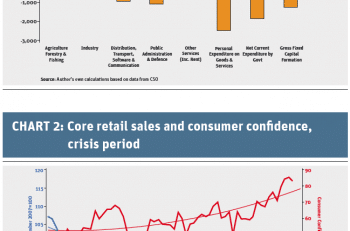
    Outside multinationals it’s grim – even for property and competitiveness. By Constantin Gurdgiev ‘The national property price index peaked at 70.0 in December 2013 but slipped to 69.1 in March 2014’ In the recent elections Fine Gael and Labour insisted on recounting their successes in reversing the economic crisis: tens of thousands of jobs created, property markets and investment on the up, households finally facing into the prospect of tax cuts in Budget 2015: the economy stabilised. Save for the contracting pharma sector – suffering from the externally generated patent cliff – things were getting brighter by the minute. The voters bought none of these claims. Still, the question remains unanswered: has the economic decline been reversed during the years of coalition management? It is a difficult question to tackle. So let us try and brace ourselves for a measure of cold statistics. In very broad terms, the economy can be broken into private consumption, government consumption; private investment, public investment; and net exports (exports less imports) of goods and services. Everything, excluding net exports, taken together is known as the Final Domestic Demand. Adding net exports gets you Gross Domestic Product (GDP). Adding payments on Irish investments abroad net of outflows of payments on foreign investments in Ireland gets you Gross National Product. In an economy severely distorted by the tax arbitrage of multinationals (MNCs) where foreign companies account for the entire trade surplus, Domestic Demand is the measure of economic activity that most accurately measures what takes place in the country. It excludes the pharma and Information and Communications Technology (ICT) exporters who are shovelling massive accounting profits on to our national balancesheet. Domestic Demand rose in the fourth quarter (Q4) of 2013 by €630 million compared to Q4 2012, although for the full year 2013 it was down €366 million, once we adjust for inflation. This means that 2013 was the sixth consecutive year of declines in Domestic Demand, but it also means that towards the year end things started to look a little sunnier. Looking at the composition of our demand, both public and private consumption fell in 2013. These declines were moderated by a rise in investment by €710 million year-on-year. Much of this ‘upside’ was Nama and the IDA attracting foreign investors to Dublin. In other words, it had little to do with our real economy. Residential and commercial real estate valuations did rise throughout 2013 in Dublin, though they trended down in the rest of the country. But in 2014 things have gone off the rails. The national property price index peaked at 70.0 in December 2013 but slipped to 69.1 in March 2014. In Dublin the decline was even more pronounced – from a peak of 68.5 at the end of 2013 to 67.2 in February and March 2014. Building and construction activity picked up in 2013, with the index of activity by value of construction up from 94.3 in Q4 2012 to 105.4 in Q4 2013 and by volume up from 95.7 to 106.2 over the same period. Here’s the kicker, however: much of the construction growth related to completions of already-started projects and retrofits. Planning permissions for new construction, minus those for alterations, conversions and renovations, fell year on year in Q4 2013 and were down over the full year. The pipeline of building commencements into the near future looks dire. Worse still, the contribution of industry, excluding building and construction, to GDP was down €1.1 billion in 2013. Overall, of the five broad sectors of the economy contributing to our GDP, three posted decreases in activity compared to 2012 and two recorded increases. Here’s an interesting comparative. As Chart 1 below clearly shows, since the current Government came to power in Q1 2011, our real GDP in constant-factor-cost terms grew on average by less than 0.76% per annum. During the 1990s recovery this rate of growth was around 14 times faster. Agriculture, Forestry and Fishing; Industry; Distribution, Transport Software and Communication; and Public Administration and Defence – four out of five broad sectors of the economy are down over the three years of this government tenure. Only ‘Other Services (including Rent)’ was up. No prizes for guessing which sector is dominated by internet giants pumping tens of billions of profits earned elsewhere around the world into Ireland to be recycled to tax havens: ‘Other Services (including Rent)’. CHART Village 2014 06 CHART 1.xlsx Personal Expenditure on Consumer Goods and Services has shrunk 3% since the current government came to power, falling at an annual rate of 1%, Net Expenditure by Central and Local Government on Current Goods and Services has fallen at an annual rate of 2.4%, while Gross Domestic Fixed Capital Formation fell at an annual rate of almost 2.3%. So by all metrics, save the one that covers Google and its buddies, the government’s record is hardly impressive. Which leads us to another question: what is there to look forward to in the economy between now and the next general election? There are some positive signs on the lead-grey economic horizon. The Purchasing Managers’ Indices for Manufacturing and Services are growing. Investment remains sluggish, with credit in the economy continuing to shrink and cost of loans continuing to rise gradually. But non-traditional sources of funding are showing signs of growth: investment funds, private equity and even some direct peer-to-peer lending. As banks shift defaulting mortgages into ‘restructured’ portfolios of loans, the numbers of new mortgages approvals, although volatile, are on a gentle upward slope. However, the average value of mortgages approved continues to trend down. Retail sales are faring much worse: the value of retail sales in Q1 2014 remained the same as in Q4 2013 and is up only 0.6% over the year. Their volume is up 0.2% and 2.6%. Which means that deflation is still cutting into retail earnings and new hiring is still off the agenda of Irish retailers. However, encouragingly, retail sales have finally started to move in line with consumer confidence

    Loading

    Read more

  • Posted in:

    Eamon Gilmore (2008): Finally atop the Labour Party triangle? (profile 2008)

    By Michael Smith. Eamon Gilmore needs to continue showing us his edge. “Triangulate: to move in the direction of a point by partly moving away from it”. For years the Irish Labour Party in general and its now leader, Eamon Gilmore in particular, have – characteristically – triangulated. They criticise a measure but pull their punches in part, lest they risk alienating someone or being seen as too radical. Or maybe because the Irish Labour Party, its leadership and much of its membership, after a period of radicalism thirty years ago, is now conservative by temperament. Gilmore won’t criticise the central substance of a measure; he’ll criticise its timing, its presentation, its costing, he’ll say it didn’t go far enough or something else needed to be done first. This won’t just be an add-on to his assessment, it will be his sound-byte. If Eamon Gilmore was breaking it off with you he’d say it wasn’t about you it was about him. Indeed that’s exactly what he’s been telling the unions. Speaking to the party’s youth conference about the link between Labour and the Unions, for Gilmore “It was not about the Labour Party’s view of the trade unions”. But rather, “the question is: where do the trade unions’ members see themselves in relation to the Labour Party?”. Gilmore would characteristically deny there is a problem with policies that indirectly have the effect of favouring the rich by saying he never sees such people. On a recent Questions and Answers programme, for example, he got around a question about whether he was in favour of allowing Tony O’Reilly a free medical card by saying he never saw millionaires at the doctor’s. It’s his instinct: caution outside his key passions. It allows him always to appear solid and competent and not to frighten the horses; and the pedantry even suggests erudition. But politics isn’t really about politicians. Or even primarily about competence. Gilmore needs to unlearn many of his key strategies. The question for Gilmore’s Labour Party is: Is there any beef? The policies Income Tax Labour’s 2007 Manifesto says “Labour will enhance the incomes of hard working families who have suffered from the “rip off” experience by delivering … a 2-point cut in the standard rate of tax from 20 per cent to 18 per cent”. This is directly culled from US and British populist thinking pitched at middle earners rather than the most needy in society. CGT and Corporation Tax Labour’s 2007 Manifesto which remains policy says “we recognise the need to maintain incentives for work, and to maintain Ireland’s attractiveness as a location for mobile investment and skilled labour. Accordingly we will: Maintain the existing rates of Corporation Tax. Maintain the existing rates of Capital Gains Tax”. In fact there is no reason not to increase Corporation Tax marginally to pay for services. It is also a blatant non-sequitur to imply that CGT is an incentive to work. This is definitive evidence of the Labour Party’s failure of nerve and radicalism. Universal Benefits Gilmore favours universal – i.e. non-means-tested – entitlements even against a background where the country cannot afford to give such “rights” to the richest. He seems, perhaps unwittingly, to be pandering to the middle-class base and brains of his party. Means-testing for Medical cards – including for over-seventies – and requiring university fees for those on high incomes are egalitarian policies (though in the case of the over-seventies it may be disproportionate to withdraw entitlements they have come to depend on). Applying typical Gilmore logic he says universal provision of services and benefits ensures those on middle and higher incomes have a stake in maintaining high standards of public services. In fact it is more notable they get a benefit than that they get a stake. Environment Triangulation was the key to Gilmore’s approach as Labour Party Environment spokesperson until 2007. For example Gilmore said the Protection of the Environment Bill 2003 which required householders, as polluters, to pay for the waste they generated and car-sellers to take responsibility for ”end-of-life” vehicles would “come to haunt” the Government when householders, the motor trade and local communities came to realise its impact. There was certainly a problem with the Bill which undemocratically allowed County Managers to override elected councilors, but the costs of taking care of the environment were inevitable and he should not, as environment spokesperson, have been arguing against them on blatantly populist grounds. Carbon Tax. Gilmore advocated reform of vehicle registration taxes (VRT) to encourage people to buy smaller cars, but Labour ruled out and continues to rule out introducing a carbon tax. Such taxation would damage Ireland’s competitiveness, Gilmore said. Liberal Social Agenda Gilmore has notably failed clearly to champion the classic “liberal” social positions that once galvanised his supporters. Abortion Gilmore does not feel the need to promote the party position which is to legislate for the X case. He told Hot Press, “I’m pro-choice. If abortion wasn’t as available in the UK then it would be much more on our agenda than it is now. Situations where the life of a mother is at risk, where a foetus is not viable, and, in particular, the issue of rape – those areas need to be looked at”. As he admits, it is not really on their agenda. Gay Marriage He is not pushing for a referendum for gay marriage, though typically he recently disdained the greens as having been “sold a pup” by FF in not getting commitments to hold one. He said of the Labour Party’s Civil Unions Bill, “To the extent that it stops short of changing the definition of marriage in the Irish constitution … some would argue that we have chosen the wrong approach… [but] our bill will lay the foundation to enable us to win the argument if or when there is a referendum on the issue”. Secular State. Gilmore doesn’t see the Angelus as an issue of secularity but as one of taste. He told

    Loading

    Read more

  • Posted in:

    Dublin MEP candidates. 3. Mary Fitzpatrick (Fianna Fáil)

    Mary Fitzpatrick interviewed by Michael Smith Councillor Mary Fitzpatrick, 44, was born and raised on the Navan Road in Dublin’s North Inner City, one of four children of Tom Fitzpatrick, a doctor and dentist who became a Fianna Fáil TD, She went to St Dominick’s in Cabra and to UCD where she studied politics and then Italian and German which she thought might get her a job. She emigrated in the eighties, she worked in France, Italy and the US after getting a Green Card. She worked in international sales for a subsidiary of the Associated Press By 1992 she was selling broadband capacity to the Chicago Board of Trade and others, first in the US and then back in Dublin until 2006, serving the whole of Europe. She says the key to sales is “know your product and sell its strengths”. She now lives in Glasnevin with her husband Seán and three children. Her first election was the locals in 2003/4 and she has served as councillor – always in opposition since then, currently as Fianna Fáil’s Council leader. She is most famous for being shafted by Bertie Ahern in a mutually unedifying tit-for-tat of leaflet drops which in the end secured election for his unprepossessing buddy, Cyprian Brady, ahead of her in the 2007 General Election. Brady got elected on Ahern’s transfers though he’d secured an excruciatingly small number of first preferences. Throughout the interview she is engaging, good-humoured, balanced and disconcertingly charming with an infectious laugh. She had been interested in politics from her childhood, working on her father’s campaigns and got involved with Fianna Fáil “To make a contribution for my community”. She considers herself “a centrist politician, republican, democratic republican politician, my motivation I suppose is equality and equality of opportunity”. I ask if she is open to equality of outcome – to in effect compensate some people in circumstances where people get off to such a difficult start that it’s difficult for them to explore the opportunity she emphasises. She says education is the key, ensuring people have a decent start in life, a decent home. If we could get those two things right, we would be making huge strides towards equality”. Would she describe herself as a socialist like her Nemesis Ahern? “I think in its narrowest and strictest definition it’s a failed political philosophy and it just doesn’t really exist here”. She thinks the Socialist Party are not really serious about socialism. Unusually her hero is Abraham Lincoln: “he really battled through and made real changes, and had personal courage”. Anyone else, anyone in Ireland? |”Not particularly”. What class would she describe herself as? “I don’t”. Does she think that Fianna Fáil has been of service to the country? “Yes absolutely. I think the value of Fianna Fáil hasn’t been what it should be and we need to do better and we’re all committed to doing that, but I think if you look at the entirety of Fianna Fail’s service to the country, absolutely we’ve been of service. But we need to restore value to the brand”. Okay, how would she assess the last Fianna Fail/Green Government? “I can’t answer that question because…Can I come back to it? Later she comes back with “challenged”. Kind. As to what she thinks of Ahern and Cowen, and Martin: “Bertie was your quintessential campaigning politician. Cowen I didn’t know well. I’ve met him a handful of times and he struck me as a very patriotic individual. Micheál Martin, a politician with real determination and real vision to see Ireland recover”. How would she describe his vision in a word? “Ambitious”. How many times has she met Bertie Ahern, and Micheál Martin, roughly (I don’t have a clear picture)? “Well, I must have met Bertie a good number of times; I can’t say. Micheál a good number of times as well, I don’t meet him on a daily basis”. Does she believe Bertie Ahern’s evidence to the Mahon Tribunal – on the digouts for example? “Do I have to answer that question, I don’t want to”. Who owns Bertie’s former constituency den, St Luke’s? “Talk to the General Secretary, Seán Dorgan, he’s the person dealing with it. I don’t use it, but my understanding is the ownership of the property was transferred to Fianna Fáil Headquarters”. Ever met Denis O’Brien? It’s a querulous No. Just asking. . Just what sort of bank guarantee does she think was appropriate? “I don’t think they’d any option and obviously we’ve to await the outcome of a properly independent banking enquiry”. I note there have been a number of reports : “There was a number of reports, but there needs to be an independent one or we’re never going to learn from those mistakes”. Could they not have curtailed it in terms of time or left out unsecured bondholders? “I don’t think any of us know if that was even an option for them”. The current Government. Does she think the government is improving the efficacy of the civil service and the semi-states? “My biggest experience is what they’re doing with water services and in that respect absolutely not. What we’ve had is a situation where they have taken some of our staff, our property tax – €100 million in Dublin, they’ve spent it on consultants to create an organisation that is accountable to nobody and there is no improvement in the quality of the water service”. They shouldn’t start taxing water until they’ve sorted out the problems”. She’s not too keen to say how they should pay for the improvements necessary to get up to those standards. ”Maybe they should have implemented real efficiencies”. “I’m not opposed to environmental charges including water charges – or indeed to property taxes – per se”. She accepts the principle of a local tax to be spent on local services. But “That is not what is happening. Phil Hogan made a public statement to encourage everybody to pay their property tax –

    Loading

    Read more

  • Posted in:

    Killing Kilkenny. Ditch the Central Access Scheme and build an outer ring road

    Geni Murphy ‘the Victorian terrace due for demolition contains upstanding remains of a medieval manse house associated with one of the cathedral dignatories’. ‘The report notes: “the most recent archaeological report by V.J. Keeley has not been made available for consultation”’ Despite huge opposition, Kilkenny County Council stands resolved to push through the Central Access Scheme (CAS) in Kilkenny City. The scheme will involve the construction of 2.5km of new road, including a 65m bridge through the centre of the city at a projected cost of €10.7m. Opponents of the scheme claim that the road will be visually intrusive on the urban landscape of Ireland’s best-preserved medieval city, will result in increased levels of heavy-duty traffic through residential areas, will destroy medieval archaeology and will lead to the severance of one side of the city from the other. An Bord Pleanála granted permission in 2009 for the main section of the road to be developed through the city centre (while refusing permission for additional spurs). Opponents are calling for the completion of the outer ring road around the city, which would cost in the region of €44m to complete. Their group argues that its completion, along with the implementation of the Smarter Travel Scheme (which the Council has signed up to) would negate the requirement for a heavy-duty access road. The Council however state that the road is crucial to the city’s future development. In particular, the Council cites the development of the 13-acre, former Diageo brewing site located in Irishtown and the 14-acre old cattle-mart site beside the river, as being particularly dependent on the CAS. However, it can be argued that the IT and educational businesses the Council is targeting for the developments require a well-developed IT infrastructure – not a transport infrastructure; and they are likely to be attracted to sustainable environments. As a city, Kilkenny’s most valuable asset is its built environment and this road threatens the integrity of that environment. The mart site has frontage on no less than three roads and is due for rezoning as a neighbourhood centre – so the requirement for additional access appears to be negligible. A primary concern for opponents is the visual impact of the bridge, which is to transect one of the most exciting views of the River Nore. The bridge also threatens to obscure the view of the extraordinary Palladian Green’s Bridge. Indeed, the view was a ‘protected view’ until the Council de-listed it in order to make way for the construction of the new bridge. Due to the lack of a completed ring road, currently much through-traffic, including HGVs has no choice but to traverse the city through residential areas. Communities along the road’s route are concerned that the development of this road will only serve to further feed this inappropriate traffic through their areas. CAS traffic predictions are c.12,000 vehicles per day. The CAS (or Inner Relief Road as it was then called) was first proposed back in 1978, and the road is a relic of that period of planning in which access for the car was prioritised. Now, however, towns and cities all over the world are trying to minimise the traffic entering their cores – Paris has just introduced a car-free zone along the banks of the River Seine; the entire town of Houten in the Netherlands, with a population of 44,000 people (twice that of Kilkenny) is entirely car-free; Copenhagen, Dubrovnik, Florence, Vienna and Oxford have all introduced smarter travel initiatives which limit car use and dependency. In these cities, the pedestrian and the cyclist are prioritised. Maybe Kilkenny City is not as grand as those cities mentioned above, however the extent of its preserved medieval architecture is unique in Ireland and consistently ranks as one of the primary reasons people visit the city. In 2012, the County Council announced a €15m investment in the development of a ‘Medieval Mile’ tourism initiative which is to run between the two dominating architectural features at either end of the city – Kilkenny Castle in the south and St Canice’s Cathedral in the north. The CAS is to transect this Medieval Mile at the foot of St Canice’s Cathedral, thereby creating a heavy-duty road that travellers of this Mile must traverse in order to reach the cathedral. It has also been discovered in recent months that the Victorian terrace due for demolition contains upstanding remains of a dwelling which a number of Ireland’s leading buildings archaeologists, including John Bradley (NUI) and Cóilín Ó Drisceoill (NUI) claim are medieval in date and highly likely to be the remains of a manse house associated with one of the cathedral dignatories. The report notes: “the most recent archaeological report by V.J. Keeley Ltd. (October 2013) has not been made available for consultation. All of the previous archaeological reports for the site had concluded that there was little or no evidence for standing fabric associated with the manse. Following local pressure and a requirement in July/August from the architectural heritage protection division of the National Monuments Service 21 and 22 Vicar street were stripped of plaster to reveal the underlying stonework. This work has revealed that the south gable of 22 incorporates a late medieval/Renaissance structure which has undergone Victorian alterations. The late medieval/ Renaissance structure is a c 5m high gable containing a chimney breast with shouldering that finds clear parallels in Renaissance buildings in Kilkenny: for examples the former Shee House/Parliament House and the Rothe House. This architectural device is not seen on Victorian buildings in the city.The Town Hall, Fethard, also contains shouldered chimney breasts and in Cork such chimney stacks are a feature of many fortified houses of the sixteenth-seventeenth century (eg. Ightermurragh). The evidence points towards the south gable of 22 Vicar street being the north wall of a building that stood to the south”. According to Ó Drisceoil, houses such as these are like ‘hens’ teeth’ in Ireland. It is surprising then that both the county manager and the mayor have

    Loading

    Read more