General

Random entry RSS

  • Posted in:

    Shameless Cork

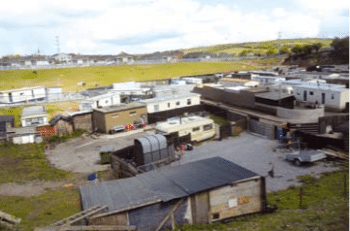
    Travellers have used the area of Spring Lane in Cork for at least four generations. An area known as the ‘old Spring Lane site’ was a traditional camping ground for Travellers. In 1987, Cork City Council created an official ten-bay halting site with very basic facilities – electricity, simple toilets, cold running water and a hard surface. Today, 33 Traveller families with 89 children live on the Spring Lane site. In 2011, then Cork city Lord Mayor Terry Shannon said he was ashamed that the Council could oversee the “Dickensian” conditions there. In the same year, the St Vincent de Paul regional President Brendan Dempsey described the site as being of “third world” standard. Traveller rights groups and some HSE officials view the conditions as a humanitarian crisis. The Spring Lane site prompted three reports through the HSE in 2012, from the Director of Public Health Nursing, the Senior Environmental Health Officer and an independent architect. The reports found acute overcrowding; inadequate sanitary facilities with un-insulated washroom facilities in poor physical repair; issues with rodent infestation; poor surfacing throughout the site; a number of caravans in very poor repair; no safe play space for children; no public footpaths but a poor quality unpaved pathway used by school children to access school; and unstable steep earthen banks on the east side of the site. The architect’s report on the site found that “there is a major lack of standard utilities that are readily available in adjoining residential developments. While electricity is available, there is no natural gas supply, no telecoms supply, no proper water management system for domestic waste, both solid and recyclable, inadequate road network, including an unacceptable road gradient for the site”. The report of the Director of Public Health Nursing highlighted a list of health issues affecting the families on the site, particularly respiratory and urinary tract infections, and linked these to the living conditions. The report of the Senior Environmental Health Officer noted malfunctioning drainage systems and broken non-functioning drains resulting in recurrent flooding in rainy weather, and continuous dampness for the residents. Some residents sleep in a caravan provided by the local authority with a bucket propped up on a shelf above their heads to collect the rain that is pouring through the roof. They must walk out into the cold to an outdoor un-insulated, unheated breeze-block shed containing a steel toilet and tub to help their children get washed for school. These are the lucky families who have a toilet shed. Most of the families live on the periphery of the site without access to any facilities. Cork City Council confirmed last year that the electrical system on the site is overloaded and dangerous. The families have known about this for a long time. The electricity supply on the site constantly ‘trips’ and overloads and residents live in constant fear of electrical fires. Many families cope with resilience, and the site boasts successful activists, volunteers in local youth groups and women’s groups, athletes, carers, as well as very active women’s and men’s groups. It has an above average number of young Travellers who complete their leaving certificate. However, the stress of these conditions and the indifference of the local authority over a long period of time take a toll on people’s health. Some residents talk about battling depression and anxiety. A number of the families have applied to be housed off the site in their local area. However, the number of families securing this housing has been few. The families and their representative organisations, the Traveller Visibility Group and the Cork Traveller Women’s Network have campaigned for better living conditions for over two decades. This has included participating for years on numerous partnership structures with Cork City Council, raising the issues with City Councillors and TDs, linking with the media, and supporting the production of reports on the site. Sadly, in 2011, a proposal to improve conditions, which included additional bays to alleviate overcrowding, was defeated by a Council vote following massive objections from residents in the broader Ballyvolane area. Three years on conditions, and the residents’ lot, continue to deteriorate, disgracefully. Louise Harrington is from the Cork Traveller Women’s Network and Caroline Barnard is from the Traveller Visibility Group.

    Loading

    Read more

  • Posted in:

    Town Hall power grab

    The Local Government Reform Bill 2013 is nearly through the Oireachtas. It gives effect to ‘Putting People First: Action Programme for Effective Local Government’, published in 2012 by the Minister for Environment, Community and Local Government. The changes proposed will give ultimate control over local and community development to local authorities. This has been described as bringing coherence to the sector by the Minister. It has been described as a takeover of civil society and a power-grab by practitioners and academics. The Bill provides for the establishment of Local Community Development Committees (LCDCs). These are ostensibly independent of the local authority. But, as the Minister recently stated in the Dáil, they are local authority committees, and membership of these LCDCs will be tightly controlled. The LCDCs are supposed to achieve an alignment between local and community development and the work of local authorities. On the surface this may seem practical and difficult to argue against in these times of limited resources. However, for those of us engaged in the community sector this is more about control. There is a danger that the alignment process will bring to an end any independent community development work that remains at local level. LCDCs are to be responsible for what is done and spent in the fields of local and community development and for the co-ordination, governance, planning and oversight of all publicly funded local and community development work. It is likely that what is left of an independent community sector will have to implement what is decided by the LCDCS. In the future local and community development work will be tendered, opening the way for privatisation of community development. Profit may replace social justice as the driver. The community sector is that element of civil society that works with and represents the most disadvantaged and marginalised communities. It works to challenge and reduce poverty, social exclusion and inequality. It is a key part of our democracy and provides for a form of participative democracy, giving people opportunities to engage in decisions that affect them. Community development is the approach used by the community sector in its work to bring about positive social change. It is based on participation, collective action and empowerment. We had built an impressive, if sometimes imperfect, grassroots infrastructure. State-funded programmes, State-funded, supported the work of independent community organisations within disadvantaged area-based communities and within communities such as Travellers and disadvantaged women. Community organisations often find themselves advocating against policy or legislation that will negatively affect their communities or advocating for changes in policy that will have positive impacts on their communities. They must remain outside the control of the state if this crucial advocacy work is to continue. The 2001 White Paper on a Framework for Supporting Voluntary Activity and for Developing the Relationship between the State and the Community and Voluntary sector had acknowledged this. It stated that “it would be wrong for Government to seek to control and be involved in every aspect of voluntary activity, but there is no doubt that it can provide an enabling framework to help this activity. Where this involves direct supports, a delicate balance must be struck between having a relatively light official involvement and maintaining proper accountability”. This position now appears to have been reversed. One of the most striking findings of the Community Workers Cooperative (CWC) work on this issue is the dearth of information and consultation with those directly affected by these changes. The CWC, along with other national organisations, is now seeking engagement with those most affected by the changes; an open and transparent selection process to the LCDCs; specific inclusion of those who represent the interests of women, Travellers, migrants and other minority groups, and socially and economically disadvantaged communities within LCDC structures; respect for the community sector/civil society to remain independent and autonomous of the State; and adequate resources to make this a reality. The Local Government Reform Bill will bring decision-making further away from disadvantaged communities. Concerted efforts are required to ensure that, at the very least, the interest of these communities is at the core of the work of the LCDCs.

    Loading

    Read more

  • Posted in:

    Thought-food for the left-wing

    Seamus Sheridan doesn’t want to talk about cheese. “I love what I do and I know the jobs it supports but this isn’t really about me or Sheridan’s Cheesemongers”, he says. As an advocate for Irish food producers and the slow food movement, Sheridan could talk for Ireland on the subject of food but today he is wearing his political hat as the Green party spokesperson on Agriculture, Food and the Marine. This year he will run for election to Galway city council and he believes that Ireland is facing in to a struggle over food and agriculture that will have broad longterm consequences for the country. Starting from a market stall selling cheese in 1995 Sheridan’s Cheesemongers has evolved into a well-regarded business with shops in Galway, Dublin, Waterford, and a shop and distribution centre in Meath. In recent years they’ve added a new business making brown bread crackers in Cork and they now employ a total of 45 people. These days, ‘Sheridans’ and Irish farmhouse cheese are virtually synonymous, but he says it’s a workaday struggle for small food producers. Starting from a market stall selling cheese in 1995 Sheridan’s Cheesemongers has evolved into a well-regarded business with shops in Galway, Dublin, Waterford, and a shop and distribution centre in Meath. In recent years they’ve added a new business making brown bread crackers in Cork and they now employ a total of 45 people. These days, ‘Sheridans’ and Irish farmhouse cheese are virtually synonymous, but he says it’s a workaday struggle for small food producers. ‘Agri-food’ and fisheries is Ireland’s biggest indigenous industry and under the Food Harvest 2020 initiative, the Department of Agriculture, Food and Fisheries aims for a 33% increase in the primary output in agriculture, fisheries and forestry, and a 40% increase in value added. Sheridan believes that this massive expansion of food production can only come about by ceding control of our food to a handful of multinationals. “What worries me is that we – and particularly this government – seem to have developed very close links with large multinational food producers. Fine Gael is supporting and promoting the agri-food business to the exclusion of artisan and craft food producers and small and medium farmers”. He believes that the government is taking the hard-won reputation of Ireland’s traditional food producers and handing it over to food corporates chiefly interested in producing processed food. Last year, Sheridan challenged Minister Simon Coveney’s characterisation of the opening of the Kerry Foods’ research facility outside Naas as “probably the most significant announcement ever” in Irish agriculture. “I welcomed that investment and the jobs it created, but the most significant announcement ever?” says Sheridan. “Make no mistake, a lot of food science – even though people start in it with good intentions – is used not to feed the world but to generate maximum profits at a maximum price targeting the less-well-off in our society who can least afford it. Look how many ingredients are synthetically developed to mimic flavours – that seems to be the holy grail of Irish food development. But let’s look at what end products they develop. Is it real or synthetic ham?”. Sheridan marvels at the facility with which the corporate food sector has borrowed the language of artisan food production and green policies. “I’m now watching the entire Irish agricultural sector which looks like an ad for the Green Party”, he says. “You’ll see this language: Origin Green, sustainable Ireland, ‘Farm to Fork’. But our green image is not just a marketing tool. It has to be based on an ethos. We’ve seen disgraceful examples in the horse meat scandal. Some of the protagonists’ websites were claiming to be fully-traceable from farm to fork”. Sheridan contrasts government support for multinationals and food corporates with support for small food businesses. “When you take away raw agricultural produce and the multinationals, we have the smallest amount of indigenously owned exporters in Europe. It’s very difficult for small businesses to survive unless you export so we have to be an export-led economy if we are to generate sustainable jobs particularly in relation to food and crafts. As a business person, let me say that we need far more support for small businesses”. Sheridan wants to see more people from business and other areas of the social economy getting involved in politics. “It is possible to be involved in business and be on the left, and we need to strengthen the left wing, in a modern sense. Labour are doing admirable work in social reform but they are letting Fine Gael and multinational corporations run rings around them”. Sheridan’s involvement with party politics began in the late the 1990s when he got involved in a court case to defend the rights of Irish cheesemakers to produce cheese from raw milk. “That case was really my first political involvement with the corporatisation of food”, he says. “Fighting the raw cheese case also gave me a real appreciation for the importance of science in politics and it gave me great faith in the judicial system. Protest all you want, but if you believe your case is valid, go to the district court. In a way that’s what brought me into contact with the Green party, because the only TDs willing to help me at that time were Trevor Sargeant and John Gormley”. “Food” says Sheridan, “is wrongly portrayed in Ireland and the UK as an issue for the middle classes, or even as an elitist issue. Food and the quality of food is a left-wing issue all across Europe. The Slow Food movement [which emphasises the connections between food, community and environment] had its origins in the Italian communist party. Carlo Petrini, who founded the Slow Food movement, asked ‘why shouldn’t we eat good food, and support our local farmers?’ There is a misinformed idea that Greens are anti-farming. When you go to the South of France, you’ll find that José Bové, who is one of the most

    Loading

    Read more

  • Posted in:

    Big bogs bags begs question

    The Programme for Government’s commitment to review the policy-banning turf-cutting climaxed last month. And no one is sure who won. This is hardly surprising when Minister Deenihan’s full house was revealed to be more than 600 pages of documents – a draft National Peatlands Strategy, draft National Raised Bog Special Areas of Conservation (SAC) Management Plan, and a Review of Raised Bog Natural Heritage Areas (NHAs). Of course the first question to be answered was the one that Jonathan Clinch put to him on the ‘World at One’ radio news. Were the SACs where we had seen stand-off s between turf-cutters and the Guards to be protected or not? His hands were tied, the Minister explained, by European law. The prohibition would remain. Ming Flanagan, the TD who has baited the Minister on this subject since his election, delivered another of his endless clichés: the “devil was in the detail”. Of course the cliché is right. On page 119 of the SAC Management Plan we find that ‘further exhaustive engagement with turf-cutters and representative groups will continue’, explaining ‘this engagement process will also provide opportunities for continued turf-cutting proposals to be considered where relocation solutions prove elusive’ (and where the €23,000 in staged tax-free payments have been refused). The Government already owes the EU for SAC designated bogs lost to turf cutters since their listing in the 1990s. These new reports show that of 1,990 hectares in 1994, more than 730 hectares had been destroyed by 2012. These must be replaced by habitat of equal value and at least equal extent. So too will 48 of the 75 National NHAs raised bogs where the turf-cutting ban announced by John Gormley in 2010 is to be lifted to allow for continued cutting by contractors acting on behalf of several thousand people. Those 75 bogs covered 17,000 hectares. The Minister suggested that he could do this as the EU rules for SACs do not apply to (national) NHAs. But he omitted to mention that in 2005 Ireland had designated these 75 sites as NHAS in the first place only in exchange for the Commission withdrawing proceedings seeking daily fines against Ireland for allowing turf-cutting to continue without assessment, after a 1999 judgment of the European Court of Justice. Worthy of conservation in 2005 to avoid daily fines, eight years later they only have ‘some ecological value’ and their ‘contribution to the attainment of the national conservation objective is expected to be marginal and/or restoration would be prohibitively expensive for the conservation benefits achieved.’ Further ecological concern is being expressed that the selection of bogs for the chop took more account of their turf-cutting value than of their critical position as stepping stones required, under the EU Directive, for protected species – such as the red grouse and the white fronted goose. Like electronic systems, ecological systems must have redundancy built in. It may seem from the turf-cutters point of view that two nearby small bogs is one too many, but a fire on one could lead to local extinctions without a nearby refuge. And at this stage it has to be asked: where are all these replacement bogs coming from? What magic supply of pristine bogs did we not reveal in 2005? Just as it appears Ireland has been exposed as insincerely recognising the conservation value of the 75 bogs designated as NHAs in a desperate, and successful, attempt to end the threat of daily fines, so it now appears that Bord na Móna was less than fully transparent when Dutch influence and the Irish Peatland Conservation Council forced the transfer to the OPW of their raised bogs of high conservation value in the 1990s. Consequently, they were left alone until these recent revaluations unearthed them. But if this is the case, they should have been protected anyway instead of stored up for future destruction, as Bord na Móna is committed to opening no further bogs. We may expect that Ireland has not quite heard the last of this from the EU Commission, though even there an indulgence of national sensitivities to the detriment of environmental science and a conservation imperative has set in with the transfer of key personnel out of the Environment Directorate. To top it all off, the recent decision of An Bord Pleanála that industrial extraction by international corporations like Westlands and Bulrush requires planning permission has been stayed by the High Court. It accepted the companies’ pleas that to cease production while waiting for the Irish Court system would be an unfair competitive bind on their businesses. And the elephant out on the wetland? Greenhouse gas emissions. Bogs are our Amazon. Draining them releases greenhouses gasses. Burning turf releases even more. If there was ever a case of non-joined up thinking in a climate-change world, destroying our bogs is it. Tony Lowes

    Loading

    Read more

  • Posted in:

    RoadMEP

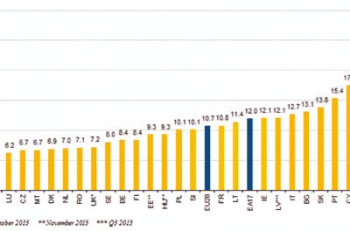
    May’s elections to the European people are far more important than just a test of public opinion about the state of our national political parties. Just over 388 million voters will elect 751 members of the European Parliament (MEPs) who will play a key role in determining whether or not Social Europe can be rescued and the democratic deficit and growing alienation at the heart of the EU can be addressed. These elections are a key opportunity to bring about a fundamental change of direction and to address three interrelated crises that threaten the future of the EU: a solidarity and equality crisis, a crisis of democratic legitimacy and an environmental crisis. At the heart of the solidarity and equality crisis is the rapid increase in unemployment, poverty and inequality across the EU and the growing divergence between Member States. Economic and fiscal policies are being implemented at the expense of social policies and austerity measures are undermining and dismantling welfare states. Over six and a half million more people are living in poverty or social exclusion than in 2008: a total of 123 million people, close to one in four Europeans, in 2012. Children are at greater risk of poverty or social exclusion than adults with a rate of 27.7% against 25. %. Unemployment in the EU is 10.9% and for the first time ever, more than 25 million people are unemployed in the EU, an increase of nearly 9 million since 2008. Over 11 million people are long-term unemployed. Nearly a quarter of economically active young people are unemployed. Nearly one in five third country nationals are without a job. More and more people in employment are being forced into insecure and low paid employment. The working poor represent one third of working age adults at-risk-of-poverty. The burden of economic adjustment is destroying Social Europe and is hitting the most vulnerable groups hardest. Candidates should be committed to supporting and monitoring the implementation of the European Commission’s social investment package and, in particular, campaigning for the active implementation of the Recommendation on “Investing in Children”. All candidates should be asked to sign up to the European Manifesto, “I am a child rights champion”, launched by international and European children’s rights organisations. This calls for a political commitment to promoting children’s rights in the work of the European Parliament. Candidates should be committed to strengthening social protection systems across the EU, supporting EAPN’s campaign for an EU Directive on minimum income schemes, and working for accessible and quality public services for all. The EU’s positive track record on promoting gender equality and anti-discrimination measures must be reinvigorated. Candidates should commit to ensuring that the rights of groups such as migrants and people from a minority ethnic background are fully realised and that support for asylum seekers and refugees is enhanced, with responsibility shared more fairly across the EU. Europe faces a crisis of democratic legitimacy. The EU is increasingly viewed as being controlled by an elite that is taking decisions in the interests of the few. It is imposing austerity measures that are transforming the EU into a Europe of “them” and “us”. The lack of accountability and legitimacy is combining with a growing sense of insecurity and fear as a result of the social crisis. This is leading to a rise in Euroscepticism and a growth in racism, xenophobia, discrimination and nationalism. Not surprisingly many European citizens are turning their back on Europe because they feel Europe has let them down when they most needed it. Candidates must be committed to further strengthening the role of the European Parliament to shape legislation and to hold the European Commission and Council to account and to ensuring that the voice of civil society is heard in European policy making. Economic policies have also been increasingly applied at the expense of environmental policies. The current economic crisis is not just a fiscal crisis. It is the result of an unsustainable model of development which is based on overconsumption and results in an ever increasing ecological deficit. Yet the measures imposed to address the economic crisis are just more of the same. The latest European Commission proposals, the 2030 Framework for Climate and Energy EU2030, reflect this with their rowing back on the obligation on Member States to reach specific renewable energy targets by 2030. Candidates should be committed to revitalising Europe’s employment strategy, building a more environment and climate-friendly economy, and creating jobs through investment in thermal retrofit of housing and in sustainable energy sources. The European elections are an opportunity to demand a change of direction. It is vital we elect MEPs who are committed to addressing these three fundamental crises. Hugh Frazer

    Loading

    Read more

  • Posted in:

    Punching the Telly

    After Christmas my voice was knackered from shouting abuse at the tellybox. Such was the fury, I thought I’d share it with Village, for therapy. For instance, one 30-second Vodafone TV ad tickled my comedy tummy much more racily than three whole hours of sit-com by Jason Byrne? In the advert, a woman runs in to a pub loo to consult a pub quiz expert. Now he confuses whales with Wales, because he is thick. A great dumb gag, but beautifully shot, comically acted by the main player, (a Yank doppleganger of David Walliams). A hard working conceit taking the maximum from excellent timing. With just 30 seconds, bang, job done, that’s enough. Meanwhile, Jason Byrne clattered onto screens in Britain and Ireland on a ‘Mrs Brown’s Boys’ rebound with six, six!, 30-minute episodes of a train wreck called ‘Father Figure’ I cringed at what was more war-crime than sit-com, embarrassed too for some great comedy actors, who looked lost on Byrne’s vanity project. And where exactly was ‘Father Figure’ set? Is it a drab suburb of Dublin, (Ballinteer?) cut and pasted into Huddersfield? Or what? Who cares, it was brutal. RTÉ didn’t promote it at all – see, they knew they had a big fat turkey on their hands. Saints be praised it had no DVD Christmas presence and I pray it won’t be repeated … but you know RTÉ. Still, I heard a swaggering Jason Byrne puff his effort on ‘Front Row’, BBC Radio 4’s flagship arts programme. He described ‘Father Figure’ as – ‘Some Mothers’ Do Ave ‘Em’ meets ‘Outnumbered’. What, exactly: ‘Some Mothers Do Ave ‘Em’ eked a dated humour from nothing more subtle than a whining Man-Girl-Boy and catchphrases “a bit of trouble” and “OOOh… Betty”. Did I do a whoopsee? Yes you did and you made a series out of it, forty years ago. And ‘Outnumbered’ was about as pacy as a family outing to Starbucks, without even SMDH’s Keatonesque pratfalls. You’ll find more sophisticated humour on ‘Peppa Pig’. More energy, credible characters and plot development but then ‘Peppa Pig’ has been professionally worked through. Byrne needs to tiptoe back to comedy writer John Henderson, who saw him through a number of series on RTÉ and BBC, and the tolerable ‘The Lounge’. To the next ad break! This time, Surf. Two studenty English birds are in a laundry room. Dreamy Girl has a vintage dress, which she absolutely adores. Stoic Pal looks on, bored, benignly tolerating her pal’s frock fanaticism and there you have it. Simple. The acting is acute, the humour gentle, sweet and durable, so with each viewing you see another lovely nuance in the performances.The understated genius is the rarity of the gentleness. Topical gems are rare in this provincial country, where history repeats itself but jadedly so as to leave no drama, with no proper celebs (who stick around), unreformed parish-pump politics and an incestuous cabal of self-furthering few Meeja Personalities. Yet in this Depression Éire, we have had at least five newish, topicalish satirical series fighting over a lean funny-bone. Bring me the head of the Head of Comedy, at RTÉ. Wait, there never has been a Head of Comedy at RTÉ. So one gifted impressionist slugs it out with another gifted impressionist, as Oliver Callan goes toe to toe with Mario Rosenstock. Some of Mario’s characters are better judged than Callan’s. Most of Mario’s sketches are produced better than Callan’s. But Mario’s scripts are third world. Feels like Mario needs an editor (let’s be honest: an executioner) for the TV show, but sure the make-up is on, the set is built – Action! Let’s ignore all the trends, timings and lessons learned over 17 years ago, when ‘The Fast Show’ first appeared – sure, linger a while. Half the time you’re left credulous waiting for the punch line as you realise yet another sketch is bearing down on you before you thought the previous one had been terminated. So, why can’t these guys get together, maybe make ONE knockout series? Why that’s as mad as saying “we’re a tiny country with the population of Greater Manchester, we need only one decent bank.” I feel an ad break coming on. Mario’s orange fitness freak on the Aviva campaign is funnier, over a precious 30 seconds, than many of the characters he stretches out over his thirty minute romps. After the metaphorical break the exact same topical leftovers are then scavenged by brave ‘Irish Pictorial Weekly’ and the woegeous ‘Republic of Telly’. Baldy Noonan? Tick. Roy Keane? Tick. First come. First satirised? In 2013 ‘Irish Pictorial Weekly’ went for even more tortured obscurantism than usual, though of the three it’s the success and there are moments of brilliance with appalled Germans and cossetted traitor civil servants. And the self-indulgent (mad, angry and above all loose) but usually brilliant ‘Savage Eye’, with its menagerie of lunatics, grows on you and leaves the taste of vomit when you come back to politics as it is actually practised, in a way that only the disaffected scion of a great dynasty of public men like David Andrews (junior) could conjure so acutely (see Ardal O’Hanlon). Oh no, then there’s ‘Republic of Telly’. Bad Culchie Chic – a terrible, pixellated, rough, RTÉ in-house rag-mag. A bogman’s amateur half hour and Jennifer Maguire trun’ in. The Rubber Bandits look like they’ve turned up on the wrong show? Go Pictorial, next year boys! Bernard O’ Shea features on ‘ROT’ – today’s non threatening, gas craic, RTÉ Golden Balls. A company man, like our Jason, O’Shea is perfect for scrutiny by an uptight Tubbs on the ‘Late Late Show’. See, Tubridy fears those sharp, edgy comics – the ones that answer back and don’t buy his corny feed lines. Tom Cruise. The nation’s toes, nails, hair, skin: they all crawled. O’Shea and Cruise, brothers in edgy comedy, on Tubridy’s ‘Late Late’. Whereas ‘Irish Pictorial Weekly’ feels about five years overdue, back then it should have been at

    Loading

    Read more

  • Posted in:

    Consensus on Seanad change

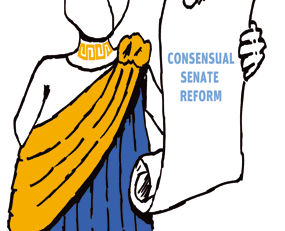
    A dynamic Seanad Éireann is crucial to a dynamic democracy. The Dáil hosts less and less challenging, expert-informed debate. Since last October’s referendum, many people are coming to a realisation of the need for Seanad reform that strengthens the institution. In its current form, although some great work does get done, the Seanad is only performing to a fraction of its potential. The Government’s recent reform proposals hardly change that at all. Democracy Matters has mapped out a vision for how the Seanad can be energised through a panel system. This is what was envisaged in the 1937 Constitution, but with the six university seats drawn from the entire third-level sector and with every citizen having an opportunity to vote. We propose 43 Seanad seats being drawn from all areas of national life: an agriculture, fishing and related areas panel, an arts, language, education, culture and literature panel, a labour – organised and unorganised – panel, an industry and commerce panel, and a public administration and social services (voluntary and statutory) panel. These panels would replace the politically-loaded, unevenly-weighted, and archaic representation in the current Seanad composition. Currently some citizens have up to seven votes in Seanad elections, while the majority have no vote at all. Our proposal will not require another constitutional referendum. As a cross-political-party [and none] campaign for Seanad reform, Democracy Matters has identified a consensus emerging on a number of areas that are seen as crucial to Seanad reform. Universal citizen suffrage where one person has one vote is a must. Gender equality is an underpinning priority. People of Northern Ireland as well as diaspora citizens need to be able to vote. The Seanad should take on the central function of contributing to and scrutinising EU legislation. The Dáil, for all its strengths, demonstrates an increasing vulnerability to being swayed by Party whips to serve various kinds of political expediency. This stifles real and passionate debate. The last few years have seen a large number of Dáil resignations from ‘conscientious objectors’ to the dictats of larger parties. The proposed Seanad reforms counter this head-on. The Seanad would be a democratically elected chamber in which the aspirations of the 1937 Constitution would be realised. It would be composed of an equal number of men and women on the basis of equality, chosen by all citizens to give a real voice to aspects of our national life that are rarely heard in the present system. A reformed Seanad would make Leinster House the centre of a rich, vibrant and inclusive democracy, bringing new freshness and breadth of vision to the Oireachtas, The Seanad is already far more than a ‘talking shop’, a rubber stamp or a retirement home for failed politicians. But this cross-Party reform agenda can build its energy to become a place of lively debate, expertise and decision-making. This is not just an aspiration, it is a distinct and practical possibility. Based on the referendum, I am hopeful that we can enact Seanad reform by the end of the lifetime of this Government. We could get an agreed Bill through the Dáil in 2014, in time for a general election as early as 2015. It may be 7-10 years before we get another chance to address this issue. Democracy Matters has proposed that an all-party Task Force be designated to see a reform process through to publication of Heads of Bill. In parallel, a Seanad working group should identify and implement the procedural changes required to make the day-to-day business of the Seanad more effective and efficient. Allparty agreement should be sought for the passage of legislation in late 2014. My central hope is that the Irish people will see the relevance of this campaign and make themselves heard through their respective political affiliations at local level, so as to accelerate meaningful Seanad reform with a view to the Oireachtas becoming democratised in its entirety. Senator Katherine Zappone

    Loading

    Read more