General

Random entry RSS

  • Posted in:

    Continuing someone else’s journey

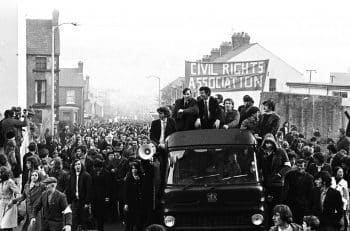
    Last month in Belfast the first of many commemorative events took place to mark the fiftieth anniversary of the formal founding of the Northern Ireland Civil Rights Association, NICRA. The organisation was pivotal in bringing together all those who were discontented with the status quo in the North. Within eighteen months, a wave of protest over civil rights engulfed Northern Ireland, forcing the Westminster government to implement a series of reforms (in access to housing, voting, and disbanding the B-Specials), which in turn toppled the local government and instigated almost thirty years of direct rule. The Linen Hall Library holds the most extensive collection of primary materials on the civil rights movement, and it has dedicated itself for this year and next to discussing the movement’s impact 50 years on. In this vein, the library hosted two events in April: the first, a talk by Professor Paul Arthur, who was a student at Queen’s University Belfast in the 1960s and a member of People’s Democracy. So far, his 1974 book is the only published account of the student movement in Belfast. The second event was a discussion panel on ‘Civil Rights – a missed opportunity?’ sponsored by the Connolly Association, which included speakers Professor Anthony Coughlan and Kevin McCorry. I noted three key things from both events. First, Paul Arthur spoke about the various agendas that existed within NICRA, including the student movement of which he was part. He prefaced some of this with a quote from Seamus Deane’s 1972 poem, ‘Derry’: “The unemployment in our bones Erupting on our hands in stones; The thought of violence a relief The act of violence a grief …”. For Arthur, these lines best encapsulate the ever-present wavering between militancy and constitutionalism that existed in the broader civil rights movement, a debate that has been identifiable in histories of the movement since. Professor Anthony Coughlan, in an article published for this magazine in February this year, firmly lays the blame for the explosion of violence from this period onwards at the door of People’s Democracy, a student-led group that was part of the broader civil rights movement. According to Coughlan, the People’s Democracy march from Belfast to Derry in January 1969 “raised the sectarian temperature markedly”. This need to scapegoat and to recriminate began almost immediately with the publication of the Cameron Report commissioned by the British government, a 1969 document that Coughlan suggests is “still the best account of the early Civil Rights period”. Later historians, such as Henry Patterson and Joe Lee, have continued in the same vein. As a result, the mainstream, consensus narrative of the civil rights movement in the North, tends, unfairly, to side-line the student impact or represent it as an irrelevant irritant to the more mature, sober and minimalist activities of NICRA and to the emerging political ideologies of a newly energised nationalism. But if we look closely at the Queen’s University student newspaper, the Gown, in the years leading up to this period, we can appreciate how wide the political scope of student activism had become. These students were internationalising the situation in Northern Ireland, arguably more than NICRA was, by linking it not only to the civil rights movement in the US, but more widely to student movements for free speech and freedom to assemble in Europe, to anti-colonial struggles in Africa and Vietnam, and to gender rights. The second thing that became clear at both events is that the civil rights movement is remembered differently by different people. Arthur perceptively remarked that in his reappraisal of the movement, there was a great deal of re-remembering and mis-remembering. Issues of civil rights, past and present, remain vital to the contested political culture in Northern Ireland. Equally important are the issues of memory, legacies of conflict, and dealing with the past, which continue to threaten the stability of the government there. As the centenary commemorations of the Irish revolution (1912-23) have revealed, memory is crucial to the understanding of Northern Ireland culture precisely because it is an indicator of collective desires and self-definitions. Since 1998, society in the North has been marked by a tendency towards increasingly divided memory. Events from the start of the Troubles have been interpreted in contrasting ways and the facts themselves are often disputed. There has been very little consensus about what happened, why it happened, and crucially, how to remember what happened. Even within communities, there has been a tendency to promote one set of memories over others. The civil rights movement circulates through Northern Irish memory in forms and through channels that are at once powerful, dangerous, and hotly contested. Debate continues on how much discrimination existed in Northern Ireland during the Stormont years (1921-1972) as well as the movement’s relationship to the violence of the 1970s and the 1980s. Yet remembrance is also a form of forgetting, and the dominant narrative of the civil rights movement – distilled from history and memory, twisted by ideology and political contestation, and embedded in museums, murals, public rituals, and textbooks – distorts and suppresses as much as it reveals. Current realities (the signing of the Good Friday Agreement in 1998 that enshrined civil rights at its core, the ongoing issues since over how to deal with the past, and austerity policies implemented since 2009 that affect living standards) combine and influence the ways in which people relate and integrate the dimensions of past and present experience. A battle over the movement’s legacy has been waged within the Catholic community over the last decade, with both Sinn Féin and the SDLP claiming to be the true inheritors of the movement. How the Protestant and unionist community remember the movement has yet to be explored. In the commemorations of the civil rights movement, and the origins of the conflict that are approaching in the next number of years, it is not enough simply to ‘debunk’ or ‘explode’ the myths that are associated with the movement over the last fifty years, but

    Loading

    Read more

  • Posted in:

    Obituary: Terry Kelleher

    Terry Kelleher was born in 1948, in Dublin. His dad was a doctor in the British Army so he was educated in schools in Egypt, Austria, Germany, and eventually Wicklow. His elder brother John, later movie producer (‘Eat the Peach’) and film censor, recalls teaching him to walk, lured by sweets, on the Empress of Australia as it cruised to Egypt. They were close and later they would bunk into movie houses or, even better, act out the parts, and, as garrulous teenagers, interview each other. Terry spent six years in Clongowes Wood College in Kildare, winning prizes for Essays and Debating. He excelled at acting, famously featuring as loathsome Sir Richard Rich in ‘A Man for all Seasons’, amusingly opposite an older John Bruton as Cromwell. He did well academically and played prop on the Senior Cup Team. He was always strong. Perhaps under the usual parental pressure he completed a law degree in UCD though he never intended to practise it. He was a popular Director of DramSoc, working with Mary Finan and Veronica O’Mara (mother of actors Jason and Rebecca); and even acted a bit, including in ‘Anthony and Cleopatra’. The plays would go on in Newman House, in the Aula Maxima or Little Theatre (now the James Joyce centre). He became Deputy Editor of Hibernia Magazine in 1970 when it was in its heyday under the editorship of John Mulcahy, mostly writing about politics and culture and enjoying shepherding the often anonymous contributors. Hibernia in that period has been described as “a cross between the Good Wine Guide and Republican News” by Conor Cruise O’Brien, and as “irreverent”, “eclectic”, and “crusading” by John Horgan. Terry loved it. He moved on to the more workaday but, somewhat, better-paid Sunday Press around 1973. He wrote a guidebook to his beloved Dublin called ‘The Essential Dublin’. During the early stages of his relationship with Sheffield-born Rita, best friend of Terry’s sister Siún, he moved to London where he became a reporter in RTÉ’s London Office, on TV and, mostly, radio. Terry was outstanding. He married Rita and was a loving step-father to Rebecca and Dan. Jenni came along in 1981 and he could not have been more proud. In the mid-1970s he joined Thames Television, working first as a researcher, then a producer, later becoming Deputy Editor of ‘Thames News’. He was editor of Thames’ weekly magazine, London Reports and later its business affairs programme, ‘The City Programme’. He was made redundant with 2000 others when Thames lost its franchise and expired in 1991 in big-banging London. Hibernia in that period has been described as “a cross between the Good Wine Guide and Republican News” by Conor Cruise O’Brien, and as “irreverent”, “eclectic”, and “crusading” by John Horgan. Terry loved it. It was then that he entered his working prime – fuelled by a remarkable passion and integrity – establishing his own independent company, Platinum Productions, which made many high-quality programmes for Channel 4 and the BBC, including several editions of ‘Dispatches’ and specials for the ‘Money Programme’. In 1987 he produced and directed one of the most important miscarriage of justice documentaries ever made, presented by the formidable Paul Foot: ‘Murder at the Farm: Who Killed Carl Bridgewater?’. In 1978 13-year-old Carl Bridgewater had been shot in the head at close range at isolated Yew Tree farmhouse in Staffordshire as he did his paper-round. The Bridgewater Four were convicted of the killing during a burglary. Foot made the case that “Carl did not just interrupt the burglars or burglar, he knew them! The position in which the body was found indicates to me that someone asked or made Carl sit down. Then, he approached the boy and shot him at close range”. The thesis was convincing and in February 1997, after almost two decades of imprisonment, their convictions were overturned in the Court of appeal on technical grounds, and the three surviving defendants were released. The murder remains officially unsolved. In 2003 he upped sticks for St. Remy, one of the most charming towns in sun-kissed Provence, France, where Nostradamus was born and Vincent Van Gogh had been in the asylum. He spent perhaps his happiest years there, buying a house with a swimming pool and forging solid local friendships. Soccer-mad, he was thrilled when Jenni started working with the Football Association and later the Premiership in London. However, this was crowned when she got married to Tony Parks, one-time goalkeeper for Spurs, the hero who saved the final penalty in the shootout in the 1984 UEFA Cup final. The wedding was followed by revelries in the parkland of the gorgeous Hotel de l’Image in St. Remy. Little Lily was born three years ago. Terry was also best man at John’s wedding to Amanda last year in the town. These events were centrepieces of his last years. Sadly he had suffered ill health for decades. Having had run-ins with glaucoma and cancer while in London, he was diagnosed with Multiple sclerosis shortly after moving to St. Remy. This terrible disease sapped the energies of this, the most resilient of men, but his cheerfulness prevailed, year after year, even as he became painfully wheelchair-bound. It was too much in the end. The hospital in Arles told him he was losing the war and that all they could do was “accompany him”. At Easter, though not a religious man, he ‘celebrated’ the elevation of brother John’s long-suffering Sheffield United back into the Premiership, though he was a Wednesday man himself. He lapsed into a coma and by Easter Tuesday he was gone. All of his kids spoke proudly of him at the funeral in Nimes. A memorial service will be held in Dublin.

    Loading

    Read more

  • Posted in:

    Protestant abuse immunity from redress payments (and reportage)

    Joe Duffy’s ‘Liveline’ knows a good story when it sees one and came across a doozy in the Irish Times on 20 March. Kitty Holland had interviewed Mary Higgins, CEO of Caranua (meaning ‘good friend’), the state organisation set up to provide continuing support for victims of institutional abuse. Higgins said that some abused people she was employed to assist would never be satisfied, while some others had engaged in fraud. That was ‘Liveline’ sorted. Higgins’ uncomfortable presence on the RTÉ radio programme provided a target for survivors. ‘Liveline’ phones hopped for days afterwards. The encounter also provided a promotional tagline, broadcast on other RTÉ programmes for a week. Repeatedly, Duffy was heard insisting that Higgins should state: “The amount of money we have been given by the religious orders is not enough”. Caranua has since 2014 administered a Residential Institutions Statutory Fund, designed to provide ongoing non-cash support to abuse victims. It is limited to €110m, the sum promised by 18 Roman Catholic religious congregations in a 2002 deal, in return for indemnity against prosecution. Since 2002 the separate Residential Institutions Redress Board has spent €1.5bn compensating over 16,000 former residents of Industrial Schools, Children’s Homes and other institutions. For effect, the state has set an unrealisable goal of retrieving 50% of the cost from the 18 orders. All of the confusion surrounding responsibility for abuse and attempts to assuage society’s guilt, by assigning blame, is reflected in this story. Caranua realised last year that the rate at which it was spending would erode the fund before all were helped. A €15,000 per applicant limit was applied. The cap and the perceived disdain with which they were viewed by the head of an organisation supposed to assist them, revived some victim’s feelings of rejection. Caranua was no longer a friend, but became a new oppressor of those who had been abused. The spending cap turned the organisation into an abuse means-tester. Joe Duffy repeatedly asked Higgins to demand that the Roman Catholic Church pay more. Callers suggested approaching the Vatican. This refrain came from government too. The Catholic Church is to blame so the church should pay for its sins. The government narrative presents the Catholic Church and its 18 congregations as responsible for 100% of the abuse. The state paying half is presented as a more than reasonable compromise. Roman Catholic clergy perpetrated horrendous abuse. The institutional church covered it up and protected abusers. That is a fact whose political and social consequences should have monetary ones too: so says the public mood. There are a couple of complications. The children abused in residential institutions were usually put there and paid for by the state. The state had a duty of care. Inadequate inspection and regulation, and substandard payments per head of institutional population ensured that it failed in its duty. It was privatised social control of the poor and marginalised on the cheap, wrapped up in a harsh regime of sanction that was supposedly moral, though mostly it was immoral. Redress was and is a public liability. The call for a religious contribution to its cost incorporated an element of public relations, that could focus public anger on the Roman Catholic Church, an institution with which most Irish people had an intense emotional relationship. After all, the relationship has moved pretty rapidly since the late Bishop Eamon Casey was found to have shared his bed with Annie Murphy, especially when other clergy were found to have entirely unacceptable sexual tastes. An organisation that thrived on the basis that it was morally superior was on a descent to ridicule and revulsion. But that is not the only complication. On ‘Liveline’ on 22 March, three days into the story, Joe Duffy devoted 18 uninterrupted minutes to Eileen Macken, who is nearly 80. Eileen stated that her experience of Caranua, which paid for new windows and doors, was positive. Eileen was upset at hearing others’ negative experiences. Being a good and thoughtful person, she worried whether she might have been unconsciously selfish in accepting the help Caranua literature encouraged her to apply for. Eileen related how she had been to the hospital that morning and that she required painful injections to her hands. In his folksy way Joe Duffy made a reference to Padre Pio, which passed Eileen by. Eileen is a member of the Church of Ireland, where Padre Pio’s stigmata are not a regular topic of conversation. Eileen was brought up in two Protestant residential institutions. In 1937 she came into this world in a doctor’s surgery on Dublin’s fashionable Leeson Street. From there she was consigned on her own to the Protestant evangelical Bethany Home. From five months until the age of 17, Eileen resided in the Church of Ireland Orphan House on the North Circular Road, later Kirwan House. Eileen suffered severe physical and emotional abuse in primary school, where a teacher punished her relentlessly because she was born out of wedlock. Eileen, who wanted to be a nurse, was destined for life as a servant in homes of richer members of the Church of Ireland community. She eventually escaped that fate. Eileen outlined her good fortune in making a loving family with husband George, but also her inability to find out where she came from. She recently suffered a severe setback in that quest, which she explained. Eileen’s orphanage was listed officially with the Residential Institutions Redress Board in 2002 as a place where abuse occurred. Eileen told the Board her story and reportedly received €70,000 by way of compensation. Then along came Caranua in 2013, promising more help from its €110m fund. But, here is the rub: why are 18 Roman Catholic congregations expected to fund victims of Protestant-ethos institutions? How are they responsible for abuse that occurred in Protestant institutions? Why are the Church of Ireland and other Protestant congregations paying nothing, is the question no one is asking. There is a song that goes ‘That’s the way God planned it’. In

    Loading

    Read more

  • Posted in:

    Hot Air on Cold Air

    In the 1970s, climate scientists knew there was a link between CO2 and global warming, the cooling effects of sulphate aerosols in the atmosphere and even of Earth’s cyclic change of orbit around the sun, believed to be the precursor to the planet’s ice ages. Between the 1940s and 1970s was a period of global cooling in the Northern Hemisphere; ground temperatures dropped, the polar caps appeared to be growing and weather patterns brought unseasonal amounts of snow and ice cover. In particular, satellite imagery revealed a sudden increase in Northern Hemisphere snow cover between 1971 and 1972. As far back as 1938 an analysis of long-term warming trends from the 1870s had been published, demonstrating for the first time that temperature increase was linked to the onset of the industrial revolution and CO2 emissions. A survey of scientific literature from 1965 to 1979 found 7 articles predicting cooling and 44 predicting warming, but it was global cooling that made media headlines. In the early 1970s, scientists debated why the Earth appeared to be cooling, and it was hypothesised that sulphate aerosols – which reflect sunlight – might be countering the warming effects of carbon dioxide. A small number of scientists posited the notion that the Earth might, in fact, be heading toward an ice age. America and Europe had escaped the 500-year-long so-called ‘Little Ice Age’ around 1850, and it was feared there could be a worldwide return. Moreover, it had been discovered that the present interglacial age was in fact an anomaly in Earth’s history and that a new glacial age was due ‘soon’. How soon was open to wide debate. Echoing these concerns, Professor Kenneth E.F. Watt, scientific and policy advisor to the Center for the Study of Carbon Dioxide, said in 1970: “If present trends continue, the world will be about four degrees colder for the global mean temperature in 1990, but 11 degrees colder by the year 2000. This is about twice what it would take to put us in an ice age”. NASA too, was concerned, and in July 1971, NASA scientist S.I. Rasool predicted that if fossil-fuel dust continued to be injected into the atmosphere over several years, “such a temperature decrease could be sufficient to trigger an ice age”. At a meeting of the National Academy of Sciences (NAS) in January 1974, certain scientists suggested the evacuation of six million people from the Sahel region in Africa. They feared faced starvation due to the effects of global cooling. Well-meaning 1970s celebs got in on the act. Leonard Nimoy narrated the apocalyptic T.V. documentary, ‘In Search Of The Coming Ice Age’. In his authoritative Vulcan timbre, Nimoy intoned: “Climate experts believe the next ice age is on its way…if we are unprepared for the next advance, the result could be hunger and death on a scale unprecedented in all of history…during the lifetime of our grandchildren, arctic cold and perpetual snow could turn most of the inhabitable portions of our planet into a polar desert”. Predictably, the press seized on all these apocalyptic predictions and, ignoring 1970s scientific consensus, afforded credibility to the global cooling theorists as they revelled in the story’s sensationalist potential. Very soon, global cooling found new advocates as reporters fell behind the new narrative. Even the reputable, ‘quality’ press foretold the end of civilisation: ‘New Ice Age Coming – It’s Already Getting Colder’ (L.A. Times, Oct 1971); ‘Scientist Sees Chilling Signs Of New Ice Age’ (L.A. Times, Sept 1972); ‘Science: Another Ice Age?’ (Time magazine, Nov 1972); ‘Ice Age, Worse Food Crisis Seen’ (The Chicago Tribune, Oct 1974); ‘The Cooling World’ (Newsweek, Apr 1975); ‘The Big Freeze’ (Time magazine, Jan 1977). The New York Times, in particular, left impartiality and journalistic standards out in the cold. In the period from 1924 to 2005, The Times reported four climate changes, each one contradicting the last: ‘MacMillan Reports Signs of New Ice Age’ (Sept 1924); ‘America in Longest Warm Spell Since 1776…’ (Mar 1933); ‘Scientists Ponder Why World’s Climate is Changing; A Major Cooling Widely Considered to be Inevitable’ (May 1975); ‘Past Hot Times Hold Few Reasons to Relax About New Warming’ (Dec 2005). It was these inconsistencies and the preference of sensationalism that obfuscated genuine debate and misinformed the general public, obscuring very real concerns over global warming. It could be argued that journalists were simply reporting what scientists were saying, but much of the information was misrepresented, only a minority of the scientific community were referenced or quoted, and conflicting scientific literature was not referred to. It was unbalanced, unscientific. Campaigners inevitably picked up on the journalism. At the first Earth Day celebration in April 1970, environmentalist Nigel Calder warned “the threat of a new ice age must now stand alongside nuclear war as a likely source of wholesale death and misery for mankind”. A number of ‘solutions’ were put forward to counter the cooling, including pumping extra CO2 into the atmosphere, diverting arctic rivers and even melting polar caps by covering them with black soot. However, climatologists – not implausibly – believed these measures would only create more problems than they would solve. The impact of CO2 was never forgotten and some attempted to establish a sort of CO2/aerosol calculus. The opposing effects were weighted in a 1971 paper by Rasool and Dr Steven Schneider; the conclusion of this study was that an increase by a factor of four in global atmospheric aerosol could be enough to trigger another ice age. Critics noted that the effects of aerosols in the atmosphere had been overestimated in comparison to the warming effects of CO2. In 1975, the NAS backtracked on its initial concerns, reporting: “Our knowledge of the mechanisms of climate change is at least as fragmentary as our data…Not only are the basic scientific questions largely unanswered, but in many cases we do not yet know enough to pose the key questions’. The heat was cooling. By 1980, predictions of an imminent ice age had largely ceased, as scientists

    Loading

    Read more

  • Posted in:

    Beauty Is Education Is Truth

    In certain circles it is still a compliment to say someone is civilised. Or for that matter a lady or a gentleman. Mostly, however the expressions are now notable for class undertones as if to be a gentleman was to be Bertie Wooster, to be a lady a badge of subservience. The word has been corrupted which is a pity for it is critically needed in dangerous times. So, for example, being civilised is certainly not a question of wealth or social status. Look at the boorish barbarians, Mr Trump and his entourage, or the Tory Brexiteers, or indeed significant tranches of the Fine Gael middle class in Ireland. The plummy, clubbable barrister may consider justice a mere game. Being civilised is not intrinsically related to education, at least to formal education. Increasingly the education system is imparting in people narrow technocratic skills useful for employability but no taste, no ethics, no sociability, nothing particularly civilised. We are breeding a generation of rote learners not critical thinkers. A new age of conformity where obedience to authority for the sake of it is necessary for success. Moreover, within the college structure promotion and preferment are now linked to an increasingly controlled discourse where ideas that cut across the norm that suit the vested interests of the status quo – ideas that have even a tinge of leftism or anti-authoritarianism, are penalised. It need not be stressed that. The paradigm of discourse is neo-liberalism and knee-jerk conservatism which morphs very easily into indulgence of fascism, the antithesis of civilisation. Certainly education through wide-ranging reading is part of being civilised. I do not trust decision-makers who do not read literature and history for pleasure or or have some smattering of philosophy (totally absent in Ireland) and social theory. Musical appreciation too is a requisite. It seems to me that those seeking positions of civic responsibility who have functions to perform but do not have a sufficiently wide framework of reference or indeed cultivation to come to nuanced and balanced decisions should be disqualified from appointment in the first place. Of course it is a lot to ask as we are living in a frenetic and frantic world where many of us are increasingly in survival mode. What time have we for reading or for that matter the opera – yet not to read at all seems to me an abnegation of responsibility. Make the time. And when I mean reading I do not mean scanning a newspaper or surfing the internet. I mean reading a book. Ask anyone from the Irish government’s front bench of Ireland to read The Brothers Karamazov or Ulysses and see how they would fare. Force them to do so at gun point. A rather thuggish senior counsel once sought to priggishly reprimand me for reading. People become interested in other things such as women he intimated, boorishly, studdishly. In another Russian novel “Fathers and Sons” by Turgenev the effete aristocrat Pavel Petrovich is ridiculed by the new breed of nihilistic proto-Bolshevik intellectuals. Being civilised becomes a crucial sign of weakness or opportunity to the unscrupulous and the cynical. They see it as a softening and a weakness and in our increasingly Social Darwinist world as an opportunity to eliminate or destroy. Of course the employment of letters and irony unsettles those who do not have it. Depth and sophistication are very dangerous to those whose modus operandi is calumny and simplification. The ambiguity and subtlety of language is a powerful weapon. Even Enda Kenny seems to know this. The Pen, properly used at least, if not mightier than, is always a useful counter-weight to the Sword. Being civilised also does not necessarily mean having taste or good manners. Heydrich played Schubert at the Wannsee conference as he ordered the mass liquidation of the Jews. My late friend Judge Hardiman ate like a hungover Cockney ne’erdowell in a greasy spoon café yet he was one of the more civilised individuals I have met. But Hardiman was a master of the truth. One need only read his judgments on our delinquent tribunals and constabulary. One of the fruits of being civilised is an affinity with, indeed a quest for, the truth. I’ll hang my definition on that. The Zeitgeist phrase is the nonsense, ‘post-Truth’. Of course Truth is transcendent. For facts it is a matter of empiricism, of evidence, of induction. For opinions it is not so clear but attitudes that converge on decency, that maximise, or optimise, freedom and equality, are best. It’s good to be robust and unambiguous in disparaging nonsense in facts, and intolerance in opinions. Climate-scepticism and Trumpism/the ‘Alt-Right’ are exemplars. They deserve no credit. A proper zeal for the truth is the likes of Chomsky’s attitude to structuralism and post-structuralism which he manifests with overarching clarity: “It’s entirely possible that I’m simply missing some- thing, or that I just lack the intellectual capacity to understand the profundities that have been unearthed in the past 20 years or so by Paris intellectuals and their followers. I’m perfectly open-minded about it, and have been for years, when similar charges have been made — but without any answer to my questions. Again, they are simple and should be easy to answer, if there is an answer: if I’m missing something, then show me what it is, in terms I can understand. Of course, if it’s all beyond my comprehension, which is possible, then I’m just a lost cause, and will be compelled to keep to things I do seem to be able to understand, and keep to association with the kinds of people who also seem to be interested in them and seem to understand them (which I’m perfectly happy to do, having no interest, now or ever, in the sectors of the intellectual culture that engage in these things, but apparently little else). “Since no one has succeeded in showing me what I’m missing, we’re left with the second option: I’m just incapable of understanding. I’m

    Loading

    Read more