Archives

OK

Random entry RSS

Loading

  • Posted in:

    Paying for Tubs, Miriam etc.

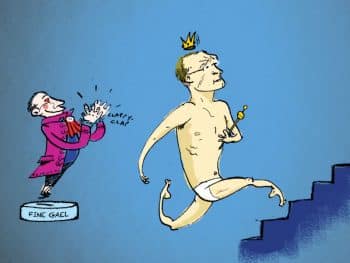
    The idea for a television licence decoupled from ownership of a television, proposed by Fine Gael as long ago as the 2011 election campaign as a “content tax” or “public broadcasting charge to apply to all households and applicable businesses, regardless of the device they use to access content” has undergone several iterations since, but is not on the agenda of anyone realistic about Irish politics. Meanwhile RTÉ continues to struggle financially to keep its head above water. In the coalition government that followed the 2011 election, Labour ministers – Pat Rabbitte then Alex White – took over the communications portfolio, and neither seemed enthusiastic about a new and more wide-ranging TV licence scheme, especially given the problems water charges were causing. The idea of a content tax was quietly shelved. The idea was raised again following a Sean O’Rourke interview with RTÉ director general Dee Forbes on the subject of the station’s finances, during which she mentioned the fabulous value-for money of the RTÉ TV licence. “The licence fee [€160] is 40 cents a day. That’s what it costs the Irish viewer. I think that’s incredible value for money. Quite honestly I think it should be double that”, she told the mid-morning show. “Look at the Scandinavian markets where the licence fee is double that and you see what they’re getting for that. The more money we have to play with content the more we can do. The case we’re in now is critical. We’re fighting for survival as an organisation. What I have to do, along with the team here, is ensure that we do survive”. There followed a flurry of RTÉ stories, as Forbes was forced to clarify she was not saying the licence fee should be doubled, minister Denis Naughten effectively ruled out any fee increase, and the usual stories about who might take over licence collections to reducing the non-payment rate (estimated at 15 percent of the 92% of households that have a TV) were reheated. The station had a €2.8m deficit in 2015 and the 2016 figure is expected to be multiples of that figure, for reasons ranging from the expense of covering the Olympics to the decline in UK-based advertisers due to Brexit. In January 2017, it announced plans to sell off part of its prime Donnybrook campus. A few days after Forbes’ interview, the “content tax” on all screens larger that eleven inches resurfaced. Having already been put on hold once, a broad-based broadcasting tax seems unlikely to succeed a second time. Memories of the backlash against water charges are still fresh. However, the idea now seems to be institutionally embedded. Quite conceivably, after a few years and the next round of electoral musical chairs, one could foresee a Fianna Fáil (or possibly Sinn Féin) minister propose an amalgamated Home Tax, which would incorporate a broadcasting charge to finance RTÉ alongside the existing property tax, refuse charges, and perhaps even water charges. It would be marketed as an efficiency, so that harried taxpayers would only have to keep track of one tax bill instead of several. Italy, Greece, and Portugal take their fees as part of household electricity bills. By then, RTÉ may have stemmed the flow temporarily by selling off some of the family silver and organising another round of redundancies, but it will still be caught in a downward spiral as advertising migrates to the behemoths of Google and Facebook. Of the fee, approximately 85% goes to RTÉ to carry it out its Public Service Media commitments. A further 7% is paid to the Broadcasting Authority of Ireland for the operation of the Broadcasting Funding Scheme, TG4 also receives €9.24m per annum and An Post is paid approximately 6% of the fee in respect of TV licence collection activities. Dee Forbes did have a point when she spoke about the value the station offers at “40 cents a day”. Denmark, a country with only a slightly larger population, charges €322 for a TV licence, over twice the Irish rate. In addition, the licence is not restricted to TVs, but can also apply to computer screens. The results of that greater investment can be been seen on Irish TV and other screens, where viewers are familiar with successful exports like ‘Borgen’ and ‘The Bridge’. Everyone in Ireland benefits from a financially healthy RTE, not least because occasionally ‘Prime Time’ or ‘This Week’ can spend half an hour dissecting the latest HSE or Garda omnishambles, and someone has to do that work. And a financially healthier firm would also have the resources to produce two or three high-quality programmes a year which it could export to other TV markets, earning additional revenue. But persuading the multitude that they need to pay more for RTÉ when presented with, for example, Ryan Tubridy’s annual salary, may be an uphill climb too far for Ireland’s politicians.  Written by Gerard Cunningham

    Loading

    Read more

  • Posted in:

    Protestant abuse immunity from redress payments (and reportage)

    Joe Duffy’s ‘Liveline’ knows a good story when it sees one and came across a doozy in the Irish Times on 20 March. Kitty Holland had interviewed Mary Higgins, CEO of Caranua (meaning ‘good friend’), the state organisation set up to provide continuing support for victims of institutional abuse. Higgins said that some abused people she was employed to assist would never be satisfied, while some others had engaged in fraud. That was ‘Liveline’ sorted. Higgins’ uncomfortable presence on the RTÉ radio programme provided a target for survivors. ‘Liveline’ phones hopped for days afterwards. The encounter also provided a promotional tagline, broadcast on other RTÉ programmes for a week. Repeatedly, Duffy was heard insisting that Higgins should state: “The amount of money we have been given by the religious orders is not enough”. Caranua has since 2014 administered a Residential Institutions Statutory Fund, designed to provide ongoing non-cash support to abuse victims. It is limited to €110m, the sum promised by 18 Roman Catholic religious congregations in a 2002 deal, in return for indemnity against prosecution. Since 2002 the separate Residential Institutions Redress Board has spent €1.5bn compensating over 16,000 former residents of Industrial Schools, Children’s Homes and other institutions. For effect, the state has set an unrealisable goal of retrieving 50% of the cost from the 18 orders. All of the confusion surrounding responsibility for abuse and attempts to assuage society’s guilt, by assigning blame, is reflected in this story. Caranua realised last year that the rate at which it was spending would erode the fund before all were helped. A €15,000 per applicant limit was applied. The cap and the perceived disdain with which they were viewed by the head of an organisation supposed to assist them, revived some victim’s feelings of rejection. Caranua was no longer a friend, but became a new oppressor of those who had been abused. The spending cap turned the organisation into an abuse means-tester. Joe Duffy repeatedly asked Higgins to demand that the Roman Catholic Church pay more. Callers suggested approaching the Vatican. This refrain came from government too. The Catholic Church is to blame so the church should pay for its sins. The government narrative presents the Catholic Church and its 18 congregations as responsible for 100% of the abuse. The state paying half is presented as a more than reasonable compromise. Roman Catholic clergy perpetrated horrendous abuse. The institutional church covered it up and protected abusers. That is a fact whose political and social consequences should have monetary ones too: so says the public mood. There are a couple of complications. The children abused in residential institutions were usually put there and paid for by the state. The state had a duty of care. Inadequate inspection and regulation, and substandard payments per head of institutional population ensured that it failed in its duty. It was privatised social control of the poor and marginalised on the cheap, wrapped up in a harsh regime of sanction that was supposedly moral, though mostly it was immoral. Redress was and is a public liability. The call for a religious contribution to its cost incorporated an element of public relations, that could focus public anger on the Roman Catholic Church, an institution with which most Irish people had an intense emotional relationship. After all, the relationship has moved pretty rapidly since the late Bishop Eamon Casey was found to have shared his bed with Annie Murphy, especially when other clergy were found to have entirely unacceptable sexual tastes. An organisation that thrived on the basis that it was morally superior was on a descent to ridicule and revulsion. But that is not the only complication. On ‘Liveline’ on 22 March, three days into the story, Joe Duffy devoted 18 uninterrupted minutes to Eileen Macken, who is nearly 80. Eileen stated that her experience of Caranua, which paid for new windows and doors, was positive. Eileen was upset at hearing others’ negative experiences. Being a good and thoughtful person, she worried whether she might have been unconsciously selfish in accepting the help Caranua literature encouraged her to apply for. Eileen related how she had been to the hospital that morning and that she required painful injections to her hands. In his folksy way Joe Duffy made a reference to Padre Pio, which passed Eileen by. Eileen is a member of the Church of Ireland, where Padre Pio’s stigmata are not a regular topic of conversation. Eileen was brought up in two Protestant residential institutions. In 1937 she came into this world in a doctor’s surgery on Dublin’s fashionable Leeson Street. From there she was consigned on her own to the Protestant evangelical Bethany Home. From five months until the age of 17, Eileen resided in the Church of Ireland Orphan House on the North Circular Road, later Kirwan House. Eileen suffered severe physical and emotional abuse in primary school, where a teacher punished her relentlessly because she was born out of wedlock. Eileen, who wanted to be a nurse, was destined for life as a servant in homes of richer members of the Church of Ireland community. She eventually escaped that fate. Eileen outlined her good fortune in making a loving family with husband George, but also her inability to find out where she came from. She recently suffered a severe setback in that quest, which she explained. Eileen’s orphanage was listed officially with the Residential Institutions Redress Board in 2002 as a place where abuse occurred. Eileen told the Board her story and reportedly received €70,000 by way of compensation. Then along came Caranua in 2013, promising more help from its €110m fund. But, here is the rub: why are 18 Roman Catholic congregations expected to fund victims of Protestant-ethos institutions? How are they responsible for abuse that occurred in Protestant institutions? Why are the Church of Ireland and other Protestant congregations paying nothing, is the question no one is asking. There is a song that goes ‘That’s the way God planned it’. In

    Loading

    Read more

  • Posted in:

    Hot Air on Cold Air

    In the 1970s, climate scientists knew there was a link between CO2 and global warming, the cooling effects of sulphate aerosols in the atmosphere and even of Earth’s cyclic change of orbit around the sun, believed to be the precursor to the planet’s ice ages. Between the 1940s and 1970s was a period of global cooling in the Northern Hemisphere; ground temperatures dropped, the polar caps appeared to be growing and weather patterns brought unseasonal amounts of snow and ice cover. In particular, satellite imagery revealed a sudden increase in Northern Hemisphere snow cover between 1971 and 1972. As far back as 1938 an analysis of long-term warming trends from the 1870s had been published, demonstrating for the first time that temperature increase was linked to the onset of the industrial revolution and CO2 emissions. A survey of scientific literature from 1965 to 1979 found 7 articles predicting cooling and 44 predicting warming, but it was global cooling that made media headlines. In the early 1970s, scientists debated why the Earth appeared to be cooling, and it was hypothesised that sulphate aerosols – which reflect sunlight – might be countering the warming effects of carbon dioxide. A small number of scientists posited the notion that the Earth might, in fact, be heading toward an ice age. America and Europe had escaped the 500-year-long so-called ‘Little Ice Age’ around 1850, and it was feared there could be a worldwide return. Moreover, it had been discovered that the present interglacial age was in fact an anomaly in Earth’s history and that a new glacial age was due ‘soon’. How soon was open to wide debate. Echoing these concerns, Professor Kenneth E.F. Watt, scientific and policy advisor to the Center for the Study of Carbon Dioxide, said in 1970: “If present trends continue, the world will be about four degrees colder for the global mean temperature in 1990, but 11 degrees colder by the year 2000. This is about twice what it would take to put us in an ice age”. NASA too, was concerned, and in July 1971, NASA scientist S.I. Rasool predicted that if fossil-fuel dust continued to be injected into the atmosphere over several years, “such a temperature decrease could be sufficient to trigger an ice age”. At a meeting of the National Academy of Sciences (NAS) in January 1974, certain scientists suggested the evacuation of six million people from the Sahel region in Africa. They feared faced starvation due to the effects of global cooling. Well-meaning 1970s celebs got in on the act. Leonard Nimoy narrated the apocalyptic T.V. documentary, ‘In Search Of The Coming Ice Age’. In his authoritative Vulcan timbre, Nimoy intoned: “Climate experts believe the next ice age is on its way…if we are unprepared for the next advance, the result could be hunger and death on a scale unprecedented in all of history…during the lifetime of our grandchildren, arctic cold and perpetual snow could turn most of the inhabitable portions of our planet into a polar desert”. Predictably, the press seized on all these apocalyptic predictions and, ignoring 1970s scientific consensus, afforded credibility to the global cooling theorists as they revelled in the story’s sensationalist potential. Very soon, global cooling found new advocates as reporters fell behind the new narrative. Even the reputable, ‘quality’ press foretold the end of civilisation: ‘New Ice Age Coming – It’s Already Getting Colder’ (L.A. Times, Oct 1971); ‘Scientist Sees Chilling Signs Of New Ice Age’ (L.A. Times, Sept 1972); ‘Science: Another Ice Age?’ (Time magazine, Nov 1972); ‘Ice Age, Worse Food Crisis Seen’ (The Chicago Tribune, Oct 1974); ‘The Cooling World’ (Newsweek, Apr 1975); ‘The Big Freeze’ (Time magazine, Jan 1977). The New York Times, in particular, left impartiality and journalistic standards out in the cold. In the period from 1924 to 2005, The Times reported four climate changes, each one contradicting the last: ‘MacMillan Reports Signs of New Ice Age’ (Sept 1924); ‘America in Longest Warm Spell Since 1776…’ (Mar 1933); ‘Scientists Ponder Why World’s Climate is Changing; A Major Cooling Widely Considered to be Inevitable’ (May 1975); ‘Past Hot Times Hold Few Reasons to Relax About New Warming’ (Dec 2005). It was these inconsistencies and the preference of sensationalism that obfuscated genuine debate and misinformed the general public, obscuring very real concerns over global warming. It could be argued that journalists were simply reporting what scientists were saying, but much of the information was misrepresented, only a minority of the scientific community were referenced or quoted, and conflicting scientific literature was not referred to. It was unbalanced, unscientific. Campaigners inevitably picked up on the journalism. At the first Earth Day celebration in April 1970, environmentalist Nigel Calder warned “the threat of a new ice age must now stand alongside nuclear war as a likely source of wholesale death and misery for mankind”. A number of ‘solutions’ were put forward to counter the cooling, including pumping extra CO2 into the atmosphere, diverting arctic rivers and even melting polar caps by covering them with black soot. However, climatologists – not implausibly – believed these measures would only create more problems than they would solve. The impact of CO2 was never forgotten and some attempted to establish a sort of CO2/aerosol calculus. The opposing effects were weighted in a 1971 paper by Rasool and Dr Steven Schneider; the conclusion of this study was that an increase by a factor of four in global atmospheric aerosol could be enough to trigger another ice age. Critics noted that the effects of aerosols in the atmosphere had been overestimated in comparison to the warming effects of CO2. In 1975, the NAS backtracked on its initial concerns, reporting: “Our knowledge of the mechanisms of climate change is at least as fragmentary as our data…Not only are the basic scientific questions largely unanswered, but in many cases we do not yet know enough to pose the key questions’. The heat was cooling. By 1980, predictions of an imminent ice age had largely ceased, as scientists

    Loading

    Read more

  • Posted in:

    Garda too strong, yet too weak

    The Garda appears to be stumbling from crisis to crisis. As Village was going to print Fianna Fáil was considering a vote of no confidence in its management and the Government had agreed a ‘root and branch’ review. It is now difficult to keep account of all of the controversies that the force has been embroiled in – or the associated inquiries. The current difficulties with a million phantom breath tests, and 14,700 wrongful convictions for motoring offences, the ongoing tribulations of Garda management in the mishandled controversy surrounding the Garda whistleblower, Maurice McCabe, apparent misaccounting in Templemore and rumours of false crime, including murder and domestic-violence, statistics, are just the latest in the downward spiral of scandals – but are nothing new.  For most of the history of the new Irish state the success of the Garda force in presenting a neutral, unarmed and publicly acceptable form of policing after a bitter civil war has been the subject of wide-ranging favourable commentary. However, in the modern era, certainly from the 1980s onwards, the force has not coped well. Vincent Browne recently recalled how, following the murder of the British Ambassador Christopher Ewart-Biggs in 1976, two gardaí who argued a fingerprint allegedly found on a helmet near the scene of the explosion was not the suspect’s were moved out of the fingerprint unit and were effectively demoted. A subsequent inquiry into the affair led by the head of the fingerprint unit in Scotland Yard concluded that what was done in the Ewart-Biggs case “endangered the science of fingerprinting worldwide”. In 1977 Nicky Kelly, Osgur Breathnach and Brian McNally, members of the then newly formed Irish Socialist Republican Party (IRSP) were convicted of committing a £200,000 train robbery in Sallins, Co Kildare. The only evidence against them was confessions they made while in Garda custody and while in that custody there was clear evidence that they had suffered significant injuries. More that 20 gardaí gave evidence in almost identical phraseology that the accused were not assaulted in custody and that the confessions were voluntary. Kelly was ultimately pardoned and the other two acquitted. In many ways I am the last person to be critical of An Garda Síochána. My own grandfather joined the force in 1922, rising to the rank of Chief Superintendent, was shot at during the civil war and was compelled to carry a revolver for most of his service career. The fact that my father was a Minister from before I was born meant that much of my parenting and early lessons in life were actually provided by my fathers two Garda drivers. They were really part of our family and in many ways an inspiration to us growing up. My grandfather’s old dress uniform hung in his bedroom wardrobe well into retirement and we would gaze at it, as children, with great awe – its gold-braid peaked hat and the Sam Browne belt with blue whistle and tie.  Over the years in politics, business and in journalism I have interacted with senior gardaí and never found them wanting. In particular I found Garda Commissioners Pat Byrne and Fachtna Murphy to be exemplars of professionalism and would go as far as to count them as friends. Most of the gardaí I have spoken to, not the previously mentioned I hasten to add, have been shocked by revelations in the whistleblower affair. Few understand how the current Commissioner can retain her position, given that she must have known about so many of the controversies that are undermining the force including the incendiary rumours that were circulated about Maurice McCabe, including by senior members of the force. Though out of politics I was also on the receiving end of these stories. When the Garda want to put something out there they are not shy about it.  One reason why the Garda has not made an easy transition into the modern era of more sophisticated crime is because much of its work from 1969 onwards was taken up by the demonstrable threat to the state posed by the IRA. It gave a culture of secrecy and stealth the upper hand within the force. In a recent Irish Times’ article Vincent Browne claims: “Lawyers, acting for accused persons associated with illegal organisations, stated repeatedly during that time – ie in the 1970s and 1980s – that Garda perjury was a regular feature of such cases and, later, became almost a constant feature of many criminal trials, whether subversive related or not. At no time was there any inquiry into this or was any Garda disciplined within the force in that connection”. The same over-zealousness accounts for the fact that it is now suspected that at least 2,800 non-999 calls were monitored, in 23 Garda stations, from 1980 to 2013. The Ian Bailey case currently advancing to the French courts has aired serious allegations that gardaí considered paying someone in order to frame Bailey for murder. The instincts of many gardaí have been called into question. More generally in the JC case streetwise Supreme  Court Justice Adrian Hardiman rehearsed the critical findings of tribunals of inquiry into Garda conduct and cited recent “deeply disturbing developments” in relation to the force and its oversight. “If the ordinary citizen were provided with a defence of ‘I didn’t mean it’ or ‘I didn’t know it was against the law’, then many parts of the law would become completely unenforceable, he noted. The conflict in the North occasioned a corollary and opposite problem: the resources that had to be devoted to the conflict in Northern Ireland skewed the force’s operations. While on the one hand the conflict engendered some heavy-handed tactics, on the other it reduced the force’s efficacy, weakening it. So, the Garda was late to counter the threat posed by armed and well-organised crime gangs. The fact that for example the Kinahans have become one of the biggest drug gangs in Europe tells its own story. Symptomatic of the weakness of the Garda was the incident

    Loading

    Read more

  • Posted in:

    Beauty Is Education Is Truth

    In certain circles it is still a compliment to say someone is civilised. Or for that matter a lady or a gentleman. Mostly, however the expressions are now notable for class undertones as if to be a gentleman was to be Bertie Wooster, to be a lady a badge of subservience. The word has been corrupted which is a pity for it is critically needed in dangerous times. So, for example, being civilised is certainly not a question of wealth or social status. Look at the boorish barbarians, Mr Trump and his entourage, or the Tory Brexiteers, or indeed significant tranches of the Fine Gael middle class in Ireland. The plummy, clubbable barrister may consider justice a mere game. Being civilised is not intrinsically related to education, at least to formal education. Increasingly the education system is imparting in people narrow technocratic skills useful for employability but no taste, no ethics, no sociability, nothing particularly civilised. We are breeding a generation of rote learners not critical thinkers. A new age of conformity where obedience to authority for the sake of it is necessary for success. Moreover, within the college structure promotion and preferment are now linked to an increasingly controlled discourse where ideas that cut across the norm that suit the vested interests of the status quo – ideas that have even a tinge of leftism or anti-authoritarianism, are penalised. It need not be stressed that. The paradigm of discourse is neo-liberalism and knee-jerk conservatism which morphs very easily into indulgence of fascism, the antithesis of civilisation. Certainly education through wide-ranging reading is part of being civilised. I do not trust decision-makers who do not read literature and history for pleasure or or have some smattering of philosophy (totally absent in Ireland) and social theory. Musical appreciation too is a requisite. It seems to me that those seeking positions of civic responsibility who have functions to perform but do not have a sufficiently wide framework of reference or indeed cultivation to come to nuanced and balanced decisions should be disqualified from appointment in the first place. Of course it is a lot to ask as we are living in a frenetic and frantic world where many of us are increasingly in survival mode. What time have we for reading or for that matter the opera – yet not to read at all seems to me an abnegation of responsibility. Make the time. And when I mean reading I do not mean scanning a newspaper or surfing the internet. I mean reading a book. Ask anyone from the Irish government’s front bench of Ireland to read The Brothers Karamazov or Ulysses and see how they would fare. Force them to do so at gun point. A rather thuggish senior counsel once sought to priggishly reprimand me for reading. People become interested in other things such as women he intimated, boorishly, studdishly. In another Russian novel “Fathers and Sons” by Turgenev the effete aristocrat Pavel Petrovich is ridiculed by the new breed of nihilistic proto-Bolshevik intellectuals. Being civilised becomes a crucial sign of weakness or opportunity to the unscrupulous and the cynical. They see it as a softening and a weakness and in our increasingly Social Darwinist world as an opportunity to eliminate or destroy. Of course the employment of letters and irony unsettles those who do not have it. Depth and sophistication are very dangerous to those whose modus operandi is calumny and simplification. The ambiguity and subtlety of language is a powerful weapon. Even Enda Kenny seems to know this. The Pen, properly used at least, if not mightier than, is always a useful counter-weight to the Sword. Being civilised also does not necessarily mean having taste or good manners. Heydrich played Schubert at the Wannsee conference as he ordered the mass liquidation of the Jews. My late friend Judge Hardiman ate like a hungover Cockney ne’erdowell in a greasy spoon café yet he was one of the more civilised individuals I have met. But Hardiman was a master of the truth. One need only read his judgments on our delinquent tribunals and constabulary. One of the fruits of being civilised is an affinity with, indeed a quest for, the truth. I’ll hang my definition on that. The Zeitgeist phrase is the nonsense, ‘post-Truth’. Of course Truth is transcendent. For facts it is a matter of empiricism, of evidence, of induction. For opinions it is not so clear but attitudes that converge on decency, that maximise, or optimise, freedom and equality, are best. It’s good to be robust and unambiguous in disparaging nonsense in facts, and intolerance in opinions. Climate-scepticism and Trumpism/the ‘Alt-Right’ are exemplars. They deserve no credit. A proper zeal for the truth is the likes of Chomsky’s attitude to structuralism and post-structuralism which he manifests with overarching clarity: “It’s entirely possible that I’m simply missing some- thing, or that I just lack the intellectual capacity to understand the profundities that have been unearthed in the past 20 years or so by Paris intellectuals and their followers. I’m perfectly open-minded about it, and have been for years, when similar charges have been made — but without any answer to my questions. Again, they are simple and should be easy to answer, if there is an answer: if I’m missing something, then show me what it is, in terms I can understand. Of course, if it’s all beyond my comprehension, which is possible, then I’m just a lost cause, and will be compelled to keep to things I do seem to be able to understand, and keep to association with the kinds of people who also seem to be interested in them and seem to understand them (which I’m perfectly happy to do, having no interest, now or ever, in the sectors of the intellectual culture that engage in these things, but apparently little else). “Since no one has succeeded in showing me what I’m missing, we’re left with the second option: I’m just incapable of understanding. I’m

    Loading

    Read more

  • Posted in:

    Islamophobia

    In the great pantheon of aggrieved minorities in the US, no other has been open to such unrestrained media hostility and acts of violence against its people and property, as the nation’s Arab-American community. Muslims have been repeatedly singled-out by successive presidential administrations for attacks against civil liberties, covert surveillance by the sprawling intelligence apparatuses and heightened security checks on spurious national security grounds. This is despite the fact that the 54 fatalities caused by Muslim-American extremists in 2016 (123 since since 9/11) is dwarfed by the more than 240,000 Americans murdered over the same period. Between 2001 and 2015, more Americans were killed by homegrown right-wing extremists than by Islamist terrorists. President Trump is attempting indefinitely to suspend entry to the US from seven Muslim-majority countries. However, since 9/11, only 23 percent of Muslim-Americans involved with violent extremist plots had family backgrounds in these seven countries and in fact there has not been a single death caused by extremists with family backgrounds in any of them. Clearly the new regime is driven by something more than the need for a proportionate and necessary response. Inherent racism towards Muslims is now such an ingrained feature of US life that any president need only mention the word “Islam” and the public mind convulses with images of bearded men and Kalashnikovs intent on destroying all that is beautiful in the world. Media outlets have spent the last 40 years subjecting people of Muslim faith to repeated attack, endlessly broadcasting, as Gore Vidal once put it, “images of monstrous figures from Hieronymus Bosch staring out at us, hellfire in their eyes”, thus laying the groundwork for a public bedrock of anti-Arab sentiment now firmly established. The path has always been littered with the rose petals of electoral success for any politician willing to espouse crude anti-Muslim rhetoric. The fact that Donald Trump has capitalised off the back of these now withered leaves is unsurprising given the history of religious racism in the country. The core of Trump’s support comes, as it did with Reagan and Bush, from right-wing Evangelical Christians. These voters have enormous financial power, are overwhelmingly white and devoted to Israel, or rather what that State represents according to their religious beliefs. To such voters who take a literal interpretation of the bible, Armageddon is scheduled to take place in Israel at a date unspecified when the forces of good (white, Christian) will defeat the forces of evil (guess who?). In the eyes of the good book’s holy warriors, Israel, as bastion against evil, must be protected at all costs, thus explaining the fundamentalist Christian love of the Jewish State. Religiosity is therefore key. According to a 2016 Gallup Poll 41% of all respondents in the US regarded themselves as ‘Born Again’. In the same poll 72% believed in Angels and 47% believed that the Bible was the “inspired word of God”, up from 45% in 1976. This voter class is highly suspicious of outsiders, especially foreigners from the Middle East whom they view as attempting to subvert their Christian country (happily renamed the ‘Homeland’ since Bush) through the utterly implausible tool of Sharia law. They are thus easy prey for the passive-aggressive racism of Trump. The absurd belief among many of Trump’s followers that Muslims are little more than a fifth column in the US, intent on destroying freedom’s land from within, resonates freely. The roots of this anti-immigrant racism stretch back far to the nineteenth century and anti-Catholic bigotry that swept the country during the flood of immigration from Ireland after the Great Famine in the 1840s. Contemporary accounts reported shiploads of ragged, starving Irish disembarking onto the piers of Castle Clinton – forerunner to Ellis Island – to the hostility of the mainly Protestant merchant elites. Alarmed at the influx of Catholic Irish and German immigration which they perceived as undermining pure “Republican” ideals because such immigrants would owe loyalty not to the United States but to the Pope, native-born White Anglo-Saxon Americans formed the ‘Know-Nothing’ political party, devoted to extending the citizenship term to 20 years and deporting all immigrants with criminal convictions. The hatred would not die easily. When Al Smith, the first Irish American Catholic to hold the position of Governor in the country, became the Democratic candidate for president in 1928, the anti-Catholic hatred was so violent that Smith’s campaign train, passing fiery crosses on the hills of Kansas and Oklahoma, was turned back in some Western and Midwestern stops for fear that the police could not protect him. The bigotry was so intense that Smith campaigner Simon Rifkind would later comment that “I had not been aware of the intense anti-Catholicism that prevailed in this country… When I came to mid-America, it really hit you in the face”. Smith, hero to the working man in New York, was crushed in the general election. Perhaps most blatantly infamous was the racist incarceration during World War II of 110,000 people of Japanese ancestry who lived on the Pacific coast. Sixty-two percent of the internees were United States citizens. These actions were ordered by President Franklin D Roosevelt shortly after Imperial Japan’s attack on Pearl Harbor. Citizens who were as little as 1/16 Japanese and orphaned infants with “one drop of Japanese blood” could be placed in internment camps. Spiro Agnew once sagely noted that “the United States, for all its faults, is still the greatest nation in the country”. After Martin Luther King was assassinated Agnew berated Baltimore’s black leaders, in person, for the riots that followed. He once called an Asian American reporter a “fat Jap”. Fabulously corrupt and someone for whom books were only ever used to remedy uneven table legs, Agnew was of course Vice-President under Richard Nixon and it was Nixon, ever fascinated with secrecy, who initiated Operation Boulder, a visa-screening programme targeted against Arabs entering the US in the wake of the massacre of 11 Israeli athletes at the Munich Olympics in September, 1972. Ever since Arabs would prove

    Loading

    Read more

  • Posted in:

    Central Bank’s expensive atonement

    The suppurating carcass of the proposed Anglo Irish Bank headquarters on North Wall Quay in Dublin became a symbol for Ireland’s economic collapse. Its original architects Traynor O’Toole Ltd – in what is best seen as a fitting gesture – eventually went bust. In plain view of all on Dublin’s regimented riverside, the country ogled five years of awkward nudity as it chaperoned visitors – and emigrants – to the airport and port. The 20,000 sq m skeleton would at last be fleshed when Central Bank bought the site in May 2012 from NAMA for €7m. The morally bankrupt Central Bank was the only agency that could afford it, or at least the only agency that could make the Department of Finance believe that it could afford it. The fable of Aggrandised Construction and the Central Bank starts at Dame Street in the early 1970s when Sam Stephenson of Stephenson and Gibney was summoned by the Goliaths of State Financing to a meeting where they asked him to deliver a behemoth appropriate to their egos in what passed for Dublin’s financial district, and – fresh from stellar controversies over Wood Quay and Fitzwilliam St, to insulate them against inevitable controversy that would arise from their wish for a fifteen-storey building in a Georgian area with a medieval streetscape, that would involve demolishing the attractive 1790s ‘Commercial Buildings’. As with anything to do with the banking sector in Ireland its construction was controversial, though Stephenson artfully proposed a building that was no more than eight storeys. The problem was a breach of the planning permission involving a 30-feet exceedance of the permitted eight-storey height and the complicity of the planning authority. Dublin Corporation, the site shut down in the summer of 1973. A cause celebre for the cynics it was as late as 1979 and only after a public inquiry into the flouting of planning laws and a 400% cost overrun (£10m mitigated only by the payment by Stephenson of a ‘fine’ of £200,000 to the Central Bank) that it could be officially opened. The building is one of a handful of buildings in the world where the structure uses suspensions held from its centre. During construction each floor was built at ground level and then hoisted up with all the fittings and services already in place. Internally the offices are lit by floor-to-ceiling glazing which also gives the buildings its bold, layered, almost striped. appearance. Even though it is set back from the street line, its scale and massing dominates the street and skyline. Since, pending overdue traffic-calming on College Green, Dublin city-centre has no square, its plaza became the natural gathering area for skateboarders and protesters, notably Occupy. Sam Stephenson’s building has become the face of the Central Bank. When Village attacked the regulatory culture of the Bank some years ago it illustrated the story with an image of the building blindfold and with an orange in its concrete mouth. This imposing, impenetrable brute could not keep up with the changes, not only in modern corporate environments but also in society. Stephenson, roguish contrarian that he was, probably wouldn’t have wanted it to. Manifesting the old hierarchical system that served the Bank and the country so badly, the governor and directors occupied the infamous ‘seventh floor’, the city’s attic and a no-go zone for most staff – notably women, designed as it was with no ladies’ toilets – perhaps a last symbolic hurrah of a patriarchy before the spoilsport EEC imported equality standards including an end to the marriage bar that required women to give up their jobs in the civil service when the entered holy matrimony. There were inevitable difficulties with 1,400 staff members spread across six locations – three in Dame Street, and others near Harcourt Street, at Spencer Dock and in Sandyford for its currency centre. In January 2017 the Central Bank said it has completed the sale of its Dame Street premises to Hines and Peterson Group (Hong Kong) at a price of about €67m. Given the impending pedestrianisation of part of College Green, the new owners may well be looking to provide additional retail space at street level, some of which may encroach on space regarded as public. As it is not on Dublin City Council’s record of protected structures much – too much – is possible for this grizzled modernist avatar. Meanwhile the task of completing the new €140m headquarters was assigned to Henry J Lyons Architects, loaded with an implicit imperative to match the symbolism of the Dame St precursor. The 30,000 sq m building they have completed can house 1,400 staff and contains a range of open floor office areas and meeting rooms.Dublin’s quays are famously primarily a balance of small single-plot historic buildings and set-piece public institutional buildings including the Four Courts, the Custom House and more recently the Council’s Civic Offices. The design relates to the maritime history of the docklands with its triangular panels consolingly reminiscent of the sailing ships that once brought trade. Its distinctive colour, which shines like gold in the morning sun, has been criticised as ostentation. The form is made by wrapping the workplace in a simple but sophisticated glass skin which in turn is protected and shielded from glare and solar heat-gain by an outer layer of anodised aluminium triangular mesh panels. The perforation takes the appearance of solidity depending on the light. The concept evolved from a long discussion with Dublin City Council – which feared the appearance would be that of a big steel cage. Before the design stage Henry J Lyons statistically surveyed the staff of the Central Bank so they could envisage the life of a banker over a full week. The staff thought they needed large meeting rooms but instead what they needed was lots of smaller meeting rooms and break-out spaces. In effect conditions have been standardised on the understanding that staff can be moved at any time. There is a cashless staff canteen which accommodates

    Loading

    Read more