coalition

Random entry RSS

  • Posted in:

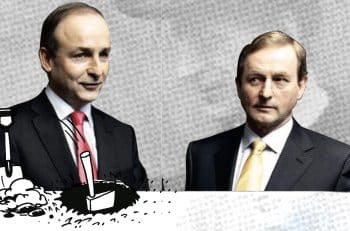
    FF won’t see coalition as an ideological issue and FG is glued to stability

    The most extraordinary coalition formed in Ireland was the first one, in 1948. It involved Fine Gael and a then-new party headed by Sean McBride, Clann na Poblachta. The Clann was a lively mixture of liberals, left-wingers and Republicans with a deep immersion in the IRA. The surprise with the Clann was that its youthful enthusiasm and vigorous campaigns against partition very nearly toppled De Valera from his then hegemony over Irish politics. McBride himself was a former IRA Chief of Staff who subsequently cut out a career for himself as an international eminence becoming a Nobel Prize laureate and founding member of Amnesty International – the campaigning global Human Rights body. Because of lingering republican bitterness against General Richard Mulcahy’s role in the civil war, Mulcahy, the Fine Gael leader, stood aside to facilitate a coalition with the Clann and its tooth and claw republican militants. John A Costello became Taoiseach in the coalition instead. The point of all of this is to illustrate that, from the very outset, coalition formation in Ireland has been a pragmatic business where big parties and small ones dispense with ideological or philosophical differences in order to provide an alternative government and run the country. Down the years few, if any, Fine Gael or Labour leaders worried too much about the differences of left and right when it came to forming a government designed to extract Fianna Fáil from prolonged periods in power. In 1989 Charles Haughey led Fianna Fáil for the first time ever into a coalition arrangement with the Progressive Democrats, stating cheerily: “Sure, it was only me that could have done it”. His party colleagues resisted it furiously believing non-participation in coalition an absolute core value for the party up to that point. The bitterness of doing this coalition was magnified by the presence of Des O’Malley and his new party – composed of individuals who had fought Haughey, then split from him to create their own party. For Haughey it was just another deal but for the Progressive Democrats, who claimed to be policy-focused, it was about taxation and other precious policy items, including a public Tribunal into the goings on in the Beef Industry. Haughey worked hard to save his own skin and persuade his ministerial colleagues of the merits of going into coalition. Apparently at one stage in the discussions around the cabinet table he held out his arms sideways demanding in relation to the opposition: “D0 you want to give them all of this?”. Shortly afterwards the new Taoiseach Albert Reynolds formed a coalition with the Labour Party which followed an election in 1992 which featured advertisements generated by Fianna Fáil scaremongering about a left-wing takeover of the country by Labour. This was no small tactic and involved giant billboards and full-page newspaper adverts in a bid to frighten voters in a move that was redolent of the ‘red scare’ tactics of the 1950s and 1960s. During the actual campaign my father, the late Brian Lenihan Senior. When all about him were these banner advertisements called for an alignment with Labour rather than the PDs. His rationale was that Labour were more compatible with FF than what he viewed as the “Thatcherite ” Progressive Democrats. He was dismissed by the party bosses during the campaign only to find himself instrumental, behind the scenes, after the election in putting the coalition deal with Labour together. Albert Reynolds, a businessman, proved to be very pragmatic when faced with the post-election numbers and getting back into power. My father had key relationships and friendships within the Labour Party and within the labour movement generally. These relationships and ability to communicate became vital to the formation of this government. When people set out to cross party divides there is a need for credible and dependable intermediaries who can give assurances on policy and how the share out of ministries will play out when the negotiations get real. This was my own experience when I set out, at the request of Bertie Ahern, to put in motion the process of having a coalition with the Green Party in 2007. In fact the groundwork had begun in the immediate aftermath of the 2002 election. Ahern was already entertaining doubts about the future sustainability of the PD coalition because of problems with both policy and numbers. I knew a number of the key figures in the Green Party, including Trevor Sargent and had been in university with both Eamon Ryan and John Gormley. Part of the reason for having a coalition with the Greens was a concern within the party about the right-of-centre nature of the PD coalition, as well as a fear that the party was already becoming too visibly identified with the building industry and big capital. It was also made easier by the overarching atmosphere of mainstreaming environmental or green issues. When the post-election numbers showed a Green coalition was necessary Bertie pressed the buttons and appointed a skilled and experienced team of negotiators so that his own ministers were locked into the items agreed with the Greens. The government itself worked well together though it has to be said it was much more difficult for the Greens to get the coalition deal past their activists than it was for Bertie to get it past his parliamentary party. Rural TDs were the most resistant regarding Green policies on farming incentives as tantamount to treason. In the event they overcame their difficulties. As with the previous Labour Coalition, outside of the main negotiations, a series of reliable and discreet intermediaries were on hand to smooth out any issues that arose in the talks. Ahern himself was a very accomplished negotiator. General Election 2016 has been dominated by speculation of a grand coalition between the once very dominant big parties of Fianna Fáil and Fine Gael. The fact that both parties combined now count for slightly less than 50% of the popular vote has hastened a frenzy of speculation about such a

    Loading

    Read more

  • Posted in:

    Skewed Irish Times asylum coverage

    The received narrative in a democracy is that there is an inherent adversarial relationship between politicians and civil servants on one side and journalists on the other. The job of the diligent journalist is to pursue transparency by scrutinising policy; they should hold government to account through critical engagement in order to arrive at the truth, or at least an approximation of the truth. The citizen is then properly informed on government policy by the journalist acting in the public interest as a watchdog on power. Well, that’s the theory at least. In Ireland and elsewhere however an incestuous nexus between media and government exists. Journalists frequently rely on anonymous sources—who are often Cabinet members and senior civil servants—to the detriment of real transparency and accountability. One story that illustrates this point well is coverage over the past year in the Irish Times of attempted reforms of the Direct Provision system and, more recently, the governmental response to the so-called ‘migrant’ crisis. Following months of protest in Direct Provision centres last summer, the Minister for Justice set up a working group, chaired by retired High Court Justice Bryan McMahon, to look into reform of the system. The group was an ‘independent’ vehicle comprising members from various NGOs and representatives from the relevant state departments including the Department of Justice (DoJ). A week after the announcement of the group, an article by Conor Lally headlined ‘Asylum claims increase for the first time in over a decade’ was published in the Irish Times. The article, apparently sourced from the DoJ, reported – accurately but well before official statistics were due to be announced – a 40% year-on-year increase in asylum applications. Lally, who is the Irish Times’ crime correspondent, had not written about statistics on asylum since 2006. In December of that year, Lally delivered another article, headlined ‘Asylum claims up 45% in first rise since 2000’. In this second piece, which again included accurate statistics before their official publication, Lally allowed anonymity to a “senior justice source” who said that “the fact the Republic was regarded internationally as recovering from its recessionary years may be a contributory factor for some of the increase”. In other words, the implication is, the increase in asylum-seeker numbers is down to crafty economic migrants falsely claiming asylum in Ireland to take advantage of our growing economy. At the time of the article, a number of “senior justice” officials were involved in the working group. The DoJ, in an attempt to limit the potential reforms being discussed by the group, had an incentive to push the narrative that the increasing numbers of asylum claims were due to an influx of ‘economic migrants’. Was Lally’s senior source involved in negotiations on the working group at the time? We may never know because Lally granted him or her anonymity for no clear reason except, perhaps, in the source’s interest. Fast forward to June 2015. Barring a couple of contentious resignations, the working group successfully completed its task and produced a report which called for minor reforms of Ireland’s Direct Provision and asylum systems. On the morning after the report was delivered to government, the front page of the Irish Times featured a story entitled ‘Minister Raises Concerns over Immigration Spike’. This article, by Fiach Kelly, was based entirely on anonymous sources. Before covering the McMahon report, Kelly gave his source prominence to say that “an estimated 700 migrants had entered the country in the space of one month”. Unlike for Lally’s statistics, there is no evidence to back up this ‘700’ figure. When he finally mentions the working group report, Kelly quotes “concern in the Coalition” that improving Direct Provision could make Ireland “a destination country for immigrants”. As a journalist, Kelly has a duty to ensure his reporting is in the public interest. It is not clear that the public interest is best served by granting anonymity to senior government sources so that they can engender and promote, using unverified figures, a concocted anxiety about welfare-seeking migrating hordes. It’s not clear if the public interest is served by contrasting the release of a long-awaited report with anonymous ‘concern’ that any change to the status quo would lead to increased immigration by people “who are in essence illegal immigrants”, as another anonymous source said in the article. What is clear, though, is that some within government and the DoJ had an interest in controlling, directing and containing the immediate political and media discourse surrounding the publication of the McMahon report. Kelly’s article allowed his sources to do that; in effect he let certain figures distort the release of the report under cover of anonymity. The intricate and incestuous nexus between government and media in this instance, you could say, trumped the democratic theory, and the imaginary adversarial relationship which we are told exists. After the release of the report, events in the Mediterranean and beyond overshadowed any Direct Provision reforms. The huge numbers of refugees arriving in Europe suddenly became big news after a number of tragedies including the death of three-year-old Aylan Kurdi in September. The EU slowly moved towards a response, finally agreeing to two refugee-relocation programmes in addition to a previous resettlement programme. Ireland agreed to take in around 4,000 under these programmes, and the government set up the Irish Refugee Protection Programme (IRPP), led by the DoJ, to deal with the logistics. The Irish Times’ coverage of the ‘migrant’ crisis on the fringes of Europe has been good. If you want to find out what’s happening in Serbia or on the Greek island of Lesbos, the Times will inform you. However, their coverage of the IRPP leaves a lot to be desired. The government is setting up, as part of the IRPP, a series of Emergency Reception and Orientation Centres (EROCs) to host and process the relocated refugees yet to arrive. Kitty Holland has produced some excellent reports on the first orientation centre (for resettled, as opposed to relocated, refugees), the Hazel Hotel in Monastarevin,

    Loading

    Read more