condition

Random entry RSS

  • Posted in:

    Protect!

    The new Minister for Social Protection will face a number of significant challenges. She has to deal comprehensively with the damage of the immediate past, while expediting long overdue reforms, and at the same time stay on top of new welfare challenges associated with changing forms of family, employment patterns, demographic trends: all betrayed by pervasive inequalities. The UN has provided some valuable guidance for the new Minister – in the Concluding Observations of the United Nations Committee on Economic, Social and Cultural Rights on the third periodic report of Ireland about implementation of the International Covenant on Economic, Social and Cultural Rights of June 2015. The Committee strongly advised that austerity policies should only be temporary and only cover the period of the crisis. They recommended that Ireland restore pre-crisis levels of social protection. They stated that Ireland must strengthen policy capacity with a disaggregated data strategy and adequate rights and equality-proofing mechanisms. Five key priorities for the new Minister for Social Protection are suggested: Redressing the impact of austerity cuts on children at risk of poverty, young people under 26, and lone parents. These groups suffered serious collateral damage from austerity budgets that failed to protect the vulnerable; Reversing reductions in welfare payments that left recipients below the poverty line; Tackling long-term unemployment in a manner that promotes inclusion in the labour market for all those who want employment, including people with disabilities, and all women; Ensuring the contribution of social welfare payments to the growing crisis in family homelessness. Changing the male breadwinner model and responding to new forms of family diversity.  The universal Child Benefit was reduced over a number of austerity budgets from €166 per month in 2010 to €130 pm in 2013, with additional cuts to the higher payments for the 3rd + child. This payment was increased by €5 over budgets 2015 and 2016 and is now €140. The combined impact of these cuts and parental unemployment means child poverty doubled over the crisis period. Social-welfare-dependent single families with children suffered cumulative cuts over the crisis. The number of jobless households with children also burgeoned. Tackling child poverty is far more complex than simply restoring child benefit to its pre-crisis level. The new Minister must take seriously the advice offered by the National Economic and Social Council (NESC0 and by various commissions and expert groups. A tiered and better targeted child-income-support system is a prerequisite for efficiently tackling child poverty but avoiding unnecessary unemployment and poverty traps. Austerity disproportionately damaged the young. Its mechanisms included emigration, deterioration in the quality of employment and severe social welfare cuts – with job-seekers’ allowance reduced by more than half for those under 25 (from €204 to €100). Many young people have emigrated to avoid not only poverty and unemployment but also low-quality employment and underemployment; others remain trapped in the parental home unable to afford the transition to independent adult life or to move to larger urban centres to seek employment. An immediate priority is resolving the situation of the 600 young people who, unable to sustain residential tenancies on such an inadequate income, are left dependant on emergency homeless services. The new Minister should revisit the previous Minister’s overzealous cuts to lone parents’ income disregards, and the decision to compel lone parents, once their youngest child is 14 years old, to work full-time. It is clear that this policy is not conducive to the wellbeing of parents or children. Various creative alternative reform proposals have been offered to promote a more positive reform agenda capable of addressing poverty and respecting parents’ choices for reconciling care work and paid employment. While the EU Survey of Income and Living Conditions (SILC) shows poverty, deprivation, consistent poverty and inequality rose over the crisis (Table 1), Watson and Maitre (2013) still nd high levels of efficacy in Irish social transfers. Despite social welfare cuts, Irish welfare payments were relatively effective in cushioning people from the worst effects of rising unemployment and falling incomes. Social transfers reduced the post-transfer poverty rate by 53% in 2004, but this rose to 71% by 2013. Despite such an impact, deprivation rates still rose from 13.7% to 24.5% between 2008 and 2011, and up to 30.5% in 2013 before decreasing. Deprivation rates for lone parents, however, peaked at 63% in 2014 (CSO). The NESC has outlined the significant social impact of the crisis (2013). It estimated that 10% of the population experience food poverty. There is growing use of ‘soup kitchens’ and runaway homelessness. The welfare system is the core mechanism for economic equality. There are, as Micheál Collins argued in last month’s Village, lessons to be learned from mistakes in previous recoveries where the failure to prioritise welfare increases saw social-welfare-dependent households’ fall dramatically behind general incomes. The new Minister must commit to, and budget for, adequacy and indexation of all social welfare payments, not just those considered ‘deserving’. These increases need to be a policy priority, not crumbs – or an afterthought. Since 2011 social welfare rates have not been decreased except for two social welfare cuts which decreased the adult working age payment by €16. As Focus Ireland recently observed these cuts coupled with an increasing cost of living, have resulted in a considerable erosion of living standards for those reliant on social welfare payments as can be seen in this comparison of recent increases in the Consumer Price Index (CPI) with stagnant Irish social welfare rates (Table 2). The last five years have seen an unprecedented level of reform in the State’s employment services, in particular merging institutions into INTREO. The Pathways to Work 2016-2020 policy document does acknowledge services are struggling to reach quality standards, with uneven service delivery and poor guidance capacity. Other capacity gaps are now being addressed by ‘Job Path’, private-sector services for the long-term unemployed. These are based on a ‘pay-by-results’ model which will probably increase pressure on people to take poor-quality employment. The new Minister must carefully consider whether this work- first activation model

    Loading

    Read more

  • Posted in:

    No civilisation in this jungle

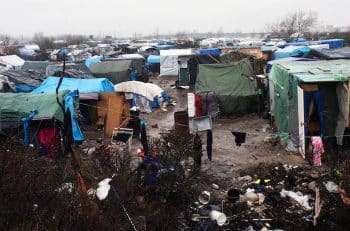
    Hundreds of people line up in a queue as soon as the doors of the van open, each hoping to get a pair of warm trousers. It is a cold November day in Calais, but some of them are wearing just shorts and slippers. In the queue I recognise a Syrian man that I met in the refugee camp on the Greek island of Lesbos just three months ago. He is so thin that it is hard to find him a slim enough pair. But what strikes me even more is his eyes – their sadness and exhaustion – that seem to reflect the cumulation of hardships of the past months, starting in his home country, and now continuing in Europe. That moment of hope and relief, when the overcrowded flimsy rubber dinghy he was on reached the shores of Europe, has now turned into hopelessness at being stuck in one of the worst makeshift refugee camps in Europe, the Calais camp, also known as the Jungle. It’s not a jungle though: it’s more of a disaster zone. Shabby tents and improvised shelters made out of pallets reach as far as the eye can see. The site is far from ideal for camping, the less so during this chilly rain; the sandy ground has become just muddy. Some parts of the camp are exposed to a heavy wind, and people are looking for help to fix their collapsed shelters. There is no electricity. Sanitation is severely inadequate. No more than 40 toilets are currently serving over 6,000 inhabitants – one for every 150, while the UNHCR recommendation is one toilet per 20 users. With only three taps in the camp, there are not many opportunities to wash hands. Litter is everywhere, and some areas are covered with human extracts. At one of the two refuse points of the camp I meet representatives of the Médecins Sans Frontières, who have come to collect the rubbish. They remind me to be careful what I touch due to the threat of scabies and other infectious diseases. A recent investigation by the University of Birmingham, supported by the Médecins du Monde, further highlights detrimental health situations in the camp including the prevalence of ‘white asbestos’, sometimes used to weigh down tenting. As food in the camp cannot be stored safely, much of it carries infective amounts of pathogenic bacteria, causing diarrhoea and vomiting. Several water storage units exhibit levels of bacteria exceeding the EU safety standards, too. The lack of washing facilities prevents the effective treatment of scabies, lice and bedbugs. Many here are suffering from mental illnesses. The makeshift hospital in the camp has the capacity of treating only up to 90 patients a day and there is a constant shortage of medical supplies. It is especially hard to provide treatment for long-term medical conditions such as tuberculosis. Many patients also come in with serious injuries, often resulting from unsafe conditions in the camp, or failed attempts to cross the border. I meet a young boy who has a broken arm, after a failed attempt to jump an England-bound train – a typical case. The United Nations High Commission for Refugees (UNHCR) has continually expressed about the reception conditions for refugees and migrants in Calais, stressing that security measures alone are unlikely to be effective, and urging the French authorities to relocate the refugees to proper reception facilities in the Nord Pas de Calais region and further afield. Some relief is expected from the proposed EU- supported refugee centre, that is expected to be opened in Calais in 2016. It will reportedly be equipped to deal with 1,500 persons. Another alternative would be to involve experienced non-governmental aid organisations such as the Red Cross to act as auxiliaries for the public authorities in the humanitarian field. Charities and voluntary organisations offer an invaluable contribution to the current European challenge, but they cannot be expected to supersede the responsibilities of European governments. Of course, permanent aid mechanisms will be required for as long as the conflicts causing the crisis, sometimes exacerbated by Western military interventions, are allowed to continue. Naiim Sherzai is standing at the exit of the camp, watching the trucks headed for British ports. Sherzai, who comes from the Helmand province in Afghanistan, is a former translator for the British forces, and had to leave the country because of the threat of the Taliban. He now wants to seek asylum in the UK, and ultimately to bring his wife and two children there. He asks whether we could recommend him any legal ways to enter the UK. But in Calais, there are no such routes available for a refugee. Lack of alternatives drives many to desperate acts, trying to hide in the trucks headed for the ferries or the Eurotunnel, or cutting the fence to hide in the trains. At least 16 people have died this year trying to get across the Channel. Tear gas fills the camp regularly as the police tries to drive out refugees from the proximity of the trucks entering the port of Calais. Although the tightened security measures and border controls have decreased the numbers of those who try to leave, groups of refugees lunge for their freedom every night. The rest, like Sherzai, find themselves lost – the road ahead blocked, but with no turning back either. In the jungle. In limbo. Johanna Kaprio

    Loading

    Read more