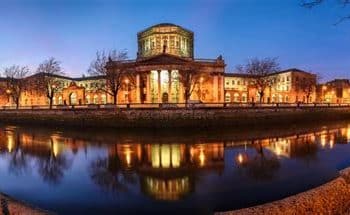
courts

Random entry RSS

  • Posted in:

    The constitutional status of the Irish language in a United Ireland. By Dáithí Mac Cárthaigh.

    Irish is experiencing a period of growth in its official use. It is a full official and working language of the European Union since 1 January 2022. Every regulation, directive and decision of the EU is now enacted and published in Irish at the same time and with the same status as the versions in the other 23 official languages of the Union, from world languages such as English, French and German to the languages of small nations such as Maltese, Estonian and Latvian. At national level, the Official Languages Act has been amended and the amending legislation signed into law by the President. The most noteworthy amendments provide that at least 20% of new recruits to the public service will be competent in Irish by the 31 December 2030 and that public services will be provided in Irish in Gaeltacht areas. At least 20% of public bodies’ advertising will be in Irish and at least 5% of their advertising budgets spend on Irish language media. Public bodies will facilitate the use of the síneadh fada. Bilingual logos, bilingual forms and bilingual advertising materials will be rolled out for public bodies. Protocols or ‘standards’ will be set in relation to services to be provided in Irish by public bodies, including services provided on their behalf by private agencies. Long-promised language legislation is being enacted at Westminster for Northern Ireland which will establish the office of Irish Language Commissioner and language standards for the provision of public services through Irish. In this context of growth, one must be watchful to ensure that the official status of Irish is safeguarded under any new constitutional arrangement. The status of Irish is secure at EU level and must be reproduced domestically. In the context of a united Ireland, the protection of minority rights will be very much to the fore, including the rights of Irish speakers. In relation to protecting linguistic minorities, Canadian constitutional law and language legislation, in particular the Canadian Charter of Rights and Freedoms provides a useful exemplar. This is set out and discussed below. Irish as the Premier Official Language From the foundation of the State, Irish is established as the national language of the country and from 1937, with the enactment of Bunreacht na hÉireann, as the first official language because it is the national language. There is a divergence between the Irish and English texts of Article 8.1. In cases such as this, the Irish version, under Article 25.5.4°, prevails. In the English version Irish is the “first official language”. In the Irish version it is the “príomhtheanga oifigiúil”  i.e. the premier or main official language. It matters not that this is more honoured in the breach than the observance. Very few laws are constantly observed but this does not nullify the constitutional imperative which flows from Article 8.1. Consider that equality as between citizens was guaranteed from 1937 by Article 40 of the Irish Constitution, but that the marriage-bar which obliged women to resign from state employment in the event that they married persisted until 1973 and that discriminatory practise was only ended under the shadow of European law. Similarly, it is because of this constitutional status and the constitutional imperative which flows from it that any victory for Irish language rights has been secured in the Courts. Anyone who proposes a reduction in the status of the language does not have the good of Irish at heart or is unfamiliar with the caselaw. The Constitution of the Irish Free State 1922 Article 4 of the 1922 Constitution provided as follows: The National language of the Irish Free State (Saorstát Éireann) is the Irish language, but the English language shall be equally recognised as an official language. Nothing in this Article shall prevent special provisions being made by the Parliament of the Irish Free State (otherwise called and herein generally referred to as the “Oireachtas”) for districts or areas in which only one language is in general use. A derogation from official bilingualism was permitted at the end of Article 4 “to provide for the contingency of the entry of Northern Ireland into the Free State” according to Kohn The Constitution of the Irish Free State (London 1932), p. 124. This, of course, is being superseded by the aforementioned UK language legislation for the North. Language matters are also discussed in Article 42: As soon as may be after any law has received the King’s assent, the clerk, or such officer as Dáil Éireann may appoint for the purpose, shall cause two fair copies of such law to be made, one being in the Irish language and the other in the English language (one of which copies shall be signed by the Representative of the Crown to be enrolled for record in the office of such officer of the Supreme Court as Dáil Éireann may determine), and such copies shall be conclusive evidence as to the provisions of every such law, and in case of conflict between the two copies so deposited, that signed by the Representative of the Crown shall prevail. There are a number of ways to read this provision. According to Hugh Kennedy, the first Chief Justice, in the case of Ó Foghludha v. McClean [1934] I.R. 469 bilingual enactment is implied by this Article: It is not for me here and now to express any opinion as to whether each Act should not have been enacted at the same time in the Irish language (as seems to be suggested by Article 42 of the Constitution). No doubt an Irish translation of each Act has been prepared subsequently and published officially but such translation has no effect as legislation, there being no power under the Constitution to delegate the legislative power of the Oireachtas to a staff of translators. I may add that legislation in two official languages concurrently is the settled practice elsewhere. The learned Chief Justice referred in particular in support of this contention to the practice of bilingual enactment in other

    Loading

    Read more

  • Posted in:

    Unruly

    What is meant by the Rule of Law and is such a concept honoured in Ireland today? I believe that the rule of law though arguably an unqualified good is not being adhered to in this state save mostly by the judiciary and that the legal system and erratic observance of legality by state officials renders our democracy fragile. In my view Ireland draws close to that amorphous notion, a failed state that cannot in reality uphold the rule of law. This opinion piece will not be a comprehensive pathology but will point out many of the salient practical features which show how the rule of law is breaking down. The Rule of Law: Theoretical Incoherence? We first need to probe the many senses in which the rule of law is described. Joseph Raz, a legal positivist who believes in “perfectionist liberalism” has suggested that the rule of law is merely a kind of shorthand description of the positive aspects of any given political system. From a different vantage point the fundamentalist Christian legal philosopher John Finnis considers that the rule of law is: “[t]he name commonly given to the state of affairs in which a legal system is legally in good shape”. Another philosopher Brian Tamanaha chimes to negative effect that the rule of law is “an exceedingly elusive notion” which leads to “rampant divergence of understandings” and is similar to the amorphous concept of Good in that “everyone is for it, but has contrasting convictions about what it is”. At bottom, there is no consensus: it is elusive at best: a form of smokescreen or professional hypocrisy at worst. But let us endeavour to be constructive. For example Carothers, though sceptical, adds a worthwhile positive definition of the rule of law as: “a system in which the laws are public knowledge, are clear in meaning, and apply equally to everyone. They enshrine and uphold the political and civil liberties that have gained status as universal human rights over the last half-century. In particular, anyone accused of a crime has the right to a fair, prompt hearing and is presumed innocent until proved guilty. The central institutions of the legal system, including courts, prosecutors, and police, are reasonably fair, competent, and efficient. Judges are impartial and independent, not subject to political influence or manipulation. Perhaps most important, the government is embedded in a comprehensive legal framework, its officials accept that the law will be applied to their own conduct, and the government seeks to be law-abiding”. Now let us stress-test certain aspects of this detailed expurgation against the patient – in this context Ireland Inc. Yes of course rights exist in our still fine, if shopworn, constitutional matrix and are enforced by the courts in many instances but there is also an undue deference to the executive that has led to the non-enforcement of social and economic rights particularly the right to housing by the courts. There is an excess of judicial caution on other rights-based claims, particularly where issues of financial iniquity and the countervailing amorphous blob, public policy, are implicated. There is also widespread violation of privacy by the state and its police force, in particular. The overly sanguine way we as a nation have accepted, in effect, what has been police and state criminality with respect to privacy for the last thirty years without widespread outcry is baffling. At least there are signals of an upsurge in civil disobedience, which when peaceful, as Habermas, the German sociologist of critical theory and pragmatist, would contend, leads to a vitalisation of democracy. Not here. Further, the scandal that is our banking structures, the disgrace of the banks varying interest-rate repayments in breach of agreements, the sometimes unconscionable evictions, are not conterminous with the rule of law. NAMA is a mess formulated by the neoliberal club which did its best to avoid a proper new deal for the Irish people. The banking inquiry was a poorly performed French farce. What is desperately needed is a right to housing. Eviction should be rare, require rehousing, and should only follow meaningful intervention by an arbitrator who can determine whether the consumer can repay and whether the bank – with or without the enlistment of a vulture fund – is bundling the mortgage at a bargain-basement rate to private-law profiteers. Further, many of our state institutions have major structural problems. The Garda are not progressive in training and intent: they do not seek justice or the truth, but rather a result. They, at times spin, embellish or at worst, manufacture evidence – and, to be candid, at times act criminally and in violation of the rule of law. Finally, there are limited independent checks and far too close a nexus between politicians and the police. The recent moving of the deckchairs by the Garda Commissioner will not change the culture or training of the force, its group think or, arguably, its competence. It needs a radical ovehaul and a redirection so primarily promotes truth- seeking, investigative process. The impartiality and independence of our judiciary needs at times to be severely questioned because there is far too close a nexus between politics and judicial appointments. Though most are appointed on merit, many of our judges are appointed for their proximity to political parties. Further, some judges have an aggrandised sense of themselves: certainly they are not servants of the state as that is not a judicial function, but rather, they are the servants of the constitution which is a bulwark to protect the people against state excess. Judges also need, in the interest of public confidence as to their impartiality, to declare their share-holdings and indebtedness to the banks. Moreover, parts of the government left itself open to the accusation, during the bugging crisis, that it was also mired in corruption. In the strictest sense it observed the rule of law but, in manner, it laid itself open to the criticism levelled elsewhere by the late great Christopher Hitchens of being crypto-fascist, pursuing a

    Loading

    Read more