demonstration

Random entry RSS

  • Posted in:

    50 years since 1968

    Not a week has gone by in 2018 Ireland without several street demonstrations, especially about abortion and the housing crisis. In France, protesting is part of the vernacular. Riots are common: just look at 1789 and 1968. Ireland and France share a reputation for feistiness. A comparison between Irish and French demonstrations could be instructive. “What do we want? Public housing! When do we want it? Now!”. More than 10,000 people are currently home- less in Ireland. The demonstration I attended, organised by the National Homeless and Housing Coalition, on 7 April was good-natured: festive and serene. People played and sang music as they marched. The Garda seemed engaged and smiled while overseeing the demonstration: a safe protest. It appeared the crowd was representative of the general population, as perhaps you might want. It started at the Garden of Remembrance and ended in front of the Custom House in Dublin in light rain, as cheerful as the weather allowed. Its effectiveness was its mainstream attendance; there was no danger here. It would, I reflected, be different: more fractious, less representative, angrier – in France. Ireland fights for Human Rights At the moment Ireland is in arms over: abortion, education, sex education, health, animal welfare, drugs. But I have the sense that some of these campaigns are not mainstream, even as protests. Certainly the Water Protests were successful, albeit the underlying political message (no new taxes?) and symbolic value were not too clear. Abortion is a long-standing divisive issue in Ireland, symbolising the hegemony and, later, decline of the Catholic Church. Protests date back to 1983 when an unwise blanket prohibition was approved in a referendum. In May there will be a rerun. There are many events, debates and demonstrations on both sides, with pro-choice as fashionable politically as pro-life must have been a generation ago. The demonstration I attended in April was ‘pro-choice’- for ‘Equality, Freedom and Choice’, organised by Rosa. The rally was jubilant and confident, almost over-confident. The Daddy of all modern Irish marches is the PAYE protests from 1979-1980. Around 700,000 Dubliners marched against the stifling ‘Pay As You Earn’ tax. The BBC called it “the largest peaceful protest in post-war Europe”. But I sense things have changed since then. There is no longer an Ireland the sense that the regime is fundamentally at odds with its electorate. Perhaps it’s because the country now mostly complies with international norms or is fast moving in that direction; perhaps it’s because the country is simply much wealthier and has never been so confident. In 2003, Irish anti-war protesters organised a demonstration for peace in Iraq. The British and Americans had invaded Iraq. 100,000 walked on the streets of Dublin. It was a thoroughly internationalist protest. In 2006, a violent demonstration took place in Dublin’s O’Connell Street. For some reason Northern Unionists wanted to organise a ‘Love Ulster’ Parade to honour the victims of the IRA. A counter demonstration materialised and a riot started. Several Molotov cocktails were thrown and cars were burnt. A total amount of 14 persons were wounded and 41 arrested by Garda. Locals put the intense violence down to the alien influence of recalcitrant Northerners: it didn’t symptomise a new riot mentality. These kinds of demonstrations are pretty rare in Ireland compared to in France, where there are wide-ranging politically-driven strikes and demonstrations every year. Governments can fall as a result of demonstration culture in France. If France had had an international bailout that was forcibly inflicted on the population; if France had had the iniquities of Nama bailing out the richest failed developers there would have been strikes and riots. A country’s protest mentality varies from generation to generation. We’ll put down the Irish monster meetings and boycotts of the nineteenth century as the fruits of a different era. Where a country is colonised and not run for the benefit of the majority – or a significant minority – wideranging subversion is to be expected. In Ireland it culminated in the Easter Rising in 1916 and the War of Independence 1919-21. In the North of course discrimination against Catholics fuelled a later whirlwind. In the Bogside riots of 1969, eight people were killed, a majority Catholic, and over 150 homes destroyed; and the IRA campaign resulted in 1696 deaths. But, though important, this all speaks little to the modern-day Republic of Ireland.   France, protest pioneer French demonstrations have been well-known and lethal since at least the 18th century with a sustained and celebrated (though not of course by Edmund Burke) historic riot: the French Revolution, facilitating a declaration of the rights of man and changing forever the notion of the political establishment. In the twenty-first century, protests are still an important political phenomenon. France has been a global leader in dissent. The rockstar of street opposition was May 1968 when strikes and demonstrations led by students and workers and the occupation of universities and factories across France brought the entire economy of France to its knees and political leaders feared civil war or revolution. The moribund government itself ceased to function for a while after President Charles de Gaulle secretly fled France for a few hours in Germany. ‘68 changed France’s democracy: the super-annuated President De Gaulle resigned, the Assemblée Nationale was dissolved, and government committees were formed to restructure secondary schooling, universities, the film industry, the theatre and the news media. The Grenelle Accord gave better conditions for the unemployed, a 35% increase in the minimum wage and a fourth week of paid leave for those in employment. Mentalities started to change too with a sexual revolution from the young. Mixed schools became more common. 1968 sundered a post-War France of austerity, conservatism and asceticism. Nevertheless the movement succeeded “as a social revolution, not as a political one”. President of the Republic (2007-12) Nicolas Sarkozy famously denounced May 1968 as the source of contemporary France’s problems. The student revolts against bourgeois society introduced a “relativism”, he argued, that undermined national identity, the spirit of

    Loading

    Read more

  • Posted in:

    Portuguese parallels

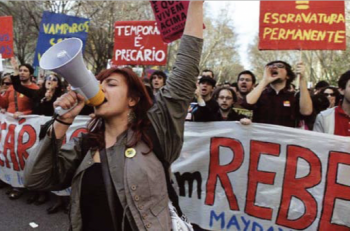
    In 2011 Portugal was at the forefront of Europe’s anti-austerity movement. Yet, four years later, as elections approach in the Autumn, there is no chance of a Left government to ally with Greece’s Syriza or the recent municipal victories in Spain. What went wrong? And can Portugal return to the frontlines? Village’s Ronan Burtenshaw interviews Bloco de Esquerda’s Catarina Príncipe. Q. First, can you tell me how Bloco de Esquerda [the Left Bloc] came about? Several events happened at the end of the 1990s that played into our foundation. The anti-globalisation movement, centred around Seattle in 1999, was important. There was a growing conclusion that we need to find new ways to work together and build projects. Some of these were forums, others were political parties. That was the international moment we were in. Then there was the Indonesia-East-Timor war and occupation. The Portuguese population had its own anti-war movement and sided with Timor against Indonesia. This managed to bring different sections of the Left together to discuss war and campaigning. Finally the failure of the abortion referendum in 1998 was also an influence. There was a referendum to overturn laws banning abortion in Portugal but no broad campaign by progressive or left-wing forces; instead every little group ran their own one. Some of these ran against each other or had clashing strategies. The Yes vote lost, so abortion was illegal in Portugal until 2007. This was the last straw for many on the Left. Q. So how did Bloco form out of these conditions? The definition of Bloco, in its first statute, is a party-movement. It is a broad party that engages with other movements without substituting for or controlling them. It is built up by this grass-roots strength and given a voice in institutions, with a political programme that unites those two domains. Therefore it manages to build strategy together with people who come from very different perspectives, activist histories and traditions. We grew steadily from 1999, when the party formed, until 2011. From 2005 Portugal had a liberal government under the Socialist Party [Portugal’s Labour Party] which had been applying austerity measures for some time before the crisis hit. They used the crisis as an excuse to escalate this. In 2009 we had elections and a broad social mobilisation against austerity. The Socialist Party still won these elections but they didn’t achieve a majority and formed a minority government. Bloco de Esquerda had 10%, the Portuguese Communist Party had 8%, so the radical Left was on almost 20%. Q. What was the result of this growth in support for anti-austerity alternatives? It didn’t mean anything in terms of the programme of the Socialist Party government. In fact, from 2009 onwards they began to impose what they called the “four pacts”, which were packages of austerity measures. The first one cut public spending, the second cut social security, and so on. In parallel they introduced continual measures liberalising the labour market. This produced social mobilisations. We had important Euro May Day demonstrations in 2010. Euro May Day parades are structures we inherited from Milan – colourful, anti-union, involving precarious/ zero-hours workers, quite creative and young, talking differently about labour. Some parts have very Negrian theories, others go with Guy Standing’s idea of the precariat. Our version of this, in contrast to those in Italy, didn’t adopt an anti-union discourse about precarious work but rather tried to ‘add struggles to the struggle’ and forge links with the unions, joining them on the May Day march. We developed a theoretical framework called “precarity in life”, which was a new form of labour discourse. We weren’t just talking about conditions at the point of production – contracts, wages and so on. We talked about the way labour instability affects different spheres of life, and affects you differently if you are a woman, a migrant, or LGBt. We were exploring the relation between exploitation and oppression, developing the particularities of these, but framing it in a new and accessible way. This allowed us to bring together the feminist, anti-racist and LGBt movements with the anti-precarity movement to form the Euro May Day. Euro May Day fed into the first really big demonstration occurring on March 12th 2011 called Geração à Rasca, Generation with No Future. It was started by a call on Facebook by four people, all of whom had some previous involvement in politics but had not been particularly active. It grew exponentially. This was the time of the Arab Spring with all the discussions about the role of new media in facilitating protests so the Portuguese media took this up as our own little experience of it. The organisers were on television almost every day. Soon they realised that they could not organise this phenomenon themselves so they put a call out to social movements and those involved in Euro May Day to help them out. In the end the demonstration had 500,000 people in various places, in a country of around ten million. Q. Was it mostly young people? We were expecting that it would be but in the end it was intergenerational. This proved our thesis in the anti-precarity movement that the issue couldn’t be dealt with in generational terms. There is a particularity to how young people experience insecurity but almost half of the Portuguese working population is precarious right now so you can’t talk about it as generational. The movement was very broad so it was quite apolitical. At the time it was correct to do this but it had limitations. there were no demands, which was necessary because it would not have brought out many people if it was too concrete, but the right-wing also used this space. Two months after the big demonstration they won the snap elections. This was then followed by the arrival of the Troika and the signing of its memorandum by the two right-wing parties who were in coalition [the PSD and People’s Party] and the Socialist Party, who had lost the election.

    Loading

    Read more