Dublin City Council

Random entry RSS

  • Posted in:

    Wild geese

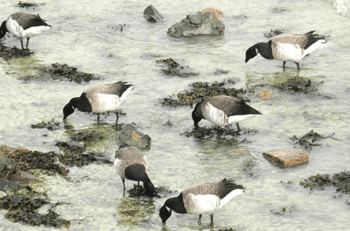
    In April An Bord Pleanála surprisingly granted permission to Crekav Trading for 104 houses and 432 apartments on playing fields east of St Paul’s College on Sybil Hill Road in Raheny, despite receiving more than 1,000 objections, and a recommendation for refusal from Dublin City Council. The site was originally part of the St Anne’s estate, the home of the Guinness brewing family on which Lord Ardilaun forged a magnificent Palazzo out of the original seventeenth century house. According to Dublin City Council’s Parks Division, St Paul’s is the most important ex-situ (ie outside of the North Bull Island) feeding site for Brent Geese in Dublin, based on numbers (a large majority of the Dublin population feed at this site), regularity of use, geographical location in relation to North Bull Island, size, and the relative lack of disturbance. The Brent Geese on the North Bull Island Special Protection Area are now largely reliant on the availability of inland feeding grounds, like St Paul’s. These lands are not designated but are nonetheless protected under habitats legislation. The only exception whereby development might be deemed to be compliant with this protection would be in exceptional cases where there is overriding public interest, and even then, only when no feasible alternative for the development has been demonstrated, and compensatory measures to offset the ecological damage are implemented. There is no suggestion that these exceptional circumstances and compensatory measures are to be found in the case of this development. Development on feeding areas forces the geese to travel greater distances to feed and potentially brings them into conflict with agricultural interests feeding on winter cereal crops. This results in greater expenditure of energy which affects the condition of the birds and their ability to complete the annual migration to their breeding grounds. The cumulative effects of this residential development proposal alongside existing impacts on geese arising from other already permitted developments which have removed some of their feeding sites, should have been assessed by An Bord Pleanála. In addition it should have considered whether adequate feeding areas will be left for Brent Geese after these developments are complet and whether any such areas are zoned appropriately in the Dublin City Development Plan. An Bord Pleanála is obliged to comply with European law on these issues . In considering the proposal, An Bord Pleanála’s inspector noted that the extent of potentially suitable feeding areas for the geese within Dublin city is finite and that the currently recognised feeding sites that are considered to be an alternative to the lands at St Paul’s may currently be experiencing pressures, including recreational disturbances, that may limit their capacity to accommodate the loss likely to occur as a result of the proposed development. Not withstanding this concern by its inspector, the planning board went on to grant consent for the development at the St Paul’s site. Of course Bord Pleanála decisions are formulaic and legalistic but we can take some indirect insight into its possible thinking from the reasoning in the report of its inspector whose conclusion it adopted: “The numbers of inland feeding areas are relatively significant, the geese appear to be thriving based on their increasing populations and I consider that the loss of this site as a feeding ground will not adversely impact on the conservation objectives of any of the five designated sites. In light of this assessment, I am of the opinion that there is capacity for the existing ex-situ inland feeding areas to absorb the loss of St Paul’s and I consider it reasonable to conclude on the basis of the information on the file, which I consider adequate in order to carry out a Stage 2 Appropriate Assessment, that the proposed development, individually or in combination with other plans or projects would not adversely affect the integrity of the five relevant European sites, in view of their Conservation Objectives”. However, whether this reasoning meets the requirements of European law and related case law remains to be seen. Bord Pleanála is under political pressure to approve housing schemes, in a housing crisis and the government is infamously unconcerned with environmental and planning niceties. In particular, for instance. The lack of certainty around the capacity of alternative sites to absorb geese displaced from the St Paul’s site may be problematic. Dublin City Council had eloquently warned in its submissions to An Bord Pleanála that the suggested capacity of alternative sites to accommodate the displaced geese is questionable and may not be achievable. The St Paul’s site is one of the top eight inland feeding sites for Brent geese. Accordingly, Bird-Watch Ireland and the Irish Brent Goose Research Group commented in their submission to An Bord Pleanála on this application: “We conclude that is an unacceptably high proportion of the population to be expected to be displaced to and absorbed within the existing network of sites and not in keeping with the conservation objectives of adjacent European protected sites” and furthermore that: “To suggest that these birds are flexible and will simply move elsewhere is simplistic and is especially weak given the recent pattern of development (all representing habitat loss) in the area”. The application was made under the new Strategic Housing Development ‘fast track’ planning system. This allows applications for schemes of more than 100 homes to be made directly to An Bord Pleanála, bypassing the local authority decision phase and excluding the possibility of an appeal. This leaves judicial review as the only course of action for those aggrieved by the planning consent. A miffed Dublin City Council, which turned down a less intrusive application for an associated application for sports facilities on a site at St Paul’s adjoining this one (on grounds of impacts to Brent geese) is hostile to the decision. City Manager Owen Keegan told the Council: “My recommendation, based on planning advice, was the board should not have granted this”. He obtained, presumably suitably conservative, legal advice that it did not have “locus standing” or legal standing to take

    Loading

    Read more

  • Posted in:

    Don’t go: despite structural problems, no time for local government defeatism (March 2009)

    “Should I Stay or Should I Go?” – so sang The Clash in their classic hit of the 1980s. According to two contributors to the December edition of Village, it is a question being asked by many members of City and County Councils, particularly in the Dublin area. In the December issue, former Councillor Mick Rafferty told us why he was leaving and Fine Gael’s Councillor Gerry Breen why he was staying. The common feature of both was their sense of defeatism. Mick is calling it a day because he thought the procedures and politicking were too much and Gerry is staying, even though he is unhappy with the ways things work, or more accurately don’t work. Regrettably Gerry offered no new ideas and Mick retreated to the concept, so beloved of those who actually wield power, of “participative democracy”. A policy that sounds good in theory but ensures in practice that real power remains with the elite. The picture Mick painted of the role of a Councillor, is not one I recognise. The reality is that these Strategic Policy Committees were designed to contain Councillors rather than empower us. “Keep them busy and they will be less of a nuisance”. In my sixteen years as a member of Dublin City Council I am proud of a record of achievement that has benefited both Dublin and my own electoral areas. I have also by and large enjoyed the work. Nor do I agree with Mick’s apparent view that all Councillors somehow share the same agenda and should work as if we are all on some agreed common course. I am a Labour member of the Council. I seek to advance my Social Democratic policies. I do not share the political objectives of Fianna Fail, Fine Gael or Sinn Fein. It is worth noting that of the sixteen, some went because they were elected to the Oireachtas, others because a political career had effectively been closed off by rivals, one moved to live abroad and some because their personal lives had changed since their initial election. In general we as Councillors do not set the rules by which the Council operates. More often than not they are imposed on us from the Department of the Environment in the Custom House. It was from there that the Strategic Policy Committees, Corporate Policy Groups and City and County Development Boards were dreamt up. It is these unproductive structures that impose the wasteful time constraints on Councillors. These are but some of the areas we need to change. Mick is correct that the Housing Strategic Policy Committee, chaired by my colleague former Councillor Mary Murphy, over the last few years published progressive policy papers on housing and related matters. In better times I hope that these yield fruit. Yet, the reality is that during our “Celtic Tiger” years, as the policy papers piled up, the housing and homelessness list of Dublin City Council rose in parallel. The reality is that these Strategic Policy Committees were designed to contain Councillors rather than empower us. “Keep them busy and they will be less of a nuisance”. We will not however force change by walking away from the problem. For me Local Government matters. In terms of planning, housing, community development, provision of accessible recreational, cultural and sporting opportunities it is very often the first point of call. The fact that it has been starved of funding over the last decade should not obscure that fact. While the detail of such reform is extensive the essentials are not. If they are to be in any way meaningful they must include: An Independent source of funding for Local Authorities – not subject to the whims of the Department of the Environment. Reform of the City and County Managers Act, creating a new post of Chief Executive Officer – accountable to and appointed by the relevant Local Authority following recruitment through the Public Appointments Commission. A directly elected Mayor of Dublin with a five-year term and accountable to an enhanced Dublin Regional Authority. The extension of the role of the Dublin Regional Authority to include Transport and Planning and subsuming bodies such as the Dublin Transport Authority and the Affordable Housing Partnership. Real controls and limitations on electoral spending at local elections. Yes, I want real reform. I sought election many years ago to improve my local community and because I enjoyed the cut and thrust of political life. In one of the many deserving tributes to the late Tony Gregory, one person wrote of Tony’s legal struggle to remain a member of the City Council following the ban on holding the dual mandate. Tony sought to retain his Council seat because he too knew that Local Government matters. The author of that tribute was Mick Rafferty. Mick was right. I have never regretted my decision to seek election to the Council and my belief that local government is the best model to deliver real reform to Irish Society has intensified over those years. The Public need and deserve a better system. It is time for those who agree to Stand up for Democracy, Stand up for Local Government and in my case Stand up for Dublin.

    Loading

    Read more