Elections

Random entry RSS

  • Posted in:

    Portuguese parallels

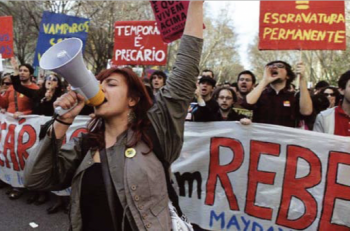
    In 2011 Portugal was at the forefront of Europe’s anti-austerity movement. Yet, four years later, as elections approach in the Autumn, there is no chance of a Left government to ally with Greece’s Syriza or the recent municipal victories in Spain. What went wrong? And can Portugal return to the frontlines? Village’s Ronan Burtenshaw interviews Bloco de Esquerda’s Catarina Príncipe. Q. First, can you tell me how Bloco de Esquerda [the Left Bloc] came about? Several events happened at the end of the 1990s that played into our foundation. The anti-globalisation movement, centred around Seattle in 1999, was important. There was a growing conclusion that we need to find new ways to work together and build projects. Some of these were forums, others were political parties. That was the international moment we were in. Then there was the Indonesia-East-Timor war and occupation. The Portuguese population had its own anti-war movement and sided with Timor against Indonesia. This managed to bring different sections of the Left together to discuss war and campaigning. Finally the failure of the abortion referendum in 1998 was also an influence. There was a referendum to overturn laws banning abortion in Portugal but no broad campaign by progressive or left-wing forces; instead every little group ran their own one. Some of these ran against each other or had clashing strategies. The Yes vote lost, so abortion was illegal in Portugal until 2007. This was the last straw for many on the Left. Q. So how did Bloco form out of these conditions? The definition of Bloco, in its first statute, is a party-movement. It is a broad party that engages with other movements without substituting for or controlling them. It is built up by this grass-roots strength and given a voice in institutions, with a political programme that unites those two domains. Therefore it manages to build strategy together with people who come from very different perspectives, activist histories and traditions. We grew steadily from 1999, when the party formed, until 2011. From 2005 Portugal had a liberal government under the Socialist Party [Portugal’s Labour Party] which had been applying austerity measures for some time before the crisis hit. They used the crisis as an excuse to escalate this. In 2009 we had elections and a broad social mobilisation against austerity. The Socialist Party still won these elections but they didn’t achieve a majority and formed a minority government. Bloco de Esquerda had 10%, the Portuguese Communist Party had 8%, so the radical Left was on almost 20%. Q. What was the result of this growth in support for anti-austerity alternatives? It didn’t mean anything in terms of the programme of the Socialist Party government. In fact, from 2009 onwards they began to impose what they called the “four pacts”, which were packages of austerity measures. The first one cut public spending, the second cut social security, and so on. In parallel they introduced continual measures liberalising the labour market. This produced social mobilisations. We had important Euro May Day demonstrations in 2010. Euro May Day parades are structures we inherited from Milan – colourful, anti-union, involving precarious/ zero-hours workers, quite creative and young, talking differently about labour. Some parts have very Negrian theories, others go with Guy Standing’s idea of the precariat. Our version of this, in contrast to those in Italy, didn’t adopt an anti-union discourse about precarious work but rather tried to ‘add struggles to the struggle’ and forge links with the unions, joining them on the May Day march. We developed a theoretical framework called “precarity in life”, which was a new form of labour discourse. We weren’t just talking about conditions at the point of production – contracts, wages and so on. We talked about the way labour instability affects different spheres of life, and affects you differently if you are a woman, a migrant, or LGBt. We were exploring the relation between exploitation and oppression, developing the particularities of these, but framing it in a new and accessible way. This allowed us to bring together the feminist, anti-racist and LGBt movements with the anti-precarity movement to form the Euro May Day. Euro May Day fed into the first really big demonstration occurring on March 12th 2011 called Geração à Rasca, Generation with No Future. It was started by a call on Facebook by four people, all of whom had some previous involvement in politics but had not been particularly active. It grew exponentially. This was the time of the Arab Spring with all the discussions about the role of new media in facilitating protests so the Portuguese media took this up as our own little experience of it. The organisers were on television almost every day. Soon they realised that they could not organise this phenomenon themselves so they put a call out to social movements and those involved in Euro May Day to help them out. In the end the demonstration had 500,000 people in various places, in a country of around ten million. Q. Was it mostly young people? We were expecting that it would be but in the end it was intergenerational. This proved our thesis in the anti-precarity movement that the issue couldn’t be dealt with in generational terms. There is a particularity to how young people experience insecurity but almost half of the Portuguese working population is precarious right now so you can’t talk about it as generational. The movement was very broad so it was quite apolitical. At the time it was correct to do this but it had limitations. there were no demands, which was necessary because it would not have brought out many people if it was too concrete, but the right-wing also used this space. Two months after the big demonstration they won the snap elections. This was then followed by the arrival of the Troika and the signing of its memorandum by the two right-wing parties who were in coalition [the PSD and People’s Party] and the Socialist Party, who had lost the election.

    Loading

    Read more