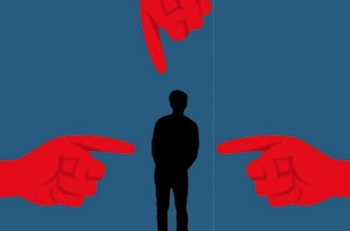
There are two dominant interpretations of what’s come to be known as “call-out culture”. Many see it as an effective way of holding people, particularly public figures, to account for objectionable deeds and utterances that their status might otherwise have allowed them get away with. Social media has certainly played a massive role in an accelleration of accountability that is changing the way big organisations function. For the powers-that-be many styles of “cover-up” are simply no longer possible. One individual can go viral with their story in a matter of minutes. However, many others see call-out culture as trial by mob, a return to a medieval mentality, or puritanism in another guise – particularly when applied to individuals rather than institutions. Either way, I think – I hope – everyone can agree people shouldn’t be held to account for things they haven’t actually said or done. Yet over the past year it seems there is a disturbing new trend in the now conglomerated battlegrounds of media and social media. The values of call out culture – the idea that people should be made atone for perceived offence through group-shaming – are no longer a phenomenon of those periphery cultures largely concerned with traditional arenas of cultural theory: questions of gender, minorities, and identity. In 2017, call out culture went mainstream in a big way. I’m not referring to the Hollywood purge, which did aim to address gendered issues, and seems to have been long-overdue. The culture of the call-out – its language, style, mentality – started to intrude into new domains. The standard of offence became radically expanded, and the concept of proportionality (let the punishment fit the crime) went out the window. The most depressingly ridiculous example of this has to be the career ending decision of Barry McElduff to make a short video in a local shop, pretending not to be able to find a loaf of bread which was in fact balanced on his head. The video was posted the night before the, to be fair – fairly inauspicious – date of the 42nd anniversary of the Kingsmills massacre. Kingsmills was one of the most despicable atrocities of The Troubles. A group of workers had been travelling on a bus home from a factory when they were stopped by what was ostensibly a British Army patrol. In one of the most poignant gestures of the Troubles, when the gunmen asked the single Catholic worker to identify himself, his Protestant co-workers tried to prevent him stepping forward, as they believed it to be a loyalist gang targetting Catholics. He identified himself nonetheless, but was spared. It was the 10 Protestant workers who were machine-gunned to death. Another man survived despite having been shot 18 times. After the the video was “called-out” on Twitter, condemnation of Kingsmills seemed immediately to become coterminous with condemnation of McElduff. Defence of McElduff was taken to be defence of the massacre. This is a fixture of this style of thinking – any query as to whether or not the accusation is accurate is taken as defence of the deed that has been alleged. Those who queried the likelihood the then MLA was performing some piece of bizarre Daliesque sectarian performance art, were met with rebuttals reasserting how wicked a deed the massacre was, and that it was no laughing matter. Surely true, but irrelevant to ascertaining whether or not McElduff was actually referencing Kingsmills when he put the loaf on his head. I watched in dismay as a number figures across the political spectrum – some of whom I’ve long admired – rushed to condemn McElduff, refusing to countenance the notion that this was an unfortunate coincidence. His own then ordained leader-to-be, Mary Lou-McDonald proved of the same mind-set as she condemned McElduff’s tweet as “crass”, “stupid”, and “unforgivable”. She of course had not condemned the numerous social media posts prior to this in which McElduff had balanced other comestibles on his head, although there were many – it seems to have been a running pantomime gag for the politician. When someone points me to the sectarian atrocity he was referencing when he took a photo with a Snickers balanced on his scalp, then I’ll believe there was ill-intent. It was instead his young daughter who was left to try and defend her father against the social media onslaught, explaining the photo was taken in the shop she worked in, the family always ate Kingsmills bread, etc etc, to absolutely no avail. Fixed thinking is another aspect of this praxis – no amount of evidence will exhonerate the accused, any defence offered is taken as further evidence of their guilt. What mattered to McDonald was not the facts of the matter, or loyalty to someone who dedicated their life to a political party she joined in the late 1990s, what mattered was assuaging the mob. And this has become the prime directive for many powerful people, not only in politics, but in the media and corporate world. This is regrettable, as another recurring theme is that the outrage is often so loud it entirely obfuscates the circumstances of the original incident. In another example, John Connors drew ire after tweeting that he personally wouldn’t call the police on someone for “robbing bread”. This was then completely conflated with events later that same day, when a stolen digger was used to smash and try to steal the safe from a Lidl which had earlier been looted of food and drink. No amount of clarification could convince many of the call-out crew that Connnors was not trying to downplay or justify an event that hadn’t even happened when he originally tweeted. Thankfully Connors is comparatively invulnerable to these tactics, unlike McElduff his career is not subject to the vicissitudes of political sensitivities. Lest anyone accuse me of being partisan, here’s an example of precisely the same style put to use in the opposite direction. When former Taoiseach Liam Cosgrave died, RTE presenter Sean O’Rourke retold