illegal

Random entry RSS

  • Posted in:

    Island of Tyreland

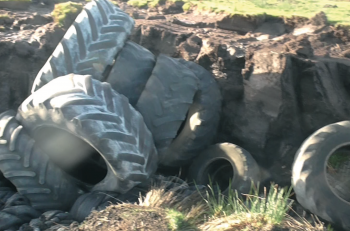
    Carndonagh is an area of outstanding natural beauty that nestles in the shadow of the Grinlieve Mountain, only eight kilometres from the designated Natura 2000 sites, Trawbreaga Bay Spa and the North Innishowen Coast. Safeguarded by the 1992 Habitats Directive both these ecological wonders are home to protected animal species and diverse wetlands. Outwardly this area seems idyllic and well-protected; however, on 4 December 2011 Sunday Life newspaper exposed Meenyollan, Carndonagh, as the location of a vast illegal tyre dump fed by KF Tyres, Corody Road, Derry (top right). The landowner, Michael McLaughlin, was also claimed to be complicit in the dumping. Nearly ten million tyres had been buried, unregulated, in the period 2008-2011 alone. At least one for everyone in the audience. It has made Carndonagh Europe’s largest illegal tyre dump. Following the Sunday Life exposé in 2011, Donegal County Council promised robust enforcement including an extensive cleanup operation. KF Tyres should have been made responsible in whole or in part for the cleanup operation Donegal County Council promised. However, seven years on, there is still clear evidence of tyres being illegally buried at this location and there is little evidence of a cleanup. The pristine fields, underpinned by tyres which leach into the meandering water table, contrast starkly with the surrounding boglands and call to mind previous violations and unseen toxicity (bottom right). Although it is difficult to find out the exact composition of a tyre, and there are lots of different types most of them include synthetic carcinogens, solvents and heavy metals, for example. KF Tyres and Michael McLaughlin escaped prosecution and in fact subsequently applied for and were granted a range of permits and planning permissions by both Donegal County Council and the Northern Ireland Environment Agency (NIEA) allowing them to legally operate at the same site. These incongruous decisions, some of which were granted in breach of the legally-man-dated sequence, reduced the promised enforcement to no more than knuckle raps. After an abortive attempt by planning consultant Jim Harley to get McLaughlin’s development deemed “exempt” from planning permission, an unlikely new wheeze was to tout it as land reclamation with secondary drainage benefit. Yet still the terms of the new permits permissions have been flouted. Photographic evidence clearly shows that illegal dumping is still going on at the site. In 2018 KF Tyres and Michael McLaughlin are still controversially involved on this site, while Donegal County Council behaves as if it is unaware of this. In 2015, Planning Permission was obtained for the use of 8448 tyres in 105 bales (80 tyres per bale) over a five- year period, suggesting even what Donegal County Council considers reasonable has been overwhelmed by illegal dumping on a much greater – indeed unconscionable – scale.   The photographic evidence (left) shows that neither McLaughlin nor KF Tyres appear to be compliant with the terms of the planning permission, which demands that the tyres that are used be baled, not loose (left, bottom right); nor do they seem to care. Moreover, Donegal County Council evidently does not appear to know what is going on. For example, after the Sunday Life article in 2011, Donegal County Council promised an investigation and robust enforcement. However, in January 2012, mere weeks after the article, Donegal County Council granted McLaughlin a five-year Waste Management Facility permit (WMP) (top right). Why? No planning permission had been granted though one is mandatory before a WMP can be issued. Without the requisite planning permission all tyres taken to Cardonagh around that time continued to be transported and dumped illegally. Jim Harley, formerly of Harley Planning Consultants, has figured in strong criticisms levelled against the Donegal County Council planning department when he worked there a decade ago. These are currently being reviewed by a senior counsel on behalf of the Department of Housing, Planning and Local Government. Harley acted as a planning consultant for McLaughlin when he was granted planning permission in November 2015. There was one condition: that he apply for a WMP. But there was an existing WMP that had been issued illegally. It was illegal precisely because it should not have been issued before planning permission was granted. The Sunday Life article stated in 2011 that KF Tyres had a WCP (waste carriers permit) with Donegal County Council to collect “end of life tyres” but it had no permission to bury tyres at Carndonagh. It is yet another anomaly that KF Tyres obtained a valid Waste Carriers Licence for the South in 2011 but no planning permission or commensurate licence for the site it operated from in Derry. It is strange that Donegal County Council neglected to contact the NIEA about KF Tyres in 2011. The NIEA went on to grant Ken Ferguson a WMP (bottom right) allegedly oblivious to the illegal dumping. This information would have been immeasurably beneficial in averting the current situation. Donegal County Council should have been monitoring the site, verifying the number of tyres being buried both by KF Tyres and McLaughlin. No assessment appears to have been made, north or south of the border, of how many Trans Frontier shipments (TFS) and what tonnage of tyres, KF Tyres declared to the NIEA it had transported between 2012 and 2015.   It is not clear how many physical border and site inspections were made by Donegal County Council and the NIEA during this period. As stated both the WMPs (previous page) were granted under Appendix II of the EU Waste Frame Directive 2008/98EC: recovery operations. R10-Land Treatment resulting in benefit to agriculture or ecological improvement; R13 – storage of waste pending (right). Amazingly there is no reference to waste tyres or indeed anything like rubber within this directive, nor to the burial of solid waste in any form. Land reclamation using tyres is deemed dangerous and illegal in Northern Ireland , but not in the Republic – yet both countries are bound by the same European Directives. Given the toxicity of tyres and the stringent legislation on their

    Loading

    Read more

  • Posted in:

    It's different up here

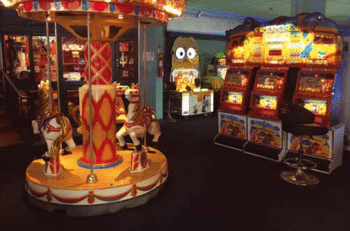
    Justice is not a motif found emblazoned around Donegal. Its outing accounts for much in my home town of Bundoran and elsewhere in the county. In particular the power the late sean McEniff had over local governance is very unsettling – through politics and wealth. He was Fianna Fáil’s longest-serving councillor and perhaps its richest man. His hotel empire extended to ten hotels countrywide including the Skylon in Dublin and the Great Southern in Bundoran. Journalist Gemma O’Doherty and others have alleged that McEniff interfered with the Garda investigation into the death in 1977 of six-year-old Mary Boyle, but it is the power his empire wields over the slot machines that have for fifty years dominated and blighted once-elegant Bundoran that particularly concerns me here. McEniff’s empire traces its foundation to slot machines. McEniff was by far the largest slot machine operator in the town, and ignored the law: his slots would make big pay-outs, just enough to keep the key punters, most of them poor or old – or both, hooked. In 2009 Bundoran town council adopted a submission from the slot-machine operators – McEniff being the largest – to the Department of Justice – as its own submission. the submission had been adopted by the council on the same day at a special meeting which had only three councillors present. The quorum for any meeting was four councillors to be present, though nobody called halt. The submission said Bundoran’s 1,000 machines were “an integral part of the overall Bundoran product, both on and off the season, and a key reason why visitors continue to be attracted to the town”. Growing up in Bundoran, I remember from a young age the dangers of gaming machines. A friend of my mother came down from the North on the bus with her wages on a Friday and rushed up to play gaming machines in the town. By Sunday evening she had to ask my mum for money to get back home, after losing everything. The 2008 Department of Justice report on ‘regulating Gaming in Ireland’ states “the committee is aware of the type of gaming machine which accepts €500 notes. The Act of 1956 provides a maximum stake in gaming machines of 6d and a maximum prize of 10 shillings. The Act is not being enforced and that brings the law into disrepute”. The Garda Síochána, the Revenue and the Council have long since abjured responsibility for enforcing the gaming laws. A 1985 ‘Today Tonight’ programme on RTÉ focused on Law and Order in south Donegal, particularly Seán McEniff’s gaming. Donegal county council sued RTÉ for defamation for what it said about the inappropriate relationship between Donegal [county] council and the Garda but a legal settlement saw it agree to remove the programme, on the steps of the High Court. One of the last convictions for illegal gaming in Bundoran was in 2000 after Charlie Bird did the exposé on illegal gaming here. The solicitor for McEniffs Bundoran Limited said to the Judge at the time that “Charlie Bird should be prosecuted” as he had played an illegal gaming machine. Poor Sean died last year but his empire remains in the family. I recently objected in the District court to renewal of the gaming licence to McEniffs Bundoran Limited. The first Judge and McEniffs’ solicitor removed themselves from the case, the solicitor coming off record after I raised a concern of conflict of interest. I objected as a member of the Public, though I have had my travails with sean McEniff when I was Bundoran’s traffic warden. When I objected that gaming machines accept notes while the 1956 act maximum is 20 cent, the solicitor for the McEniffs Gerry McGovern did not deny it. Instead he just noted that revenue issued certificates and that gardaí and fire officers had no objections. “If there was a difficulty, the gardaí and revenue wouldn’t be long moving in”, he said. But that is the core of the problem. As to my objection that there were too many machines in Bundoran, Judge Denis McLoughlin said that would only be valid in case of a new application. McGovern said it was an application that had been renewed umpteen times and hadn’t been changed. And in Donegal it seems that is the main thing. The Revenue’s webpage states that it up to the District court to “limit the amount of the stakes and prizes and limiting the number of gaming machines”. But Judge McLoughlin was not interested. I have been before the District, circuit and High Courts on occasion, always representing myself. In 2012 in Donegal Circuit Court, Judge Keenan Johnston highlighted that as a lay litigant “She`d be entering the court with one hand tied behind her back”. The dysfunctionality of Donegal from policing to planning to electoral fraud to unemployment to paedophila is now well documented. Sometimes you feel fighting for justice here leaves you very much alone. Patricia McCafferty

    Loading

    Read more