Irish Independent

Random entry RSS

  • Posted in:

    Capitalisteracy

    Ireland has a dreadful, inequitable, dangerously failing healthcare system. The State’s answer is the likes of healthy Ireland, which runs a public campaign that, in essence, throws the responsibility for health on to individuals – who seemingly just need help from an initiative to ‘empower and motivate them’. February saw the launching conference – hosted by the Broadcasting Authority of Ireland (BAI) at Facebook Ireland HQ – of a new network, Media Literacy Ireland (disclosure: I’m in it). From the conference stage there was lots of talk about empowerment and not much talk exploring from whom it might be necessary to take power away. There was even a speaker from healthy Ireland, lest the analogy be missed. Don’t be surprised, then, to encounter an Irish campaign in the next year or two imploring you to the media equivalent of ‘eat your vegetables, get some exercise, don’t smoke cigarettes’. Something along the lines of ‘read the Irish Times, trust in Miriam, don’t tweet fake news’. Or maybe not. Media Literacy Ireland potentially has some of the hallmarks of industry-friendly campaigns like Drink Aware and Gamble Aware, plus the involvement of a regulator, the BAI, which might like a campaign that implicitly justifies light-touch regulation abetted by ‘greater public awareness’. On the other hand – and credit to its organisers for this – Media Literacy Ireland has come into being as a genuine network of interested researchers, activists, community-media practitioners and others. And most of us in it are not disposed to frame the problem with Irish media as one of public credulousness, to be addressed by offering tips for spotting ‘extremism’ online. Regular readers will know my view: that media (like healthcare) have a capitalism problem, and that everything from fake news to clickbait to inadequate investigative resources to Denis O’Brien ows from that basic source. But you don’t have to agree with me and name the underlying problem as capitalism to understand that there are structural causes for crises such as the one that erupted recently over Government ‘advertorial’. “I believe the Government is attempting to exploit the difficulties many local and regional titles are facing to promote their party interests”, said no less a media critic than Fianna Fáil’s Timmy Dooley, the party’s spokesman on communications. (How sweetly old-fashioned that word ‘communications’ can sound as it grapples with the changing world.) Media literacy, if it is to be of any use, has to do more than implore us to look for the little ‘special feature’ tag on the top of a piece of paid corporate or government puffery, then to regard the ‘journalism’ below with due scepticism. It must mean understanding ‘the difficulties’ for all journalism that operates in the current market, especially one in which technological change has accelerated existing trends toward blurred lines, and in which advertisers have alternatives to local and regional newspapers when it comes to reaching eyeballs. If the most poignant aspect of that brief, quickly snowed-under ‘Ireland 2040’ crisis was the image of the Taoiseach issuing guidelines for labelling advertorial content – guidelines of which the most callow intern in a local newsroom should surely already be aware – we shouldn’t lose sight of the fact that media have been operating at the edges of such guidelines for decades, for the benefit of advertisers looking to buy a little ersatz editorial credibility. How can this fail to be a lesson about how fragile, at best, any such credibility has become ? As the media may or may not have told you, global research shows trust in media is in tatters – media are less trusted than governments, NGOs, businesses – and Irish people are at the mistrustful end of the distribution. In this context, media literacy can hardly consist of legacy media saying ‘trust us, not them’. What can be done ? (Yes, short of getting rid of capitalism.) Anyone who has worked in a newsroom knows what a frightening prospect it would be to try to earn the public’s trust with transparency and accountability about our editorial practices. On a daily basis, contingent and incomplete information is transformed into definitive statements of ringing certitude. That’s one sausage factory we don’t want you to see inside, especially since the work often consists of sticking our label on someone else’s meat. The irony is that the technology often over-simplistically blamed for creating the journalism crisis has long offered tools for remarkable transparency, tools that most journalists have chosen to use only in limited ways. What if hyperlinks in journalists’ stories led not to dull pages of cross-references or to Wikipedia, but rather to images of documents and notebook pages, audio of interviews, pictures of the journalist in the field ? It can be done and has been done, but the experiments in transparency of the early web – notably the extraordinary 1996 investigative series by the aptly named Gary Webb in the San Jose Mercury news, about the CIA’s involvement in the cocaine trade – have rarely been repeated, let alone built upon. Such transparency would foster media literacy without the onus being placed on the audience. Whether it would foster trust is, of course, a matter of what audiences thought of the practices revealed by transparency. Interactivity and social media mean we have some tools whereby that reaction could be tested and gauged. Dublin Institute of Technology, thankfully, is prepared to put its money where my media-literacy mouth is: it’s funding a project that will will use the Liberty, a student- produced ‘hyperlocal’ newspaper and website for Dublin’s Liberties area, to innovate in the area of journalistic transparency. We’ll employ social media as a forum for sharing ‘the story behind the story’, with tweets, Facebook updates, Youtube videos and Instagram posts that unveil aspects of the production of journalism, from notebook pages to editing history, from who-was-interviewed to who-refused. A doctoral-level researcher will be responsible for implementation, monitoring, community engagement and evaluation of this project, which should help readers to understand better the process of news construction, and help journalists-in-training become accustomed to

    Loading

    Read more

  • Posted in:

    Election Times

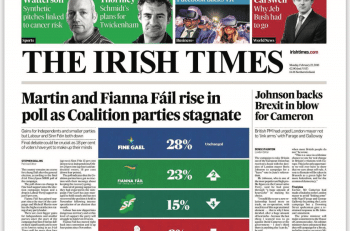
    The story of an election is much more than a few headlines, but the Irish Times front pages mercifully, if languidly, devoid of the kind of blatantly partisan positioning seen elsewhere, provide in hindsight a neat narrative of the campaign, with the slow realisation that Fine Gael was in trouble, the lack of a clear alternative emerging, and of course, “events, dear boy”. While its columnists and editorials may have declaimed preferences in the run-up to the general election, the Irish Times‘ front page generally affected a more neutral stance, certainly by comparison with the anti-Sinn Féin headlines which dominated the Irish Independent and its Sunday sister during the February campaign. The ‘newspaper of reference’ (formerly “of “record”) began the month in ‘phoney war’ mode, leading on Monday 1 February with coalition plans to “target home buyers and parents in poll pledges”. On the Tuesday, with still no election date declared, the story was “Taoiseach prepares Fine Gael ministers for election”. Perhaps ominously, on both days the below- the-fold story concerned the revelations regarding “Grace” a young woman with intellectual disabilities abused while in HSE care in a foster home. The story would feature again several times during the month and, by the end of the campaign, would threaten to inculpate Michael Noonan. Wednesday’s paper finally brought the official election notice, leading with Fine Gael ministers outlining their election promises, but the shine was short lived. Thursday, and the first election poll, brought “disappointing news for Coalition parties”. Much of the remainder of the campaign was spent trying to push back against those low poll numbers, which stubbornly refused to rise. By the first weekend, Fine Gael had announced a “tax U-turn to hit voters earning €100K” (the top 10% of all earners, though Irish Times readers would be better paid than the average). The election narrative was dominated at first by Fine Gael (at least on the front page) but it changed dramatically in the second week. The murderous Regency Hotel rampage called attention to cuts in Garda numbers and resources and Fine Gael, which prides itself as a law and order party, found itself on the back foot. At one point Sinn Féin’s Mary Lou McDonald attacked the government for being soft on crime during an RTÉ radio debate. By the end of the week, the lead story that Garda “may be issued with new weapons” helped to restore marginally Frances Fitzgerald’s battered image, but you know you (we?) are in trouble when Sinn Féin are attacking you from the right on crime. Meanwhile, bubbling below the fold, the news was no better. Lowry, Drumm and Luas strikes festered, and the Times awarded the first TV debate to Micheál Martin. Week Three began with Labour striking out to create a separate identity, promising “an abortion vote in any new deal” – definitely a plus for liberal Irish Times readers. Smaller parties got their first acknowledgement the following day, as the lead reported they did best in the previous night’s debate. For the rest of the week, it was almost as if the Irish Times tired of the “boring” election campaign, with more conventional “newsy” lead stories on an HSE inquiry into baby deaths, welfare benefits for migrants, and Brexit. Week Four began with the writing on the wall, summarised in a single Monday headline “Martin and FF rise in polls as Coalition stagnate”. Tuesday the paper reported Kenny and Martin had “equal backing in race for Taoiseach”, and the final TV debate failed to resolve anything for this hard-to-please newspaper as “leaders fail to land killer punch”, before Kenny’s “last-ditch call for vote in favour of stability.” Below the fold on the same day, the first mention of Sinn Féin in a front-page headline volunteered no favours: “Canvasser for Adams owns hay shed where ‘Slab’ Murphy cash was found”. ‘Slab’ was also the subject of one of the few passionate editorial columns (now perhaps self-deprecatingly titled “the Irish Times view”). Others quite reasonably despaired of the “short election, short of vision”. But while front pages covered national trends, debates and polls, and columnists inside the paper from Una Mullally (who, surprisingly for someone with a political agenda, gave up interest) to Breda O’Brien (vote for people of conscience, if you know what I mean) via Fintan O’Toole (who in the end detected an unlikely victory for social democracy) and Noel Whelan (who again somehow spotted the Fianna Fáil revolution implausibly early) ventilated partisan viewpoints, perhaps the most concise reportage on what happened on election day was by religious affairs correspondent Patsy McGarry, who on the day of the count reported from the north inner city, less than ten minutes from Tara St in a neighbourhood where few read the Irish Times, and fewer would share its editorial concerns: one, a hooded man, was picking up rubbish and putting it in a black plastic bag.“I didn’t vote. I don’t have a voting card. I was abroad for five years. It’s not important at all”. Gerard Cunningham

    Loading

    Read more