• Posted in:

    Politics instead of vision

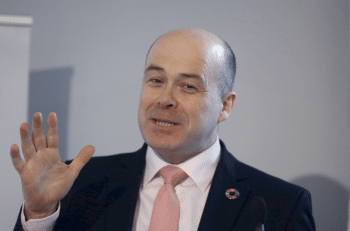
    Denis Naughten (45) was born in Drum, County Roscommon, site of the Meehambee Dolmen, a portal tomb estimated to be 5,500 years old, and educated at St Aloysius College, Athlone which closed last year, University College Dublin and University College Cork, where he did a PhD in Food Microbiology (impressively focused on extracellular polysaccharide – complex carbohydrates – production in lactic acid bacteria). Just as DeV was said to be one of only three people in the world who understood Relativity, Naughtenites allege he is driven by the scientific approach. He is married to Mary Tiernan and they have four children. In the New Year of 2017, Naughten was nearly killed while cycling with his wife along a road between Roscommon town and Fuerty when struck by a car, sustaining back injuries. Naughten’s father, Liam, was a Fine Gael TD (1982- 1987) and was Cathaoirleach of Seanad Eireann from 1995 to late 1996. Young Denis succeeded him following his tragic early death aged 52 in a car crash, at a by-election to Seanad Éireann in 1997 , making him the youngest ever senator. He has the ever-important keen interest in all sports and has played Gaelic football with Clann na nGael GAA club and held both county and provincial athletic titles with Moore AC. He was elected for the Longford–Roscommon constituency in the 1997 general election, aged just 24, and re-elected in 2002 when he and Simon Coveney were initially touted as the ace young guns who might replace the jaded Michael Noonan – before Big and wily Phil Hogan moved in to clear the path for Enda Kenny – with preferment promised. Within his first few weeks in the Dáil, he duly became Fine Gael Spokesperson on Youth Affairs, School Transport and Adult Education. This appears to be his level. He was re-elected at the 2007 general election for the new constituency of Roscommon–South Leitrim. In June 2010, he unwisely supported Richard Bruton’s leadership challenge to Enda Kenny, after he had been promised the deputy leadership in a Bruton shadow cabinet. Following Kenny’s victory in a motion of confidence, Naughten was not re-appointed to the front bench and there was bad blood between him and Kenny, perhaps partly because Kenny and Liam Naughten had been close. In October 2010, he was appointed as party Deputy Spokesperson on Health. He was a member of the Governing Council of the Association of European Parliamentarians with Africa which aims to strengthen parliamentary democracy in Africa and keep Africa high on the political agenda in Europe. He prevailed again at the 2011 general election. He voted against the Government in a motion to reverse cuts at Roscommon Hospital and lost the party whip. This parochial issue was the making of him; defined him. His party and constituency colleague Frank Feighan voted with the Government on the controversial issue, despite intense pressure from angry locals. The Government won the vote. On 13 September 2013, he and six other expellees formed the Reform Alliance, described as a “loose alliance” rather than a political party or “loose cannons”. The now largely forgotten grouping included TDs Lucinda Creighton, Billy Timmins, Terence Flanagan, and Peter Mathews as well as Senators Paul Bradford and Fidelma Healy-Eames who lost the whip over an abortion vote. In the run-up to the 2016 General Election Naughten told the Connacht Tribune he would be willing to prop-up a minority Government after the general election – as long as it maintained and invested in Portiuncula Hospital Ballinasloe and Roscommon Hospital, and local health services. He seems to draw his political tempo from his service on Roscommon County Council and the Western Health Board from January 1997 to October 2003. Any more profound political philosophy or vision of the common good has never crossed his lips. Naughten is really a rural populist, the Big Man, with a veneer of scientificism. His website is propelled by slogans like ‘Putting People First” and promises to “Get More Jobs to Cross The Shannon” and “Ensure That Every Child Leaving Primary School Can Read and Write”. Naughten was re-elected in 2016 and the numbers catapulted him to a ministry. The ambitious and crafty Naughten emerged as Minister for Communications, Climate Action and Environment in Enda Kenny’s Fine Gael/Independent minority government after two months of negotiation following the 2016 general election. He styles himself an Independent and has long dumped both Lucinda Creighton’s Reform Alliance and Shane Ross’s Independent Alliance. A year into his second government, Enda Kenny was asked if he would accept Minister Naughten back into Fine Gael. He said that was a matter for Naughten, and that he was doing a good job as an Independent Minister. He said: “How am I getting on with Denis Naughten? Great”. With Enda Kenny gone his rehabilitation is complete. So… time to see if the quiet man with the scientific bent is any good – playing, as they say, senior hurling. COMMUNICATIONS He has little interest in the communications brief, as it is of little value to his constituency. He has been almost invisible as minister for data protection – for Google and Facebook. The underpowered Data Protection Commissioner serves under the aegis of his department from an unimpressive office in Portarlington. Ireland took Facebook’s word for it that very few of the 87 million people compromised by Cambridge Analytica were Irish. He has, however, pushed for wider availability for high-speed broadband. Partly because viability has been undermined by Ireland’s unique fetish for one-off housing, Eir (successor to Eircom) pulled out of the bidding for the National Broadband Plan. Naughten was notably unable to get Eir, which owns much of the national phone infrastructure, to bid for the least attractive – farthest flung – next tranche of business, after it had delivered the most lucrative tranche to 300,000 houses in denser communities. Naughten may have been so reluctant to accept the logic of densifiying rural communities, anathema to his electorate, that he was blinded to its economic downsides. HIS MOST INFAMOUS OUTING IN HIS MEDIA

    Loading

    Read more

  • Posted in:

    Nationalists as Real Men

    In 1909 Patrick Pearse wrote a short six-verse Irish-language poem, ‘A Mhic Bhig na gCleas’, translated into English as ‘Little Lad of the Tricks’. A relatively disposable piece, it has since gone on to have an infamous status; proof for many that Pearse had dark sexual proclivities: … Raise your comely head Till I kiss your mouth: If either of us is the better of that I am the better of it. There is a fragrance in your kiss That I have not found yet In the kisses of women Or in the honey of their bodies… Ruth Dudley Edwards’ 1979 revisionist biography, ‘The Triumph of Failure’ makes much of this poem, presenting it as evidence of Pearse’s supressed tendencies. And later works have echoed her, to the point that the trope of Pearse-as-Paedophile is now standard fare among Irish historians. Similar speculations have also been made about Eoin O’Duffy and even about Michael Collins. Such tabloid innuendos, though, ignore a central truth about Irish nationalists in the early years of the twentieth century: masculinity mattered for them. Not in the sense of private peccadilloes, but as a key part of their public ideology. Masculinity did much work for organisations like Sinn Féin and the Irish Volunteers, allowing them, as it did, to imagine what national sovereignty and the end of British colonial rule would look like. It allowed them to analyse that British rule as an effeminising influence on Irish men. And it allowed them to attack opponents, such as the Irish Parliamentary Party, as unmanly traitors. The heavy emphasis on masculinity also does much to explain how and why women and leftists were systematically frustrated in their efforts to influence the national movement; imagining the nation as a male fraternity was a convenient way to dismiss feminism or socialism as divisive ideologies that pitted brother against brother. In another of Pearse’s most famous texts, ‘The Murder Machine’, the educator-nationalist railed against the British state schools in Ireland (the “machine”). And in a telling passage, Pearse denounced the contemporary school system as worse than “an edict for the general castration of Irish males”. Anglicised Irishmen, he said, are “not slaves merely, but very eunuchs”. For Pearse, Irish men had been emasculated by British colonialism and by the slow parallel process of Anglicisation. These were common anxieties among almost all Irish nationalists. A recurring theme in Gaelic League publications was that the Irish, by abandoning their native language, had become de cient and deformed and no longer real men. As one turn-of-the-century Gaelic Leaguer said, if the Irish continued to speak only English, then “we can never be perfect men, full and strong men, able to do a true man’s part for God and Fatherland”. The movement to revive the Irish language was thus imagined as a process of reasserting a purified male power and was often associated with a recovery of sovereignty and strength. When the Irish Volunteers were established in 1912, many of their founding members had already imbibed the thinking that saw national revival and masculine revival as two parts of a broader whole. Writing in the Irish Republican Brotherhood’s Irish Freedom newspaper in July 1912, Ernest Blythe, a government minister in the 1920s, discussed the contribution that the Volunteers would make to healthy Irish masculinity. While he criticised the weak “ abby men” that predominated in Ireland, he also spoke of a subterranean manliness still surviving, he said, thanks to both militant nationalists “but also those whose thoughts have gone no further than the running and leaping and hurling which they delighted in”. The future Irishmen, whom physical-culture and physical-force enthusiasts such as these would birth, would be noticeable by their “mighty lungs and muscled frames”. The Volunteers were “the rebirth of manhood unto this Nation”. Their muscular masculinity would replace the abby weakness of Ireland under British rule. Talk of masculine power continued to circulate in the years after the Rising. Indeed, Ernie O’Malley, a medical student turned IRA soldier, later remembered that one positive effect of the war was that the “familiar stage-Irishman had disappeared”, replaced by the confident, armed men of the IRA. The rhetoric of heroic men standing together for the national interest, also lent itself to suppressing the ‘wrong’ kind of politics. A 1921 pamphlet on ‘The Labour Problem’ published by the Sinn Féin-allied Cumann Léigheachtaí an Phobhail presented socialism as an intrusion into the national fraternity of men: “Labour… is like a virulent foreign element in the social system… whatever else we are, capitalist or worker or neither, we are all Irishmen interested beyond anything else in the welfare of our common country, and as an Irishman speaking to Irishmen I put it that these industrial conflicts, if continued, will inevitably impair, if not utterly destroy, our common country”. Feminism was denounced in almost the exact same terms. The tourism-friendly version of Irish nationalism that has featured in the ‘Decade of Commemorations’ has received a large dose of justified criticism. With the government promoting an image of romantic, if depoliticised Irish rebels, it is worth remembering, first, how much Irish nationalism was a product of the encounter with British colonialism. Second, the State that emerged from this national struggle was noticeably coercive, particularly when it came to female citizens or left-wing politics. Masculinity, and the nationalist desire to create a harmonious nation of muscular men, was central to all of that. Masculinity matters. Aidan Joseph Beatty Aidan Joseph Beatty is Scholar-in-Residence at the School of Canadian Irish Studies, Concor- dia University, Montreal and author of ‘Masculinity and Power in Irish Nationalism, 1884-1938’. aidanbeatty.com

    Loading

    Read more

  • Posted in:

    History is not Herstory

    Less than 30% of the writers in Village are women. And only 30% of the articles submitted for publication come from women. What’s going on? Village is politically correct and right-on. Uniquely it never, to take an example, markets magazines by putting attractive women on the cover. Village takes progressive social theory seriously. It consistently takes the most ‘liberal’ stance on abortion and reproductive rights. Most of all, and this is what determines so much of its stance, Village believes in inconvenient and prickly equality of outcome, not shiny and friendly equality of opportunity. In other words not just opening up for all, but giving the worse-off an actual leg up or a quota to compensate for the iniquities of history. This applies to women as much to any group. The new Dáil will have only 35 women out of 158. This is a more-than-50% improvement since 2011 and the number of female candidates was up to 163 from 86 in 2011 when it yielded 22 women out of 166 (up from 3 in 1973 and 22 in 2002 and 2007). Nationally, the average number of first-preference votes per man was 4,205. For women, it was 3,260. Village has given a good bit of of space to women who want to change this, to move towards fty percent female representation in parliament. The Electoral Act 2012, amusingly promoted by Phil Hogan and opposed by Fianna Fáil, applied a gender-quota rule that parties had to have at least 30% candidates of each sex or they lose half of their state funding. All parties except Direct Democracy Ireland applied their quota. Village supports this. I support this. That’s politics. We should push for immediate progress, everywhere. History and culture are different. The Abbey Theatre got into trouble recently because only one of the ten authors chosen for its 1916 commemorative programme, Waking the Nation, was a women. Other theatres and film bodies have taken similar flak. A recent rather unconvincing evocation of the Rising, Rebellion, made efforts to portray the events of that era with women to the fore. I disagree with these approaches. As to the Abbey’s Programme, what if the women took bog-standard anti-feminist positions, would they still merit advancement in the programme? Is it that a third of the writers should usually write pro-feminist pieces or is it that the third should have written pro-feminist pieces in this instance? Should there also be a certain number of works produced that have been written authors from racial minorities, from the young and the old, from LGBT and straight? Should it be the same with the actors? What about the audience? The answer to much of this is No. And as regards history, you’re trying to record the way things were: history. You shouldn’t, and you don’t need for any political reason to, distort it. All you can do with history is acknowledge and let it inform, though never determine, your politics. For the same reason that you don’t make the ruling classes working classes or younger than they were in the interests of some perceived correctness, you don’t pretend that women were the protagonists in the Rising. Unfortunately they were not. I also disagree more generally with distorting the facts to suit the ideology. The idea underpinning politics is to resolve the facts objectively and then apply the ideology. Not the other way around unless you thing your ideology is so weak that it won’t fit certain facts. In which case change your ideology, it was wrong. When the facts don‘t suit your ideology it is time to find a new ideology, or stay quiet; and more precisely to realise you should have had a better ideology in the first place The debate on women’s rights has become unintellectualised, entrenched and sometimes underinformed. For example a recent only partly-corrected Una Mullally article in the Irish Times misreported that Fianna Fáil’s policy was to have “up to a third of its candidates women”. She ridiculed the policy even though the policy did not, and legally and logically could not have, said this. It would certainly have been nice for those of us who believe that the point of that party is only ever to adopt progressive agendas, at the very last minute, if Fianna Fáil had got it so skewed, but they had not. Between Una Mullally and her employer they could not bring themselves to correct the article properly. The reason for the politics of women’s equality is that it has been an unequal world. It was an unequal world when they (men) made God a Man, it was unequal in 1916 and it’s still unequal because women earn less, are politically less powerful and have less autonomy than men. Only a fool would deny it. Because of the legacy of thousands of years of suppression women have not written as good, or indeed nearly as many, plays as men. Women also write differently from men, largely for socio-cultural reasons but also sometimes for reasons based in their physiological natures. The point is to change that by counterbalancing. Women of today who want it and show talent should get more training in playwrighting paid for by the state and its institutions, than that available to similar men, particularly training that helps them break down prejudices and that facilitates overcoming sexist obstacles to success. An admirable recently announced initiative from the Irish Film Board is doing roughly this. Such initiatives tend to generate equality of outcome. Regrettably in the arts it will be some generations before the volume of brilliant works by women rivals the volume of brilliant works by men, created over the aeons, even controlling for the heightened relevance of contemporariness. It is different with politics which, unlike history, does not or should not, trade in the past. It is possible, indeed imperative, to push for progressive change. It is, because of the nature of the discipline, and the period in which it trades – the past, not possible to push for change of

    Loading

    Read more