• Posted in:

    If not zeal then logic

    It could not be clearer. The Irish Human Rights and Equality Commission Act 2014 says that public bodies must, when they are preparing strategic plans, assess and identify the human rights and equality issues that are relevant to their functions as policy maker, employer and service provider. Public bodies must also identify the policies and practices that they have in place or that they plan to put in place to address these issues. We can only assume they meant it when they enacted the legislation, two years ago now. The excitement could, therefore, hardly be contained as the Department of Education and skills was first out of the traps with its new statement of strategy. All other Government Departments are still in the process of finalising their own new statements of strategies. They lag behind education, hot off the press with its ‘Action Plan for Education 2016-2019’. The statement of strategy opens with a picture of a smiling minister Richard Bruton and his commitment that “we can work together with all the people who work in and depend on the education and training service to, collectively, make it into the best in Europe”. This ‘best in world’ stuff is cringe-inducing but, whatever, how did it manage the new public sector duty? It is worth setting it out in full. It comes under the less than promising subheading “ensuring equity”. Equity, it must be remembered, is about fairness, not the more particular, more ambitious equality, not even human rights. It goes like this… “As part of their public sector duty, public bodies are required to consider human rights and equality issues relevant to them. In preparing this document, such issues were considered and individual actions address matters specific to the education and training sector. Ensuring access to an equitable system is a driving force throughout the Department’s work”. That’s it. It feels like a crude two fingers to the legislation, to the Oireachtas that enacted it, and to anybody who had naively entertained expectations deriving from the legislation. Human Rights don’t even get another mention in the 64- page document. Equality gets a mention as it is part of the name of the Deis (Delivering Equality of Opportunity in Schools) initiative and, under Goal 2, where the statement of strategy complacently recites that “we have made considerable progress in advancing equity and equality of opportunity”, but does deign to acknowledge that “significant challenges remain if we are to ensure that children and young people from different backgrounds are adequately supported so that they can experience success in the education system”. Anything vaguely equality-related is squashed into Goal 2 of the strategy statement which is to improve the progress of learners at risk of educational disadvantage or learners with special education needs. Goal 2 has 18 actions. This compares with 35 actions under Goal 1 to improve the learning experience and success of learners, 29 actions under Goal 3 to help those delivering educational services to continuously improve, 37 actions under Goal 4 to build stronger bridges between education and the wider community, and 20 actions under Goal 5 to improve national planning and support services. The Irish Human Rights and Equality Commission has produced limited but clear guidance on implementing this public-sector duty. The steps required include: Undertake an assessment of human rights and equality issues that are relevant to its functions, to the services it provides and to its employees. The Department of Education and Skills Statement of Strategy demonstrates no evidence of such an analysis. Consult broadly with employees, managers, trade unions, individuals and communities accessing and using the services, and other key stakeholders, which may be affected by inequalities and human rights issues. The Department of Education and Skills received submissions from 600 individuals and groups but there is no evidence that any of these related to equality and human rights or the public-sector duty. Screen and analyse policies and programmes from a human rights and equality perspective, identifying which existing policies and programmes are particularly relevant. The Department of Education and Skills Statement of Strategy demonstrates no evidence of such screening or analysis. Develop action plans on human rights and equality with defined actions and responsibilities. The Department of Education and Skills Statement of Strategy demonstrates no evidence of such an action plan. So, what next? The Irish Human Rights and Equality Commission, in its guidance, states that where it “considers there are failures to fulfil the Public Sector Duty, it can invite a public body to carry out an equality and human rights review of the work of the organisation and prepare and implement an action plan”. Logically then, the only outstanding matter now is when will the Irish Human Rights and Equality Commission act? Niall Crowley

    Loading

    Read more

  • Posted in:

    SF won’t prop up FF, FG or Labour

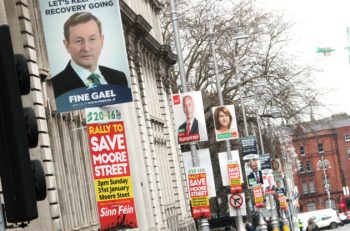
    The recent General Election was a very good one for Sinn Féin. We increased our number of TDs from 14 to 23. That’s a 65% increase – a success by any standards. Importantly, Sinn Féin also further increased the geographical spread of the party. There are now very few regions in the State in which there isn’t Sinn Féin Dáil representation. There is also in place, another whole raft of Sinn Féin representatives who, although not returned at this election are very likely to be elected next time around if they continue with the valuable work they are doing. So, Sinn Féin returns to the Dáil, not just with a significantly larger team but also with a team of very high-calibre TDs, including more women and more younger representatives. Sinn Féin had two clear objectives going into the election. The first was to get rid of a Fine Gael/Labour government that has brought chaos to housing and health, imposed unfair taxes and promoted mass emigration. We succeeded in that. In the early days of the election campaign we holed the coalition’s strategy below the waterline by proving that their figures were wrong and that they presented €2 billion which they did not have. I think we were also successful in demonstrating that you cannot have US-style taxes and at the same time invest in decent public services.Our other objective was to prove to people that there is a realistic, credible political alternative of which we are a significant part. That is very much a work in progress. We may not have succeeded, at this point, in getting enough seats to form a progressive Government but that will improve as we go on. But the realignment of politics in this State took an important step forward in this election and the next election will see that trend intensify. The political domination of Fine Gael and Fianna Fáil is finished. What we now need to do is increase the cohesion among those who advocate an alternative view of how the economy and society should be organised. Over the past five years, Sinn Féin has been the genuine voice of opposition in Leinster House, offering an alternative to the dreadful austerity policies of Fine Gael, Labour and Fianna Fáil. All of Sinn Féin’s pre-Budget submissions demonstrated a way of ensuring economic growth while also being socially equitable and protecting the vulnerable. We repeatedly warned the Government of the escalating homelessness crisis. The Government refused to listen and it became an emergency. We also consistently raised the issue of all-Ireland integration and the political, economic and social case for a united Ireland. Sinn Féin has now received an enhanced mandate to continue with that work. The post-election sham fight between Fine Gael and Fianna Fáil is nothing to do with the real issues affecting citizens. The people who were homeless last Friday will remain homeless under Fine Gael and Fianna Fáil. Patients will still languish on trolleys in our hospitals under Fine Gael and Fianna Fáil because those parties are not serious about resolving these issues. Going into this election Fianna Fáil picked up on a sense that voters were moving to the left, so they began to steal the phrases Sinn Féin was using about fairness and a recovery for all. That strategy resulted in a partial recovery of the Fianna Fáil vote itself but still left it far, far short, in his-torical terms, of where it once stood. Throughout the election campaign, Sinn Féin made it clear that we would not prop up those parties that created and sustained the economic and social crisis facing our people. That is the mandate we received and we will not break our commitments. Sinn Féin will continue to consult with others, including those aligned to the Right2Change platform, on the way forward. If not in the immediate period ahead, the objective of a genuinely progressive alternative Government in which Sinn Féin plays a lead role is a live possibility. Over 400,000 people voted for candidates aligned to the Right2Change platform to end water charges. The Fine Gael/Labour Government has been defeated and water charges should leave the stage with them. What is now clear from the election is that people voted for real change and a more equal society. Sinn Féin is committed to achieving that and to pursuing and preparing for the peaceful reunification of Ireland and the reconciliation of all our people. Whether in Government or in opposition, Sinn Féin will stick by the mandate we have been given. Gerry Adams Gerry Adams TD is President of Sinn Féin

    Loading

    Read more